2 Gingers

Distiller: Cooley, Co. Louth, Ireland (Beam Suntory)2 Gingers

Style: Blended Irish

Age: NAS (about 4 y/o)

ABV: 40%

Michigan state minimum: $20

Appearance: Dark gold (possibly colored), with short-lived legs.

Nose: Rich and malty. Sherry, dried flowers, brown butter, vanilla and spice.

Palate: Full bodied and semi-sweet. Cashew brittle, five spice powder, more vanilla.

Finish: Slightly rubbery, with a little spice, caramel and alcohol.

Mixed: There’s a lot of emphasis on mixing in the marketing of 2 Gingers so I gave a few of their signature drinks a try. The Big Ginger (whiskey, ginger ale and a squeeze of lime) was good. The lime juice does a good job of cutting what might otherwise be too sweet. The B53 (whiskey, coffee liqueur, Irish cream, Gran Marnier) is a variation on the B52 shot and even better. The spice and malt notes from 2 Gingers play very well with the orange liqueur and set off the coffee flavors nicely. I also tried it in a traditional Irish coffee in which it performed admirably.

Parting words: This brand was founded in Minnesota, strangely enough, by Irish-born bar and restaurant owner Kieran Folliard. It was named for his ginger mother and aunt whose portraits grace the logo. He sold the brand to Beam in 2012 and it is now distributed over most of the U.S. Although the name Kilbeggan is splashed all over this bottle, I can’t find any evidence that any of it was made at that distillery. Maybe that’s Beam’s plan for the future.

Anyway, it excels as a cheap, easy drinking mixing Irish whiskey. It resembles Powers more than Jameson in that respect, but it’s a little lighter in flavor. If you’ve been curious about having a go at 2 Gingers, I recommend it.
Baker’s

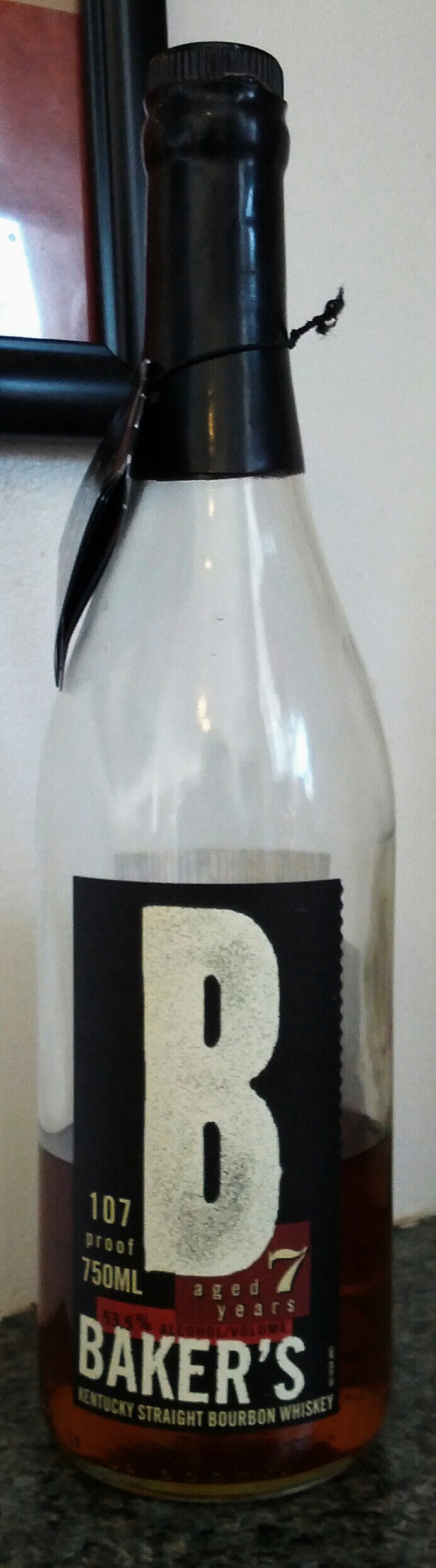
Maker: Jim Beam, Clermont, Kentucky, USABaker's

Age: 7 y/o

Proof: 107 (53.5% ABV)

Michigan State Minimum: $47

Appearance: Dark Copper with thick legs.

Nose: Leather, alcohol, caramel. Water brings out a weird rotten vegetable smell.

Palate: Full bodied and sweet. Cotton candy, plum, oak, oregano, clove. Goes down a little easier with water and brings butterscotch into the mix.

Finish: Hot and sweet. Peppermint cotton candy. I don’t know if such a thing exists but if it does, it tastes like this. Milder and sweeter with H2O.

Parting words: Baker’s is named after Baker Beam, grandson of Jim’s brother “Park” Beam (not to be confused with Parker Beam, Heaven Hill master distiller) and thus second cousin to Booker Noe. For further confusion, consult the interactive Beam family tree here.

It’s is a part of Beam’s Small Batch collection. The other members are Knob Creek, Booker’s and Basil Hayden. Basil is the whipping boy of the group, being no more than Old Grand Dad in a fancier bottle. Knob Creek is very popular and rightly so. It’s the oldest and the only one with line extensions (Rye, Single Barrel, Smoked Maple). Booker’s is barrel strength and is the sort of flagship of the group, with a 25th anniversary, 10 y/o edition being released soon. Baker’s is 7 y/o and 107 proof and unfortunately occupies the “ignored middle child” spot in the Small Batch family.

I bought this bottle when I learned that Baker’s price was going up substantially in Michigan. I hadn’t had it in a very long time and I was pleasantly surprised. I reviewed the now dusty Beam Distiller’s Series last year. It was also 7 y/o and tasty, but Baker’s has a depth of flavor and weight that the DS lacked. This is probably because of the lower barrel entry proof used for Baker’s and Booker’s. It also fares well compared to Booker’s. Booker’s is higher proof but its age has been creeping down as its price has been creeping up. Booker’s currently sells for close to $60 in Michigan, which in my opinion is absurdly expensive for a 6 y/o bourbon, barrel strength or not. Baker’s price has risen in tandem with Booker’s, but it has stayed 7 y/o which gives it the edge over its cousin.

The only flaw is the inexplicable rotten garbage smell that came out with water. That problem is easily solved by not adding  water or using it very sparingly. Overall Baker’s is a very good bourbon at a decent price. That earns it a recommendation.

My Two Ounces: Suntory, Beam and Marketing

Cap from Maker's Mark Facebook Page
Cap from Maker’s Mark Facebook Page

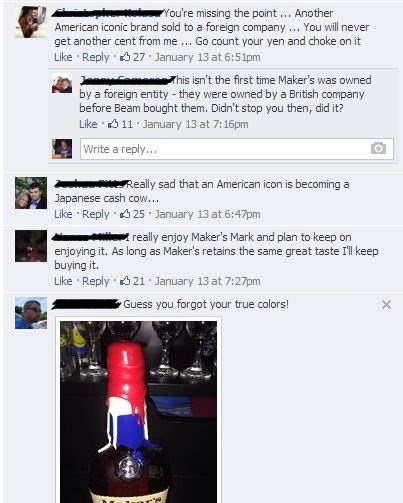
It was announced earlier this week that Suntory, a privately held Japanese whisky company, will purchase Beam Inc. (owner of Jim Beam, Knob Creek, Old Grand Dad, Maker’s Mark, Laphroaig, Canadian Club, Teacher’s and many other brands) this summer for somewhere between $13 and $16 billion dollars. Online reaction was swift and passionate, to put it kindly. While the response from enthusiasts has been nearly all positive, most of the non-enthusiast response was negative. Much of the negative was xenophobic and some of it was flatly racist. Most of those critical voices can and should be written off as cranks. People claiming that they will no longer drink Maker’s Mark or Jim Beam because their grandfathers fought against the Japanese in the 1940s shouldn’t taken seriously and neither should people who don’t know the difference between China and Japan.

My first reaction was was that this news signals a big restructuring in the spirits industry. It is technically an acquisition, but the result will look more like a merger. Suntory already owned two Japanese distilleries, three single malt distilleries in Scotland and the McClelland’s single malt Scotch brand. With Beam’s holdings, Suntory is poised to become the third largest spirits company in the world behind Diageo and Pernod-Ricard. Consolidation has been the theme of the booze world from the 1930s to the present and that won’t be changing any time soon. Beam Inc. itself is the result of a series of mergers and acquisitions over the past few decades.  As an enthusiast I was excited about the possibility of new ownership of Beam’s brands, especially since the management of some of those brands has been poor in recent years.

Why was the reaction so negative among non-enthusiasts? It’s because they believed what Beam told them.

Bourbon marketing is something that most enthusiasts become immune to quickly. A little knowledge goes a long way to dispel the yarns the bourbon industry spins. Yarns like the one that Jim Beam has been made by the same family with the same recipe since the eighteenth century. Or that Maker’s Mark was first whipped up in Bill Samuel’s kitchen and has been a quaint, family-oriented, backwoods operation ever since. There may be tiny threads of truth in both yarns, but they are not true in any real sense. A few minutes reading a book or searching on the internet is enough to dispel most myths like those. The harder ones might take a few hours. Enthusiasts have the inclination to do that . Most drinkers don’t.

Those drinkers who don’t are the ones who are angry. They’ve grown emotionally attached from years of hearing those myths. Hearing that their favorite little family business is actually a multinational corporation that is about to be swallowed up by another multinational makes them feel like they’ve been played for suckers. Which makes them angry, which makes them look for someone to direct that anger toward, which is where Suntory and Japan come in.

Something that is not a myth is the American-ness of bourbon. By federal and international treaty it can only be made in the U.S. It is mostly made from what we call corn and the rest of the world calls maize, a New World grain, and aged in American white oak. Congressional proclamations have been made about how American bourbon is. Bourbon producers use an appeal to patriotism in their marketing in the U.S. and even overseas advertising and labels themselves stress how American a drink it is. Bourbon producers aren’t the only ones who use this kind of marketing. American automakers have used this angle to sell cars and especially trucks over the years. Like the yarns about the producers themselves, these messages get repeated and work their way into the consciousness of the uncritical whiskey drinkers. For them, drinking becomes a patriotic exercise. What they drink shows how much they love their country. So when they discover that the maker of their patriotic beverage is owned by a Japanese or Italian or British company, they feel, again, played for suckers. Which makes them angry.

Where does this leave us? This whole ugly mess should lead drinkers, producers and their marketers to do more thinking about what they’re doing. The producers need to think about if they are setting themselves up for backlash further down the road with short-sighted marketing focused on myth-making or patriotism. For their part, drinkers (and consumers in general) need to take a little more time to know what they’re drinking, how it’s made and who makes it. This means moving beyond skimming the label, it means picking up a book or at least a few web searches.  I recognize that most people don’t have the time to do a lot of digging into what they drink, but knowledge is viral. If one person take the time to dig up some good information, that person tells another and that person tells another who might be inspired to do a little more digging herself. Let’s hope that’s what’s happening now.

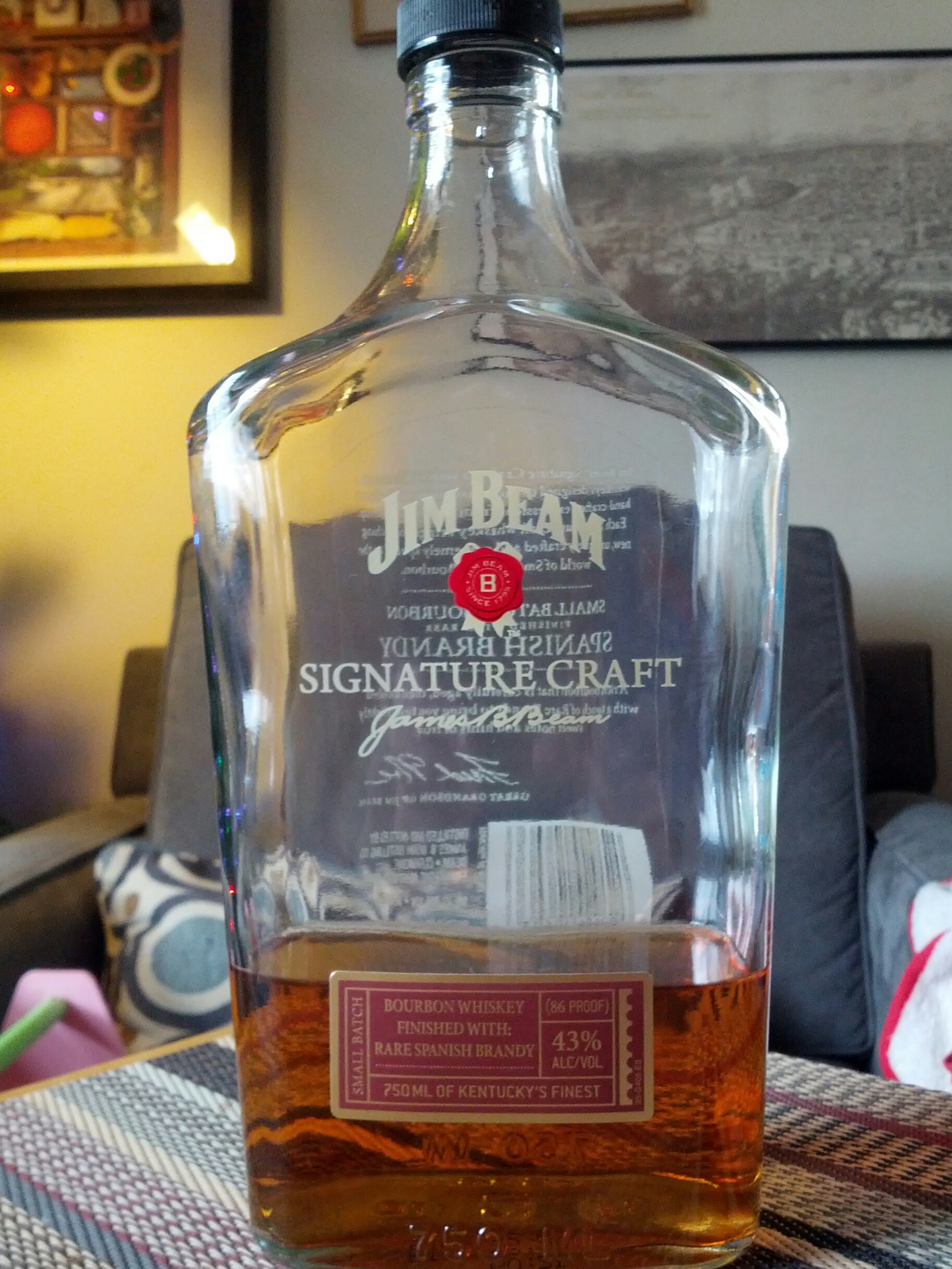
Jim Beam Signature Craft: Spanish Brandy Finish

Maker: Jim Beam, Clermont/Frankfort, Kentucky, USAJB Span Bran

Style: Bourbon finished with Spanish Brandy

Age: NAS

Proof: 86 (43% ABV)

Michigan State Minimum: $40

Appearance: Medium copper.

Nose: Cereal, alcohol, butterscotch, leather, old oak, yeast.

On the palate: Full bodied and sweet. Butterscotch candy, burn, yeast, a touch of jalapeno.

Finish: Hot but sweet. Lingers and tingles for quite some time with butterscotch, burnt caramel, dandelion stem.

Parting words: The Jim Beam Signature Craft series is a new line from Beam with two parts. One part is a 12 y/o, 86° Jim Beam recipe bourbon and the other is an annual release of a finished or otherwise unusually treated bourbon. The Spanish Brandy Finish is the first of that second piece. This is not a brandy barrel finish, this is finished with a touch of the brandy itself.

This whiskey has gotten mixed reviews from enthusiasts, but I think it’s pretty good. Except for the finish, the brandy does a good job of rounding out the rougher yeasty and vegetal characteristics of young Jim Beam. It brings a rich butterscotch sweetness to the nose and palate too.

Complaints have also been made about the price. Yes, better bargains can be found for $40, but it’s something different and I don’t mind paying a little extra for that. Beam has been doing a lot of experimentation over the past few years. Not all of it has been successful, but I think this is. It’s worth buying a bottle to have another option for sipping after a holiday meal. Jim Beam Signature Craft: Spanish Brandy Finish is recommended.

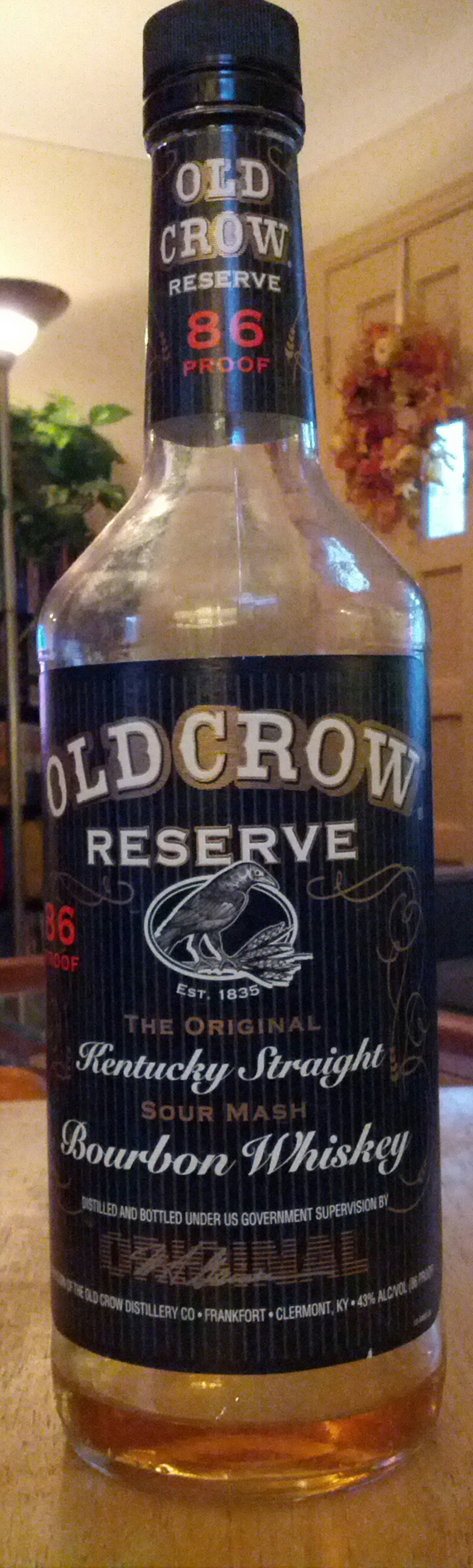
Old Crow Reserve

Maker: Jim Beam, Clermont/Frankfort, Kentucky, USAOld Crow Res

Age: 4 y/o

Proof: 86 (43% ABV)

Michigan State Minimum: $11

Appearance: pale copper, thin wispy legs.

Nose: Alcohol, cumin, dumpster, Romaine lettuce

On the palate: Soft, medium bodied. Alcohol, caramel, parsley.

Finish: Alcohol, more dumpster. Fades quickly, thank God.

Parting words: I wanted to give this a more positive review, I really did, but it’s just not good at all. I was planning on saying this was another missed opportunity for a good line extension of a heritage brand, much like Early Times 354. It is that, but while ET 354 was dull, Old Crow Reserve is just bad. Four years old is not very old for a bourbon, but it’s usually long enough for some of the funk to be taken off, but it actually seems to have increased in this case. I could say more, but nothing needs to be said. If you are desperate for alcohol to put into cola, this might be acceptable. Otherwise, it doesn’t work at all on any level. One of the worst bourbons I’ve had. Old Crow Reserve is not recommended.

Jim Beam Distillers Series

Maker: Jim Beam, Clermont, Kentucky, USA (Beam Inc.)JBDS

Age: 7 y/o

Proof: 90 (45% ABV)

Appearance: Medium copper with nice thick legs.

Nose: Alcohol, caramel, oak, tan roux, sourdough starter, lavender.

On the palate: Full bodied and slighly sour. Heat, cola, caramel, vanilla, yeast.

Finish: Heat building into more heat. In the background some corn syrup, licorice, and a touch of wood.

Parting words: This is officially a dusty now, meaning it is no longer being produced and is only available as old stock sitting on shelves. When it was released a few years ago it wasn’t met with much hoopla by the bourbon enthusiast community. Jim Beam is not a popular line with many enthusiasts and there has been a seven year old version of the white label Jim Beam available in Kentucky for many years. So many were underwhelmed or simply ignored this bottle. One bourbon writer said the only reason to buy it would be for the fine  picture of Fred Noe on the label, and he already has a few of those. I disagree.

I think for what it is, Distillers Series is a fine bourbon. While the seven year old white label is bottled at 80 proof (and the eight year old black label at 86), DS was bottled at 90 proof and was available all over. To me, it tastes how the standard white label should taste. It’s not subtle or particularly complex, but it’s a good sipping bourbon for the beginning of the evening or while tending the grill or smoker. I think it’s worth seeking out if you enjoy that sort of thing. Jim Beam Distiller’s Series is recommended.

Old Grand-Dad, Bottled-in-Bond

Maker: Jim Beam, Clermont, Kentucky, USAold-grand-dad-bonded

Style: High rye bourbon

Age: NAS (at least 4 years old)

Proof: 100 (50% ABV)

Appearance: Copper with long sticky legs.

Nose: Caramel, butterscotch blondies fresh from the oven, alcohol, cumin.

On the palate: Medium bodied and sweet. Burnt caramel, butterscotch, clove, lavender.

Finish: Corn syrup, dark toffee, fairly hot, long and warming.

Parting words: Old Grand-dad is an old brand, one of the classic “Olds”, the others being Crow, Taylor, Forester, Charter, Fitzgerald and a few others. It was one of the brands Beam acquired when they bought out National Distillers in 1987, the purchase which made them into a major player in the spirits world. While Olds Crow and Taylor were changed to the standard Jim Beam yeast and recipe (some might say they even “trashed” those brands), Beam continued to use the same recipe and even the same yeast strain for Old Grand-Dad. Other variables like proof off the still and into the barrel and warehousing did change though.

At any rate, Old Grand-dad’s vital statistics may have changed somewhat, but it is still one of the best bargains and best kept secrets in the bourbon world. For every poseur on a waiting list for Pappy Van Winkle there are 10 cases of Old Grand-dad being purchased and enjoyed by people who know the value of a solid, unpretentious whiskey. Old Grand-Dad BiB is recommended.

Knob Creek Rye

Maker: Beam, Clermont, Kentucky, USA

Age: NAS

Style: Low rye, Kentucky-style, rye whiskey. Yes, I’m making that a thing.

Proof: 100 (50% ABV)

Appearance: dark copper.

Nose: Sweetness, aniseed, cumin, woodruff, lavender, caramel.

On the palate: Medium bodied with some alcohol bite. Dry with some good but well-balanced rye character.

Finish: Dry and clean. A nice, long, post-sip tingle.

Parting words: Jim Beam Rye (along with its sister-label, Old Overholt) has long been a whipping boy for American Whiskey enthusiasts. Underwhelming would be the best word for it. It lacks rye character or, frankly, much character at all. Still it has been a big seller in a small (but fast growing) segment. It is available almost everywhere Beam’s bourbons are available.

In 2008 Beam released a new product called Ri1 (Rye One, get it?) in a handsome, modern-looking bottle. The hope was to provide an upscale Beam rye for rye enthusiasts and especially mixologists. The rumor was that more Ris would follow, Ri2, Ri3, Ri4, etc. At this point, it’s probably safe to call Ri1 a flop. The stuff was/is over-priced and underpowered at $47 and 92 proof. No further numbers have been forthcoming either.

Knob Creek Rye is widely perceived as a replacement of sorts for Ri1. Knob Creek bourbon has been a very successful brand for Beam. Many whiskey lovers (like this one) considerit to be the best bourbon made from the Jim Beam mashbill (Beam also makes Old Grand-dad, but uses a different recipe and yeast).

Knob Creek rye is a great improvement on Ri1 and a welcome extention to the Knob Creek line. Like the bourbon, it is 100 proof and comes in an attractive, retro-styled bottle. It lacks an age-statement, but youth is not a problem here. If you enjoy Kentucky-style ryes, then you will probably enjoy this whiskey. It is well-balanced, unlike many of the newer high-rye ryes (a style I enjoyed at first but I am quickly tiring of), and very sippable. The higher proof does it a world of good. It brings out the complexity and spice that get muffled in the 80 proof Beam rye.

One problem Knob Creek Rye shares with Ri1 is the price. When it first arrived in Michigan, it sold for $40 a bottle. I thought it was expensive, but given the proof and the scarcity of rye, it was a fair price (barely). The state minimum price has since been hiked by $5. That pushes it over the edge for me. If you can find it for under $40, I recommend it. If over, leave it on the shelf.

Jim Beam (White Label)

Maker: Jim Beam, Clermont/Boston, Kentucky, USA (Beam)

Age: 4 y/o

Proof: 80

Appearance: Medium gold.

Nose: Corn syrup, alcohol, caramel, semi-rancid walnuts.

On the palate: Light-bodied and mild. Burn caramel, pecans.

Finish: Some caramel candy flavors, some bitterness, no discernible oak.

Parting words: Jim Beam is the best-selling brand of bourbon whiskey in the world. I have trouble figuring out why.

White label Jim Beam is the first bourbon I ever tried back when I was 21. If memory serves, it tasted better than this, but memory is a tricky thing. I do remember thinking that I liked it better than Jack Daniels back then. Jack lacked the character of Jim. I still think that’s the case. While Beam isn’t very good, it has more going on than Jack Daniels. That’s something. It’s cheaper, which is also something. I cannot recommend Jim Beam white label, but Beam does have better products just a little farther up the shelf. Beam Black label, Distiller’s Series, Baker’s, Knob Creek and Booker’s are all good, though not always good bargains.

Old Grand-Dad 114

Maker: Jim Beam, Clermont, Kentucky, USA (Beam Inc)

Age: NAS

Style: High rye bourbon

Proof: 114 (57% ABV)

Appearance: Caramel, with thick legs and necklace around the rim of the glass

Nose: Alcohol, butterscotch, vanilla, toffee, coconut.

On the palate: Full bodied, fruity, and bold. Vanilla, caramel, cocoa, and then burn. Sweeter with water, but still aggressive. Tropical fruit, vanilla, toffee.

Finish: Hot and long with a bit of vanilla, then a hot tingle all over the mouth. Fades to toffee with a hint of char. With a bit of water, dark chocolate, caramel blondies.

Parting words: This is one of the best bargains in bourbon, arguably the best. Although I am a maverick in this respect, I prefer the current Beam-manufactured edition to when Old Grand-dad was made by the now-defunct National Distillers Corporation. The ND version had even more butterscotch flavor, but always struck me as a bit unbalanced.

My friend Joe describes OGD 114’s aroma and flavor as that of the burnt edges of a pan of brownies. I think he nails it. Not only is this stuff delicious, but around $30 a bottle for virtually barrel-proof bourbon is nearly impossible to beat for value. Old Grand-dad 114 is highly recommended.