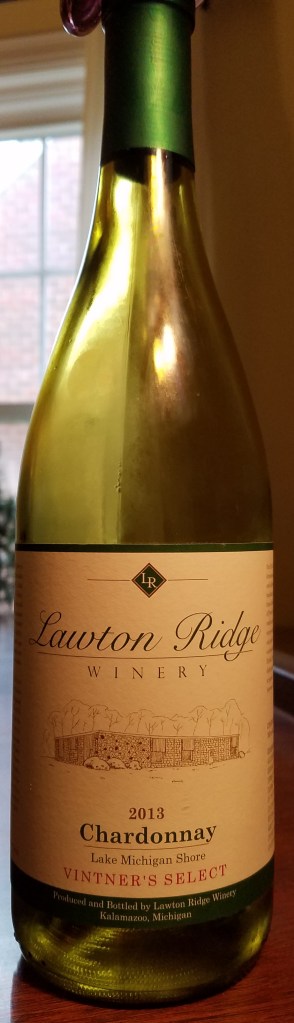
Maker: Lawton Ridge Winery, Kalamazoo, Michigan, USA
Grape: Chardonnay (at least 85%)
Place of origin: Lake Michigan Shore AVA, Michigan, USA
Vintage: 2013
Style: Oaked, malolatic fermented Chardonnay
ABV: 12.7%
Price: $15 (winery)
Appearance: Very pale gold.
Nose: Creamy, slightly bitter, French oak, lemon thyme.
Palate: Full-bodied and medium sweet. Oak, citrus peel, white peach, pineapple sage.
Finish: Clean and fruity with a hint of oak.
Parting words: Lawton Ridge winery is located west of Kalamazoo, Michigan, but thier vineyards (around 10 acres planted) are near Lawton, Michigan, south of Paw Paw. It has been in commercial operation since 2005 or so. According to their website, they pride themselves on producing terroir-focused food-friendly wines.
This Chardonnay was one of my favorites when we visited the tasting room last year. It’s a departure from their standard, all stainless Chard. According to the label, this wine is finished in oak barrels for three months immediately before bottling. It’s a good example of judicious use of oak in Chard. It has a hint of the brown butter aroma that California Chardonnay is known for, but it’s balanced by fruit and herbal aromas. It’s one of the best oaked Michigan Chards I’ve had and a steal at $15. 2013 Lawton Ridge Vintner’s Select Chardonnay is highly recommended.
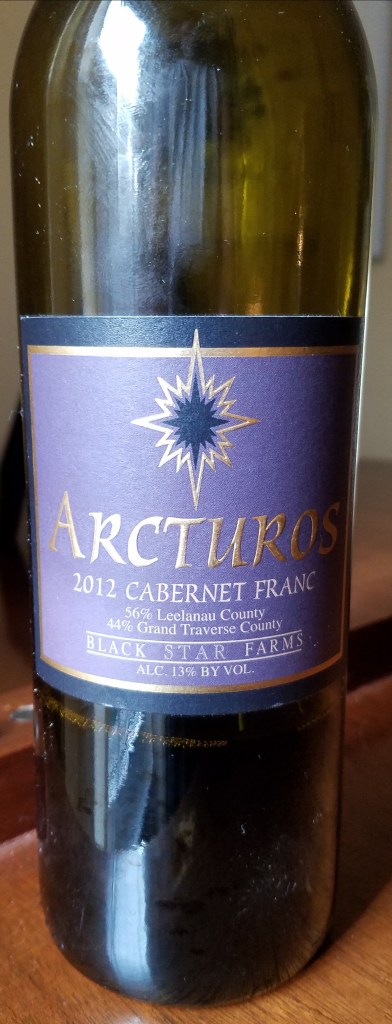
Maker: Black Star Farms, Sutton’s Bay/Traverse City, Michigan, USA
Grape: Cabernet Franc (at least 75%)
Place of origin: Michigan (56% Leelanau Co, 44% Grand Traverse Co), USA
ABV: 13%
Price: $28.50 (website, 2013 vintage)
Appearance: Dark burgundy. Opaque.
Nose: Roasted red pepper, sautéed mushrooms, raisins, crushed blueberry.
Palate: Medium-bodied and dry. Chicken jambalaya, oak.
Finish: Tangy and oaky.
Parting words: Chicken jambalaya is a weird tasting note, I know, but I think it’s apt for the combination of vegetal (bell pepper, celery), sweet (tomato, onion), tart (tomato), toasty (toasted rice) spicy (bell pepper, black pepper) and earthy (tomato, celery, chicken) flavors I got in this wine.
I reviewed the 2004 Arcturos Three Black Lot Old Mission Peninsula Cab Franc back in 2011 in the early, halcyon days of this blog. It was more subtle and refined than this wine, but it was also two years older. At the time I thought it was too old, but my palate has shifted toward lighter, fruitier reds so it sounds really good to me right now. The 2012 Cab Franc is good right now but I think it will continue to improve into the first couple years of the next decade. $28.50 is a fair price, especially if one holds on to it for a few more years. There are probably a few 2012s still kicking around, but 2016 and 2017 should be as delicious as this vintage and as age-worthy. Goes well with beef, pork, turkey and spicy Latin chicken dishes. 2012 Arcturos Cabernet Franc is recommended.
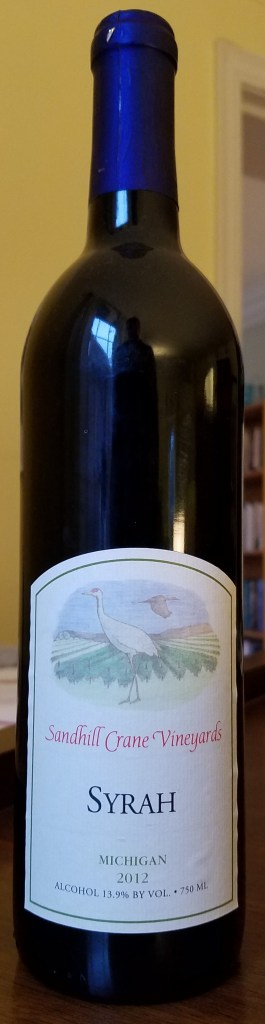
Maker: Sandhill Crane Vineyards, Jackson, Michigan, USA
Grape: Syrah (at least 75% by law)
Place of origin: Michigan, USA
Vintage: 2012
ABV: 13.9%
Purchased for: $24 (Michigan by the Bottle Tasting Room, Royal Oak)
Appearance: Dark burgundy.
Nose: Plum, blueberry, cedar, mace.
Palate: Medium-bodied, medium sweet. Blackberry, cherry juice, French oak, nutmeg, clove.
Finish: Juicy, then oaky with a little tang.
Parting words: Sandhill Crane’s home is in Jackson, Michigan, in a small cluster of wineries including Chateau Aeronautique and Sleeping Bear Winery. They make wine from a mix of estate grown grapes and grapes from other areas of Michigan. They’re known, at least to me, for their reds which are consistantly some of the best in the state. They have a large, swinging tasting room with a restaurant and frequent events. It’s less than ninety minutes from most places in the Detroit Metro area and not far from Ann Arbor and Lansing either, making it a popular destination for those interested in a relaxing Saturday afternoon away.
Syrah’s home is in the Rhöne valley, but tasting this wine left me wondering if its second home could be in southern Michigan. This is cool climate Syrah to be sure, fruity and slightly acidic, but still with the grape’s spicy calling card. The Rhöne vallery isn’t as hot and dry as many people assume anyway. Syrah doesn’t seem to do well in northern Michigan, but in the south and southwest it seems to do better and in the hands of a skilled winemaker like Holly Balansag it can be delicious. We had this wine with chicken tacos and it paired very well. Sandhill Crane Syrah also pairs well with beef and pork. 2012s are going to be hard to find now, but 2016 and 2017 are looking as good as 2012 was or even better. Make sure you give it a good four or five years in the cellar to enjoy it at its best! 2012 Sandhill Crane Syrah is highly recommended.
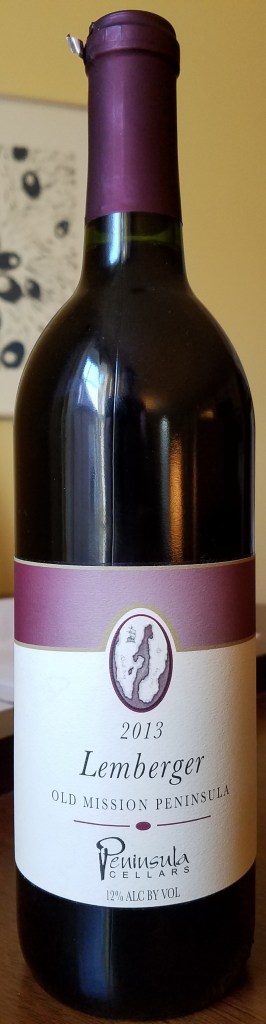
Maker: Peninsula Cellars, Traverse City, Michigan, USA
Grape: Lemberger, aka Blaufränkisch
Place of origin: Old Mission AVA, Traverse City, Michigan, USA
Vintage: 2013
ABV: 12%
Purchased for $22.50 (Michigan by the Bottle Tasting Room, Royal Oak)
Appearance: Dark ruby.
Nose: Blueberry pie, tomato, black pepper. “grapes when you eat them” -nosing note from my 7 y/o daughter.
Palate: Blackberry juice, wild mushroom, pink peppercorn, a little tartness.
Finish: Tannin, then acid.
Parting words: What do Pinot Blanc and Lemberger have in common? They’re both popular grapes that I just haven’t been able to get excited about. Both grow well in Up North, West Michigan and southern Michigan wine countries and both have been floated as “signature grapes” for the state. I’m not a fan of the concept of regions promoting one “signature grape” in general, but if I had to pick, neither Lemberger or Pinot Blanc would be in my top five.
As I do with a lot of things, I’ve been questioning myself over my disinterest in Lemberger and Pinot Blanc and wondering if it meant that my palate was flawed or I’m some kind of moron. So I’ve been trying to drink more of both kinds of wine. This bottle is a part of that effort.
Austria is considered Lemberger’s home turf, although it probably originated farther south and east. It’s known as Blaufränkisch in Austria where it is the second most planted red wine grape. The first is Lemberger’s offspring, Zweigelt.
While I may have had a breakthrough regarding Pinot Blanc, Lemberger’s appeal remains elusive. This is a well made wine, better than the last Lemberger I tried, but I still find myself wondering why it’s such a favorite of some Michigan wine drinkers. For me it’s too rough around the edges. In the past year or two I’ve been moving into sweeter, fruitier wines (Gamay, Riesling, Pinot Noir, cool climate Cab Franc and Merlot) and this wine’s tannic finish and unbalanced earthiness were an unpleasant surprise to my palate. Chilling it did eliminate much of that roughness but I would rather not have to chill a red wine at this price.
I think much of Lemberger’s popularity in Michigan is being driven by how well it grows here (which is a good thing!) but as for me, I still prefer it in blends rather than bottled as a varietal. Austrian Blaufränkisch often improves with extended cellar time, so maybe this one needs more time. Luckily I have another bottle of this in my cellar so I can test that theory in a couple years. Anyway, as it is now 2013 Peninsula Cellars Lemberger is mildly recommended.
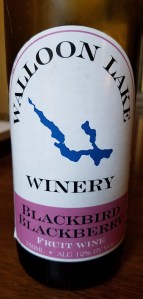
Maker: Walloon Lake Winery, Petosky, Michigan, USA
Purchased August of 2016
Variety: Marionberry
ABV: 12%
Price: $19 (winery)
Appearance: Dark purple, almost opaque.
Nose: Crushed blackberries.
Palate: Sweet with a tang. Blackberry jam.
Finish: Tangy. Fills the cheeks.
Parting words: Walloon Lake is a medium sized lake (6.67 square miles), oddly shaped, spring-fed lake in northern Michigan east of the much larger Lake Charlevoix (27.88 square miles) and south of the much much larger Lake Michigan (22,404 square miles). It’s one of northern Michigan’s prime locations for vacation homes, including one owned by the Hiltons and Windemere, the Hemmingway family cottage . It is also home to more modest cottages including Greentree, co-owned by friends of the blog Amy and Pete.
Walloon Lake, as viewed from Greentree cottage.
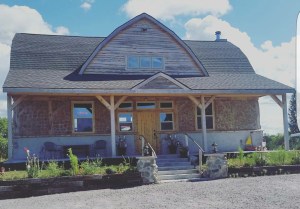
Walloon Lake Winery is located east of the North Arm of the lake, outside of Petosky. They’re a part of the Bayview Wine Trail and the Tip of the Mitt AVA. For my thoughts on that AVA, see here. Walloon Lake pulled out a surprise win earlier this year when their North Arm Red (made from hybrid Marquette grapes) won best dry red at the state-sponsored Michigan Wine Competition. The name Blackbird comes from Blackbird Road which runs from the North Arm of Walloon up to Lake Michigan just west of the winery.
The tasting room at Walloon Lake Winery
Taking notes on fruit wines is difficult because most of them just taste like an alcoholic version of fruit juice. There are some differences between cherry wines, but even those are more subtle than in wine grapes, even across different cherry varieties. That said, Blackberries are my favorite type of berries and its fairly rare to see a blackberry wine so I thought it was worth a review. Walloon Lake also makes cherry, blueberry and sparkling peach wines.
Blackbird Blackberry does great service to a great berry. It’s full-bodied and balances the sweetness, tartness and that earthy musk that makes blackberries so distinct. $19 is expensive for a fruit wine but I think it delivers. Blackbird Blackberry is recommended.
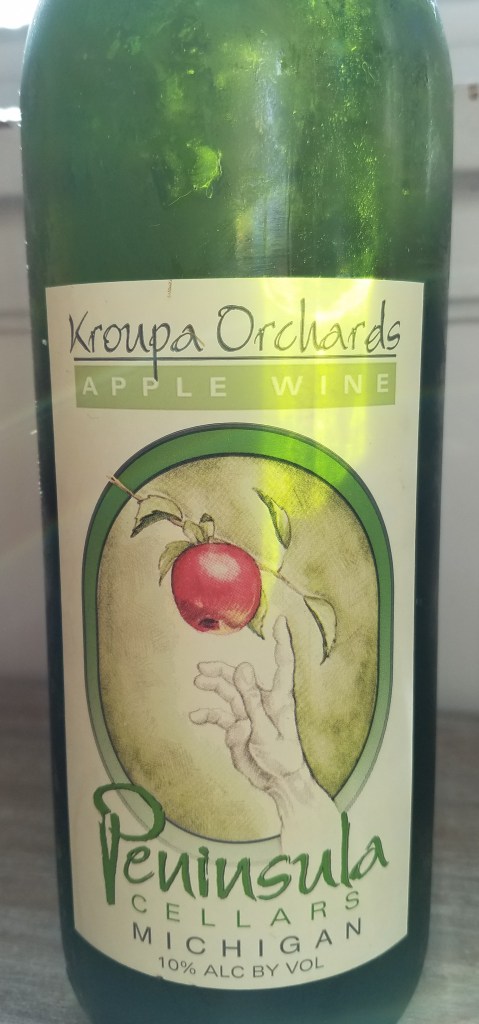
Maker: Peninsula Cellars, Traverse City, Michigan, USA.
Varieites: Macintosh, Spy, Empire, Rhode Island Greening.
Harvest: 2016(?)
Style: Sweet apple wine.
ABV: 10%
Price: $16/750 ml (Michigan by the Bottle Tasting Room, Royal Oak)
Appearance: Light gold.
Nose: Cut table apple, swimming pool.
Palate: Full-bodied and sweet. Apple juice, Gala apple.
Finish: A faint glimmer of tannin but still sweet. Long.
Parting words: Kroupa Orchards Apple Wine falls into the weird category of products that are good but disappointing. Peninsula cellars is one of the best wineries in Michigan’s best wine region. I love almost every wine they produce, so maybe my expectations were too high for this product. It’s not bad by any stretch. It has a lucious sweetness that is pleasant, but I expected something more thoughtful from this winery.
I think much of my disappointment stems from the choice of fruit all of which are baking apples. It’s the equivalent of making wine from Concord or Niagara grapes. Concord wine can be enjoyable, but it will never be as good as a well-made Pinot Noir or Riesling. It’s the same with apple wine or cider made from baking or table apples. Kroupa Orchard Apple wine is easy drinking with lots of apple flavor, but it lacks the complexity of a finely crafted hard cider that tannic or acidic apples would bring to the mix. Even accounting for the larger bottle and higher ABV, $16 is pricy for a product like this. Kroupa Orchard Apple Wine is mildly recommended.
Palate: Medium bodied and well-balanced. Blackberry jam, raspberry juice, light oak, seared steak.
Finish: Fruity and tart, then chewy and oaky.
Il bel lago
Parting words: Bel Lago is located on the shores of Lake Leelanau, in the Leelanau peninsula. The view certainly lives up to the name! Owners Charlie Edson and Amy Iezzoni are known for their cherry wine (Amy practically invented the stuff), field blends and their committment to ripeness. That committment is clearest in the Bel Lago’s rich, rounded Pinot Noir and Auxerrois (Blanc) wines.
Tempesta is not estate grown and not a field blend, obviously, but it does have that trademark ripeness. Oak is present, but not used to cover up anything, just to enhance the savory quailities of Cabernet Franc. Fruit and earthy flavors are in the lead, yoked together by Tempesta’s mid-palate tartness.
$44 is a lot for a non-AVA Michigan red. One could find similar wines from California at a lower price. I still think Tempesta is worth the price in a good vintage like 2012 when cellared for at least four years. 2012s may be nearly impossible to find now, but 2016 was a stellar vintage and 2017 is looking like it may be as well. Bel Lago’s 2012 Tempesta is recommended.
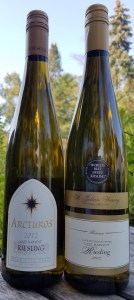
St. Julian Lake Michigan Shore Reserve Late Harvest Riesling= SJ
Arcturos Old Mission Peninsula Late Harvest Riesling= Arc
Makers
SJ: St. Julian Winery, Paw Paw, Michigan, USA
Arc: Black Star Farms Old Mission, Traverse City, Michigan, USA
Places of origin
SJ: Burgoyne Ridge vineyard, Berrien County, Lake Michigan Shore AVA, Michigan, USA
Arc: Old Mission Peninsula, Traverse City, Michigan, USA.
VinSugar at Harvest (in brix)
More information on the back of the SJ label
SJ: 21.1°
Arc: 22°
ABV
SJ: 12%
Arc: 9.5%
Price (current vintages)
SJ: $13 (website, though I have seen it for under $10)
Arc: $17.50 (website)
Appearance
SJ: Medium gold
Arc: Light gold, almost green.
Nose
SJ: Pear, orange juice
Arc: Kerosene (I was the only one who got this note), lemon thyme, peach.
Palate
SJ: Medium bodied but rich. Big pear. Like getting one stuffed up my nose, in a good way.
Arc: Fuller bodied but drier. Crisp apple, lime, candied lemon.
Finish
SJ: Sweet, almost sherry-like.
Arc: Cleaner. Bitter sage.
Tasting panel
Liz: Preferred SJ. Found it more complex and fruitier.
Amy: Preferred SJ. Arc is for summer sipping by the lake. SJ is also for sipping by the lake, but fall is coming soon!
Pete: Preferred Arc. Found SJ too harsh.
The Panel: Liz and me.
Amy and Pete
Parting words: Michigan is known for Riesling. It’s the most planted wine grape in the state. It’s grown both in the “Up North” wine regions and in West Michigan. Riesling wine is made in a broad array of styles from bone-dry Austrian Smaragd to syrupy Mosel Trockenbeerenauslese. Michigan Rieslings don’t (yet) span that entire spectrum, but they have the middle of it well-covered. On the sweet end are Late Harvest Rieslings like these. The ripeness of the grapes used to make these wines is in the neighborhood of the grapes that would go into a German Spätlese.
I have been wanting to do something like this for a while. LMS vs OMP, West Coast vs Up North. It seemed like the best way to do that was to do it with two wines from two big producers in each area. Black Star Farms is the Up North titan with a winery in both Leelanau and Old Mission and there’s nobody in LMS (or the state) bigger and older than St. Julian. Also both of these wines are commonly found at bigger grocery stores in my area, often at discounted prices.
We all thought both wines were very good, but I was a little surprised at how much almost everyone (including myself) preferred St. Julian. While I didn’t find it as complex as Arcturos, it was richer and more enjoyable. Although St. Julian had less sugar (at harvest and residual) than Arcturos it tasted much sweeter and fruitier. Although the folks at the winery described it as “a bright, clean wine designed to be consumed shortly after release” here, it has held up very well, and probably even become richer. Arcturos held up well too. Both are good values, but St. Julian has the edge there too especially considering it’s a single vineyard wine (albeit a very large vineyard). 2012 St. Julian Lake Michigan Shore Reserve Late Harvest Riesling and 2012 Arcturos Old Mission Peninsula Late Harvest Riesling are recommended.
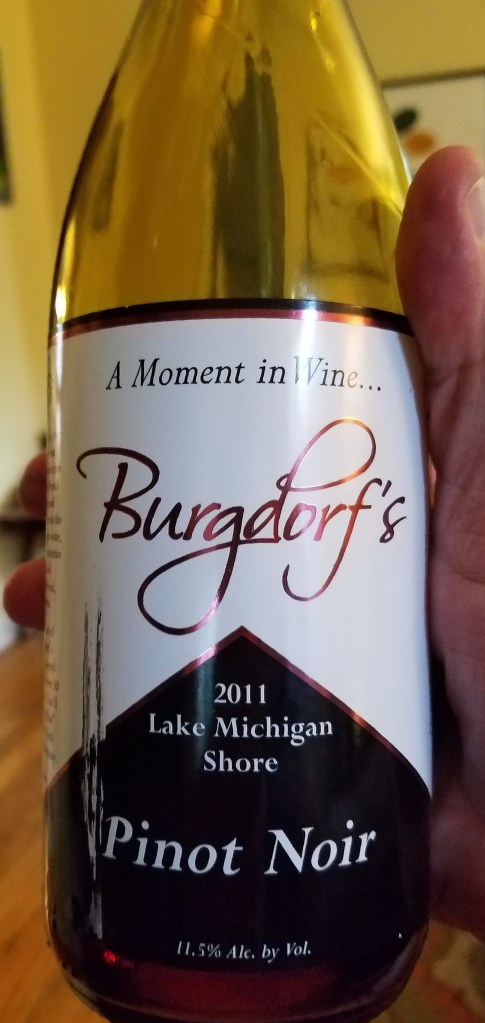
Place of origin: Lake Michigan Shore AVA, Michigan, USA
Vintage: 2011
ABV 11.5%
Price: $26 (Michigan by the Bottle Auburn Hills Sipper Club)
Appearance: Dark red, like cherry juice.
Nose: Cherry jam, touch of French oak, cedar.
Palate: Medium bodied, acidic with a little fruit and spice. Cherry juice, blueberry, black pepper.
Finish: Overdone blueberry pie.
Parting words: Burgdorf’s Winery is located in Haslett, Michigan, near Lansing. They’re known for their quality fruit wines and blends but they produce good varietals as well, most of which are not estate grown. This is one of their best. 2011 was an excellent vintage in Michigan overall, though some winemakers struggled with reds. No struggle here. I usually prefer softer Pinot Noir but the spice and oak here make it very food friendly. We had it with pizza margarita and BBQ chicken and it held its own with both. It tastes like its coming to the end of its life, though, so if you find this vintage, open and drink promptly!
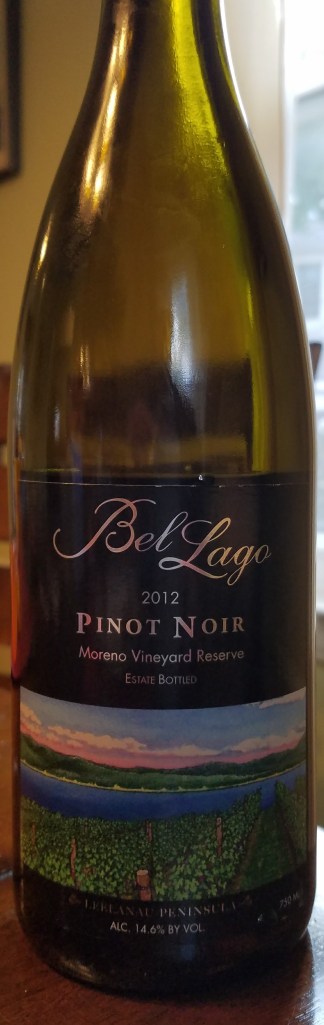
Palate: Juicy on entry. Medium bodied. Cherry, red currant, blueberry, pink peppercorn, strawberry.
Finish: Juicy with growing oak.
Parting words: Bel Lago winery lives up to its name, Italian for “beautiful lake”, with one of the most beautiful views on the Leelanau Peninsula. It overlooks Lake Leelanau, which is named after the peninsula & county which was itself named by Indian agent and ethnographer Henry Schoolcraft in honor of his wife Jane Johnston Schoolcraft who wrote under the name Leelinau, a neologism created by her or Henry. Henry used the name for Native American women in some of the stories he wrote. Henry created several other pseudo-indigenous place names in Michigan, including Lenawee, Alpena, Kalkaska and Oscoda, combining native words with Latin or Arabic elements.
Pinot Noir was one of the varieties hardest hit during the disasterous 2014 and 2015 Polar Vortex vintages. I recently spoke to a Northern Michigan winemaker who told me that he was burnt out on the grape. This winemaker said that Pinot Noir is not worth growing in Michigan because it’s a pain in the ass to grow and it’s rarely any good (my paraphrase).
Bel Lago’s Moreno Vineyard Pinot Noir is a brilliant counterpoint to that view. Oak and spice provide the right amount of contrast to highlight the fruit that drives this wine. This wine is an excellent example of how good Pinot can be in Northern Michigan, at least in a long, hot year like 2012. $45 puts it at the top end of Michigan reds, but I think it’s worth the money. It’s as good as Pinto gets in Michigan. Bel Lago Moreno Reserve Pinot Noir 2012 is highly recommended.






 Sipology