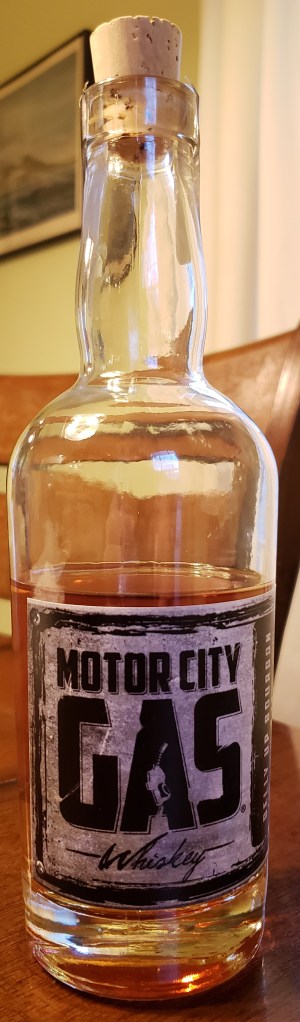
Wiser’s 10 Year Old, Triple Barrel

Maker: Wiser’s, Windsor, Ontario, Canada (Corby/Pernod Ricard)
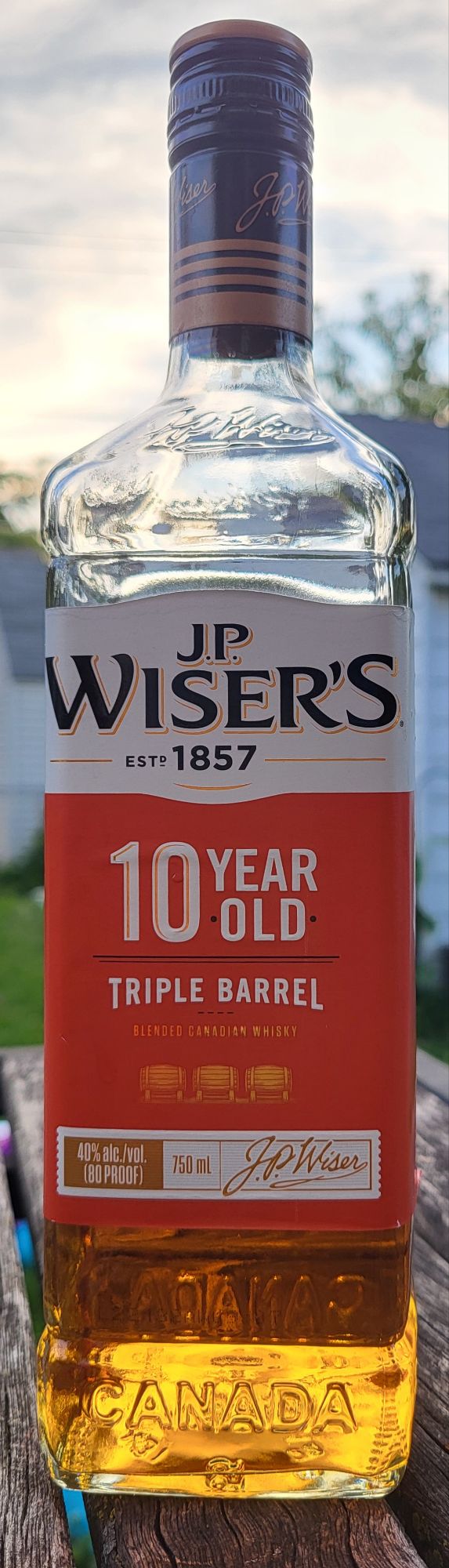
Distillery: Hiram Walker, Windsor, Ontario, Canada.

Style: Blended Canadian Whisky (blend of corn and rye), aged in new oak, ex-bourbon, and ex-Canadian barrels.

Age: 10 y/o.

ABV: 40%

Michigan state minimum: $25

Appearance: Orangy copper.

Nose: Roasted grain, leather, thyme, grape soda.

Palate: Full-bodied and creamy. Bourbon, vanilla custard, heat.

Finish: Anise, roasted sweet corn.

Mixed: Adequate in an old fashioned, but best neat or on the rocks.

Parting words: As long-time readers know, I’m a big fan of Wiser’s entire line of whiskies. It’s made at the biggest distillery (by far) in the Detroit Metro area, so even though it’s technically an import, drinking Wiser’s still counts as drinking local.

Anyway, this is a very fine sipper for the price. As I said above, and as the website recommends, Wiser’s 10 is best consumed neat or on the rocks. Its delicate, elegant personality can easily fall victim to bullying by strong mixers. It even had trouble standing up to the Angostura bitters in the Old Fashioned I’m currently nursing.

What better way to celebrate Canada Day than with a Glencairn of Wiser’s 10, a flavorful, balanced, and affordable whisky that represents some of the best spirits Canada has to offer. Wiser’s 10, Triple barrel is reccomended.
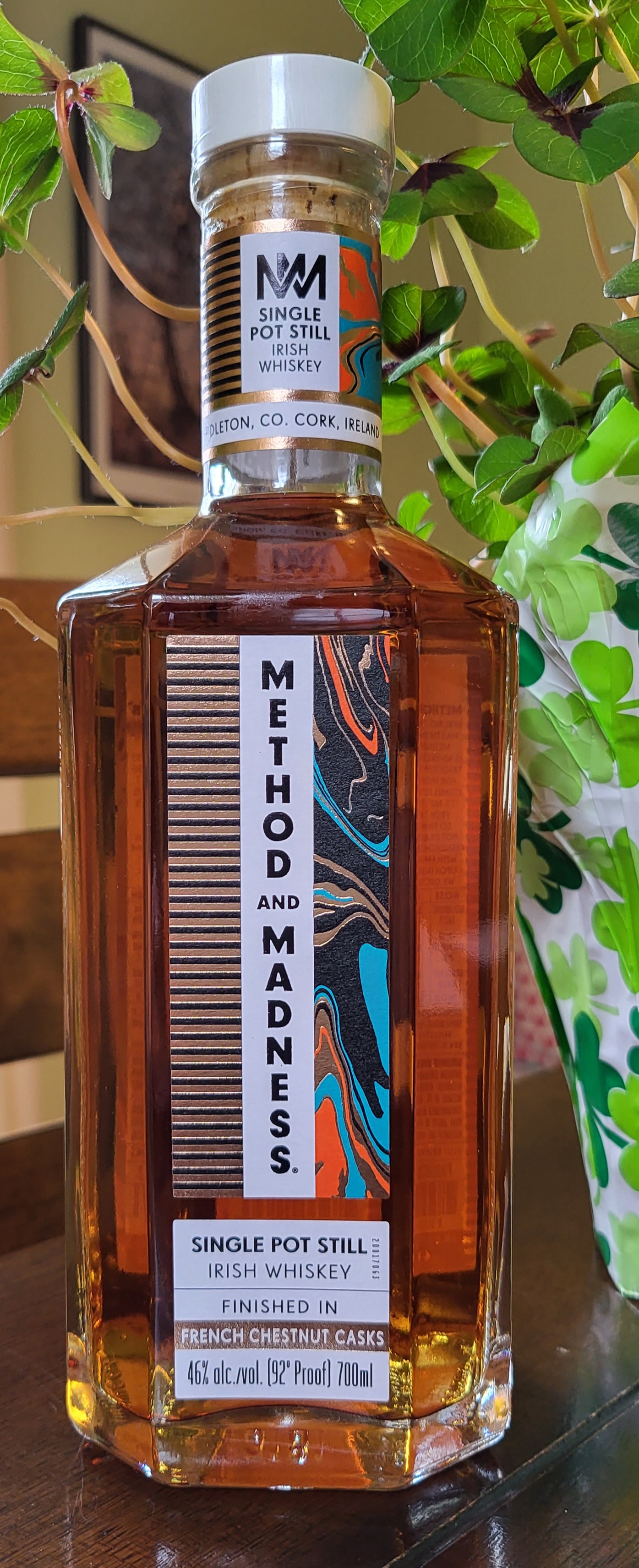
Method and Madness Single Pot Still

Maker: Midleton, Midleton, Co. Cork, Ireland (Irish Distillers/Pernod Ricard)

Style: Single pot still (mix of malted and unmalted barley), finished in chestnut wood.

Age: NAS

ABV: 46%

Michigan state minimum: $77/700 ml (comes out to about $82 for 750 ml)

Appearance: Light copper.

Nose: Malt, chestnut shells, cut lumber, cinnamon sticks, vanilla.

Palate: Full-bodied and sweet. Cinnamon gummies, old oak, walnut shells.

Finish: Nutty and drying.

Parting words: Method and Madness is a new-ish line of experimental Irish whiskeys from Irish Distillers, makers of Jameson. There are three expressions available in Michigan: single grain ($57), single pot still (this one), and single malt ($90). There are even pricier expressions, like the33 year old, very limited edition Mizunara oak finish edition single pot still.

As for this one, it’s more than I normally like to pay for a 46% ABV, NAS whiskeys, but the last Irish whiskey I purchased was cheap and dull, and I just got a vasectomy last week, so I decided to treat myself. Plus I’d never heard of a chestnut wood-finished spirit of any sort, so I was intrigued.

I’m glad I did. This is a luscious, rich whiskey with a unique (but not weird) nuttiness that comes through on all three levels of tasting. It’s a refreshing Sunday night or special occasion sipper, and as such is priced appropriately. If you’re looking for a change of pace for St. Patrick’s Day (or any day) this year, give Method and Madness a try. It is recommended!

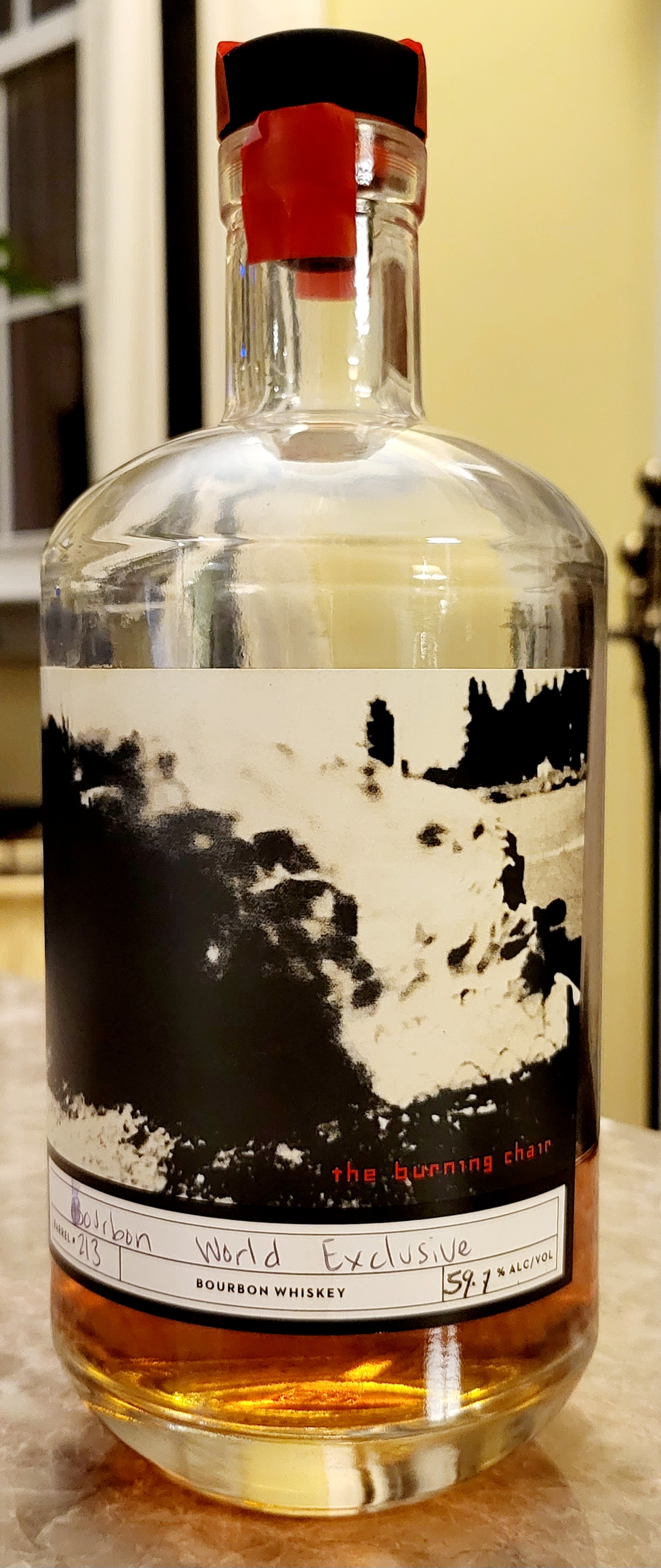
Burning Chair

Maker: Savage and Cooke, Vallejo, California, USA.

Distillery: Ross & Sqibb, Lawrenceburg, Indiana, USA.

Style: Bourbon whiskey finished in Zinfandel and Grenache (70/30%) barrels.

Age: NAS

Proof: 119 (59.7 ABV)

Barrel: 213

Purchased for $70 (Vine and Table)

Tasted with a little water.

Appearance: Medium copper.

Nose: Big spice, char, cayenne, oak, and sweet red wine.

Palate: Full-bodied with a velvety, sweet opening. Wild cherry Lifesavers, then oak, spice, and burn that slowly grows until it burns the roof of my mouth like a hot slice of pizza.

Finish: Burn and cherry wine. Not quite cough syrup but right on the edge.

Parting words: Savage & Cooke is a restaurant/distillery in Vallejo, California. It was founded and is owned by Dave Phinney, known as “the The Prisoner Guy” in wine circles. It’s another case of a rich guy getting into the micro-distilling business, and also another case of a distillery that seems to be more of a distillery-themed restaurant than what normally passes for a distillery.

As cheesy as all that sounds, this is one of the better finished bourbons I’ve tasted. One of the keys is starting with good, already aged whiskey. Too many producers, large and small, try to use finishes to cover up flaws in the spirit. That almost never works, so I’m glad Savage & Cooke didn’t try. This has a solid whiskey base. The finish is noticeable, but not overwhelming, and well-integrated. It’s everything a wine-finished bourbon should be.

The price, on the other hand, is higher than it should be. I knew $70 was too much when I paid for it, but it is barrel strength, unavailable in the Mitten State, an exclusive retail bottling, and Dave Helt was pouring samples of it at the time. So I paid it, and I haven’t really been disappointed. As a result, Burning Chair (barrel 213) is recommended.

Bear Face

Maker: Mark Anthony Group, Vancouver, British Columbia, Canada

Distiller(s): Undisclosed.

Style: Single grain (corn) Canadian Whisky.

Cooperage: Ex-bourbon, then finished in French oak wine red wine barrels, then in new Hungarian oak.

Age: 7 y/o

ABV: 42.5% ABV

Michigan state minimum: $33

Appearance: Medium copper (coloring is allowed in Canadian whisky).

Nose: Roasted corn, leather.

Palate: Full-bodied and rich. Corn syrup, leather, Cabernet Franc, dried cayenne chili.

Finish: Silky and a little sweet, with a bite at the end.

Parting words: The Mark Anthony Group has nothing to do with the Roman general or the pop singer, it originated in 1972 as a BC-based wine importer. Its best known product is the (in)famous White Claw sparkling seltzer. Bearface is not Mark Anthony’s only Canadian Whisky. It also owns a brand called Dillon’s, which is not sold in Michigan, and I haven’t seen anywhere else in the US.

“What is elemental aging”? you may ask. As far as I can tell, it’s when they put the finishing casks in unheated storage containers outside and let them sit for a bit. I was a little disappointed to read that. I had hoped that they placed the casks in the woods to encounter actual bears, but alas no.

Bearface smells like a punched up version of Crown Royal (probably because of all the corn) but it’s much more pleasant to drink. Too often finishes are used in an attempt to improve bad whisky. I suspect that’s not the case here, but if it is, the attempt has been successful. $33 is a good price for a Canadian of this age and quality. The packaging is a little corny (oh no a bear attacked the bottle!) but Bearface is recommended.

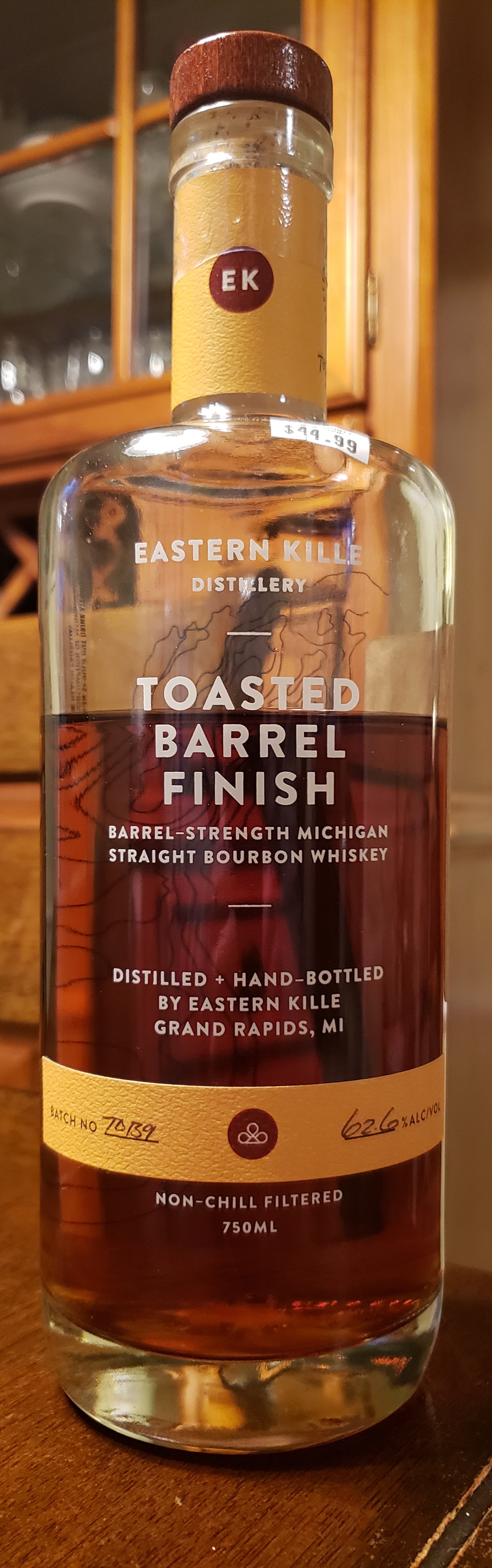
Eastern Kille Toasted Barrel Finish Barrel Strength, Holiday Market selection

Maker: Eastern Kille, Grand Rapids, Michigan, USA

Selected by: Holiday Market, Royal Oak, Michigan, USA

Style: Toasted barrel finished Michigan straight, rye recipe, bourbon

Age: 3 y/o (Barreled 10/31/17, bottled 11/4/20)

Batch: 70139 (or TOB9)

Barrel: TOB62420-9

Proof: 125.2 (62.6% ABV)

Purchased for $45.

Note: Tasted with a splash of water.

Appearance: Dark copper.

Nose: Oak, sawdust, wood varnish, ash, whiff of amaretto.

Palate: More sawdust and toasted oak, with some sweet dessert flavors lurking somewhere in the background.

Finish: Sawdust, then burn.

Parting words: Eastern Kille (Gray Skies until dumb Campari threatened them with a lawsuit over the word sky, which they apparently own now), is a distillery and bar in Grand Rapids, Michigan. Like many other businesses of the type, Eastern Kille also gets distribution around the state. I thought I had reviewed one of their products before, but it turns out I hadn’t.

They seem to be one of the distilleries that is trying to do things “the right way” so I jumped at the chance to try a single barrel selection from one of my favorite places to buy spirits. The toasted barrel appealed to me because rebarreling can sometimes be a good way to give young whiskeys a little more depth and oak character. The downside is that if the whiskey is left in the second barrel too long or the finishing barrel is too small (or both) the wood can overwhelm the spirit, and turn it into what I call “beaver bourbon.”

Sadly, the latter is what has happened here. Eastern Kille Toasted Barrel Finish is an overly woody, unbalanced whiskey. There are some interesting things going on under all that oak, but they fade as soon as that finish hits like a 2×4. I tried mixing it with some success in a boulevadier, but that was all it was good in. The oak quickly overwhelms everything else, even a Manhattan made with a bold vermouth.

Eastern Kille Toasted Barrel Finish is not recommended. That said, I’m not giving up on this distillery. There’s a good, solid base here so I’m eager to try their standard bourbon. Watch this space for that review!

Thomas S. Moore, Cabernet Sauvignon cask finish

Maker: Barton 1792, Bardstown, Kentucky, USA (Sazerac)

Style: Rye-recipe bourbon finished in Cabernet Sauvignon casks.

Age: NAS (at least 4 y/o)

Proof: 95.3 (47.65% ABV)

Michigan state minimum: $70

Appearance: Ruddy brown.

Nose: Overdone cherry pie, particle board, alcohol, anise.

Palate: Full bodied. Cherry juice, oak, then burn.

Finish: Cherry vanilla ice cream, alcohol.

Parting words: Sazerac has done a lot with the Barton distillery in Bardstown since they purchased the distillery from Constellation in 2009. The latest thing is the Thomas S. Moore line of wine barrel finished bourbons.

I’m not a purist when it comes to finished bourbon. I think a finish can be a nice addition to bourbon when applied judiciously and when the underlying bourbon is good quality. Fortified wine finishes are pretty common with whiskeys of all kinds, so I thought I’d try the Cab Sauv finish first. The finish adds some fun, fruity notes, but they’re quickly overcome by an underlying unrefined harshness. Water reduces the heat, but the harshness remains. It reminds me of going to my senior prom. I was wearing a tux and a sporting a fresh haircut, but underneath I was the same crude, rude teen.

If this were $20 cheaper, this harshness might be easier to overlook or I could write it off as an interesting mixer, but $70 is serious money for a bourbon from a major distiller. Sazerac can do better than this.

While I’m at it, I might as well mention the bottle and label, which are worse than what’s inside. The two tone horse picture, disjointed graphic design, and ugly, generic bottle, makes Thomas S. Moore look more like a prop from a mid-century movie set than a 21st century high-end bourbon.

Thomas S. Moore, Cabernet Sauvignon cask finish is not recommended.

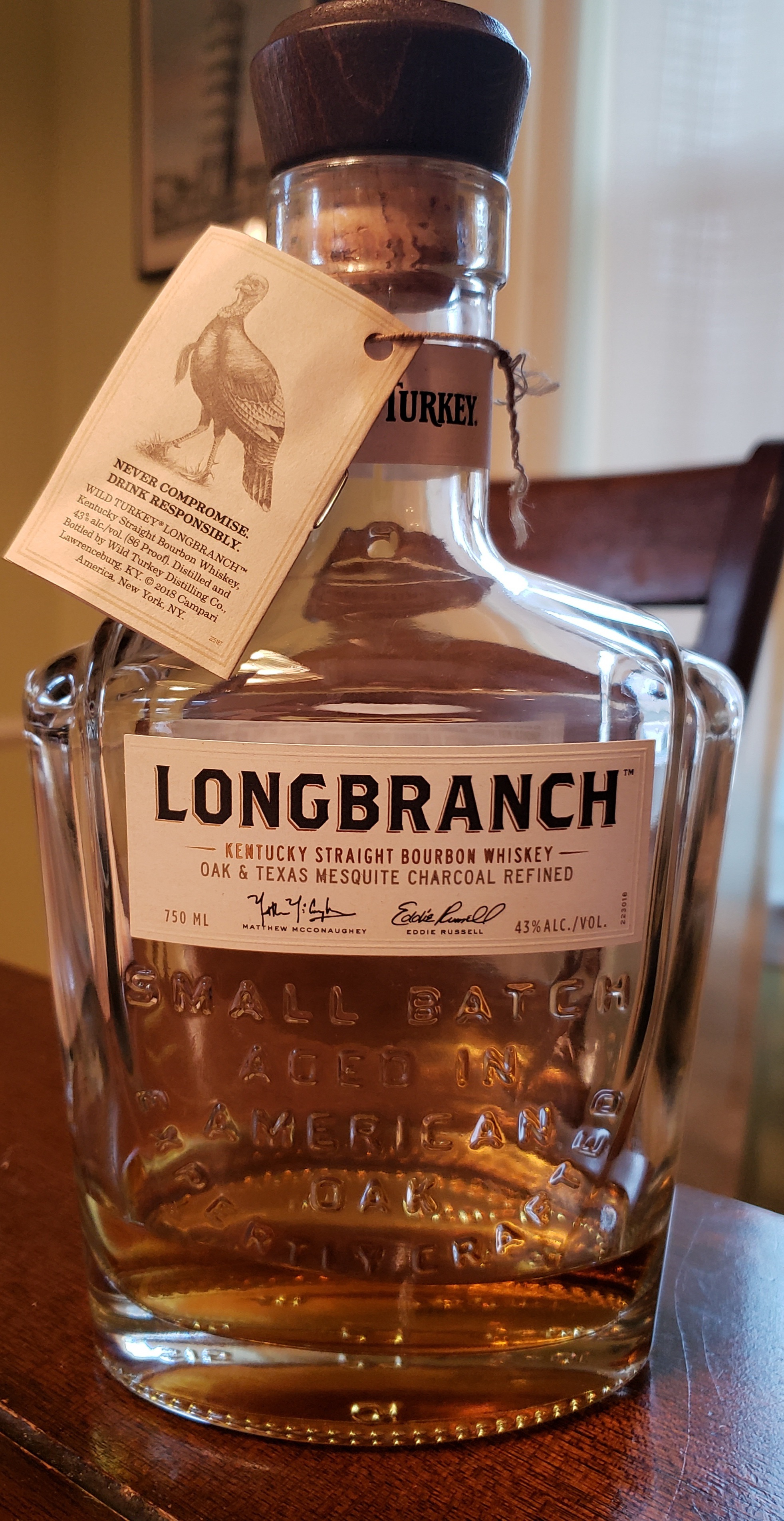
Longbranch

Maker: Wild Turkey, Lawrenceburg, Kentucky, USA (Campari)

Style: Straight, standard recipe bourbon “refined” in oak and Texas (!) mesquite charcoal.

Celebrity: Matthew McConaughey

Age: NAS (at least 4 y/o, but hang tag says 8 y/o)

Proof: 86 (43% ABV)

Michigan state minimum: $40

Parting words: Since the invention of what we now call bourbon, humanity has been asking one question: What if you took aged Wild Turkey and filtered it through oak and then Texas (as opposed to Mexican, I guess) mesquite charcoal? Thanks to Eddie Russell and movie star Matthew McConaughey, we now know the answer.

The process seems to be similar to the one behind Dickel Rye. Standard Dickel and Jack Daniels filter their whiskey before it goes into the barrel, which I don’t think they’re doing here, but the internet has not been particularly clear on this.

The target market seems to be the bougie casual bourbon drinker who isn’t a fan of assertive, high proof whiskeys (what Wild Turkey is known for) and values “smoothness” but still wants flavor and a fancy-looking bottle. In other words, Basil Hayden and Woodford Reserve drinkers. But why shouldn’t Wild Turkey have a share of that market?

At any rate, there’s nothing not to like about Longbranch. The price is even reasonable for Celeb Whiskey. I wouldn’t say it’s as good as fellow Texan Willie Nelson’s Old Whiskey River (a collaboration with Heaven Hill), but it’s still all right, all right, all right.

I apologize.

Longbranch is recommended.

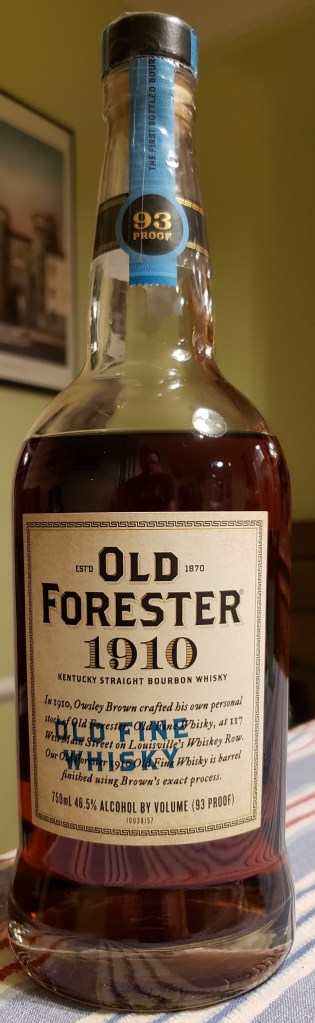
Old Forester 1910

Maker: Brown-Forman, Louisville, Kentucky, USAwp-1578702014650.jpg

Style: Barrel-finished straight bourbon whiskey.

Age: NAS

Proof: 93 (46.5% ABV)

Michigan State Minimum: $55

Appearance: Chestnut.

Nose: Light oak, ghost pepper, toasted pecan.

Palate: Full-bodied. Brown Sugar and then burn. With water: Pralines, plum, cocoa.

Finish: Long. Maple candy, then alcohol and bubble gum.

Parting words: This is the fourth and final entry in Old Forester’s superb Whiskey Row series of historically inspired bourbons. I’ve liked every single one and I like this one too. The first two, 1870 and 1897, were better (probably older) versions of their two standard expressions the 86 proof and 100 proof (fka Signature) Old Foresters. The third (my favorite) was the 114 proof 1920.

Brown-Forman went in a different direction for 1910, jumping backward ten years to replicate an alleged incident when a fire on the bottling line forced the distillery to store bourbon in a second barrel for some reason. The whole thing sounds a bit dubious to me, but, historicity aside, this is a very good bourbon. The second barrel (new I believe) rounds out OF’s usually sharp edges to give it decadent candy flavors without becoming overly sweet. Depite the relatively low (93) proof for serious bourbon people like you and me, OF 1910 benefits from a few drops of water.

1910 is cheaper than 1920, but much harder to find in my experience. $55 may seem like a lot for a 93 proof NAS bourbon from a big distillery, but it’s well worth it in this case. It’s an excellent capstone to the Whiskey Row series. Old Forester 1910 is highly recommended.


Crown Royal French Oak Cask Finished

Maker: Crown Royal, Gimli, Manitoba, Canada (Diageo)

YKdIteRA.jpeg
Photo courtesy of Diageo.

Style: Toast French oak cask finished Canadian blend.

Age: NAS (at least 3 y/o)

ABV: 40%

Michigan State Minimum: $70 (MSRP: $60)

Note: Noble collection series

Thanks to Lisa Wendling and Diageo for the sample.

Appearance: Medium copper.

Nose: French oak, burnt orange peel, pine resin, creamed corn, grains of paradise.

Palate: Subtle. Custard, toasted oak, vanilla, cinnamon.

Finish: Cut lumber, burn.

Parting words: Despite mocking Diageo and lionizing Vijay Mallya on Twitter for years, the fine folks at Diageo graciously sent me a sample of Crown Royal French Oak Cask Finished Canadian Whiskey.

I’m not a great fan of the regular CR or the special deluxe, but I have enjoyed several of the other expressions, like the Blender’s Mash and Northern Harvest Rye. This is another good one. The French oak (sourced from the Vosges) is not overwhelming and mixes with the classic roasted grain flavors of Canadian whisky to produce pleasant potpourri aromas. Unfortunately, like many Canadian whiskies, the palate doesn’t deliver on the promise of the nose. An extra 5% ABV would probably help in that regard. Still, it’s worth the MSRP, though the Michigan price is pushing it. Crown Royal French Oak Cask Finished is recommended.


Belly Up Bourbon

Maker: Motor City Gas, Royal Oak, Michigan, USA20190111_164605.jpg

Style: Bourbon finished in rum barrels

Age: NAS

Proof: 90 (45% ABV)

Price: I forgot (only available at distillery).

Mixed: Due to limited time frame, I only tried a couple. Very good in a Manhattan and an Old Fashioned.

Appearance: Medium-light copper.

Nose: Toasted hazelnuts, caramel, new leather.

Palate: Full-bodied and sweet. Grade A maple syrup, vanilla cream soda, cinnamon.

Finish: Hot and a little syrupy, fading into oak.

Parting words: Motor City Gas is a bar/distillery on the eastern edge of downtown Royal Oak, Michigan. Most other Bar/Distillery combos focus on using their stable of spirits in cocktails, but at MCG the emphasis is on the whiskeys themselves, of which there are a bewildering amount. When I was there, they had seventeen different whiskeys and whiskey-based liqueurs on the menu, including bourbon, rye, corn whiskey, malt whiskey, oat whiskey and ginger and hickory nut liqueurs. Most of the whiskeys were finished or infused with rum, apple cider, hops, apple pie, and stout barrels making an appearance. There were a couple peated whiskeys too, with a peated malt and a peated bourbon (review coming soon) on the menu.

At the time I bought this bottle, I didn’t realize this bourbon was finished in a rum barrel ( I may have been a tad tipsy at time of purchase), until I sat down to write this review. If I hadn’t know that I probably wouldn’t have guessed. The rum barrel brings a sweet, slightly syrupy, vanilla taste that works very well in classic cocktails. I don’t remember the price but a full bottle is pretty expensive. The 375 ml bottles cost the same per ml but as I’ve said before, it’s better to pour out half of a $30 bottle than three quarters of a $60 one. Belly Up Bourbon is recommended.