Uncle John’s Perry

Maker: Uncle John’s, St. John’s, Michigan, USA20170302_115559.jpg

Varietal: 100% Bartlett

Style: Dry Perry

ABV: 5%

Price: $11/750 ml (Binny’s)

Note: Note: At the time of purchase, I received a complimentary bottle of Russet cider and of Uncle John’s Apple Brandy.

Appearance: Bright yellow with a big fizzy head.

Nose: Fresh cut pear, golden delicious apples, kiwi, papaya.

Palate: Dry and effervescent. Pear peel, Meyer lemon, leather mineral water.

Finish: Drying and slightly tart.

Parting words: Uncle John’s Perry is part of their line of premium ciders including Russet (blend of Russet varieties, with Golden Russet making up the majority), Melded (a blend of English, French and American heritage cider apples), and Baldwin (single variety cider from Lake Michigan Shore apples).

This perry is a source of pride for Uncle John’s co-owner and operator Mike Beck. It’s easy to see why. Many perries taste and smell like fermented syrup from a can of pears. This perry is beautifully dry and gently tannic, all made using Bartlett, the same variety of pears that end up in the can! Mike told me that there are heirloom pear varieties that are intended for use in perry but they are even harder to find than cider apples. If anybody reading this has more information about perry pears, please comment!

Anyway, this is the best perry I’ve ever had. It made me rethink the category as a whole. America needs more good perry! Uncle John’s Perry is highly recommended.
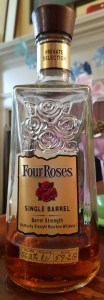
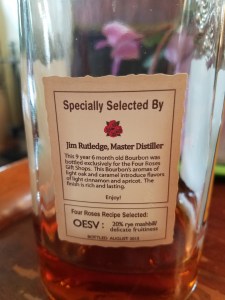
Four Roses Single Barrel Barrel Strength, Gift Shop Selection

Maker: Four Roses, Lawrenceburg, Kentucky, USA20170302_144319.jpg

Age: 9 1/2 y/o

Recipe: OESV

Warehouse RN, Barrel 57-2G

Bottled August of 2015

Proof: 112.4 (56.2% ABV)

Purchased for $70? (from memory)

Appearance: Bright caramel.

Nose: Caramel, lavender,  alcohol, oak, butterscotch, pool chlorine. More light chlorine with water.

Palate: Sweet on entry, butterscotch then burn. Bubblegum comes out with water.

Finish: Hot, oaky, chocolatey. Muted with water added.

wp-1488638774417.jpgParting words: Having reviewed pretty much every American whiskey on the market (and some not on the market) over the years, I’m going to start doing something I’ve resisted doing in the recent past: reviewing store picks of bourbon and rye. Given how quickly picks move off the shelves and how slowly I drink them, the goal is not to call attention to the picks themselves but to establish which retailers are good pickers and which aren’t. Gift shop selections are usually a safe bet and the selections from the Four Roses gift shops have been some of the best.
This one I wasn’t so sure about at first, though. With one judiciously applied ice crude, it was all oak. When I finally sat down with it neat, it started speaking to me. It has the beautiful interplay of candy and flowers we all expect from Four Roses. Now, the pool chlorine notes sound bad, I know, but it’s more of a whiff of summer swimming pools than bleach.

This was one of the last gift shop selections made during the tenure of 4R’s sainted former master distiller, Jim Rutledge. It’s a worthy farewell. This Four Roses gift shop selection is recommended.

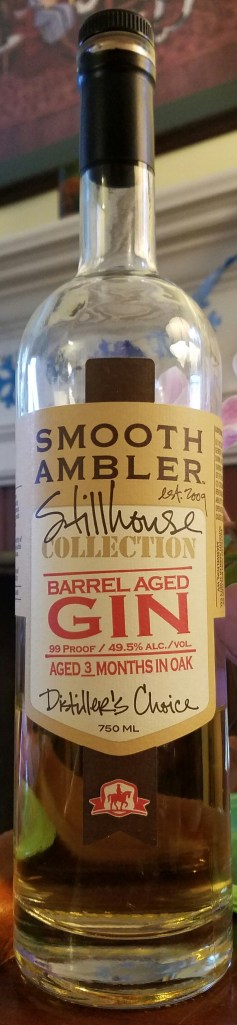
Smooth Ambler Barrel Aged Gin

Maker: Smooth Ambler, Maxwelton, West Virginia, USA20170301_170705.jpg

Style: Barrel aged (3 months in ex-Old Scout bourbon barrels) dry gin.

Batch 4, bottled 12/13/2012

ABV: 49.5%

Price: $41 (The Party Source, Newport, Kentucky)

Appearance: Very pale gold, like a young white wine.

Nose: Juniper, cedar, bitter lemon, sweet cinnamon, wet earth.

Palate: Full bodied and medium dry. Candy orange slices, five spice powder, mace.

Finish: Sweet and citrusy.

Mixed: Did well in literally everything I put it into. Great in the cocktails in which barrel aged gin usually excels like perfect martinis, negronis and Princetons. Surprisingly, it’s every bit as good with tonic, juice and in a dry martini. Did very well in a McClary Bros. Ginger & Lemon shrub.

Parting words: Smooth Ambler is best known for their wonderful and popular Old Scout line of MGP-sourced bourbon and rye. They’re not just independent bottlers, though. They also distill spirits themselves. One of those spirits is their well-made Greenbriar Gin. It’s a juniper-heavy, but still full bodied gin good for just about anything. Unlike many gin producers, they use a mixed grain recipe that is similar but not identical to the mashbill used for their Yearling wheated bourbon. That gives it complexity and heft that many craft gins lack.

That heft serves it well when they put it into barrels. The result is a gin with the bitterness and spice one expects from a barrel aged, but with an added edge that allows it to work just as well with tonic and dry vermouth as it does with sweet vermouth and amaro. This is a one-stop gin. No need to keep a bottle of Seagram’s in the fridge  for G & T’s when you have this gin on your bar. That versatility goes a long way towards making it worth a purchase even at $41. It’s like that friend you have who is just as much fun to be around at a rock concert as she is at a house party or an art museum. Smooth Ambler Barrel Aged Gin can go anywhere with flavor. Highly recommended.


Left Foot Charley Tale Feathers Pinot Gris, 2011

Maker: Left Foot Charley, Traverse City, Michigan, USAwp-1488403717038.jpg

Place of origin: Tale Feathers Vineyard, Old Mission Peninsula AVA (western slope), Traverse City, Michigan, USA. For more information on the vineyard, see here.

Vintage: 2011. For more information on the vintage, see image below.

ABV: 12%? (From memory)

Purchased for $19 (Holiday Market)

Appearance: Medium gold.

Nose: Roasted brazil nuts, mineral water, lychee, lavender.

Palate: Medium bodied and medium dry. Nutty brown butter, coconut, oregano.

Finish: White grapefruit fading into herbal tastes.

20170301_162702.jpgParting words: Tale Feathers has partnered with Left Foot Charley for many years now. It’s a small (2 1/2 acre) vineyard in west central part of Old Mission. It’s planted entirely with Pinot Gris. The Wilsons’ focus on that grape has paid off in a big way for them and LFC. Theirs is arguably northern Michigan’s best Gris.

The 2011 vintage was strong for whites in Michigan, though not as strong as 2013. It was still one of the best of the past decade. A lot of its fruit has faded over the past 5+ years, but it remains a beautifully structured wine. I wouldn’t let it go much further than this, though. 2011 Left Foot Charley Tale Feathers Pinot Gris is recommended.

Hawthorne Pinot Noir Reserve, 2012

Maker: Hawthorne Vineyards, Traverse20170208_211507.jpg City, Michigan, USA

Place of origin: Hawthorne estate, Old Mission Peninsula AVA, Traverse City, Michigan, USA

Grape: Pinot Noir (100%)

ABV: 12.3%

MSRP: $22

For more information, see tech sheet here.

Appearance: Bright ruby, almost transparent.

Nose: Blueberry, new oak, cherry juice, raspberry jam, allspice, pepperoni.

Palate: Light bodied and semi dry. Fruit cocktail but with beefy oak and tannins looming in the background like hired goons.

Finish: A little chewy and oaky, but still refreshing and fruity.

Parting words: I had this bottle in the wine rack in our dining room (the wine version of the on deck circle in our house) when I saw a local wine loving friend of mine raving about it on social media. So I had to make it the next one I opened. I’m glad I did. It’s very good.

Perfectly balanced between fruit, spice and meat, it’s easily one of the top Michigan Pinots I’ve had. Hawthorne is becoming one of my favorite Michigan wineries on the back of the wonderful wines they produced in the 2012 and 2013 vintages. Don’t let the shiny labels and modern condo-esque tasting room fool you, these are people who take growing grapes and making wine very seriously. These bottles can be found on the odd grovery store or wineshop shelf, but Michigan by the Bottle Auburn Hills is the place you can be sure to find some. Hawthorne Vineyards 2012 Pinot Noir Reserve is highly recommended.

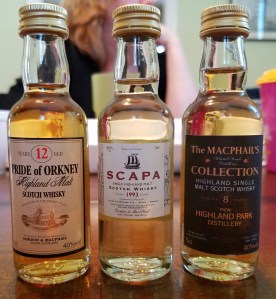
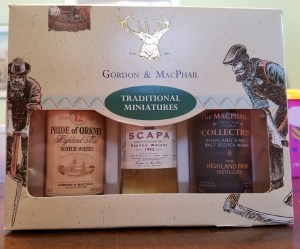
Triple Head to Head: G & M Orkney Tripak

P= Pride of Orkney, 12 y/o blended maltwp-1486168550560.jpg

S= Scapa, 1993 (bottled 2008) single malt

H= Highland Park, 8 y/o single malt

Bottler: Gordon & McPhail, Elgin, Moray, Scotland, UK.

Distiller

P= Highland Park, Scapa.

S= Scapa, Kirkwall, Orkney, Scotland, UK (Pernod-Ricard)

H= Highland Park, Kirkwall, Orkney, Scotland, UK (Edrington)

Age

P: 12 y/o

S: 15 y/o

H: 8 y/o

Region: Highland/Island

ABV: 40%

Price: I forget.

Appearance

P: Medium caramel.

S: Lighter. Straw.

H: Virtually the same as P.

Nose

P: Alcohol, oak, malt, a little peat.

S: Mild.Oak, seabreeze.

H: Toasted almonds, oak, peach.

Palate

P: Medium bodied and creamy. Caramel, bourbon.

S: Mild. Not much happening but a little burn.

H: Mild. Butterscotch, peat, lemon meringue.

Finish

P: Mild and slightly sweet. Caramel, buttercream.

S: A little fruity. Fades quickly.

H: Slightly chewy but mild. Peat ash, Atlantic ocean.

20170203_193337.jpgParting words: These whiskies come from the two most northerly distilleries in Scotland, Highland Park and the other one in Orkney, Scapa. Highland Park is almost universally beloved for its perfectly balanced and flavorful 12 & 18 y/o bottlings. Scapa is not nearly as well known or highly regarded as HP, but the 16 y/o producer bottling does have its fans. Scapa is unpeated, unusual for a an Island malt, but they did release a peated expression last year.
Pride of Orkney (of G & M’s now defunct “Pride of” series) is a blended malt containing whisky from both of these distilleries. It’s the best of the three. While it’s not earth shattering, it is well balanced with good flavor considering its proof and the fact that it’s a blended malt containing some pretty mild whisky. I suspect it contains caramel coloring. The Highland Park 8 y/o is fine for what it is, a young malt from a good distillery. Higher ABV would do it a lot of favors, but it’s pleasant enough as it is.

Scapa 1993 is one of the dullest single malts I’ve ever had. It doesn’t do anything to distinguish itself, tasting like a generic second-tier single malt. It’s like eating a sleeve of water crackers. It will do if there’s nothing else in the house but you’re left feeling like you just wasted time and calories for nothing.

These three expressions are close to impossible to find on their own now, but I bought this set of minis at a large liquor store just a couple years ago so there are probably more of these sets floating around out there. There is/was also an Islay tripak set. Probably more interesting than this. If you’re curious about the whiskies of Orkney, you might find the Orkney tripak fun but I can only mildly recommend this set.


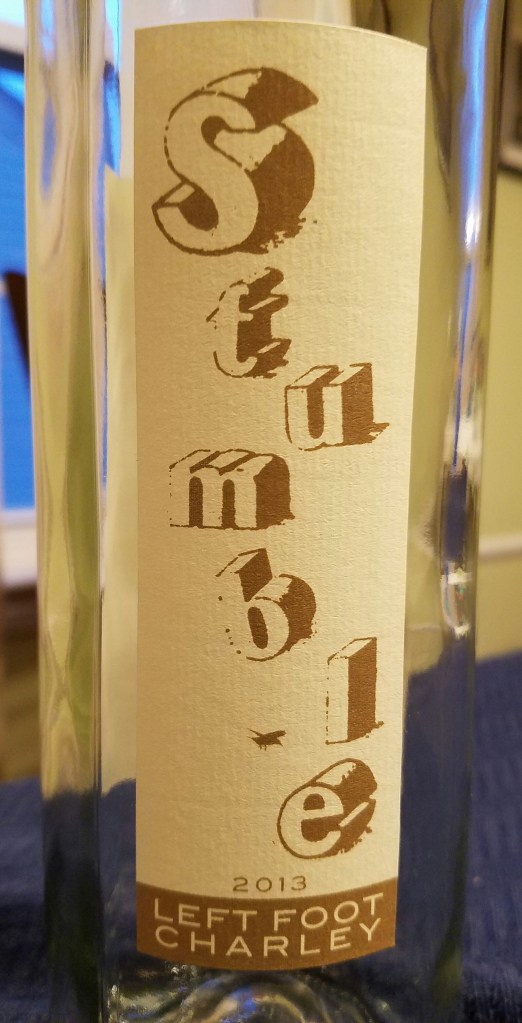
Stumble, 2013

20170121_075549.jpgMaker: Left Foot Charley, Traverse City, Michigan, USA
Grapes: Riesling (50%), Gewürztraminer (50%)

Place of origin: Old Mission Peninsula AVA, Traverse City, Michigan, USA

ABV: 11.5%

Other information (from here): Residual Sugar: 25 g/l, pH: 3, titratable acidity: 9.7 g/l, 649 cases produced, fermented & aged in stainless steel.

Purchased for $16 (Holiday Market, Royal Oak, Michigan)

Appearance: Light gold.

Nose: Lychee, apple juice, pineapple sage.

Palate: Pineapple, Granny smith apple, lemon thyme.

Finish: Clean, pineapple, mineral water.

Parting words: I haven’t liked a lot of the Riesling blends I’ve had in the past. The Riesling either gets lost or shows through but is of poor quality. This wine is delightful though, like just about every wine Left Foot Charley has ever produced. The Gewürz adds a nice bite to bring the Riesling into balance. LFC wines are usually single vineyard bottlings but not vineyard is listed for Stumble. I’m guessing that’s because the grapes for this one came from multiple vineyards.

I liked it best on its own, but I can imagine Stumble pairing well with spicy Chinese or SE Asian food. $16 is more than a fair price for a wine of this type and quality. Stumble is recommended.


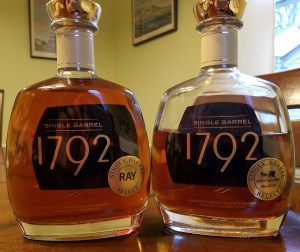
Head to Head: Ray’s vs Red Wagon 1792 Single Barrel

20170120_101320.jpgMaker: Barton 1792, Bardstown, Kentucky, USA (Sazerac)
Age: NAS

Proof: 93.7

Michigan state minimum: $42

Ray= Selected by Ray (Rural Inn, Indianapolis, Indiana)

RW= Red Wagon (Troy, Michigan)

Appearance

Ray: Light copper

RW: Darker, medium copper.

Nose

Ray: Alcohol, grape bubblegum, leather.

RW: Over-toasted walnuts, cut grass, caramel.

Palate

Ray: Sweet and fruity, then burn. With water it becomes sweeter with more vanilla and less fruit.

RW: Caramel apple, oak, burn. Oakier with vanilla and classic old bourbon flavors when water is added.

Finish

Ray: Brown sugar, then burn. Water brings the fruit back out.

RW: A little chewy, then lingering warmth.

Parting words: The Sazerac corporation purchased the Barton-1792 distillery from Constellation brands in 2009. Their primary motivator may have been Barton’s tall airy warehouses but they were surely after 1792 Ridgemont Reserve as well. The brand started out as something of a Woodford Reserve ripoff (see here) but soon settled into its own niche as a decent selling upper-middle shelfer. Sazerac capitalized on that success and added a series of line extensions and opened up the single barrel expression for selections by retailers and enthusiast groups.

These two barrels are good examples of how much variation there can be, even in those breezy rickhouses. Ray’s was fresh and fruity while the Red Wagon barrel was chewy and mature. The Red Wagon barrel might be older, but it’s more likely that the oakiness came from being on a hot upper floor. I was able to taste Ray’s before I bought it, at an informal tasting at the Rural Inn around Thanksgiving. I bought the Red Wagon bottle blind, but I’ve enjoyed their selections before. If I had to pick one that I enjoyed more, it would be Ray’s but both are tasty, worth the money and worth seeking out. Both these 1792 Single Barrel selections are recommended.

Knappogue Castle 12, A & L selection

Maker: Castle Brands, New York, New York, USA20170112_143446.jpg

Distiller: Unknown. Either Cooley or Bushmills.

Selected by A & L Wine Castle, Ann Arbor, Michigan, USA (216 bottles)

Style: Triple Distilled Irish Single Malt

ABV: 46%

Purchased for $50

Appearance: Brassy orange.

Nose: Alcohol, oak, tarragon, vanilla scented candle, pineapple.

Palate: Medium bodied. Green apple on entry, buttercream, persimmon pudding.

Finish: Big and creamy. Oakm then pineapple upsidedown cake.

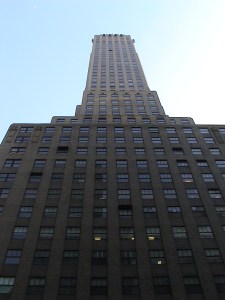
chanin_building_side_up
The Chanin Building, home to Castle Brands.

Parting words: Long time readers will remember that Knappogue Castle was one of the first Irish whiskeys I really fell in love with. The love affair continues with this beauty.

A & L did a great job selecting this barrel. It’s creamy, fruity and complex, with power rare for Irish Whiskeys. In 2013 I wrote the following about the standard Knappogue 12: “My only quibble is the low proof. I would love to be able to taste this at cask strength, or at least 46% ABV.” I’m glad they took my words to heart.

These Knappogue selections are rare, but if you find one, I highly recommend that you buy it!


Photographs

Bottle picture taken by me.

Chanin Building picture By Doc Searls from Santa Barbara, USA – ny_mayday02_09.JPG Uploaded by xnatedawgx, CC BY-SA 2.0, https://commons.wikimedia.org/w/index.php?curid=11332153


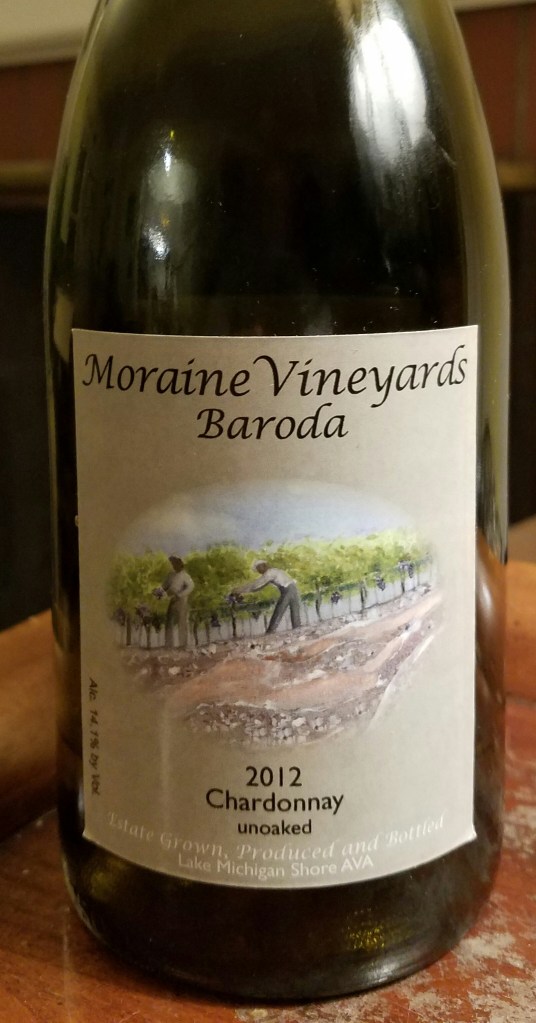
Moraine Vineyards Chardonnay, 2012

Maker: Dablon Vineyards, Baroda, Michigan, USAwp-1484144619731.jpg

Place of origin: Moraine (now Dablon) estate, Lake Michigan Shore AVA, Michigan, USA

Style: Unoaked, dry Chardonnay.

Vintage: 2012

ABV: 13.1%

Price: $20 (winery)

Appearance: Light gold.

Nose: Tangerine, brown butter, peach, mango, minerals.

Palate: Dry. Butter, melon, mineral water, banana.

Finish: Bitter butter batter, gravel dust.

Parting words: 2012 is a vintage best known for its excellent reds in LMS and the northern Michigan AVAs. The whites I’ve had from 2012 have been inconsistent, even from large producers. I tasted this wine at the Dablon tasting room and I was pleasantly surprised.

Moraine Vineyards Chardonnay is unusual for Michigan.  The unoaked ones tend to be round, fruity and mild but Moraine is boldly dry, even drier than its ABV would suggest. It’s more like a Chablis or Mâconnais than a  typical Michigan Chard. Fatty fish or creamy cheese would be excellent pairings, but chicken and pork chops would work too. I really enjoyed this wine. Worth the money and then some. 2012 Moraine Vineyards Chardonnay is highly recommended.