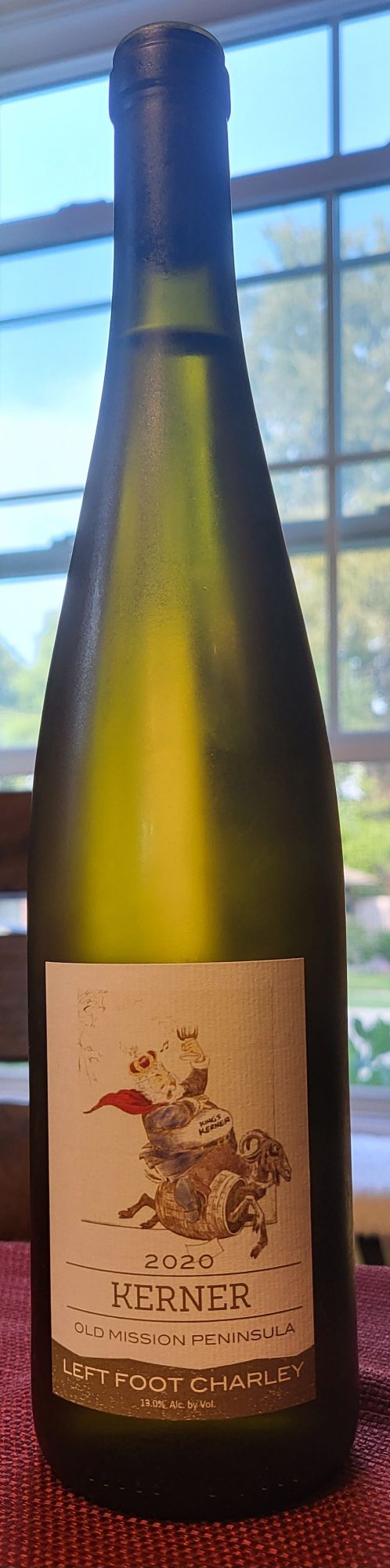
Exploring Michigan’s Unique Kerner Wine by Left Foot Charley

Maker: Left Foot Charley, Traverse City, Michigan, USA

Place of origin: Island View Orchard, Old Mission Peninsula AVA, Traverse City, Michigan, USA.

Grape: Kerner (at least 85%).

Vintage: 2020.

ABV: 13.3%

Purchased for $25 (Michigan by the Bottle, Auburn Hills, Michigan)

Appearance: Light gold.

Nose: Canned pear, thyme, golden apple.

Palate: Green apples, gravel, touch of leather.

Finish: Medium tart. pear, white pepper.

Parting words: Kerner is a grape that is not widely grown outside of Germany and Northern Italy. It is a newer vinifera variety, first released to the grape-growing public in 1969, the result of a cross between Trollinger (a red wine grape) and Riesling, both of which are pretty old varieties.

Anyhow, I like this grape a lot, especially in this dry style. Kerner isn’t as complex as a top tier Riesling, but it’s aromatic enough and easier to grow than its parent. I could see it doing well in white blends as well, but it’s already well-balanced on its own.

Anyway, I hope we see more Michigan Kerner in the future. Left Foot Charley’s is recommended.

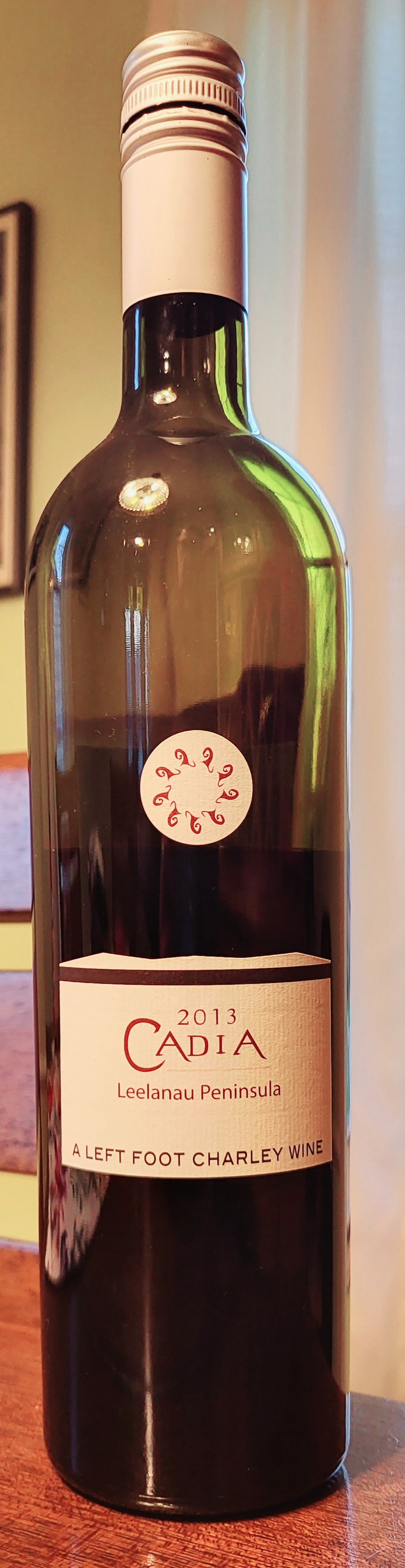
2013 Cadia: Gill’s Pier

Maker: Left Foot Charley, Traverse City, Michigan, USA.

Grower: Gill’s Pier, Northport, Michigan, USA

Grapes: 53% Merlot, 47% Cabernet Franc. Field blend.

Place of origin: Gill’s Pier estate, Leelanau Peninsula AVA, Northport, Michigan, USA.

Vintage: 2013 (final year for Gill’s Pier)

ABV: 12.5%

Purchased for $33 (Holiday Market)

Appearance: Dark purple.

Nose: Blackberry, blueberry, amaretto, tiny bit of oak.

Palate: Medium bodied. Dry with fruit jam. with some tannic grip on the back end.

Finish: Light, drying. Acid and oak.

Parting words: My first review of 2013 Gill’s Pier Cadia was a video review back in April of 2020. I liked it then and I like it now even more! Bottle aging has mellowed the tannins even further, allowing the fruit to become even more prominent, and the wine even more balanced. There were clear changes to the wine over three years, despite it being under a screw cap. This puts to rest any doubt in my mind as to whether screw top wine ages in the bottle or not. It clearly does.

Sadly, Gill’s Pier is now an alpaca and yak (!) farm, but I do still have a couple more bottles from them to taste as a part of the 2012 Project. I had planned for the project to wrap up around now, but 2023 was a very busy year for a variety of reasons, so I’m behind. Never fear, though, we will finish the project in 2024!

Left Foot Charley’s 2013 Gill’s Pier Cadia is recommended.

Head to head: Left Foot Charley Dry Riesling 2016 vs 2017

Maker: Left Foot Charley, Traverse City, Michigan, USA

16= 2016 vintage

17= 2017 vinatge

Places of origin

16: Terminal Moraine (43%), Seventh Hill Farm original block (32%), Longcore (13%), and Cork’s Vineyard (12%) vineyards, Old Mission Peninsula AVA, Traverse City, Michigan, USA

16: Seventh Hill Farm (44%), Terminal Moraine (28%), Bird’s Perch (20%), Rosi Vineyards (5%), Longcore (2%), and Chown (1%) vineyards, Old Mission Peninsula AVA, Traverse City, Michigan, USA

Style: Dry Riesling.

ABV

16: 12.1%

17: 12%

Purchased for

16: $19 (Red Wagon, Rochester Hills)

17: $18 (Michigan by the Bottle Tasting Room)

Nose

16: Fruity, a little musty at first, lemon thyme.

17: Lychee, dry peach, lemon thyme.

Palate

16: Tart. Lemonheads, pear, grapefruit.

17: Drier. Mineral water.

Finish

16: Gravely, somewhat tart, but sweetens as it warms.

17: Similar. Gravel, slightly tart, but gets lemony as it warms.

Parting words: This was another head to head tasting Liz & I had with friends of the blog Amy and Pete. They’re old hat at this now so they went in with the focus of experienced wine tasters.

The overall winner was the 2017, although Amy and I liked both. Liz thought the 2016 was much too tart and Pete wasn’t too hot on it either. The 2017 had an austere elegance that the 2016 (at this point anyway) lacked. They both went very well with our snacks.

Left Foot Charley is known for its single vineyard Rieslings, one of the most famous of which is named for one of the vineyards well represented in these blends, Seventh Hill Farm. It’s the largest of the vineyards represented at a whopping 5 acres and goes back to the late 1990s. It’s owned by Tom and Linda Scheuerman and is known for its sunny southern exposure and sandy loam soil.

The second best represented of these vineyards is Terminal Moraine. It’s farmed by Lisa Reeshorst, and is 1.8 acres large. It will celebrate its twentieth anniversary next year. The others are mostly smaller. For more information on these wines and the vineyards they come from, click here for the 2016 vintage and here for 2017.

I’m not sure if the differences in these wines are terroir or vintage drive (although it’s probably a little of both) but it’s an interesting contrast. 2016 was a good vintage in Michigan, but maybe a little too hot (yes, that’s possible here). 2017 was a more balanced vintage and produced some very elegant, well-balanced wines, so our preference was not surprising. The 2016 may be a little over the hill (no pun intended) as well, although it’s still drinking just fine, in my opinion, anyway. In general, I think 2016 Michigan wines are not as age-worthy as the 2017s (although there are always exceptions).

At under $20, LFC Dry Riesling is a real bargain, especially compared to its German cousins. Both vintages are recommended, but unless you have a very expensive, climate controlled cellar, 2016 is a wine to drink now. The 2017 will probably be fine for another year or two, but why wait? It’s great now.

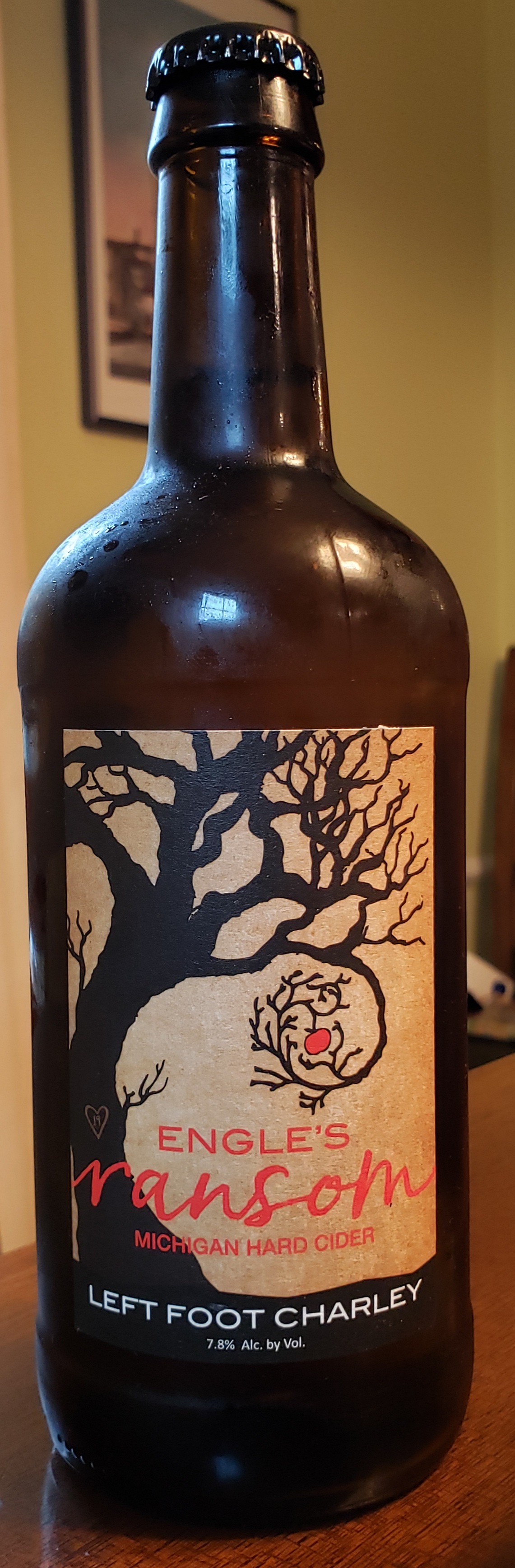
Engle’s Ransom Michigan Hard Cider

Maker: Left Foot Charley, Traverse City, Michigan, USA

Place of origin: Engle Ridge Farm, Grand Traverse County, Michigan, USA

Apples: Various European heritage varieties.

ABV: 7.8%

Price: $8/500 ml (LFC website)

Appearance: Gold with steady bubbles.

Nose: Strawberry, caramel, cut apple.

Palate: Tingly, medium light bodied, and dry. Granny smith.

Finish: Clean, apple butter.

Parting words: Left Foot Charley is best known for making some of the best single vineyard wines in Northern Michigan, but they also make some of the best single orchard ciders in Northern Michigan!

This is a great example. Engle’s Ransom isn’t a brash, funky Iberian or Norman cider. It’s a crisp, clean expression of the apples that went into it and the stony vineyard they came from. There’s a little sweetness and bitterness that keep it from turning into Pellegrino, but it’s still dry and refreshing on a hot summer afternoon.

At $8 for half a liter, this is an easy buy. Engle’s Ransom is recommended.

Left Foot Charley Gewürztraminer, 2016

Maker: Left Foot Charley, Traverse City, Michigan, USA20190415_162818.jpg

Grape: Gewürztraminer (at least 85%)

Place of origin: Grand Traverse County, Michigan, USA

Vintage: 2016

ABV: 13%

Purchased for $20 (Holiday Market)

Appearance: Quite pale gold.

Nose: Big lychee, woodruff, roasted ginger.

Palate: Peach pit, bitter orange, orange thyme.

Finish: More lychee, orange pith.

Parting words: Gewürztraminer is one of my favorite grapes. Its wine is spicy and tastes like no other grape (except Traminette). Next to Riesling, it’s my favorite white wine grape. Like Riesling it’s made in a range of sweetness levels, although it doesn’t reach the sublime heights of high-quality German Spälese or Auslese. LFC Dragon-label Gewürz is firmly on the dry end of the spectrum. The LFC website recommends cellaring this wine until 2022-2024 (!). I prefer Gewürz with a little bit of fruit to balance the spice so I opened mine in 2019, but if I find another bottle I may let it sit for a couple more years.

I’ve had a lot of Michigan Gewürz over the years and this is the best one that I can remember having. It’s good on its own but it is spectacular with spicy food. The first bottle I purchased was taken to a Chinese New Year celebration and was gone in a flash. It paired perfectly with the spicy hot pot at the center of the meal. $20 is more than fair for a high quality wine like this. Left Foot Charley Gewürztraminer (dragon label) is highly recommended.

The Cunning Ham

Maker: Left Foot Charley, Traverse City, Michigan, USA20180121_122605.jpg

Style: Dry farmhouse cider using Saison yeast.

Note: Fermented in French oak. Rested on lees. Unfiltered.

ABV: 7%

Purchased for $8/500 ml (winery)

Appearance: Light gold, slightly cloudy.

Nose: Pressed apple juice, a little funk and tannin.

Palate: Off dry, chewy dried apricot, oak.

Finish: Tart, then tart and tannic. Meyer lemon.

Parting words: Ciders have become trendy in Michigan wine and beer circles, with a number of producers branching out into cider with mixed sucess. Just because one knows how to ferment grapes or grains, doesn’t mean one knows how to make a good cider.

That said, Left Foot Charley knows how to make a good cider. Cunning Ham is a part of a line of ciders that also includes Henry’s Pippin (made with heirloom apples but not necessarily traditional cider apples),  Antrim County (single origin) and crowd favorite Cinnamon Girl (cinnamon flavored). I reviewed Cinnamon Girl here and here five years later (oops).

For a dry farmhouse cider, The Cunning Ham is very drinkable and food friendly, especially with spicy fare. I expected a little more funk and tannin but there’s nothing not to like in this bottle. $8 for 500 ml is a very fair price for a quality craft cider. I have no idea where the name came from, but The Cunning Ham is recommended.


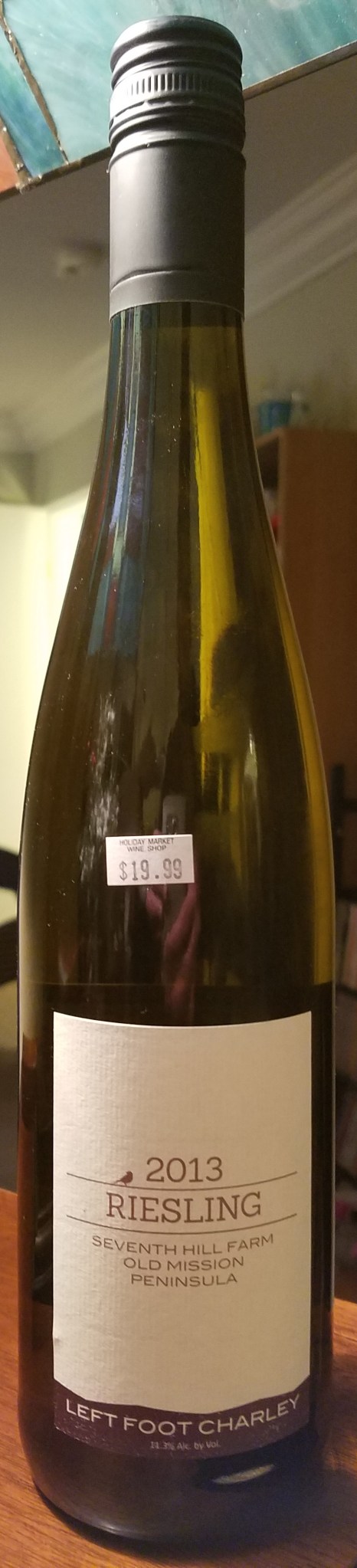
Seventh Hill Farm Riesling, 2013

Maker: Left Foot Charley, Traverse City, Michigan, USA20171205_175835.jpg

Grape: Riesling (at least 85% by law)

Place of origin: Seventh Hill Farm vineyard, Old Mission Penninsula AVA, Traverse City, Michigan, USA

Vintage: 2013

ABV: 11.4%

Purchsed for $20 at Holiday Market

Appearance: Pale gold.

Nose: Lychee,  minerals, dried apricot,

Palate: Mineral water, mandarin oranges, lemon thyme, underripe peach.

Finish: Peachy and mineral-y.

Parting words: I’ve said before that I think Left Foot Charley is the best winemaker in Michigan. Seventh Hill Farm Riesling is more evidence to support that claim. 2013 was a difficult vintage for many growers in the state, but one that ultimately produced many wonderful whites (and some good reds too!) According to the label, this wine was fermented for a relatively long time to soften the edgy nature of the vintage. What has emerged is a sophisticated, complex (but not busy) semi-dry Riesling that offers up everything you’re looking for: minerals, herbs, fruit and acid in perfect harmony. This wine is like that extremely chill friend who is at his or her best just lounging in the backyard with you some summer afternoon and talking or even not talking. No awkward silences at Seven Hill Farm.

Seventh Hill Farm Riesling is drinking great right now but would probably hold up for at least another year or two. It goes very well with food (we drank it with grilled porkchops) and is a fair price. There still lots of 2013s hanging around (it’s still available on the LFC website) so buy some if you see them! I’m not sure if there’s going to be a 2016, but if there is, it’s sure to be great too. 2013 Seventh Hill Farm Riesling is highly recommended.

Left Foot Charley Tale Feathers Pinot Gris, 2011

Maker: Left Foot Charley, Traverse City, Michigan, USAwp-1488403717038.jpg

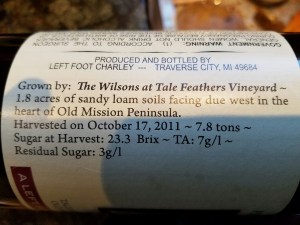
Place of origin: Tale Feathers Vineyard, Old Mission Peninsula AVA (western slope), Traverse City, Michigan, USA. For more information on the vineyard, see here.

Vintage: 2011. For more information on the vintage, see image below.

ABV: 12%? (From memory)

Purchased for $19 (Holiday Market)

Appearance: Medium gold.

Nose: Roasted brazil nuts, mineral water, lychee, lavender.

Palate: Medium bodied and medium dry. Nutty brown butter, coconut, oregano.

Finish: White grapefruit fading into herbal tastes.

20170301_162702.jpgParting words: Tale Feathers has partnered with Left Foot Charley for many years now. It’s a small (2 1/2 acre) vineyard in west central part of Old Mission. It’s planted entirely with Pinot Gris. The Wilsons’ focus on that grape has paid off in a big way for them and LFC. Theirs is arguably northern Michigan’s best Gris.

The 2011 vintage was strong for whites in Michigan, though not as strong as 2013. It was still one of the best of the past decade. A lot of its fruit has faded over the past 5+ years, but it remains a beautifully structured wine. I wouldn’t let it go much further than this, though. 2011 Left Foot Charley Tale Feathers Pinot Gris is recommended.

Cinnamon Girl

Maker: Left Foot Charley, Traverse City, Michigan, USAwp-1474425628803.jpg

Apples: Northern Spy, Golden Delicious, Ida Red.

Style: Apple cider with Sumatran and Vietnamese cinnamon (no sugar added).

ABV: 5%

Purchased for $8/500 ml (Michigan by the Bottle Tasting Room)

Appearance: Very pale gold, slow bubbles.

Nose: Cinnamon Toast Crunch Cereal, apple sauce.

Palate: Crisp and acidic, then the cinnamon kicks in.

Finish: Some tartness and cinnamon, then elegant tannins.

Parting words: Left Foot Charley might be Michigan’s best winemakers, and their ciders are very good too. Cinnamon Girl is better than most spiced ciders because the spice doesn’t cover up any of the apple character. No traditional cider apples were used in its production but there’s just the right amount of tannin, tartness and sweetness to balance the spice and bring it all together. Cinnamon Girl is recommended.