Mixed: Excellent in Manhattans, Old Fashioneds, and in a sour.
Parting words: One of the bright spots of the bourbon revival has been the return of Willet to full time production. Consistency was always an issue during Willet’s days as a whiskey buyer, but as a distiller they have been putting out solid, classic style bourbons using their surprisingly large stable of brands.
The 90 proof Old Bardstown is in Michigan now, along with Johnny Drum, Pure Kentucky, Noah’s Mill, Rowans Creek, Willet rye, and possibly some others I forgot. The 90 proof Old Bardstown is perfectly fine, but the Bond is even better. It’s a good all-around whiskey that mixes just as well as it sips neat or on the rocks. Bonded Old Bardstown is recommended!
Maker: Buffalo Trace, Frankfort, Kentucky, USA (Sazerac).
Style: High corn bonded bourbon (BT Mash bill #1).
Age: At least 4 y/o (by straight & bonded regulations)
Proof: 100 (50% ABV)
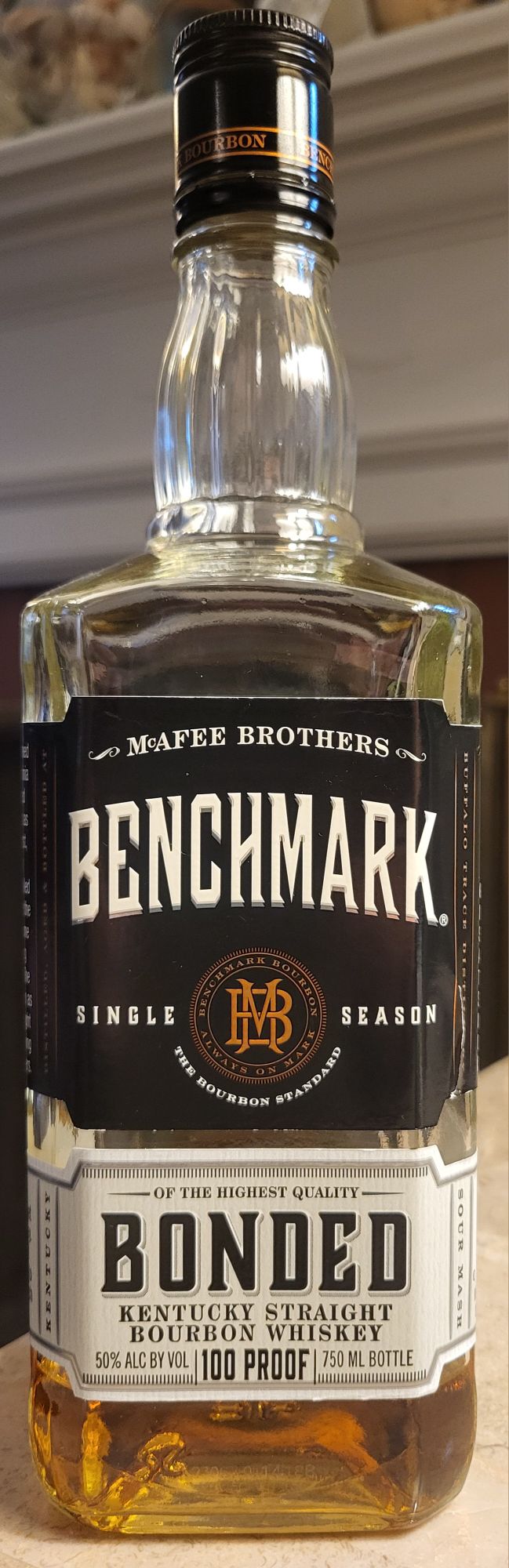
Price: $20 (Binny’s)
Appearance: Copper.
Nose: Ghost pepper, overdone creamed corn.
Palate: Full-bodied and sweet. Caramel, grape soda.
Finish: Hot with a little char.
Mixed: OK in every cocktail I tried it in, but unremarkable.
Parting words: Benchmark had been a punchline for me for many years. The “Old No. 8” is, to me, the worst bottom shelf bourbon available from a major distiller, with the possible exception of Ten High. I joked about it frequently in the old forum days. I never blogged about it for that reason, although it may have been worth it just for the mental exercise of coming up with gross tasting notes.
This bonded version isn’t too bad, though. I do struggle to justify buying it over, say Evan Williams white label at around the same price or Early Times BiB and Very Old Barton 100 proof at an even lower price. Plus it’s not even available in Michigan at the moment.
In the end, Benchmark Bonded is a decent mixer, but there’s not much of a reason to seek it out. It’s mildly recommended.
Age: 6 y/o (distilled autumn 2016, bottled January 26, 2023)
Warehouse/Floors: See photo below
Proof: 100 (50% ABV)
Michigan State Minimum: $60
Appearance: Medium reddish copper.
Nose: Spicy, with roasted corn, and a bit of caramel.
Palate: Caramel and amaretto chews, rock n rye soda, then cayenne. Water tames the spice and brings the sweet candy flavors to the fore.
Finish: Salted caramel, burn.
Parting words: The bourbon boom has seen a lot of new distilleries appear on the scene, and the last few years have seen the rise of a number of distilleries with promising futures, like (the new) Yellowstone, New Riff, Wilderness Trail, Woodinville, and many others. These folks are putting out great whiskeys right now, and are only getting better.
Something that has also happened is that a few old distilleries around the country have jumped back into the bourbon game, by releasing their own, new products. Ross & Squibb (FKA LDI/MGPI) is one example of that, and McCormick is another. When I first became interested in American Whiskey, I got to know McCormick as the making of Platte Valley corn whiskey, which comes in those distinctive stoneware jugs that used to have a cartoon Hillbilly on them. At 80 proof, it’s a bit weak, but a decent sip on a hot summer Saturday evening.
McCormick saw other distillers getting rich and asked themselves, “Why not us?” They already had the still, the corn, and the warehouses after all. They even found a historical mascot, Ben Holladay, a 19th century transportation mogul (hence the stagecoach) with ties to the distillery for the brand, So they distilled and aged some bourbon and released Ben Holladay Missouri Straight Bourbon Whiskey to the world in spring of 2022.
I had always assumed that Weston must be on the west bank of the Mississippi, just a stone’s throw from the Kentucky border. It’s not. It’s in the opposite part of the state on the northern edge of the Kansas City metro area. That makes it about 600 miles from Bardstown, Kentucky, and about 500 from Owensboro. The town’s population is about 1,700 people, which is not too different when the distillery was founded in 1856.
Missouri Straight Bourbon whiskey has more stringent standards than its Kentucky cousin. It must be made of corn grown in Missouri, and aged in a barrel manufactured in the state as well. That’s in addition to the requirements to mash, ferment, and distill instate.
Anyway, I like Ben Holladay 6 y/o. It’s sweet and spicy and mixes well too. My only complaint is the price. A bourbon from a venerable producer like McCormick shouldn’t be as pricy as a micro-distiller’s. That said, there are younger, less sophisticated bourbons being sold at twice the price right now, so I guess $60 isn’t too bad, but it could still be better.
Palate: Full bodied and sweet. Caramel, chocolate covered cherries, heat. Water takes away the heat, but leaves the candy behind.
Finish: Dry and tingly. Oak, hot chilis. Much the same with water, but a little nutty too.
Mixed: At $50 a bottle, I’m hesitant to mix this, but it did well in an old fashioned.
Parting words: This is the first Bardstown Bourbon Company product I’ve reviewed. I almost took a tour there once with my Georgia Bourbon Society comrades (I was named president of the Mitten Chapter), but I had a conflict, so I missed out.
That was before BBC had released any of its own product. I heard the tour was great, but, frankly, I wasn’t too interested in them back then. The point at which I begin taking micro distillers seriously is usually at the point when they release a bonded whiskey (or brandy or whatever). Bottled-in-Bond (from the company’s own distillery) is the test to make it into a regular spot in my liquor cabinet. If you can do that well then you’ve proven that you are worth my time.
BBC has done it well. They’ve actually done it better than they needed to. This six year old tastes like an eight year old from a large distillery. The depth of flavor and complexity was a big, welcome surprise. You can mix it or drink it on the rocks and it will be just fine, but it’s best neat or with a little water.
The entirety of BBC’s line is currently in the Michigan price book. That includes the Origin (100% BBC distilled), Discovery (BBC + sourced whiskey), Collaborative (finished), Distillery (collaborations?), and Fusion (marriage of different mashbills) series. Origin is the most affordable, which is convenient because it’s the series I’m most interested in. The Collaborative series interested me before I saw the prices. Paying well over $100 for finished, sourced whiskey doesn’t make a lot of sense to me.
At any rate, THIS bourbon is reasonably priced for its quality and proof. Bardstown Bourbon Company Origin Series, Bottled-in-Bond is recommended!
Maker: Barton 1792, Bardstown, Kentucky, USA (Sazerac)
Style: Bonded rye recipe (high malt?) bourbon.
Age: At least 4 y/o.
Proof: 100 (50%) ABV
Michigan State Minimum: $36/1 liter (works out to $27/750 ml)
Appearance: Medium copper.
Nose: Alcohol, five spice powder, dark caramel, velvet.
Palate: Medium-bodied, semi-dry. Caramel, thyme, oak, white pepper.
Finish: Dry and lightly woody.
Mixed: Good with Benedictine, and in a Manhattan.
Parting words: I reviewed the Kirkland Small Batch last summer. Back then I expressed my hope that the bonded would come in soon. It came in a few weeks after that and I got three bottles. Unfortunately I wasn’t able to review it until today, and even more unfortunately, I’m only down to one more bottle.
As one would expect, this is a step up from the Small Batch, though not nearly as much as I had hoped. There’s more complexity and depth, for sure. The cinnamon candy had been replaced with five spice, and there’s more caramel and tannic grip to it. It cleans up nicely compared to its Small Batch sibling, but it’s still not quite what I would call elegant. I would rank it below Very Old Barton and 1792 bonds, but just barely.
Still, for a store brand at this price, it lives up to expectations. It’s good in traditional cocktails, but like the Small Batch, it’s at its best on the rocks. If this one every comes around again, buy it.
Kirkland Bottled-in-Bond: Barton 1792 is recommended.
Final parting note: I took the Pepsi Challenge with this (diluted to 90 proof), Very Old Barton 90 proof, and 1792 Full Proof (diluted to 90 proof) to attempt to determine which mashbill the Kirkland BiB was: VOB or 1792/Kentucky Tavern (supposedly a high malt bourbon). I’m only about 67.924% sure, but I think the current Kirkland BiB was made from the 1792 mashbill. It has a certain spicy, burnt note on the palate and finish that bears a resemblance to it. If I am ever able to get a hold of the Single Barrel (which is in the current price book, but I have not seen on a shelf), I will attempt the same exercise.
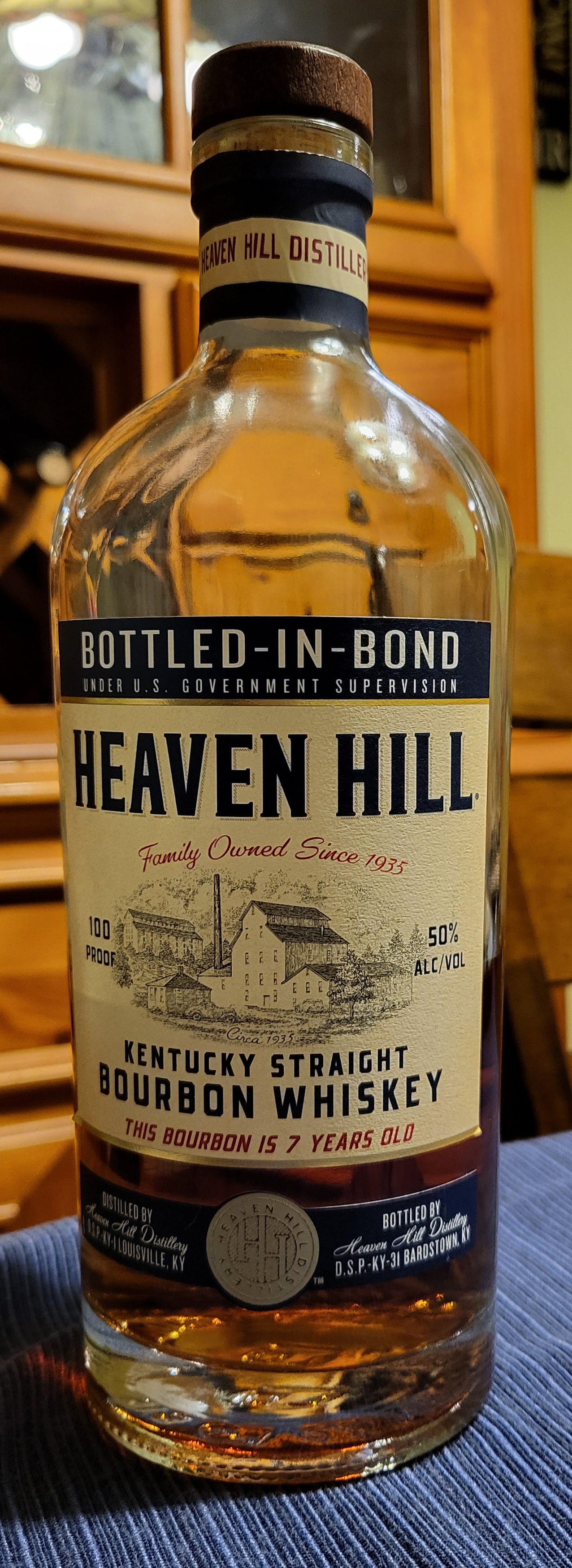
Palate: Full-bodied, and well balanced. Leather, caramel, chilies, pinch of tarragon.
Finish: Field mint, fading into cinnamon disks.
Parting words: This is not the first time I have reviewed Heaven Hill Bottled-in-Bond. The 6 y/o version was a favorite of mins for many years and I would stock up on it whenever I went to Kentucky, which was pretty frequent back then. I still have one bottle squirreled away in my basement for a rainy day or for some hopefully distant day when I get put into an old folks home. It was a pretty good bourbon, but it was an excellent value. 100 proof, 6 years of age, all for well under $20. It was my house bourbon for many years when company came over.
To their credit, when Heaven Hill decided to revamp their Heaven Hill line, they did add one year of age and give the label a fresh, modern (if a bit dull) look. Not to their credit, they more than doubled the price. HH was known for many years as the distillery of choice for cheapskates like me, because they offered a wide range of pretty good to very good bourbons at several dollars less than their competitors did at the same age/proof ranges. Now, they are unfortunately making a name for themselves by turning their ex-value bonds like Heaven Hill and Old Fitzgerald into super-premium products with prices to match.
All that said, there’s nothing wrong with this bourbon as it is. If it didn’t have the same name as one of the greatest bourbon values of all time, I might be more willing to cut it some slack. But with the almost always superior Henry McKenna 10 y/o single barrel bonded for only $10 more, it’s hard to recommend the current HH BiB. I’m not sure what the point of it is anymore, frankly. Heaven Hill Bottled-in-Bond 7 y/o is mildly recommended.
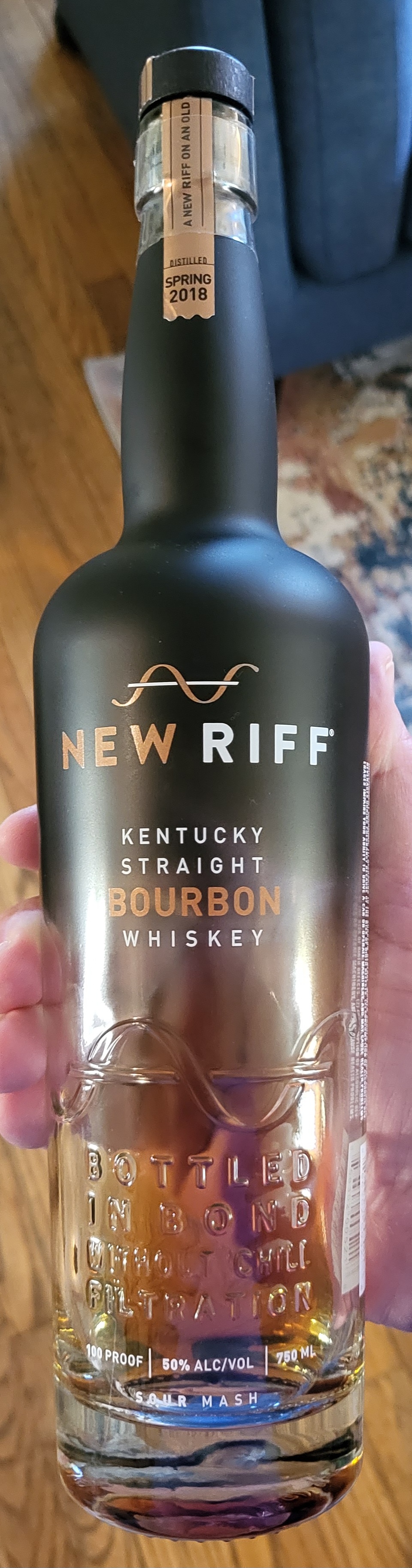
Palate: Caramel, white chocolate, ancho chili powder.
Finish: A bit of leather, a lot of chili powder.
Parting words: I last reviewed a New Riff bourbon in June of 2021, when I reviewed a Red Wagon selection of the single barrel, barrel proof expression. I liked it (eventually), but I thought it was strange. Very herbal, even for a high rye bourbon, and there was that cut lumber aroma I get out of a lot of young, “craft” whiskeys. The lumber isn’t completely gone, but the basil and tobacco are. The result is a much more conventional, but still tasty, bourbon.
Of all the macro-distilled bourbons on the market, it reminds me of Old Grand Dad the most. It lacks the yeastiness, but the spice and char is similar. I’ve had a few single barrel Four Roses expressions with a similar profile too.
$40 isn’t too bad for a quality BiB in 2023, either. Factoring in “craft” beverage inflation, it’s almost a bargain. While it’s not a Glen Buxton Riff, it’s still a solid Joe Perry one. New Riff Bottled-in-Bond is recommended.
Style: standard recipe, pot distilled straight bourbon.
Age: Not disclosed but at least 4 y/o by law.
Proof: 100 (50% ABV)
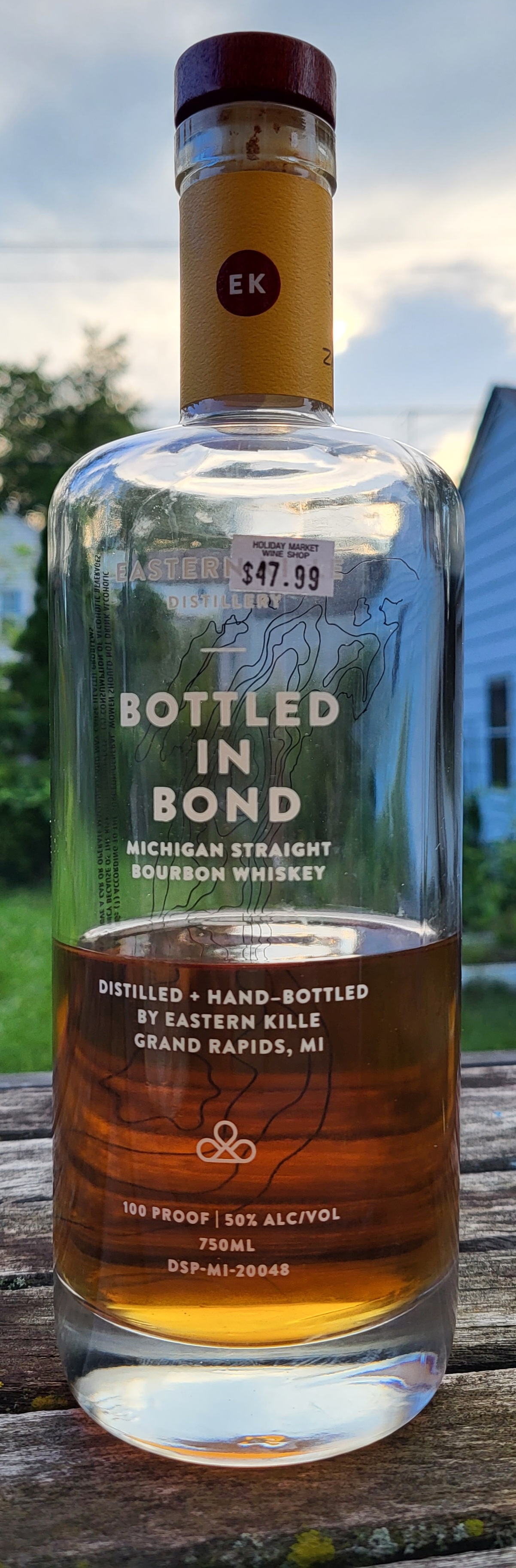
Purchased for $48 (Holiday Market)
Appearance: Medium copper.
Nose: Sawdust, anise, over-roasted almonds.
Palate: Full-bodied and mild. Caramel, barrel char, dark chocolate, dash of amaretto.
Finish: Hot and woodsy.
Mixed: Performed pretty well in Manhattans, Old Fashioneds, with Coke, and with Cherry Coke.
Parting words: To me, the moment when a new bourbon distillery comes of age is when it can release a bottled in bond bourbon. So I was very excited to try this from Michigan’s own Eastern Kille. It feels like they’ve arrived.
But where have they arrived? I’m split. The nose and finish have that sharp sawdust note that I used to associate with small barrel bourbon, but I’m not so sure that’s where it’s from anymore (mashing maybe?). I don’t fine that aspect very pleasant, and it occasionally interfered with mixers. The palate is silky and chocolatey and very good, though, so I don’t know where to land.
Water turns the sawdust down but it also turns down the chocolate and char. So I think I’m going to give Eastern Kille’s BiB a recommendation, with a few drops of water or with strong mixers (boulevardier, Manhattan with good vermouth, or Cherry Coke!). There are some really nice things going in this bourbon, and I hope they continue refining it until it’s highly recommended!
Maker: Barton 1792, Bardstown, Kentucky, USA (Sazerac)
Style: High malt (?) bonded bourbon.
Age: At least four years old (all from one distilling season).
Proof: 100 (50% ABV)
Michigan state minimum: $38
Appearance: Medium copper.
Nose: Roasted corn, sweet malt, cayenne powder.
Palate: Cola, alcohol. With water. Caramel, cola, less burn.
Finish: Sweet and custardy. Sweet cola (yes again) with melted ice cubes.
Parting words: For many years, the Bottled-in-Bond category was a guarantee of quality among American whiskeys. Then, when I was getting into the hobby, it was most common as a sign of a good value. The pendulum has swung back a bit these days and premium bonds are making a comeback. The new, pricey Old Fitzgerald and Heaven Hill BiBs, Henry McKenna, and now 1792.
I like the standard expression well enough, and I have really enjoyed the single barrel and barrel strength editions I’ve had. Sadly, the Bottled-in-Bond doesn’t live up to those. It’s not bad, it’s just not enough of an improvement on the Small Batch to warrant $8 more dollars and the hard work of trying to locate a bottle. Ironically, it may be hampered by being bonded and restricted to one distilling season. There’s a lack of complexity that the addition of older bourbon might be able to fix.
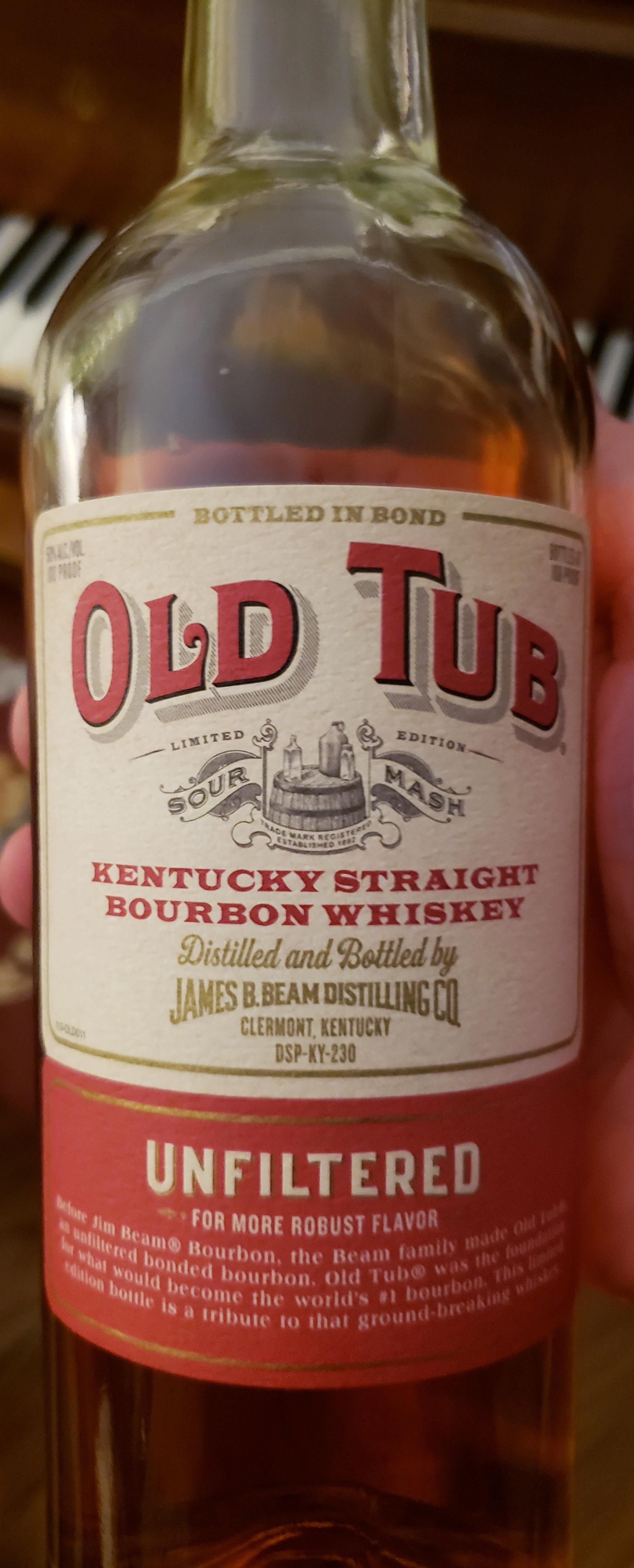
Maker: Jim Beam, Claremont/Boston, Kentucky, USA (Beam Suntory)
Style: Standard recipe, bonded bourbon.
Age: NAS (at least 4 y/o)
Proof: 100 (50% ABV)
Michigan State Minimum: Not listed but available in the state. $30ish?
Appearance: Medium copper.
Nose: That mixed peanut butter and jelly stuff.
Palate: Alcohol, burnt peanut butter and banana sandwich.
Finish: burnt peanut brittle.
Mixed: Fine mixed, but plenty of better, cheaper, options for mixers.
Parting words: Beam was on a hot streak for a while but that streak seems to have ended here with Old Tub. The name was the original name of what’s now Jim Beam bourbon. It was first produced in 1880 by David Beam’s distillery, and became the flagship bourbon of the new Jim Beam distillery after prohibition. The name was changed to Jim Beam in 1943 to honor Jim, who passed away a few years later.
I think I get what they’re going for here, and I like the idea, but I don’t think it ends up being something worth buying, other than as an objet d’art. I like Bonded Beam, but I don’t like this. Old Tub is not recommended.





 Sipology