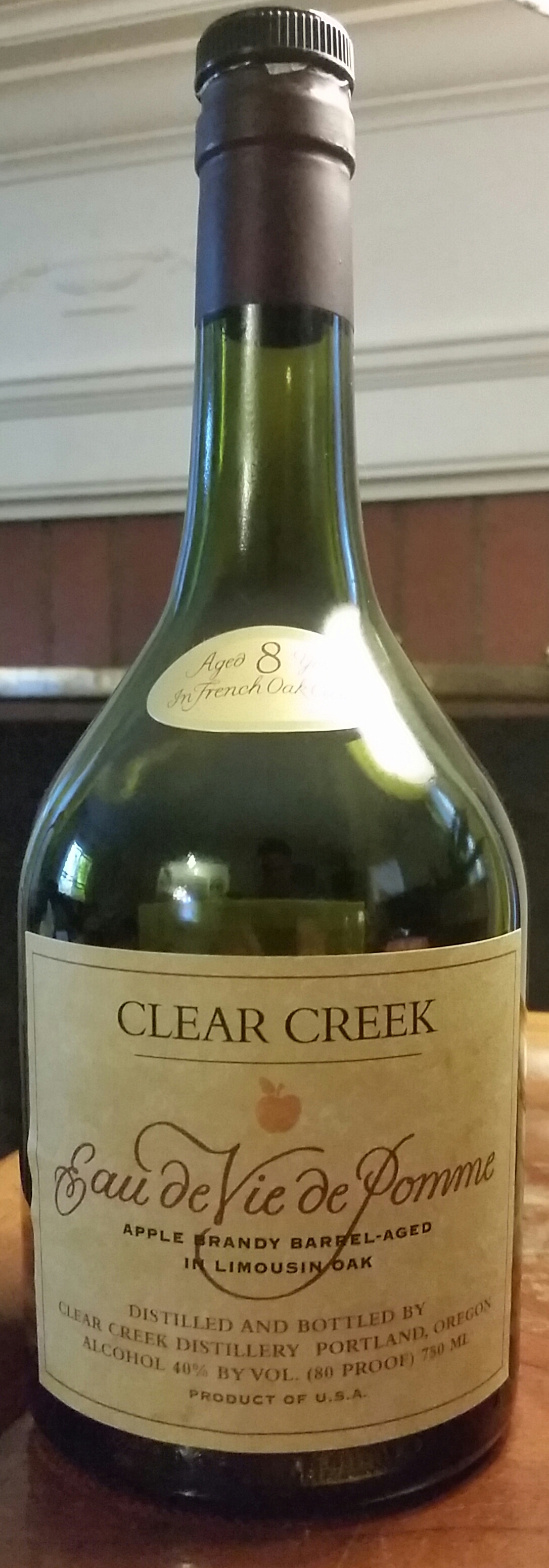
Parting words: American micro-distillers are making a lot of garbage right now. Most of that is wretched-tasting whiskey. That’s because bourbon and rye are very popular right now, so I can’t exactly blame them for cashing in. Unfortunately too many are focused on whiskey and ignoring other spirits besides the gin and vodka cash cows. What America needs is not another underaged and overpriced whiskey or vodka made from something someone picked up at the farmer’s market. What America needs is more rum, brandy, and especially apple brandy!
Steve McCarthy, founder of Clear Creek, recognized this thirty years ago (decades before distilling became a fad) and made apple brandy one of the pillars of his portfolio. This gem is the result. They have a range of fruit brandies including pear, raspberry, cherry, two plum brandies and a 2 y/o apple brandy and an “apple in the bottle” brandy.
This apple brandy is said to be made in the traditional methods of Calvados from Oregon Golden Delicious apples. I can’t speak to how closely its manufacture resembles that of Calvados, but it might be the best American apple brandy on the market. It’s definitely one of the best I’ve ever had. Black Star Farms’ 10 y/o is the only one I’ve had that comes close, but that’s $75 and only available at the tasting room. This might also be the best spirit available at this price. Clear Creek Eau de Vie de Pomme, 8 y/o is highly recommended.
Maker: Heaven Hill, Bardstown/Louisville, Kentucky, USA
Style: Straight Wheat Whiskey (made with at least 51% wheat)
Proof: 90 (45% ABV)
Michigan state minimum: $30
Appearance: Caramel with necklacing and thin legs.
Nose: Alcohol, walnut, whole wheat biscuits.
Palate: Surprisingly hot. Cinnamon, crackers, caramel, pinch of tarragon.
Finish: Butterscotch, amaretto, alcohol, oak.
Mixed: Very good in a Manhattan and an old fashioned. Didn’t try it in anything else.
Parting words: Bernheim Original is a rare thing in two ways. First, it’s the only straight wheat whiskey on store shelves made by a major American whiskey distiller. Second, after years of being NAS, it was reintroduced with an age statement this year! This is unheard of these days when tightening supplies are causing age statements to drop like passes in the hands of rookie wide receivers.
I reviewed the NAS back in 2012. Judging by my old tasting notes, this age stated version is richer and beefier than the old version. It’s no longer a lightweight and has a solid caramel backbone to support the unusual baked goods and cinnamon flavors. This isn’t a novelty anymore, this is seriously good whiskey. With micro-distilled wheat whiskeys popping up all over the place, Bernheim Original has taken its rightful place as the benchmark of the category. The price hasn’t changed much, if it all, since 2012. Even more than three years ago, Bernheim Original is recommended.
Appearance: Dark brown, like cola with a bluish tinge.
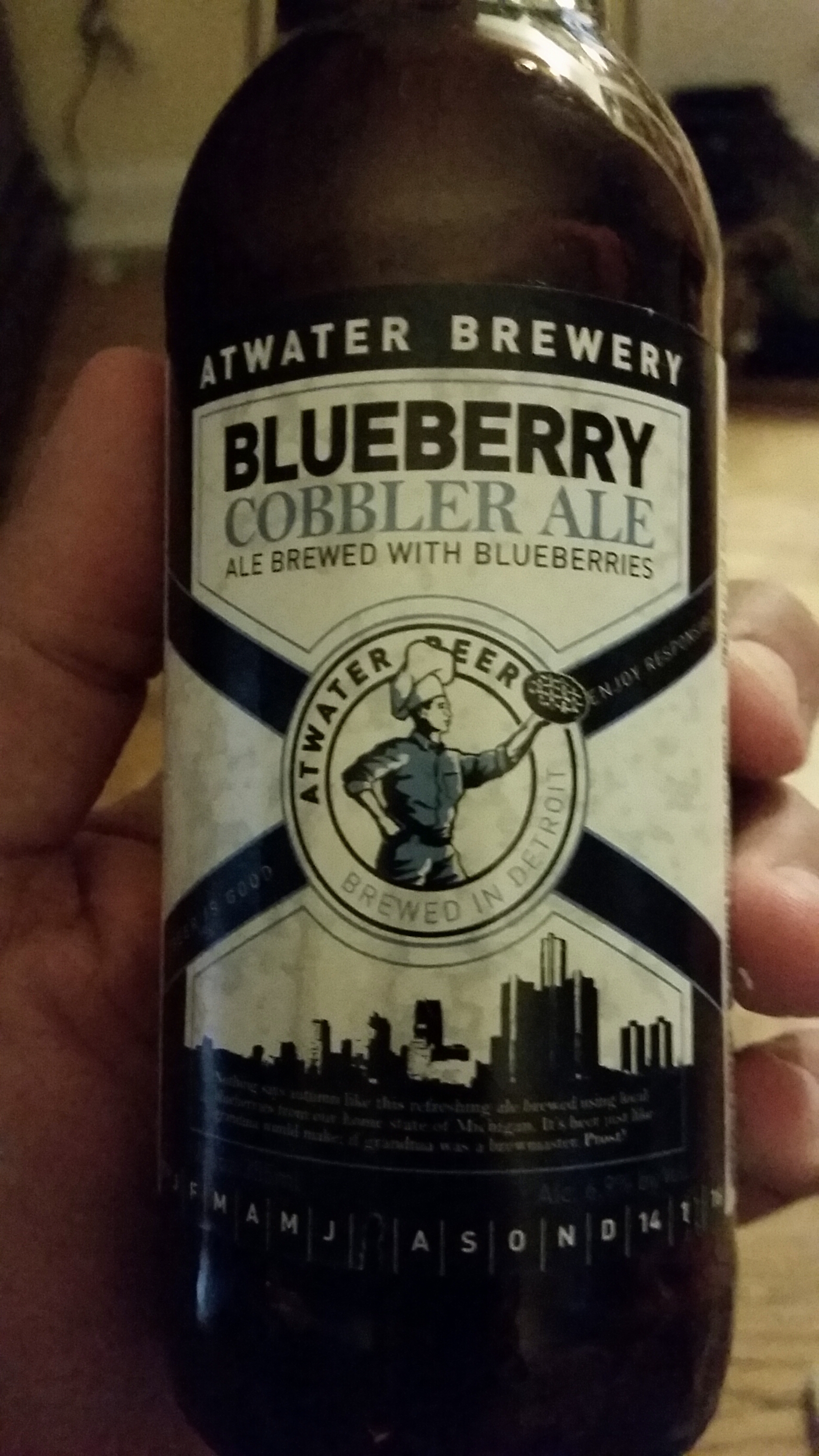
Nose: Burnt blueberry pie, asphalt, alcohol.
Palate: Dark roasted malt, cooked blueberries.
Finish: Pleasant. Bittersweet stout and blueberry pie.
Parting words: I’ve been reviewing Atwater’s beers for years and they haven’t once made any sort of contact with me on social media or anywhere else. Not even a like or a favorite. That’s a little annoying but I don’t hold it against them. Some companies are good at social media and some aren’t. My annoyance in no way negatively influenced my review, but didn’t help either.
This beer is OK, but the nose is really weird. It’s called blueberry cobbler, but it tastes much more like blueberry pie than cobbler. There’s no biscuity-topping flavors. It’s just all cooked fruit. Heck, even the guy in the Atwater logo is carrying a lattice top pie, not a cobbler. Yes, it’s a minor quibble but it points to the confused state of this beer. There’s some blueberry in there but there’s not enough to make it actually taste like blueberries. I get that they were going for a baked blueberry thing here, but the toasty malt just makes it taste like the burnt drips that stick to the bottom of the oven after the pie is done.
I like, nay, love most of Atwater’s beers but this is a failure. Blueberry Cobbler is not recommended.
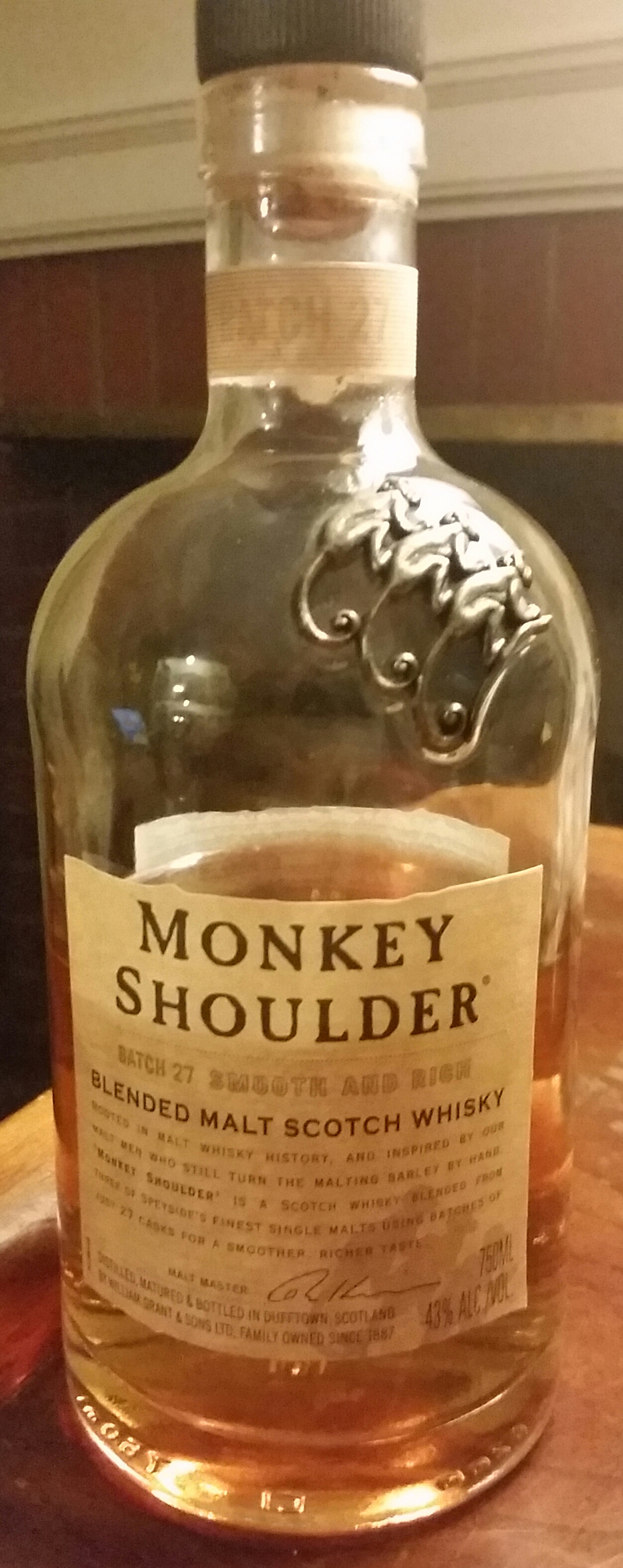
Maker: Wm. Grant & Sons, Dufftown, Banffshire, Scotland, UK
Style: Blended Single Malt Scotch (Glenfiddich, Balvenie, Kininvie)
Age: NAS
ABV: 43%
Michigan state minimum: $33
Appearance: Medium copper with a lot of necklacing and legs.
Nose: Sweet malt, vanilla, sage, alcohol, old oak, serrano peppers.
Palate: Medium bodied and semi-sweet. Vanilla buttercream, strawberry, butterscotch, sweet cinnamon.
Finish: Dry and long lasting. Crème brûlée, alcohol, oak.
Parting words: The success of blended malts like Sheep Dip and especially Compass Box’s offerings led older, older companies to take notice. Monkey Shoulder, released in the UK in 2005 was Wm. Grant & Son’s response, and it’s a dammned good one. A blended malt (formerly known as a vatted or pure malt) is a blend of all single malts. This is different from a standard blended Scotch because it contains no grain whisky, only malts.
The family resemblance to Grant’s blended whisky (the last Scotch I reviewed) is evident, but it’s much more complex, as one might expect. Like Grant’s, this is a very tasty whisky at a good price. For a top notch blended malt, it’s impossible to beat. Grant’s marketing folks keep pushing it as a mixer but it’s so good neat that I couldn’t bring myself to mix it with anything.
Palate: Dry and medium bodied. Meyer lemon and mineral water.
Finish: Short, clean and dry. A little bitterness and minerality with a spritz of acid.
Parting words: I had the privilege of wandering around the famous Block II a couple weeks ago with three of my best friends. It’s a noble, old stand of Riesling with soil is so sandy that I felt like setting up a volleyball net. As our guide told us, the sand is very important. It retains very little water, so the vines are forced to send their roots deep. This stresses the plant, and leads the plant to focus more on reproduction (fruit) than producing leaves and stems. Many also believe that greater root depth leads to more complex wine, since the roots are drawing minerals from a greater volume of soil.
Whatever the role of terroir, this is a very tasty dry Riesling that is still drinking well given its age. There’s not a lot of fruit or flowers left here, but what there is keeps the acidity and minerality from overrunning the glass. The few reviews I was able to find of this wine were from 2012 and there seems to have been a lot more going on back then.
Even with the lack of complexity, this is still a good dry Riesling at this price. 2010 Bower’s Harbor Vineyards Block II Riesling recommended. If you have one in your cellar, drink now, with food or without!
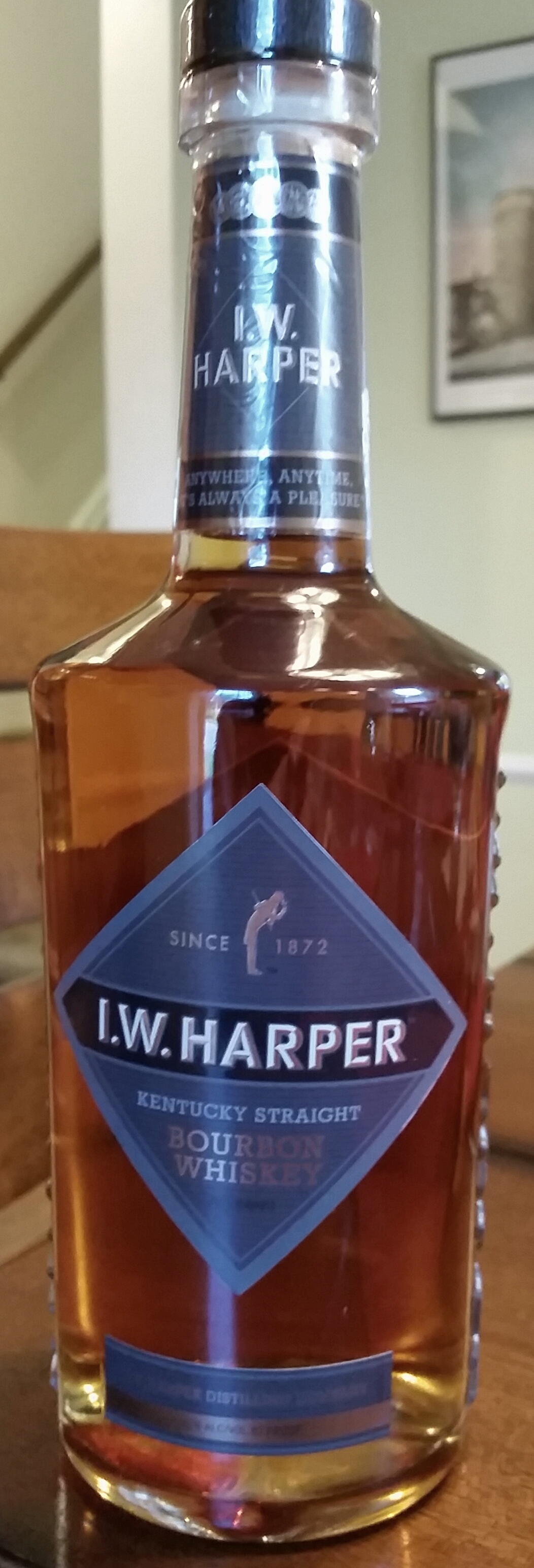
Maker: Diageo, Louisville, Kentucky/Norwalk, Connecticut, USA
Distiller(s): Unknown
Age: NAS
Proof: 82 (41% ABV)
Michigan State Minimum: $30
Appearance: Light copper.
Nose: Alcohol, cayenne pepper, leather.
Palate: Sweet and mild. Brach’s caramels, chocolate covered toffee, a little bit of alcohol bite.
Finish: Sweet but a little spicy. Caramel, cocoa, alcohol.
Mixed: Excellent in all cockltails- Manhattan, Perfect Manhattan, Old Fashioned, Boulevardier. OK on the rocks and with soda.
Parting words: I.W. Harper was reintroduced to the U.S. this year after being gone for a couple decades. I.W. Harper begin life as the flagship bourbon of Isaac Wolfe Bernheim’s (d. 1945) distillery. After prohibition, the distillery and brand were sold to Schenley. Through a series of mergers I.W. Harper came to be owned by Diageo, even though the Bernheim distilley was sold to Heaven Hill in 1997. Heaven Hill’s Bernheim Wheat Whiskey is a tribute to I.W. Berneim and his brother Bernard.
One of the first ever “dusties” I found was a bottle of I.W. Harper. It was also the first dusty I was ever disappointed with. It was bland and watery. The 15 y/o (a part of the Bourbon Heritage Collection) was bland and watery but with a little oak thrown in. This is a big improvement on those two. It’s not extremely complex, but it’s got a great mouthfeel and enough spice to keep things interesting. It also plays very well with mixers. There are better choices at $30, but I.W. Harper isn’t a bad one.
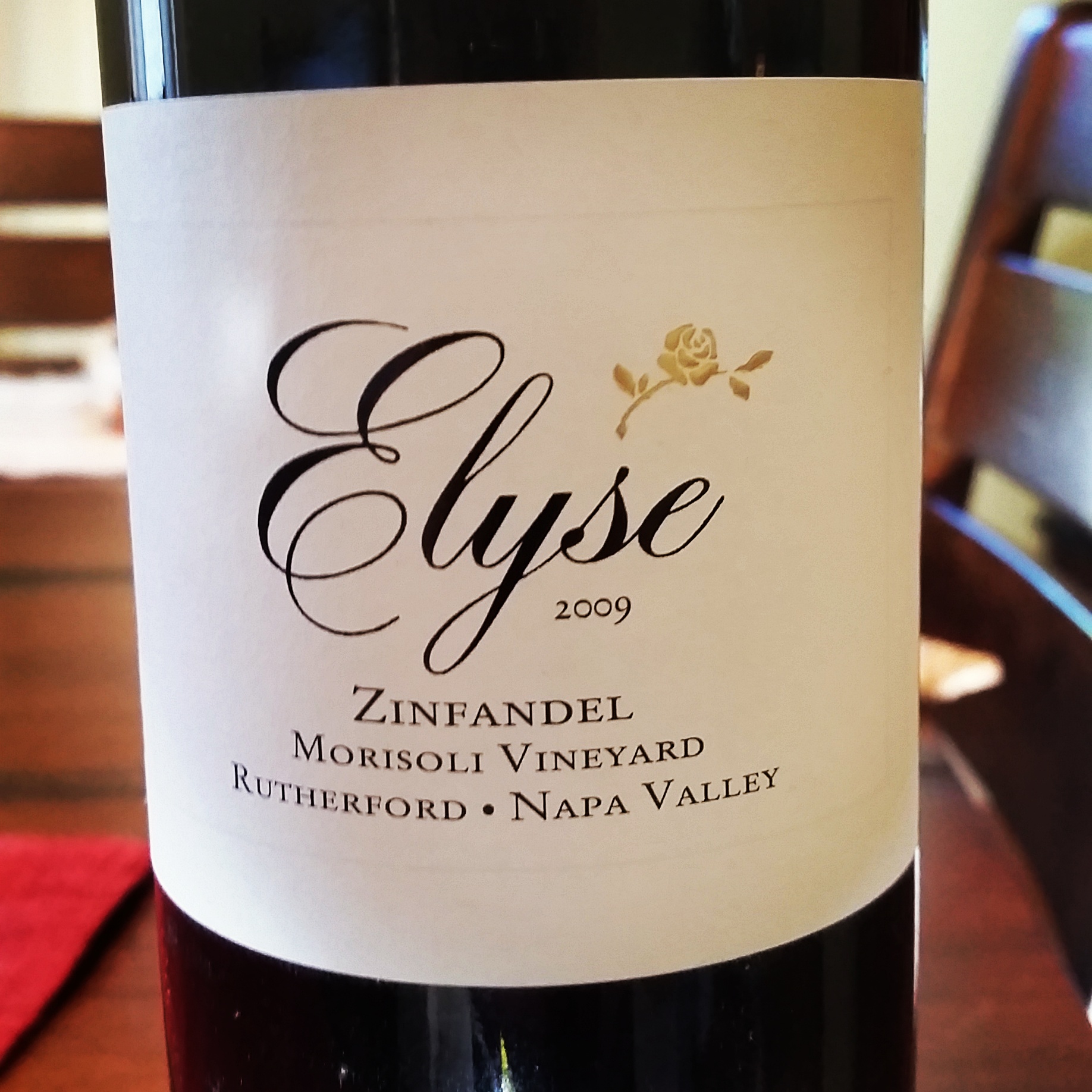
Grapes: 87% Zinfandel, 13% others (Muscat, Syrah, Carignane and more). Field blend.
Place of origin: Morisoli Vineyard, Rutherford AVA, Napa Valley, California, USA
Vintage: 2009
ABV: 14.6%
Price: $45 (We think. Didn’t save the recipt)
Note: Not sold in Michigan retail stores but they do ship.
Appearance: Dark crimson.
Nose: Blueberry jam, wild blackberry, cherry, toasted oak, a squirt of Meyer lemon
Palate: Full bodied. Jammy but well balanced with oak, clove, black currant, black and blueberries with a little burn on the back end.
Finish: Medium long. Chewy oak tannins, dried fig. Clean, but leaves me craving another sip.
Parting words: Elyse Winery is a small family located near Yountville, California that draws from vineyards in other sections of Napa Valley, including this one from the also family-owned Morisoli Vineyard. Morisoli is 57 acres located at the base of Mt. Saint John at the southern end of the Rutherford AVA. The vineyard is best known for its Cabernet Sauvignon, but Zinfindel is grown there too, and has been for over one hundred years. Elyse has been working with the the family for decades and has produced a Morisoli Cab and Zin every for every vintage back to 1986.
When my wife and I were contemplating tacking on a trip to Napa to a trip to Northern California for my cousin’s wedding (see “Two Days in Napa”) Elyse was recommended to us by our friends Jessica and Brian who have been members of their wine club since a trip to Napa they took a few years ago. The experience at the Elyse tasting room was a contrast from the big, slick tasting rooms that take in most of the wine tourist trade in Napa. It’s in a small, no frills white building and the pourers were all family members or winemakers. The only wine we picked up there was this one, but they were all quite good and reasonably priced, for Napa.
We were saving it for a special occasion so when we finally sold our tiny old house last month, we decided that was the perfect special occasion. I grilled up a couple T-bone steaks in my cast iron grill pan to go with the wine and it all worked together perfectly. Sometimes a great wine and a great piece of meat is all you need for a great meal.
The price is reasonable for a single vineyard old vine California Zin of this quality. It could probably have been cellared for another two or more years, but it is drinking beautifully now. Elyse Winery 2009 Morisoli Vineyard Zinfandel is highly recommended.
Palate: Medium sweet. Rock candy, tarragon, vanilla, sarsaparilla.
Finish: Sweet and spicy with a little bit of heat. Thyme, anise, butterscotch, bubblegum.
Parting words: Wiser’s 18 sits atop Corby’s Wiser’s line, which includes the flagship Wiser’s Deluxe, Wiser’s Rye, and Wiser’s Legacy, a mong others. Canadian whisky ages very well (the Canadian climate makes for slower aging than in Kentucky) and so I had high hopes for this.
It is a good whisky. Unlike some other Canadians at double digits, like the 12 y/o Canadian Club or the 21 y/o Collingswood, Wiser’s 18 still has some teeth at its advanced age. There’s plenty of rye spice and vanilla and even some alcohol bite on the palate, even though it’s only 40% ABV. It also comes in an elegant rectangular bottle that looks very sharp on a home bar.
Long time readers may sense a big “but” coming, and here it is: $75 is much too expensive for this. It’s much better than the all-nose Collingswood 21, the only other venerable age-stated Canadian available in Michigan, but even that bottle of disappointment is $15 cheaper. The real kicker is that Wiser’s Legacy is superior in every way. It’s 45% ABV, was $45 the last time it appeared in Michigan, and is all rye whiskey, unlike this blend.
Wiser’s 18 y/o is good, but not good enough to justify being the second most expensive Canadian whisky on the Michigan list. It is mildly recommended.
Maker: Uncle John’s Fruit House, St. John, Michigan, USA
Style: Semi-dry hard apple cider.
ABV: 6.5%
Note: Old can design pictured.
Appearance: Light gold with lots of bubbles, but a short lived, bubbly head.
Nose: Gravel, apple juice, aged late harvest Riesling.
Palate: Light bodied and semi-dry. Mildly tart apples, mineral water. Effervescent.
Finish: A touch of tartness on the front end, but then long and dry with a little sweetness just to hold it together.
Parting words: Uncle John’s empire is located about twenty-five miles north of Lansing, our proud state capital. It’s an agricultural attraction. U-pick blueberries, a market featuring asparagus, sweet corn, strawberries, sweet cherries, peaches, apples and probably more (all seasonal of course). They also have doughnuts, caramel apples, unfermented cider by the glass (mulled or unmulled), pies, jam, apple butter and just about everything else one would expect.
They also have a winery. They mostly make fruit wines, but they do offer a red blend (Merlot-led), a white blend (Chardonnay, Vignoles, Pinot Gris, Riesling), Concord, a few styles of mead and hard cider. Cider is what they’re best known for, and with good reason. They do a very good job. They make a very full line of different apple cider styles and flavors, perry and even a fortified apple wine. They have a still, too and make an apple brandy. If you’re into wasting high quality produce by turning it into a colorless, flavorless beverage, they also make an apple vodka that should be right up your alley.
At any rate, this Draught Hard Cider (now simply labeled “apple” on their new, snappy-looking white cans) is their flagship hard cider. I like it a lot. It’s dry enough to enjoy anytime but has enough sweetness to keep it from tasting like Perrier with an apple slice. It’s well balanced and I like it a lot. I can’t wait to explore some more and, better yet, take a short road trip to see the whole operation in person some time!
Uncle John’s Hard Apple Cider is highly recommended.
The Night of 100 Rieslings event was at the pavilion at Clinch Park, an easy walk from our hotel. Apparently last year it rained and the ground turned to mud, so this year it was in a paved area near what normally functions as a snack bar. Additional tables were put on the lawn adjacent to the paved section. To one side was a boat dock and to the other was a beach. The location made for a pleasantly surreal experience, sipping world class wine while hairy, tattooed men in trunks, women in bikinis and sunburnt children with water wings frolicked in the water a few yards away. Wine writer and co-organizer Stuart Pigott seemed especially tickled by the beachgoers. Music was provided by the Go-Rounds, a local favorite rock band that was quite good, although the volume wasn’t conducive to conversation. They did a good job of keeping the energy high through the evening, though.
The event began at 6 pm Sunday night so we decided to make it dinner. Each attendee was given thirteen pink wine tickets and two food vouchers. One food voucher got a person either one sausage plate with accompaniments, one cheese plate (one cow, one goat, one sheep) or two oysters. The sausages were supplied by Corridor Sausage in Detroit, a favorite of ours. The oysters were not local, obviously. They were very popular and the people serving the oysters had trouble keeping up with demand. The uncharacteristically hot day (high of 91° F) didn’t help either. I don’t remember the “varietal” names of the oysters, but one was west coast and one was east. The west coast one was all coastal funk, while the eastern one had a nice brininess and a bit of citrus. Both paired well with the wines.
It was also a challenge keeping the wines chilled in the heat but they held up very well. I even learned to appreciate warm Riesling that weekend. As you can see in the picture, there were Rieslings from all over the world. Three continents, nine countries, six U.S. states, twenty-two German producers from seven different regions and twenty Michigan producers from three AVAs were all represented, all served by certified professional sommeliers, including Detroit wine star Madeline Triffon, the first American woman to pass the master sommelier exam.
The evening was a bit of a fog so, forgive me if I can’t remember all the great wines I had, but based on my notes, some standouts were Schloss Schonborn Ausleses from 1994 and 1997, wines from Villa Wolf, G.D. Vrja (Piedmont!), Chateau Fontaine, O’Brien Vineyards Late Harvest Dry (no, that’s not an oxymoron; from OMP), Bellweather (Finger Lakes), Pacific Rim, and the Chateau Ste. Michelle/Loosen Eroica, which I’m embarrassed to say I had never tried before. I also had the opportunity to talk with and card Barry O’Brien (CEO of Select Fine Wine Imports and O’Brien vineyard owner, who wasn’t pouring his own wine for some reason), Chip Davis (Michigan manager for Chateau Ste Michelle) and Nicholas Quillé, chief winemaker for Vinmotion Wines (Pacific Rim among others).
The 100 Rieslings with our notes.
The wines were international, but the crowd was less so. Stuart Pigott is an Englishman who lives in Berlin and spends a lot of time in the U.S., so he’s pretty international in and of himself. The only German whose presence I was aware of was Dominik Sona of Koehler-Ruprecht in the Pfalz, who participated in the Salon Riesling sessions. It seemed strange to have such a low number of Germans at an international Riesling event. North America was very well represented with Quillé and Chris Williams of Brooks Winery in Oregon (easy to spot because of his infamous “If you don’t like Riesling you’re a fucking idiot” t-shirt) and a number of others from the U.S. and Canada, including the strong Michigan contingent. Speaking of that contingent, we ran into Courtney and Shannon from Michigan by the bottle and had a short conversation. They informed me that that had already found a replacement for Gill’s Pier in their Royal Oak line up, but it’s staying under wraps for now. I’ll admit that I’m privately rooting for a couple of my favorites, but it’s hard to go wrong with any winery from one of Michigan’s AVAs.
Unfortunately, the industry people did not do much of socializing with non-industry people who were present. Nametags were issued to attendees in the trade but not everyone wore theirs and they often became turned around so that the person’s name was no longer visable. Some people were easy to spot, like co-organizer Sean O’Keefe with his long flowing locks or Pigott with his flamboyant attire and tall, thin frame, but I had trouble picking anyone else out. I didn’t have a nametag myself because I went ahead and bought tickets for our group before I knew that I could get a trade ticket. Not that I ever had the urge to shout “Don’t you know who I am?!” but I had hoped to connect with more industry people and a nametag might have helped break the ice with a few of them.Not to say the night was a disappointment, not at all. It was a lot of fun and more than worth the price of admition.
The crowd started to thin out after eight o’clock, so it became easier to move around and ask the sommeliers questions about what they were pouring. Some of them stopped paying attention to tickets (I don’t think Triffon ever did) at a certain point so we all ended up getting more than thirteen pours. Around that time a few of the sommeliers ordered a pizza for themselves and passed it around. Someone broke out some red wine, too. It was very conspicuous. The red wine blazed out of the glass like lighthouse beacon in a sea of Riesling or a tongue of fire floating waist high bouncing here and there all over the patio, as if it were independent of any hand. Anyhow, The Night of 100 Rieslings was a great time. I learned a lot and had fun. If you can make it to the next one, I highly recommend it. We didn’t take any pictures that night, but Courtney and Shannon did. Their pictures can be found in their Instagram account here: https://instagram.com/michbythebottle There are also some great ones on the City of Riesling Facebook page here: https://www.facebook.com/cityofriesling
After the event we walked back to the hotel to get a snack. Unfortunately we had to order a pizza because the hotel bar’s kitchen had already closed. We ate our snack, watched some dumb TV and went to sleep.
We all got up fairly early and walked to what was basically a French themed Panera Bread. We had a nice meal there, then split up. Amy and Pete went to the beach and Liz and I went back to the hotel. She showered and got herself put together while I recorded some audio notes. I’m at my most rambling when I’m talking to myself so I quickly lost track of time and left the hotel five or ten minutes after I had intended to. I rushed over as quickly as my rheumatic joints could carry me. I arrived two or three minutes before the first session was supposed to start but luckily, it hadn’t started yet. As Amy later reminded me, Traverse City is on “Up North Time”. Glasses were still being distributed and attendees were still drifting in. Feeling a bit like a kid on the first day of school (I get weirdly anxious at things like this), I looked for people whose faces I recognized and found Courtney and Shannon, who graciously let me sit next to them. Our “Michigan bloggers’ row” was up front and stage left and we were joined in our row by master sommelier Claudia Tyagi (formerly of the Marais restaurant in Grosse Pointe) and occasionally Madeline Triffon. Pigott was behind me and Karel Bush of the Michigan Wine Council was somewhere behind me too. Very good company!
The first session was on Rieslings of the Great Lakes and was moderated by Madeline. The panel was Angelo Pavan (Cave Spring Cellars, Ontario), Meaghan Frank (Dr. Frank, Finger Lakes), Brian Ulbrich (Left Foot Charley, Old Mission), Adam Satchwell (Shady Lane, Leelanau) and Bruce Murray (Boundary Breaks, Finger Lakes). We tasted ten Rieslings from around the Great Lakes, starting with three from Niagara, three from Northern Michigan, and three from the Finger Lakes. They were all excellent. The biggest surprise to me was the outstanding 2012 Charles Baker Riesling made at Stratus Winery in the Niagara Escarpment region. It was truly outstanding and yet another reason to make a booze run to Ontario in the near future.
More of an informational panel than a discussion, the winemakers discussed what their regions had in common with one another and what made them unique. Overall, what they all have in common (even the Finger Lakes) is the lake effect, which makes them essentially a “continental maritime” climate. In a normal growing season, the lake is the winemaker’s friend. It insulates the vineyard and lengthens the growing season on both ends. It moderates the continental extremes that winemakers in northeastern North American have to deal with. On the other hand, a frozen lake is lake effect gone bad. It sucks all the heat out of the surrounding areas and drags temperatures down which can damage or even kill vines. The glaciers that formed the Great (and Finger) Lakes also dumped a lot of “glacial garbage” around them, making for widely varied soil types, in turn making for interesting wines, particularly with varieties like Riesling.
The first session ended late so co-organizer Amanda Danielson and her hard-working assistants had to rush to get everything set up for the second session so that the schedule wouldn’t be thrown off any more than it already was. I exited the room to give them more room to work. I went to the hallway to fiddle with my phone and ran into Sean O’Keefe and Stuart Pigott. I introduced myself and we managed to have exchange a few sentences before going back to the session room.
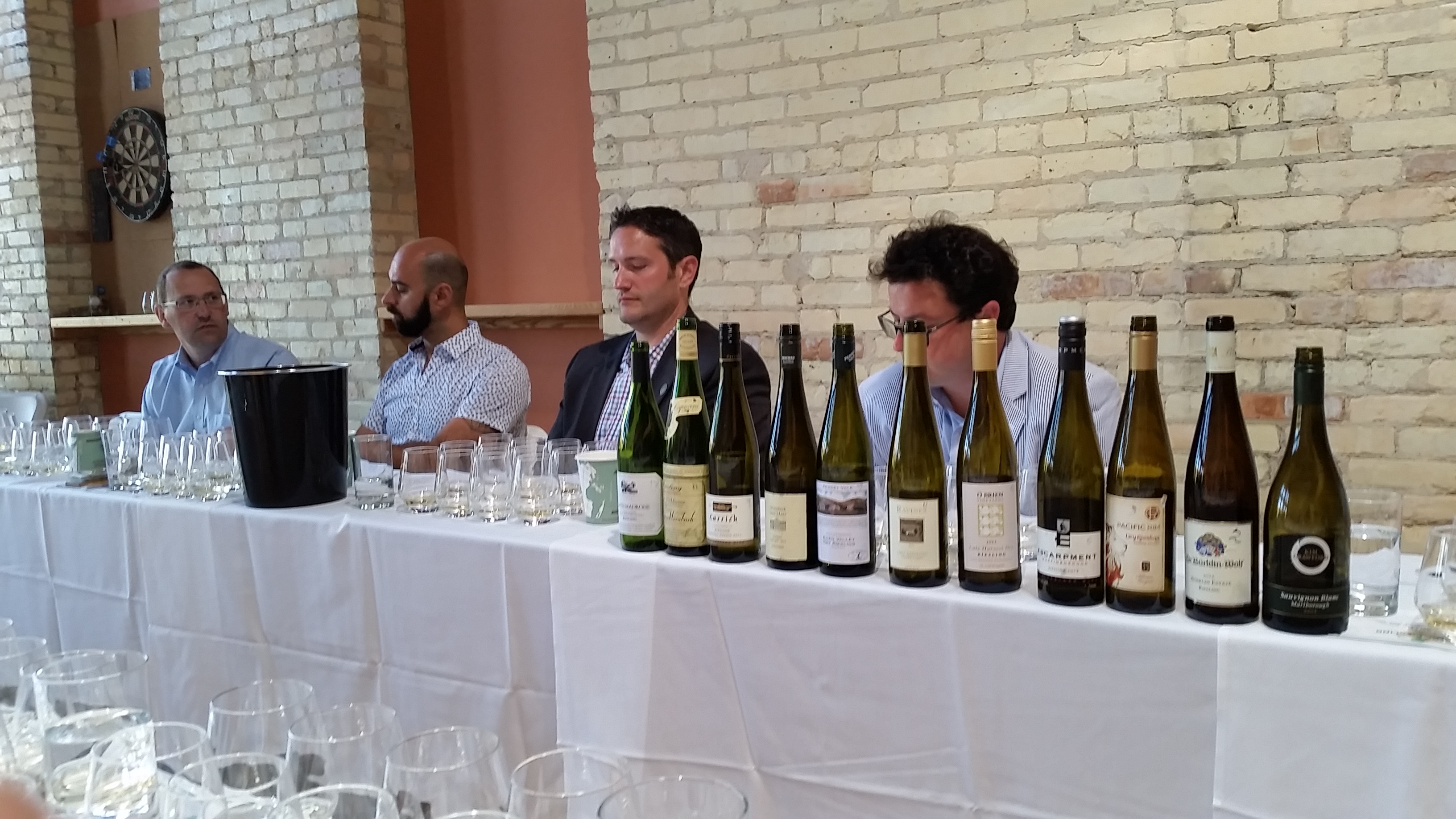
The second session was entitled “I Say ‘Sauvignon Blanc’, You Say ‘How About Dry Riesling?’: Propelling Dry Riesling to the level of ubiquity Sauvignon Blanc enjoys among consumers.” The question was a fairly simple one. How can dry Riesling become as popular as Sauvignon Blanc? The answer is not so simple. The moderator for this one was Barry O’Brien. The panelists were Eduard Seitan (One Off Hospitality, Chicago), Eric Crane (Empire Distributors, Atlanta), Mick DeCamps (Red Wagon Wine Shoppes, Metro Detroit), Lee Lutes (Black Star Farms) and Angelo Pavan (Cave Spring Cellars, Niagara).
Most of the panel for “I Say…”
Twelve wines were poured for this session. The first was Kim Crawford Sauvignon Blanc, the most popular and easiest to find New Zealand Sauv Blanc in the U.S. Then followed dry Rieslings from Germany, Washington, the Finger Lakes, Old Mission, New Zealand and Australia. Another Sauvignon Blanc, Frog’s Leap from Napa, hopped into the lineup at number eight and was followed by some largely very dry dry Rieslings from New Zealand, Austria and Alsace. The last one was an oddball Riesling from Napa. We’ll get back to that one later.
The discussion was a very lively one. The moderator began by asking the panelists to describe the differences between Sauvignon Blanc and Riesling. The descriptions ran the gamut and were contradictory at points. Sauv Blanc was described as aggressive, loud, banal, “quenchy”, chuggable, expected and seafood friendly. Riesling was described as complex, contemplative, mercurial, scary, not chuggable, and undiscovered. One panelist described Sauvignon Blanc as cleats and Riesling as figure skates. I’m still trying to figure out what he meant by that.
After the initial more or less trashing of Sauvignon Blanc (Loire Valley Sauv Blanc was explicitly excluded from said trashing), the discussion moved to consumer impressions of Riesling. The consensus was that many consumers perceive Riesling as sweet and they don’t think they like sweet wines. This point of view is prevalent among restaurant servers, too, the sommeliers said. One panelist said that he has even heard it from local tasting room employees as they were pouring for visitors! This perception is wrong in a couple of ways. First, as my dear readers know, Riesling can be made in a wide variety of styles. Second, and this was new to me, consumers say they don’t like sweet wines but their buying habits often tell another story. Many of the top selling white wines in the U.S. actually have high levels of residual sugar. It’s just that consumers don’t taste the sweetness in them. This could be to Riesling’s advantage, some of the panelists thought, because Riesling’s acidity has the ability to mask the sort of sweetness that consumers think they don’t like. The role that distributors play in influencing restaurant wine lists and the weird phenomenon of people looking down on wine from their own state were also discussed. As Sean O’Keefe has frequently said, Chicago is a much better market for Michigan wine than Detroit.
So how does one overcome this bias? By educating consumers. How does one do that? By educating those who touch the consumer. No, not anti-sexual harassment training, although the panelists would no doubt agree that’s important. What they meant was educating servers and store employees so that they can educate consumers. Sell dry Riesling by the glass. Put Rieslings on special or put them near the front of the wine list. In some cases simply including more than one on the list would be a giant leap! There was no discussion of the role that social media can play in this education process. Of course, I could have raised the issue myself but by the time the conversation started getting close to that, we were already running over and we still had a few wines to go.
I did get a word in eventually. After tasting a bone dry 2013 Domaine Wachau (Austria) and the very dry and very good Domaine Weinbach Personal Reserve (Alsace) we tasted a Riesling made by an old family winery in the Spring Mountain area of Napa. I thought it tasted like those awful buttered popcorn jelly beans that used to come in the Jelly Belly variety packs. Barry had us taste it and asked what we thought. There were a few seconds of silence then I piped up. “I thought it was awful. Didn’t like it at all,” then I gave my jelly bean note. Eric Crane got a quizzical look on his face and said something like “That’s surprising” and sniffed the wine a couple times. Brian Ulbrich piped up and told a story about a great experience he had working at that winery and others mentioned how great the family was and how great it was that they gave prime Napa vineyard space to Riesling. Karel then said that stories like those are the ones we need to tell to consumers to change perceptions. None of them said anything about how the wine actually tasted, though. The standout wines (in a good way) from that session were the Ravines Dry Riesling (Finger Lakes), O’Brien Vineyards and Domaine Weinbach, although I thought all the Rieslings except for the Californian were very good. The Frog’s Leap Sauvignon Blanc wasn’t even half bad.
The booty.
The session was then ended (Barry looked in my direction and grinned as if about to chuckle as he got up). It was around 1 pm already and my group had already eaten, but the kind folks at the Franklin allowed them to get me a pork sandwich to go (which was really good). The trip back was quick and painless. My wife and I carried back 16 bottles of wine, of which five were Rieslings.
As a whole, the weekend was a blast. Our winery visits went smoothly with no problems beyond the occasional wrong turn on a winding road. There wasn’t even much in the way of bickering in the car, which is a minor miracle given how much time we spent in the car and what I grouch I can be sometimes. Even when we didn’t like the wines somewhere, our service was great. The highlight of the winery visits was the tour and tasting at Bower’s Harbor. It was a really wonderful educational experience. Talking with a winegrower (as he called himself) in the vineyard and watching him pull off laterals and discuss viticulture in front of actual vines is as good as it gets. The talks I had with Charlie Edson at Bel Lago and Paul Hamelin at Verterra were very illuminating. The official City of Riesling events were great too. Event creators Amanda Danielson (of Trattoria Stella), Sean O’Keefe and Stuart Pigott have a lot to be proud of. The wine selection was excellent all weekend and while Michigan Riesling was well represented, the wines were truly global.
Events like this are exactly what Michigan Riesling, and Michighan wines in general, need. In order for Michigan wines to achieve global respectability, they need to be presented in a global context. We Michigan wine lovers know that Michigan Riesling (and Gewürztraminer, Pinot Gris, Lemburger, Cab Franc and maybe soon Pinot Noir) can hold its own against any other Riesling of comparable style anywhere in the world. Unfortunately, the world doesn’t know this yet. It’s always a great thing when Jancis Robinson or another famous wine person writes up a Michigan Riesling but we here in Michigan need to be contextualizing our own wines instead of waiting for others to do it for us. The City of Riesling, in both of its official aspects, did a great job of that.
We in Michigan also need to realize that we are in the same boat with New York, Ontario and other winemakers in this part of North America. Our climates are similar and the challenges we face are similar. I saw a lot of Northeastern wine collegiality that weekend. Not just in the first Salon Riesling session where one might expect it but in the second and the Night of 100 Rieslings. If Michigan Riesling is to take a place on the world stage, both contextualization and extended camaraderie need to happen and City of Riesling did an excellent job of promoting both.
Like any event in its second year, there was room for improvement. All of the problems I noticed were ones that will most likely work themselves out as the event gets bigger and better known. The sessions I attended were very heavy on sommeliers and wine business people and light on consumers and people from other aspects of the wine world. This was not so much the case on the panels themselves, which were perfectly in tune with the subject matters being addressed, but in the audience in general. The perspectives of the people whose jobs are to sell wine are very important and a vital part of any well rounded discussion like those in the Salon Riesling sessions but more perspectives are needed. As I mentioned above, the Sauv Blanc vs Riesling discussion focused a lot on the point of sale in restaurants and very little on the role of media (social or otherwise). There was a lot of guessing and reference to research on consumer behavior but no opinions from consumers themselves. I’m not sure how to remedy that, but better communication with potential attendees about the event might be a place to start. Maybe a Salon Riesling panel on Riesling in social media might be interesting, too.
The biggest area for improvement was communication prior to the event, as I touched on in the paragraph above. The website wasn’t updated until a few weeks before the event and even then it was hard for me to figure out how to buy tickets to the Salon Riesling sessions. Facebook posts were pretty regular starting in June, but unfortunately they got buried in my feed. On Twitter, where there is an extensive wine community, posts were few and far between. I don’t remember anything in local print or broadcast media about the event, either. Maybe more was done in the northern part of the state or Chicago but nothing in metro Detroit that I was aware of. Amanda and Sean both have day jobs with lots of responsibilities and Stuart is a very busy man so they probably didn’t have the time or budget to engage the media as much as they would have liked to. Engaging a volunteer to handle social media might help communication for next year, as would an increased budget for radio commercials or promoted social media posts. Hopefully as the festival continues to gain traction in its third year, a bigger budget for media engagement will follow.
The Night of 100 Rieslings was a great success, I thought. My (minor) critiques of it are outlined above. Something as simple as double sided name tags could help improve socializing and as the event becomes better known, the number of international attendees will likely increase. Having the music at a lower decibel level or having longer breaks between sets of songs might have made chatting easier too.
City of Riesling was a lot of fun and it is a very good thing for the wine world, and for Michigan wine in particular! The organizers should be very proud of what they’ve accomplished with this event. I am eagerly looking forward to next year. City of Riesling is highly recommended!





 Sipology