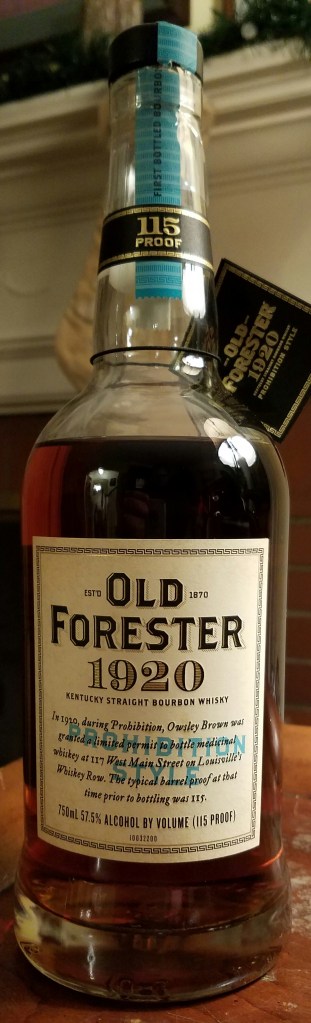
Old Forester 1920

Maker: Brown-Forman, Louisville, Kentucky, USA20170106_195909.jpg
Age: NAS

Proof: 115 (57.5% ABV)

Michigan state minimum: $60

Appearance: Bright chestnut with a clingy robe.

Nose: Crushed walnut, bubblegum, caramel, allspice, dried Cayenne. With water the Cayenne turns to sweet cinnamon.

Palate: Medium bodied. Caramel on entry, then burn. Turns chewy and spicy with water.

Finish: Grape  bubblegum, alcohol. Water brings out the oak, but doesn’t turn down the heat.

Parting words: Old Forester 1920 is the third installment in the Old Forester Whiskey Row Series. The first, Old Forester 1870 (in honor of the founding of the company), was released in 2014, 1897 (in honor of the Bottled-in-Bond act) was released in 2015. This one, released in 2016, was named in honor of the fact that Brown-Forman was one of the handful of Kentucky distillers that received a license from the US government to distill spirits for medicinal purposes. So it was actually possible to get Old Forester during Prohibition, with a prescription. It is 115 proof, not because that was the proof at which OF was sold in those days but because that was a common proof at which Old Forester came out of the barrel at the time.

All three Old Forester Whiskey Row bourbons have been good. This one is the best. It is what we OF fans have been waiting for. It does an excellent job of balancing the spice and oak of older OF with the fruity roundness of younger OF. It does this without falling into the weird plastic aromas and unbalanced oak that can come into some of the Old Forester Birthday Bourbon vintages. 1920 is both elegantly balanced and powerful, like a JS Bach organ composition or a Brahms symphony. This is the Old Forester I had hoped B-F was capable of producing all these years but thought I would never see. Now all I can think about is the next installment. Single barrel? True barrel proof? Distillate of DSP KY 414, the old Old Forester plant? I can hardly wait. Old Forester 1920 is highly recommended.

Larressingle VSOP

Maker: Larressingle, Condom, Gers, Occitanie (formerly Midi-Pyrénées), France.20161220_084818.jpg

Region: Armagnac (blend of Bas-Armagnac and Ténarèze).

Grapes: Ugli Blanc, Folle Branche (according to the internet).

Vintage: NV

Age grade: VSOP (at least 3 y/o, though the importer says this is 8 y/o).

Note: 20% of the blend was double distilled, as opposed to the customary single distillation.

ABV: 40%

Price: $50 (Party Source)

Appearance: Light caramel.

Nose: Apple juice, passito wine, stollen, old oak.

Palate: Light bodied and light in flavor. Caramel, prune juice, vanilla.

Finish: Alcohol, raisins, a little oak.

Parting words: My bottle of Larressingle VSOP is something of a mystery. I know I bought it locally but it is not on the state list and I can’t find any of sign it ever being on the list. I won’t say where I got it (snitches get stitches) but however it got here, I’m glad I was able to pick up a bottle.

Armagnac fans are fond of saying how much more flavorful and affordable Armagnac is vs. Cognac. I’m not sure where that is the case, but it isn’t here. Larressingle VSOP is affordable for an Armagnac, but it’s not very flavorful at all. The last brandy I reviewed, D’usse VSOP Cognac, was about the same price but with twice the flavor.

Despite the watery taste, Larressingle VSOP mixes pretty well. I tried it in an Old Fashioned, a Japanese Cocktail, a Continental Sour (sour plus red wine) and the quintessential Armagnac drink, the d’Artagnan (Arm + orange liqueur, oj, sugar and dry sparkling wine), named for the literary Gascon swashbuckler.

If you can find Larressingle VSOP for around $40, I recommend buying it. Otherwise, it is only mildly recommended for mixing or as an option for those just dipping their toe into the Armagnac pool.


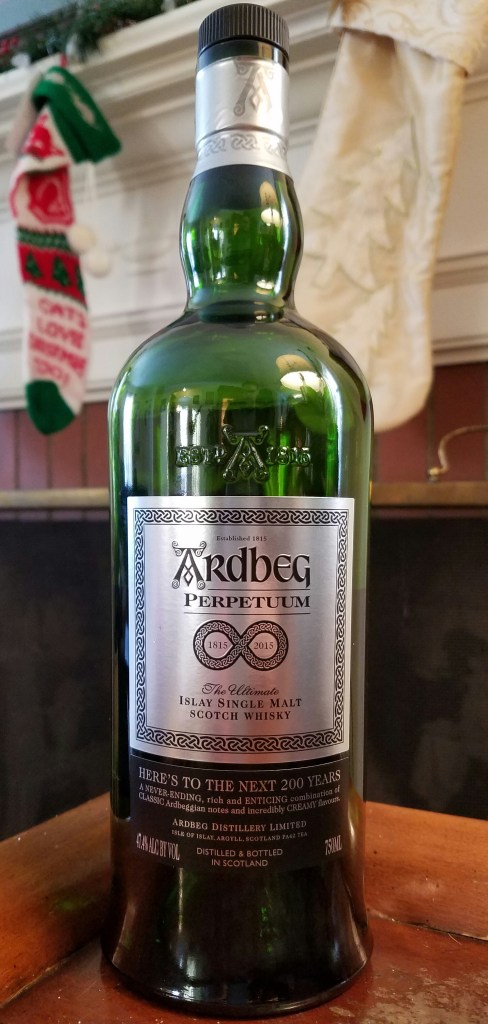
Ardbeg Perpetuum

Maker: Ardbeg, Ardbeg, Islay, Argyll, Scotland, UK (LVMH)20161220_085145.jpg

Region: Islay

ABV: 47.4%

Michigan state minimum: $100

Appearance: Very light gold.

Nose: Grilled peaches, oak, fireplace ash, cigarette smoke (Marlboro-ish), high corn bourbon, peat.

Palate: Full bodied. Butterscotch, peat ash.

Finish: Alcohol, dry chipotle chilis, sherry, fairly short.

Parting words: Is there better way to end 2016 than with a review of a whisky that was released in 2015? Yes, many better ways. I decided to review this anyway, since I picked it up late this year.

Perpetuum was released in 2015 to commemorate the 200th anniversary of the Ardbeg distillery. Many distilleries in Scotland were “founded” around 200 years ago. This is no coincidence. Beginning in 1816 and culminating in the excise act of 1823, the UK government passed a series of laws creating a level playing field for distillers in Scotland vs those in Ireland and England. Many illegal distillers went straight, refounding their operations and many new distilleries started up.

Perpetuum is a very good whisky. It’s classic Ardbeg: smoky, spicy, but still complex.Problem is, I’m not sure it’s good enough to justify the $20 markup over Uigeadail which is very similar. The well-reviewed and higher ABV Corryvreckan is $10 cheaper, too. So while Perpetuum is very good, it’s not a very good value. Ardbeg Perpetuum is mildly recommended.

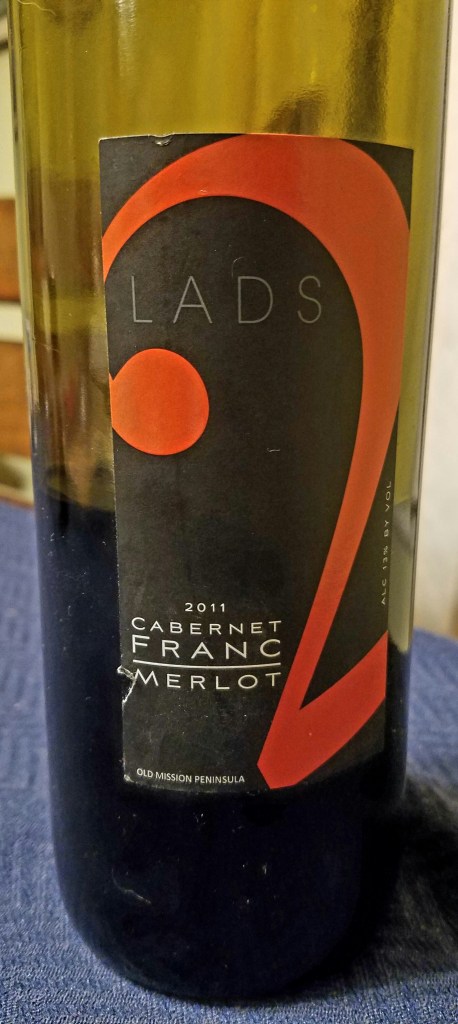
2 Lads Cab Franc/Merlot

Maker: 2 Lads, Traverse City, Michigan, USA20161215_163704.jpg

Grapes: Cabernet Franc (90%), Merlot (10%).

Place of origin: Old Mission Peninsula AVA, Traverse City, Michigan, USA

ABV: 13%

Price: Don’t remember. 2013 vintage is $32 at winery)

Appearance: Dark ruby.

Nose: Blackberry, blueberry, cherry, new oak.

Palate: Medium dry. Fruity but with backbone. Blueberry juice, roasted sweet red pepper, oak, vanilla.

Finish: Oak. A little chewy, then light vanilla.

Parting words: My wife and I bought this bottle several years ago when we made our first trip to 2 Lads. It was a part of the hallowed stash of bottles we brought with us from the old house.

I almost opened it a couple times after listening to the opinion of a couple folks in the “screw top wines don’t age” camp, but I’m glad I waited. This wine has aged into an elegant, harmonious example of what a cool climate Cab Franc can be. 2012 is generally the vintage to look for in Michigan reds, but 2 Lads Cab Franc/Merlot is proof that Michigan’s best winemakers still made good wines in cooler “white” vintages. We had this bottle with porterhouse steaks and it paired well, but given its character it could go just as well with BBQ or turkey. 2011 2 Lads Cab Franc/Merlot is recommended.

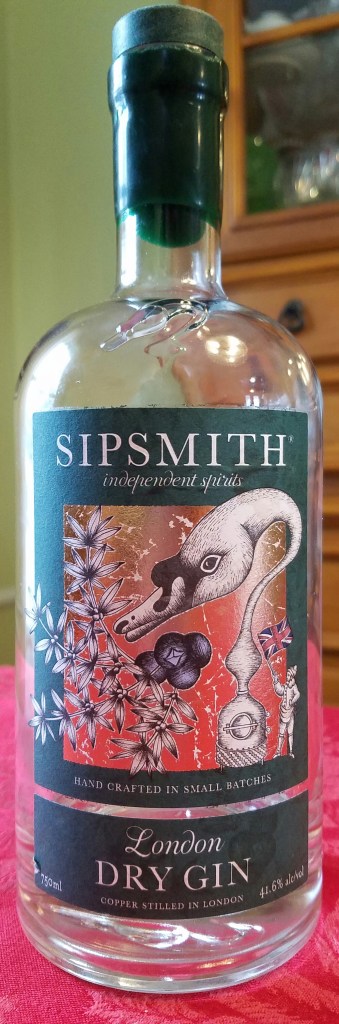
Sipsmith London Dry Gin

Maker: Sipsmith, Hounslow (Chiswick), Greater London, England, UK. (Beam Suntory)20161220_085558.jpg

ABV: 41.6%

Michigan state minimum: $40

Appearance: Crystal clear.

Nose: Juniper, lime peel, navel orange, alcohol, horehound.

Palate: Full bodied, Orange peel, alcohol, juniper.

Finish: Licorice, alcohol, pepper jam.

Mixed: Out of balance in dry martinis and with tonic. Better with juice and in richer cocktails like Negronis or Princetons.

Parting words: Sipsmith is one of the few micro-distillers that has chosen to focus on gin specifically. Many make it (and make it well) but others are focused on whiskey and see gin and vodka as a way to bring in cash while their whiskey ages. I applaud how gin-focused Sipsmith is and how seriously they seem to take their craft. That care and focus has paid off in a big way for Sipsmith’s founder when they sold out to Beam Suntory for an undisclosed sum earlier this month (December 2016).

All that said, this gin is so unbalanced that I can’t recommend it. I enjoy dry, spicy gins, but Sipsmith London dry takes it too far. It’s all sharp juniper and citrus peel balanced with nothing but alcohol. It’s like a soprano singing a capella at the top of her range for ninety minutes. High notes are good, but absent a chorus with beefy altos and basses, they become noise.

At $40, this gin is on the top shelf, even for micros. That makes its lack of balance even less tolerable. There are dozens of other “craft” gins that manage to be dry without turning into the Mojave desert. Sipsmith London Dry Gin is not recommended.

Cider Rosé

20161210_161342.jpgMaker: Uncle John’s Fruit House Winery, St. John’s, Michigan, USA

Apples: Geneva, Redfield, Watermelon, Niedzwetzkyana, others.

Style: Dry rosé cider.

ABV: 6.7%

Price: $18/750 ml (I think)

Note: At the time of purchase, I received a complimentary bottle of Russet cider and of Uncle John’s Apple Brandy, plus a discount on this bottle and others I purchased.

Appearance: Medium pink with moderately large bubbles. Big champagne-like head at first, but it dissipates quickly.

Nose: Sandalwood, ginger, apple.

Palate: Dry and medium bodied. Slightly tart but grows as it warms. Cardamom, ginger, papaya, watermelon, pomegranate, Granny Smith apples.

Finish: Applewood, big chewy tannins.

Parting words: This is a true rosé cider made from red fleshed apples, not turned pink by the addition of grape juice or something else. It’s firmly in the dry, structured, style of Uncle John’s specialty ciders. More tart than Uncle John’s Russet, it’s closer to Melded but the acid isn’t so much citrus as it is tart apples and pomegranates.
It’s fine with food, but Cider Rosé may clash with acidic salad dressings or cabbagey vegetables.

Uncle John’s Cider Rosé is recommended.
My visit to Uncle John’s Fruit House Winery & Cider Mill is chronicled here.

Jim Beam Bonded

20161209_170242.jpgMaker: Jim Beam, Clermont/Boston, Kentucky, USA (Beam Suntory)
Age: 4 y/o (minimum)

Style: Bottled in bond bourbon (single season, single distiller, 100 proof, at least 4 years old)

Proof: 100 (50% ABV)

Michigan state minimum: $23

Appearance: Light copper.

Nose: Alcohol, oak, cut grass, fresh caramel corn.

Palate: Creme brulee, alcohol, tarragon.

Finish: Alcohol, creamed corn, burnt caramel.

Parting words: Bonded Beam was a staple of the Jim Beam line for decades, but was discontinued in the 1980s. Jim Beam Bonded was (re)released in 2015 at the demand of bartenders, according to Fred Noe. It has a touch of the grassy Beam Funk, but it doesn’t overwhelm. JB Bonded mixes well in everything from Coke to eggnog to Manhattans. It’s not particularly complex but it’s what one expects from a bond at this price. Speaking of price, now that Knob Creek has dropped its age statement, it might be worth looking at JB Bonded for your sipping needs if KC’s price (currently at $37 in Michigan) goes up any more. Jim Beam bonded is a good choice to work into your middle shelf mixer rotation. It is recommended.

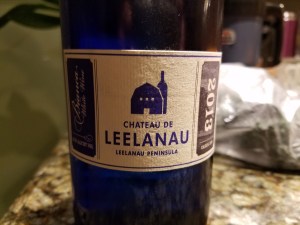
Chateau de Leelanau Bianca 2013

wp-1481146103119.jpgMaker: Chateau de Leelanau, Sutton’s Bay, Michigan, USA

Grape: Bianca

Place of origin: Leelanau Peninsula AVA, Michigan, USA.

ABV: 12.5%

Price: $18 (Michigan by the Bottle Tasting Room)

Appearance: Pale gold with tiny bubbles.

Nose: Cut apple, lemon thyme, sage.

Palate: Semi-dry and medium bodied. Peach, green apple.

Finish: Soft and apple-y fading to bit of herbal bitterness.

Parting words: When I tasted this wine, I thought it was a blend. I thought I tasted a lot of Riesling in the mix, but I couldn’t put my finger on what else might be in there. Turns out, this is not a blend but a varietal! Bianca is a hybrid with parents from the Villard and Pinot families. It was developed in Hungary and is primarily grown there.

I’m glad some made it to Leelanau because this is delicious. More Michigan vineyards should be growing it! No trace of foxiness, just crisp fruity with a pinch of herbs. Chateau de Leelanau also makes a Bianca Select in a sweeter style. I think I’m going to try to find a bottle of that too! $18 is the right price for this wine. Chateau de Leelanau Bianca 2013 is recommended.

Peninsula Cellars Chardonnay, 2013

20161018_183510.jpgMaker: Peninsula Cellars, Traverse City, Michigan, USA
Place of origin: Manigold, Old Growth vineyards, Old Mission Peninsula AVA, Traverse City, Michigan, USA

Vintage: 2013

ABV: 11%

Purchased for $17 (Michigan by the Bottle Tasting Room)

Appearance: Very pale gold with tiny stationary bubbles.

Nose: Peach, limestone dust, touch of oak.

Palate: No apparent effervescence. Medium bodied. Juicy on entry, then dries out. Bartlett pear, mineral water.

Finish: Drying continues. Oak then limestone dust.

Parting words: You’ll notice that the word “oak” appears a lot in this review. This struck me as odd, because when I when back to the MBTBTRRO tasting menu I have describing this wine, it said it was stainless steel fermented. This would tend to rule out oak, unless something unusual went on like adding oak chunks to the stainless steel fermentation vessel. Normally in such circumstances I would tgo back and retaste to figure out what’s going on, but this bottle is long gone. Due to illness and baby care, I have a backlog of tasting notes, and this is one of them.

All that to say that I don’t know what exactly I was tasting, but it was a little chewy and bitter. Whatever it was added a nice counterpoint to the fruit and minerality of this wine. Peninsula Cellars is one of OMP’s best wineries, a perfect match for the grapes of Manigold, one of OMP’s best vineyards. Delivers for the price, too. Not a lot of this vintage still around but other vintages are bound to be just as good. 2013 Peninsula Cellars Chardonnay is recommended.


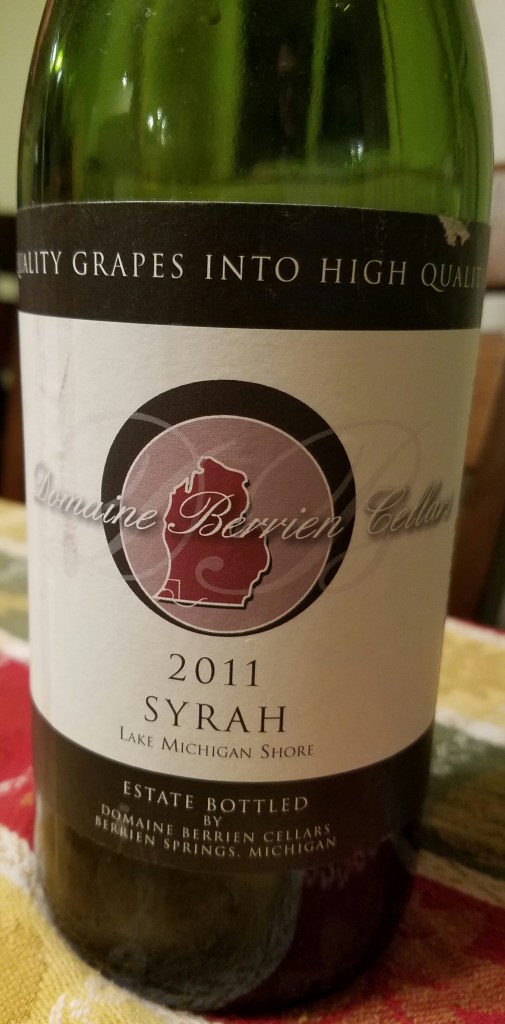
Domaine Berrien Syrah, 2011

Maker: Domaine Berrien, Berrien Springs, Michigan, USA20161112_192737.jpg

Place of origin: Domaine Berrien estate, Lake Michigan Shore AVA, Michigan, USA

ABV:

Price: Forgotten (around $20)

Appearance: Dark ruby.

Nose: Black currant jelly, oak, clove.

Palate: Medium bodied, juicy, tart cherry, then moving to bitter oak.

Finish: Chewy and drying but with a squirt of blackberry juice.

Parting words: Syrah/Shiraz is a grape most closely associated with the Northern Rhone Valley and Australia. Southwest Michigan’s climate is closer to the Northern Rhone’s but the temperature is more extreme on the top and bottom ends, like that of the rest of the northeastern of the US. Domaine Berrien’s Syrah is in the cool climate category, but the high end temps push it toward the fruitier warm climate style.

This is one of the wines that I brought over from old Sipology HQ’s “cellar” in the corner of the laundry room to my current cellar. I’m glad I let it sit as long as I did, because it’s blossomed into a wonderful wine (although it had a good head start). It’s fruity but spicy and structured and goes well with food (like turkey) but just as good without. Syrah isn’t one of Michigan’s marquee grapes, but DB does a wonderful job with it. This is a wine worth seeking out. 2011 Domaine Berrien Syrah is recommended.