Maker: Hawthorne Vineyards, Traverse City, Michigan, USA
Style: Oak aged Chardonnay (17 months in oak).
Place of origin: Old Mission Peninsula AVA, Traverse City, Michigan, USA
Vintage: 2013
ABV: 12.3%
Price: $22 (winery)
Appearance: Bright straw.
Nose: Brown roux, lemon thyme, oak.
Palate:Mandarin orange, bitter oak.
Finish: Strong oak with a bit of tartness and sweetness.
Parting words: This is a pretty good buttery, oaky Chardonnay. I was a big fan of it at the winery but for whatever reason (probably the state of my palate), it’s not thrilling me currently. Nothing remotely objectionable here, though. It’s not complex but it does serve up pleasant citrus, butter and oak flavors. The oak is strong but some people like that sort of thing (even I do sometimes). If you’re a fan of big Cali Chards, you will also enjoy 2013 Hawthorne Barrel Reserve Chardonnay. It is recommended.
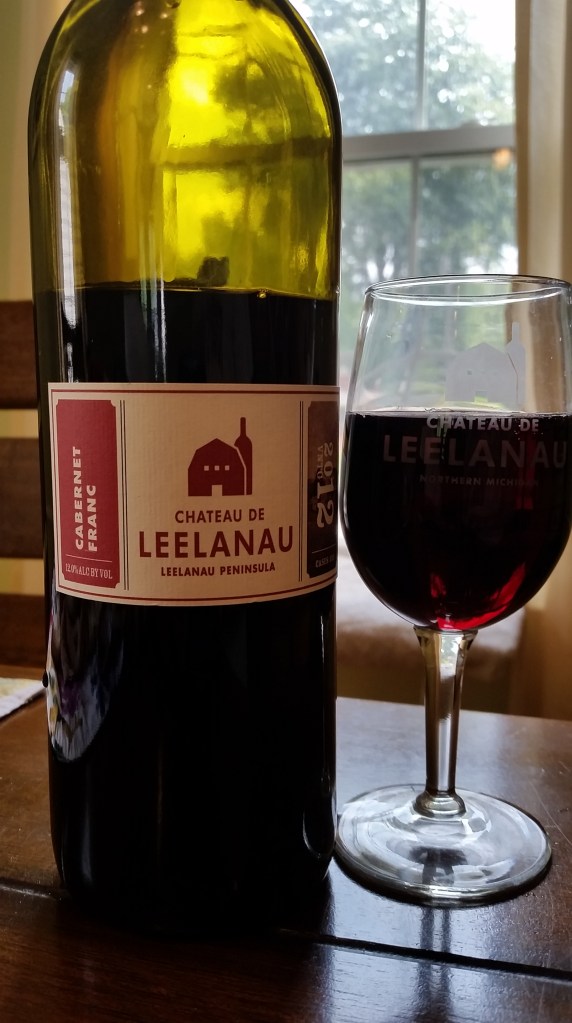
Maker: Chateau de Leelanau, Sutton’s Bay, Michigan, USA
Place of origin: Leelanau Penninsula AVA, Michigan, USA
Vintage: 2012
ABV: 12%
Production: 210 cases
Price: $24 (Michigan by the Bottle Tasting room Sipper Club selection)
Appearance: Dark plum
Nose: Wild blackberries, toasted oak.
Palate: Raspberry juice, black cherry, crimini mushrooms, oak, smoke.
Finish: Blackberry jam, oak.
Parting words: I wrote off Chateau de Leelanau for dead years ago after visiting the place and being unimpressed with everything, except the cherry wine which rose to the level of mediocre. I reviewed the wine back then, and got an annoyed comment from “Matt” who rattled off a long list of awards and an “interesting reaction” comment from MBTB’s Courtney Casey. I stand by that review, but after hearing that they’ve changed ownership since then I decided to give them another chance at a review.
Holy cats, am I glad I did. This is a fantastic wine, easily one of the top five Michigan Cab Francs I’ve had, maybe the best one. It’s earthy, fruity, oaky, perfectly balanced and delicious. Only two things about this wine disappointed me. First, that I only had one bottle. Second, that I didn’t wait for another year or two to open it. It’s only gonna get better kids. CDL’s 2012 Cab Franc is an example of the best that vintage has to offer. This is one to seek out. Highly recommended.
Once a summer, our family has what we call Grandparent Camp. We send our daughter to Indianapolis for a week to spend time with the grandparents, all four of them. When we were thinking about what to do that week, returning to Lake Michigan Shore wine country was on the top of the list. The wrinkle was that we would have the baby with us, since he’s still too little for Grandparent Camp. As most parents can tell you, taking a baby along on trips is actually much easier than taking a toddler or an older child, though. The baby doesn’t complain about getting bored or knock over shelves or have temper tantrums. If the baby cries changing the diaper or feeding will usually do the trick.
Anyway, we wanted to visit some new places but also hit some old favorites in our limited two-night stay. On the way over, we stopped at Lawton Ridge in Kalamazoo for a tasty crepe supper and some wine tasting. The whites were good as was the service. Friendly, homey, neighborhood type place. The next day (Thursday) was our busy day. We started off with a visit to Fenn Valley in Fennville (north of the cluster of wineries around Baroda but worth the trip), got lunch at Crane’s Pie Pantry (good pie and cider but mediocre food otherwise) and then headed back south stopping at old favorites Domaine Berrien (great as always), neighboring Lemon Creek (cozy tasting room) and newbies Dablon with their beautiful hilltop tasting room.
I had wanted to do a “A Visit To…” profile on one of the LMS wineries and I thought Round
The round barn
Barn would be the perfect choice. I had a nice conversation with winemaker Matt and then Brand Ambassador Bethany of Round Barn/Free Run Cellars at the Michigan Wine Showcase so I thought I’d send Bethany and email and ask if she’d be available to give us a tour for blogging purposes. A man named RJ replied that Bethany was no longer brand ambassador, but he was now and he’d be able to give us a tour. Unfortunately, he ended up having a conflict himself, and we got our tour from veteran tour guide Jessica.
Round Barn opened as a winery in 1992. It was founded by Rick Moersch, who was winemaker at nearby Tabor Hill at the time. He had owned vineyards since 1981, so he used them as the basis for his own winery which he named Heart of the Vineyard. In 1997 the round barn was purchased and moved from Rochester, Indiana to the property where it was reassembled by Amish builders. Rick intended it to serve as a home for a brandy distillery. In 2004 the winery was renamed after the remarkable building. The spirits and brewing program began then as well.
Tasting bar
We arrived at Round Barn shortly after opening. The place has changed quite a bit since our first visit several years ago. When we last visited, the eponymous round barn was used for production and the tasting room was in the other barn. The round one has been beautifully remodeled and now serves as the tasting room. The bar runs in a circle around the interior with bottles on the wall opposite. The second level has another bar
Bottles
and six compartments for small group tastings. The group tastings are a popular bachelorette party activity according to Jessica.
Our tasting was on ground level and went through the usual tasting procedure with a few add ons. The system has been in use since mid May. You can see the tasting menu and the format they use in the photo. The menu changes monthly. Nothing we tasted was bad, but the standouts were Vineyard Tears (dry Riesling/Pinot Gris/Chardonnay blend), Albariño (American, but estate grown grapes are in the mix), estate Merlot (we had a lot of Merlot on this trip!), Cabernet Sauvignon Reserve (also estate). Farm Market Blueberry and the wine-based Black Walnut Crème were standouts in the dessert arena (also the name of my new gameshow). When I mentioned that I wanted to try the Farm Market Blueberry, Jessica and had a short discussion about fruit wines. We agreed that fruit wines are really their own category that shouldn’t be judged by the standards of wine grape wines.* As I put it, it would be silly to say that a Chardonnay was bad because it lacked hop character. It’s just as silly to dismiss fruit wines for tasting too much like fruit. That’s entirely the point.
According to another employee, Round Barn has eighteen acres of vines, plus an additional four used for Free Run cellars (see below). Another two acres are used for something else, but I forgot to write it down in my notes (fruit maybe?). The vineyards didn’t suffer much damage in the polar vortex, according to Jessica. The only losses were their black currants, which I thought were illegal in Michigan, but can be grown with a special license.
We also tasted their spirits. The rum and agave spirit (distilled from imported agave juice) are both unaged and of mixer quality (as you can see above, those spirits are offered in cocktail form in the tastings). The real standout was the bourbon which is a very pleasant surprise. It is of limited production and will be reviewed in the near future. They also produce an aged brandy and a “grappa” but those are under the Free Run label and not currently offered for sale at the Round Barn tasting room. They are available at the Public House (see below). According to Jessica, there are no plans to produce an aged rum or agave spirit. There is also a blended American Whiskey on the menu that is a blend of rye and bourbon, according to RJ. I did not taste it. An Applejack is in the works too, made using locally grown apples.
Upstairs bar
Tasting suites
The roof of the round barn
Round Barn’s best known spirit is DeVine Vodka, made from grapes. As I’ve ranted about on Twitter a few times, I don’t understand the desire to take perfectly good fruit like grapes or apples and turn them into a spirit that is by nature flavorless. It’s always seemed like a waste, but as the saying goes, you can’t argue with success and DeVine Vodka has been a success. They recently followed up the success of DeVine with 269 Gin, named after their area code. It’s a basket infused gin made using the grape spirit used for the vodka and will be reviewed in the future as well.
The still
The column on the still
After touring the upstairs, Jessica led us through a beautiful courtyard to the not-
Beer Menu
roundbarn (built in 1907 on the property), now christened the Round Barn. Upstairs is a smallish bar and gift shop with seven Round Barn beers on tap and all their spirits behind the bar. It’s a decent size space with a good sized deck attached. It seems like it would have a good flow of people between the two spaces when busy (and warm). We tried a sample of Vanilla ‘Stache, a vanilla porter, there. The vanilla comes through but in a subdued way. I liked it.
Deck at the other barn with hop vine
Black Walnut tree
Round Bar
Vanilla ‘Stache
The next stop was the production facility. It’s a non-descript industrial building set several yards away from the barns. It houses the winemaking equipment, automated bottling line, still and oak barrels, (all French for the wine). Since 2014, all brewing has been located adjacent to the Round Barn Public House in downtown Baroda (such as it is). That was our next stop. RJ’s meeting was over so he was able to meet us there.
The Public House is a red building with a bar and a large seating area and a large covered patio. It once served as a tool and die shop, owned by RJ’s father, as a matter of fact. The food is limited but good. Sandwiches mostly. Our lunch (RJ comped us for this) was good. They exclusively serve their own beer and spirits. With my lunch (turkey Bahn Mi and a cup of chili) I ordered a pint of Escaped Goat, the Hef PA. It was good. I told RJ that I was a fan of wheats, so brought me a couple samples of their current wheats (Vacation wheat ale and Straw Beery Strawberry wheat ale, both good) plus a couple experiments. The first experiment was a Saison they had been working on. It was good, but was not as flavorful as I had hoped. The second was a dry, tannic cider with Balaton cherry juice added. It was really intriguing. The result was closer to a sour beer than a fruit cider. It was not ready for prime time, but it had a lot of potential that I hope is realized soon!
RB Public House & Brewery
Public House bar
The one aspect of Round Barn’s business that we didn’t get to see was Free Run Cellars. Free Run is a multifaceted project. The name comes from the juice produced from the initial pressing of the wine, called free run juice, but also from the Rick’s sons (Matt and Christian) being given “free run” in the Round Barn Cellars. All the wines under the Free Run label are from free run juice (appropriately), and are single vineyard, estate wines. Free Run also has its own facility (opening later this month) that will host four wine, four appetizer pairing tastings with an emphasis on locally sourced ingredients.
Many businesses that try to do a lot of different things end up letting their ambition getting the best of them. They are mediocre at everything instead of being good at one or two things. Round Barn does not fall into this trap. Some products are better than others, obviously, and wine is what they do best, but their beers and spirits were good too, some of them very good. If anything maybe they to be more ambitious with their beers and spirits. An aged rum could be very good. Ramping up their production of brandy might be a good idea as well. Bourbon is hot right now, but rum is also popular and getting more so. Brandy is on the way up as well. Copper & Kings in Kentucky is getting a lot of attention for bottling and selling Michigan-made brandy. Michigan producers need to be getting that attention.
Beautiful grounds, well run facilities and delicious products. Round Barn does it all and does it well. A visit to Round Barn is highly recommended.
Note: I received a free lunch at the Public House and a 25% media discount on purchases on this visit.
*”Wine grape wines” may seem redundant but the phrasing is intentional. In my opinion, wine made from grapes like Concord, Niagara or table grape varieties belongs in the “fruit wine” category. While they are grapes, they are not grown for the express purpose of winemaking. The line gets fuzzy when it comes to some native North American grapes like Muscadine that are eaten as fruit but also have a long history of being made into wine. Maybe this discussion would make a good My Two Ounces post.
Maker: Bel Lago, Cedar, Leelanau County, Michigan, USA
Place of origin: Bel Lago estate, Leelanau Peninsula AVA, Michigan, USA
Vintage: 2013
ABV: 13.9%
Price: $19 (website price for 2012 vintage)
Nose: Cut golden apple, peach, pear, leather.
Palate: Full bodied, dry. Subtle pear, cantaloupe, a drop of brown butter.
Finish: A little tangy and a little sweet, then a touch of smoke as it fades.
Parting words: Auxerrois is not a grape that finds its way onto labels very much. It’s a member of the Pinot family grapes. According to geneticists, Auxerrois shares the same parentage as Chardonnay, making it something of a fraternal twin. It’s primarily grown in Alsace in eastern France, where it is one of the most commonly grown varieties (in 2008, it was grown on twice the acreage of Pinot Blanc). Alsace is between Burgundy and Germany geographically and wino-graphically. It is best known for its white wines which include Pinot Blanc, Pinot Gris, Gewurztraminer and Riesling. Where does that leave Auxerrois? There’s a strange quirk in French wine laws that allows Alsatian wines labeled Pinot Blanc to contain any white wine from the Pinot family. Auxerrois is one of the most popular choices for Pinot Blanc, whether blended with Blanc and Gris or even all by itself(!). It brings Chard-like mouthfeel and fruit to the blend as a counterpoint Pinot Blanc’s crispness.
Bel Lago became the first winery to plant Auxerrois in Michigan in 1987. They’ve treated it with care and made a great wine out of it, year after year. Pinot Blanc has been raised as a possible signature grape for Michigan but maybe its old pal Auxerrois is a better choice. Bel Lago Auxerrois is highly recommended.
Parting words: Non-vintage (NV) wine has suddenly become much more popular in Michigan because of the two apocalyptic vintages in a row, 2014 & 2015. For reds this was especially the case, but even for Chardonnay and Riesling the polar vortex vintages were disastrous. So wine makers blended reserves of previous better vintages together so that they would have decent wine to bottle in 2016.
Bel Lago is one of the best wineries in Northern Michigan. They’re known for cherry wine, rosé
and whites (like their excellent Auxerrois) but ain’t shabby with reds either. I didn’t expect this non-vintage Pinot Noir to be good, but my expectations were exceeded. It’s not as well integrated and balanced as vintage editions, but it goes well with food and there are no obvious flaws. Chilling brings out an inky taste and aroma, so drink at room temperature if possible. $25 is about $5 too much, but I feel sorry for our wineries having to struggle through those two winters so I don’t mind paying it. Bel Lago NV Pinot Noir is recommended.
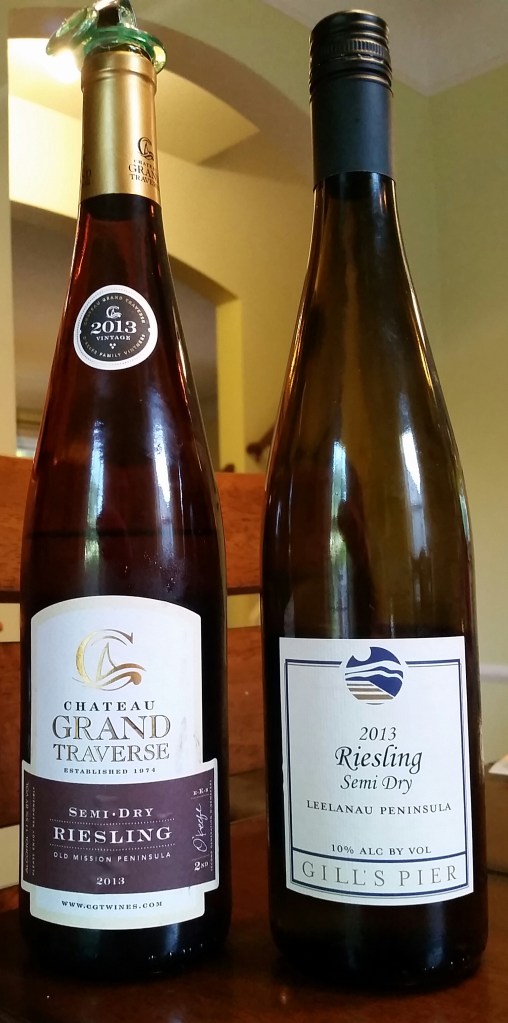
Chateau Grand Traverse (Traverse City, Michigan, USA)= CGT
Gill’s Pier (Traverse City, Michigan, USA)= GP Now defunct.
Place of origin
CGT: Old Mission Peninsula AVA, Traverse City, Michigan, USA
GP: Leelanau Peninsula AVA, Leelanau County, Michigan, USA (estate)
Vintage: 2013
ABV
CGT: 11%
GP: 10%
Appearance:
CGT: Medium gold.
GP: Pale gold
Nose
CGT: Rich. Slightly musty, old Riesling aroma when first opened, then peachy all the way through.
GP: Crisp yellow apple, Meyer lemon, lemon thyme.
Palate
CGT: Full-bodied, old Riesling feel. Mandarin orange, sage.
GT: Bracing, but still sweet. Tangerine, bottled lemon juice.
Finish
CGT: Dry, with a little bitterness.
GP: Cheek-filling tartness. Fades slowly.
Parting words: I got the idea for this head to head when I pulled a wine out of our liquor cabinet to put in our china cabinet for near term-consumption (we have an overly complex three-part staging system for wine in our house). I pulled out the CGT Semi-dry Riesling and then went to move up the bottle below it and noticed it was the Gill’s Pier Semi-dry of the same vintage. I’ve done a lot spirits head to heads, but not many wine ones so I thought this was the perfect opportunity.
I didn’t expect there to be much of a difference between these two, honestly. I was quite surprised at the contrast between two wines made from grapes grown a few miles apart in the same style and year. It’s a testimony to the varied terroir of northwest Michigan and the flexibility of Riesling. CGT is lush and decadent where Gill’s Pier is focused and elegant. If I had to choose one over the other, I would probably opt for Gill’s Pier, but just by a hair. Both are recommended. Unfortunately, Gill’s Pier estate is now an alpaca farm, but Chateau Grand Traverse is still going strong and readily available all over Michigan.
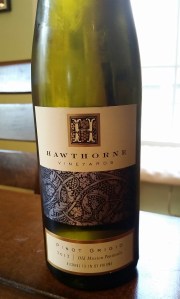
Place of origin: Old Mission Penninsula AVA, Traverse City, Michigan, USA (2013 vintage was made from a mix of estate grapes and grapes from the Rue de Vin vineyard)
Palate: Rich and buttery. Grilled peaches, mandarin oranges, heirloom apples,
Finish: Bitter, smoky finish. Burnt butter, but in a good way.
Parting words: I don’t think I’ve ever had a Michigan Pinot Gris/Grigio this buttery, certainly not one from Northern Michigan. As you know, dear readers, the butter comes from malolactic fermentation, a secondary fermentation that can happen in wines. It also has the effect of softening out the tartness of a wine. It is commonplace in red wines, but less common in white where it imparts that buttery flavor and aroma most of us associate with California Chardonnay. It is allowed to occur in many warm climate Pinot Grigios too. Traverse City is almost nobody’s idea of a warm climate location but 2012 was a hot year by Michigan standards. Although it can be controlled, malolactic fermentation is more likely to occur naturally in warm conditions so maybe the folks at Hawthorne just decided to allow nature to take its course.
However it happened, the result was good. As in many Chards, the bitter oak and butter complement each other and make it even more food friendly. I’m not sure I would want a steady diet of this style of Grigio, but it’s good for a change of pace. 2012 Hawthorne Pinot Grigio is recommended.
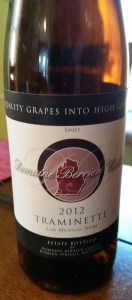
Palate- Full bodied and luscious. A little oxidation evident. Golden Delicious apple, winter savory, ginger, angelica.
Finish: White pepper, clove. Fades but leaves a subtle sweetness lingering behind.
Parting words: Domaine Berrien is best known for their reds but they produce some very good whites, like this one too. Traminette is one of the few hybrids grown on their estates, but it’s a good choice given the warmer climate and lower latitude of Lake Michigan Shore AVA. It’s a fairly new hybrid created in 1965 as a cross of Gewurztraminer with a Seyve hybrid at the University of Illinois. It’s been named the signature grape of Indiana as well.
This is described as a “German style” Traminette, which is odd since the grape is not widely grown in Germany, to my knowledge anyway. I think what they mean is that they were aiming for a wine in the style of late harvest Riesling or Gewurz from Germany. It certainly has the mouthfeel and many of the aromas of an aged Spatlese or Auslese. I almost found myself wishing that I had let it sit for another year or two, but I’m also afraid that the slight mustiness on the nose might erupt into full-blown mildew. Maybe I was right to open it when I did, then.
Anyway, Domaine Berrien Sweet Traminette, 2012 is recommended. It may be hard to find at this point, but the 2013 is kicking around.
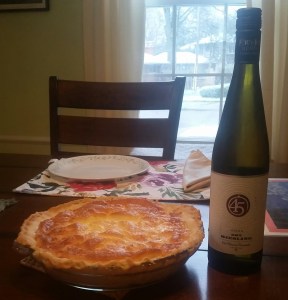
Maker: Forty-Five North, Lake Leelanau, Michigan, USA
Place of origin: Old Mission Peninsula AVA, Michigan, USA
ABV: 11.25%
Purchased for $19 (Hills, Bloomfield Hills, Michigan)
Appearance: Medium gold.
Nose: Dry and flinty. Lychee, water chestnut, Bartlett pear, dried savory, epazote.
Palate: Peach, tangerine, ruby red grapefruit, mineral water, dried chicory.
Finish: Medium length. Dry, herbal with a slight bitterness.
Parting words: Having had an odd experience when I visited Forty-Five North last summer, I had been put off from reviewing any more of their stuff. I’m very glad I reviewed this one, though. I found it languishing on a shelf at store at which I usually buy Scotch and decided to pick it up earlier this year, even though I was unsure if it would still hold up.
Held up it did. This wine was wonderful. It’s one of the driest Michigan Rieslings I’ve had. I ate it with a couple different meals, including a cheese tart, made with Raclette from Leelanau Chesse (it’s all they make). It did well with everything. It’s drinking very well now, obviously, but it will probably still be good a year or more from now. $18 was the original MRSP but it’s easily worth $19-$20 or more. 2011 is still showing very well for Michigan whites. Forty-Five North’s 2011 Dry Riesling is highly recommended.
WB= Witches Brew (Leelanau Cellars, Omena, Michigan, USA)
LR= Revenge of the Living Red (Sandhill Crane, Jackson, Michigan, USA)
ABV
HM: 12%
WB: 12.5%
LR: 12%
Price
HM: $8 (wine only)
WB: $8 (Hollywood Market, Madison Heights)
LR: $18 (Michigan by the Bottle Tasting Room, Royal Oak)
Appearance
HM & WB: About the same. Dark burgundy.
LR: Beet red, almost blood red.
Nose
HM: Sweet with cinnamon and orange.
WB: Big cinnamon with some cherry juice.
LR: More typical red wine. Dry.
Palate
HM: Tart orange. Tannic.
WB: Easy Drinking. Sweet cherries, cinnamon. Not much else.
LR: Spicy with a little orange zest and cherry.
Finish
HM: Chewy. A little sweet orange.
WB: Sweet & light.
LR: Spicy dried chillies. Ancho?
Amy’s thoughts
HM: Smells sweet but tastes dry. Good once you get used to it.
WB: Cinnamon bomb. Almost too sweet.
LR: Drier. Finish burns. Don’t like it too much.
Pete’s thoughts
HM: Don’t like it. Bad, bitter aftertaste.
WB: Like it better. Cinnamon is good!
LR: Like WB but drier. Like it the best.
Parting words: I had wanted to do a mulled wine tasting for a while, but having three bottles open at the same time is a bit much, even for me. Normally Mrs. Sipology Blog would help out but she’s currently very knocked up so I invited friends of the blog Amy and Pete over to help.
For the homemade mulled wine, I had used TJ’s Harvest Blend Herbal Tea for mulled cider back in the fall with very good results so I thought I’d try it with wine. I thought it was OK, but not as good as the two pre-mulled wines. I kept adding more sugar which made it better but still not good enough. Next fall maybe I’ll start work on perfecting a mulled wine recipe. My own creation is not recommended.
Witches Brew is a big seller for Leelanau Cellars (known for their seasonal table wines) and it floods into grocery stores statewide in September and lingers well into the winter. The Halloween theme has always been a little puzzling to me, since I associate mulled wine with the Christmas and New Year’s holidays. Pete assured me that he and many other people do associate mulled wine with the fall hayride season. At any rate, cinnamon is the dominant flavor, but clove and nutmeg also go into the brew. It has it’s share of haters, but I think it’s a decent buy for the right price (<$8). It’s NV so beware of overly dusty bottles, but they drink fine at a year or a little more after hitting the shelves. Recommended.
Sandhill Crane’s goes with a hipper zombie theme. Their original spiced wine was Night of the Living Red ($17 from the winery). According to the website it’s made with “cloves, cinnamon, nutmeg, vanilla, orange peel… and essence of fresh-squeezed zombies!” Revenge is infused with all those (including the zombie juice) plus estate grown chiles. The chiles add a nice shot of heat to the wine and set it apart from products like Witches Brew. Some, like Amy, may find this off-putting but I loved it. It’s $10 or more than WB but the taste is worth it, plus $2 from every Living Red bottle sold goes toward the college fund of the artist who created the label. That’s added value. Revenge of the Living Red is recommended.




 monthly. Nothing we tasted was bad, but the standouts were Vineyard Tears (dry Riesling/Pinot Gris/Chardonnay blend), Albariño (American, but estate grown grapes are in the mix), estate Merlot (we had a lot of Merlot on this trip!), Cabernet Sauvignon Reserve (also estate). Farm Market Blueberry and the wine-based Black Walnut Crème were standouts in the dessert arena (also the name of my new gameshow). When I mentioned that I wanted to try the Farm Market Blueberry, Jessica and had a short discussion about fruit wines. We agreed that fruit wines are really their own category that shouldn’t be judged by the standards of wine grape wines.* As I put it, it would be silly to say that a Chardonnay was bad because it lacked hop character. It’s just as silly to dismiss fruit wines for tasting too much like fruit. That’s entirely the point.



 Parting words: Having had an odd experience when I visited Forty-Five North last summer, I had been put off from reviewing any more of their stuff. I’m very glad I reviewed this one, though. I found it languishing on a shelf at store at which I usually buy Scotch and decided to pick it up earlier this year, even though I was unsure if it would still hold up.
 Sipology