Pendleton Blended Canadian Whisky

Maker: Hood River Distillers, Pendleton, Oregon, USA

Distiller: Undisclosed Canadian distillery.

Age: NAS

ABV: 40%

Michigan state minimum: $23

Appearance: light copper.

Nose: Alcohol, hot nagahyde, artificial lemon extract.

Palate: Medium bodied and sweet. Caramel, plum, burn.

Finish: Very sweet. Purple stuff.

Parting words: Growing up in Central Indiana, Pendleton meant the massive state prision in Pendleton, Indiana. In Oregon, Pendleton apparently means a massive rodeo. So how better to honor one of America’s largest sporting events than with…[checks notes]…a sourced Canadian blend?

Anyway, Hood River Distillers are best known for owning Clear Creek and McCarthy’s single malt, which I dumped out in a previous review. Bafflingly, Pendleton has a couple of line extensions as well, 1910 and Midnight, if you’re interested.

I’ve had worse Canadian whiskies, but they were all under $10 a bottle. Nothing irks this reviewer more than overpriced booze. I’d rather drink a gallon of awful but cheap whisky than one shot of overpriced whisky. To me, it’s the unforgivable sin.

Pendleton Blended Canadian Whisky is not recommended.

Mari Vineyards Late Harvest Riesling, 2016

Maker: Mari Vineyards, Traverse City, Michigan, USA

Place of origin: Irish Vineyard, Old Mission Peninsula AVA, Michigan, USA

Grape: Riesling (100%)

Vintage: 2016

ABV: 10.5%

Notes: 22.5° brix at harvest, 4.2° residual sugar

Purchased for $28 (Winery)

Appearance: Very pale gold. Tiny bubbles visable after pouring.

Nose: Cut Granny Smith apple, pineapple, lemon thyme.

Palate: Full bodied, but not syrupy. Medium sweet. More tart apple, ripe peach, mango, limestone.

Finish: Sweet with a big hit of acid in the cheeks.

Parting words: Like the Mari Vineyards “Monastery”, everything that appears on Mari wine labels has some sort of symbolic meaning. The bird escaping the guilded cage on the Late Harvest Riesling label is meant to represent winemaker Sean O’Keefe’s professional journey. He left his family’s winery, Chateau Grand Traverse, in order to spread his wings and make his own wines at Mari. CGT more or less set the standard for Michigan Riesling and the O’Keefe’s are one of the first families of Michigan wine, hence the cage’s guilding.

Sean’s late harvest Reisling (English for Spätlese) is different stylistically from those produced by his family’s winery. He strives first and foremost for balance, something this style is not always known for. The wine is undeniably sweet, but that sweetness is balanced with acid, fruit and a pinch of minerality. In fact, Sean has been making his late harvest Rieslings drier with every vintage, and just today he promised that the 2019 will be the driest one he’s ever made, firmly in semi-dry territory. I can’t wait to taste it.

Mari’s wines are near the top end price-wise for Michigan but I’ve never been disappointed. I’d easily pay $28 for a high-quality Spätlese, so I have no qualms paying that much for a wine this good. It’s maybe the best LHR being made in Michigan. As a result 2016 Mari Vineyards Late Harvest Reisling is highly recommended.

Bel Lago Pinot Noir, 2016

Maker: Bel Lago, Cedar, Michigan, USAwp-1577138116082.jpg

Place of origin: Leelanau Peninsula AVA, Leelanau County, Michigan, USA (at least 85%)

Grape: Pinot Noir (at least 85%)

Vintage: 2016

ABV: 13.3%

Purchased for $22 (Michigan by the Bottle, Royal Oak)

Appearance: Dark Burgundy.

Nose: Cedar, sauteed mushrooms, blueberries.

Palate: Cherry juice, pomegranate seeds, pinch of nutmeg

Finish: Sweet, then tart, then tannic.

Parting words: Nobody in Northern Michigan (maybe -Northern) does Pinot Noir as well as Bel Lago. This is a perfect cool climate Pinot with an elegant balance of wood, fruit, earth, and tannin wrapped together in a coat of acid. I’ve reviewed past vintages (2012 single vineyard and non-vintage, released in 2016). This isn’t in the same class as the Moreno single vineyard, but at less than half the price, I don’t think this wine is intended to be.

Still, it’s very good and well worth purchasing. 2016 Bel Lago Pinot Noir is recommended.

Domaine du Verger Brut

Maker: Val de Race Cooperative, Pleudihen sur Rance, Brittany, France20191122_102518.jpg

Place of origin: 90% Brittany, 10% Normandy

Apples: 90% bittersweet, 10% bitter

Style: Semi-dry apple cider

ABV: 5%

Purchased for $9/750 ml (Vine & Table, Carmel, Indiana)

Appearance: Light amber

Nose: Apple juice, leather, cut tart apple.

Palate: Effervescent and lightly sweet. Medium tannins, very little acid, no funk.

Finish: More tannin and a little sweetness.

Parting words: I picked this French cider up on one of my trips to Indianapolis. It’s solid, easy drinking and accessible. It has more depth than cheaper French ciders but isn’t going to knock you over with funk and tannin either. It works best as a table cider or an afternoon sipper. The price is pretty good for what it is, but I’d like it even better for a dollar or two less. Domaine du Verger Brut is recommended.


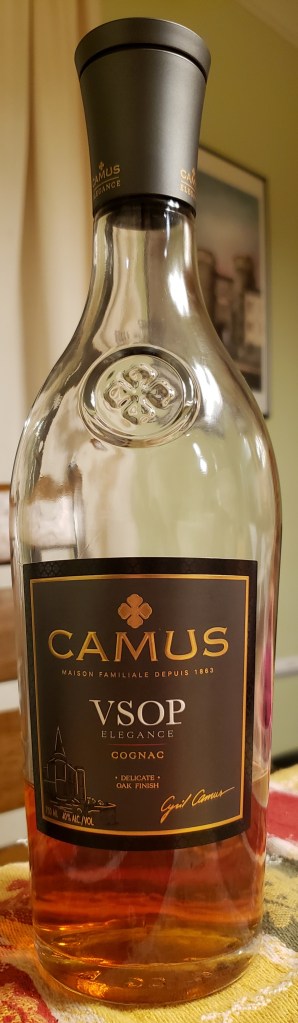
Camus VSOP Elegance

Maker: Camus, Cognac, Charente, France.20191107_175812.jpg

Region: Various

Age category: VSOP (at least 4 y/o)

ABV: 40%

Michigan state minimum: $48

Appearance: Cherry wood.

Nose: Grape soda, oak, alcohol, pink peppercorn.

Palate: Full-bodied and silky. Golden raisins, cola, vanilla.

Finish: Heat, cherry, French oak, brown sugar.

Parting words: Camus the Cognac has been produced by Camus the family since 1863. It’s a mid-sized house located in The Borderies with its own vineyards, although it does also source from other estates as well. Camus’ Elegence range consists of inexpensive (at least compared to the rest of the line) Cognac blends.

Camus VSOP Elegance is a pleasant step up from the VS which I reviewed here. I had fairly high expectations for the VSOP based on how good the VS was. Those expectations were met. It’s elegent and easy drinking, but relatively complex with lots of fruit and cola. The price of Camus VSOP Elegance is higher than most of the VSOP offerings from the big houses, but it’s also more interesting than most of those. That’s why Camus VSOP Elegence is recommended.

Roger Groult, 8 y/o

Maker: Roger Goult, Valorbiquet (Saint-Cyr-du-Ronceray), Calvados, Normandy, France.20190620_214902.jpg

Place of origin: Clos de la Hurvanière, Pays d’Auge AOC, Calvados, Normandy, France.

Age: 8 y/o

ABV: 41%

Price: $60 (Binny’s)

Appearance: Bright copper.

Nose: Crushed cider apple, toasted oak, vanilla, nutmeg.

Palate: White chocolate apple, vanilla custard, burn.

Finish: Butterscotch hard candy, ginger, kiss of oak.

Parting words: Roger Groult is a family-owned Calvados producer in the Pays d’Auge, in the eastern half of the Calvados AOC. Groult produces a full line of apple brandies that often show up on the shelves of large liquor stores in the US.

I haven’t tried any of the other Groult brandies so I can’t comment on how this one compares to the others, but I did enjoy it. There’s nothing too distictive but there’s also nothing unpleasant. At 8 years I did expect a bit more oak, but I’m not big on oaky apple brandies, so that was fine with me. I just wish that there was a little more depth. $60 isn’t terrible for an age-stated Calvados so Roger Groult 8 year old Calvados is recommended.

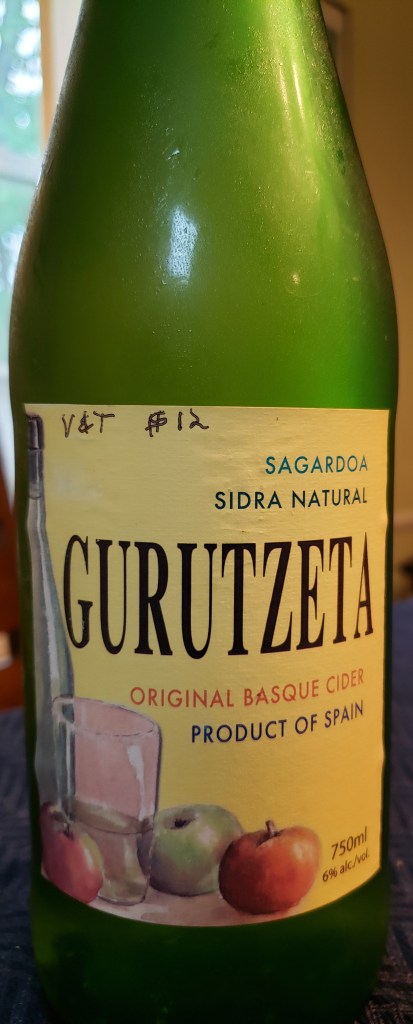
Gurutzeta Original Basque Cider

Maker: Sidreria Gurutzeta, Astigarraga, Gipuzkoa, Basque Country, Spain20190616_171204.jpg

Style: Natural Basque Spanish cider

ABV: 6%

Purchased for $12/750 ml at Vine & Table in Carmel, Indiana.

Appearance: Very hazy gold.

Nose: Apple cores, dried flowers, apricot, lemon thyme.

Palate: Apricot, Golden Delicious apple, chalk dust, pinch of sweetness.

Finish: Tangy. Siracha burn in the back of the throat as it warms in the glass.

Parting words: This is the second Basque cider (or Sagardoa as they call it) I’ve reviewed. The other one was in November of 2017. It was Isastegi Sagardo Naturala, made in Tolosa about 17 miles (27 km) south of Astigarraga. The two ciders are similar in style but Gurutzeta is more acidic and less funky than Isastegi. Neither have more than a trace of sweetness.

Basque ciders are not what I’d call good entryway ciders for most North American drinkers. While they’re not as dominated by tannin as Norman ciders, they do have much more of it than most English or American ones. and they tend to have high levels of acid and funk with virturally no sweetness. It may sound silly, but for those new to Basque cider I would suggest getting a solid feel for French cider before venturing into Basque Country. It will help you understand this unique tradition better. At any rate, Gurutzeta Original Basque Cider is recommended!


Midnight Oil

Maker: Motor City Gas, Royal Oak, Michigan

Style: Peated bourbon (made with peated malt)

Age: NAS (dumped March 31, 2018)

Proof: 105.8 (53.4% ABV)

Purchased for: I forget (at distillery)

Note: bottle is boring, so no picture, at least for now.

Appearance: Dark copper, almost chestnut.

Nose: Freshly refinished hardwood floor, cherry jam.

Palate: Black walnut, a little peat, some smoke, brown sugar.

Finish: More peat and smoke, oak, a little bite.

Mixed: Very good in strong cocktails like Manhattans or Boulevardiers.

Parting words: This is the second of two bottles I got at Motor City Gas a few months ago. I was very impressed with it at the distillery. It seemed smokier and peatier (?) there too, probably because I tasted it after their rum-finished bourbon. It was still enjoyable at home, though. The peat blends seamlessly into its young, woody character to the point where it’s nearly impossible to disentangle the two. It doesn’t drink like 105.8 proof, either, which is dangerous. It’s at its best in cocktails, though, where it can stand up to just about any mixer, even amaro and black vermouth.

The price is high (even though I can remember what it was), but it’s barrel proof and the best peated bourbon I’ve had, although there aren’t very many to be had. Available only at the distillery on the outskirts of downtown Royal Oak, Michigan. Midnight Oil is recommended.


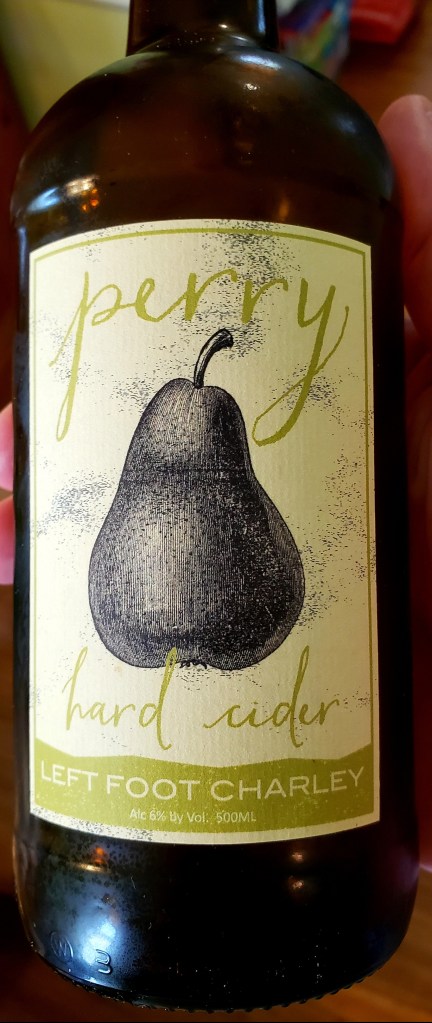
Left Foot Charley Perry

Maker: Left Foot Charley, Traverse City, Michigan, USA20190504_122122.jpg

Variety: 100% Bartlett perry

Style: Dry American perry.

ABV: 6%

Price: $8 (winery IIRC)

Appearance: Very pale straw.

Nose: Pear, cedar, yeast.

Palate: Light & dry with a few bubbles. Hint of pear, apple core, yeast.

Finish: Dry. A little tannin and funk.

Parting words: At this point in my cider-tasting career I’ve had a good number of perries and all but a couple of them have been very sweet. When I saw that this perry was 100% Bartlett, I assumed that I was in for another sweet, one-dimensional perry. I was wrong. LFC’s perry is pleasantly dry with a little yeast and even what tastes like tannin! It was a very pleasant surprise. The winery that makes some of my favorite Michigan wines now also makes my favorite Michigan perry. LFC’s Perry is highly recommended.

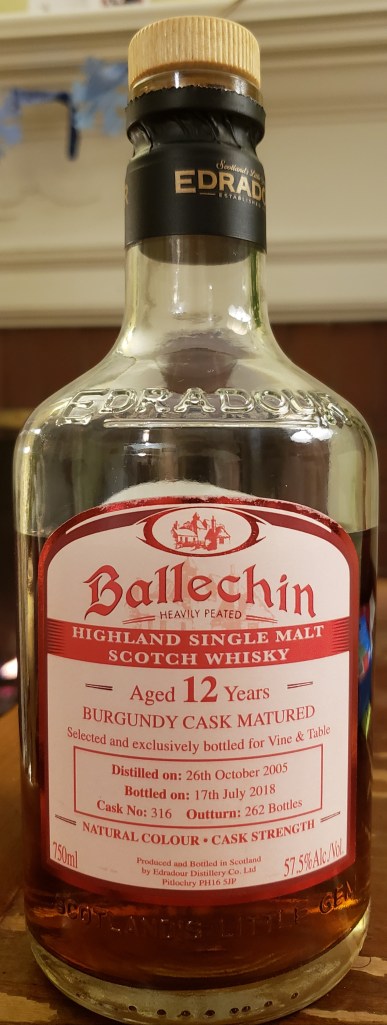
Ballechin 12, Vine & Table Cask

Maker: Edradour, Pitlochry, Perthshire, Scotland, UK20190125_195157.jpg

Region: Highlands

Style: Peated single malt

Age: 12 y/o (distilled 10/26/05, bottled 7/17/18)

ABV: 57.5% (cask strength)

Notes: 100% burgundy cask aged. Natural color. Cask #316, 262 bottles produced. Exclusive to Vine & Table, Carmel, Indiana, USA.

Purchased for $135

Appearance: Reddish copper.

Nose: Alcohol, smoke, peat, baking cherry pie, leather.

Palate: Alcohol, smoke, cherry-vanilla custard, peat, old oak.

Finish: Big & smoky, with oak, fruit and burn.

Parting words: Edradour is in the Perthshire town of Pitlochry in the Central Highlands. It shares the town with the Diageo-owned Blair Athol distillery, known for its heavy, nutty malts. Edradour has a reputation of being mild (to put it kindly). I bought a bottle several years ago and I have never felt the desire to buy another one again.

I can’t resist the smooth talking salespeople of the Vine & Table whiskey section, though, so I bought this bottle (at least double what I normally pay for any spirit) after a very impressive taste at their tasting bar. Ballechin is a new, heavily peated malt from Edradour, presumably intended to buck their dull rep.

For me, man of the people and cheap skate, to buy something this expensive, it has to be good, of course, but it should also be unique. This is both. It’s not only a peated Highlander, it’s aged entirely in a former red Bungundy cask. This gives it some unusual fruit pie aromas that set it apart from other peated malts, in a good way. I’m not sure how many of these are left but I recommend saving your pennies or drinking out of your bunker for a couple of months for this one. You won’t be disappointed. Vine & Table’s Ballechin 12 y/o is highly recommended. Adding a splash of water is also recommended at this ABV.