Rock Oyster

Maker: Douglas Laing & Co, Glasgow, Scotland, UK20161007_111358.jpg

Distilleries: Isles of Arran, Jura, plus unidentified distillers from Orkney (Highland Park?) and Islay.

Style: Blended island (including Islay) malt.

Age: NAS

ABV: 46.8%

Michigan state minimum: $60

Note: Not chill filtered, likely not colored either.

Appearance: Pale straw with thick sea legs.

Nose:Peat, alcohol, smoke, sherry, seaspray.

Palate: Medium bodied. Sweet butterscotch, then brine, peat smoke and burn.

Finish: Peat, buttercream, then burn. Lang lasting.

Parting words: 68 year old independent bottler and blender Douglas Laing & Co had a big hit a few years ago with their Big Peat blended Islay malt. They’ve now followed up with other regional blended malts. Rock Oyster is the Island edition, as one might guess from the name. Islay is usually considered its own region and not a part of the islands or Highlands but Islay whisky (-ies?) are included in the blend here. This isn’t Big Peat Jr, though. The smoky, peaty, Islay malt is balanced with sherry, bourbon and maritime aromas to great effect.

It’s hard to get a single malt this complex for $60 in these parts. There’s nothing I don’t love about Rock Oyster. Highly Recommended.

Ballentine’s 12 y/o

Maker: Ballentine’s, Dumbarton, Dumbartonshire, Scotland, USA (Pernod-Ricard)wp-1470744396154.jpg

Age: 12 y/o

ABV: 40%

Michigan state minimum: $30

Appearance: Shiny caramel, thick, widely spread legs

Nose: Wood varnish, honey, vanilla buttercream, old oak.

Palate: Medium bodied and light in flavor. Butterscotch, salted caramel.

Finish: Werther’s Original candy, alcohol, grape soda, puff of smoke.

Parting words: This review was supposed to be a head to head with Ballentine’s Finest, the entry level NAS blend, but I lost my notes to that. As a friend said to me on Twitter, “Jesus saves and so should you.” True words, but MS should also make it so that autosaved versions of one document doesn’t pop up when you open a different document and give you the opportunity to delete the autosaved versions of the one document.

Anyhoo, not much was lost because there isn’t too much going on with Ballentine’s Finest. It’s inoffensive, but $25 should buy you more than that (though the mid-century style bottle is pretty cool). For $5 more, you can buy the 12 y/o Ballentine’s which is better. This is a Speyside-centered blend with sweet malt and sherry as the leading aromas with some oak and smoke thrown in to round it out. It’s mildly interesting and priced in the same neighborhood as its competition like Dewar’s. That whole neighborhood is overpriced, though. Get yourself a 1.75 liter bottle of Grant’s instead. Ballentine’s 12 y/o is mildly recommended.

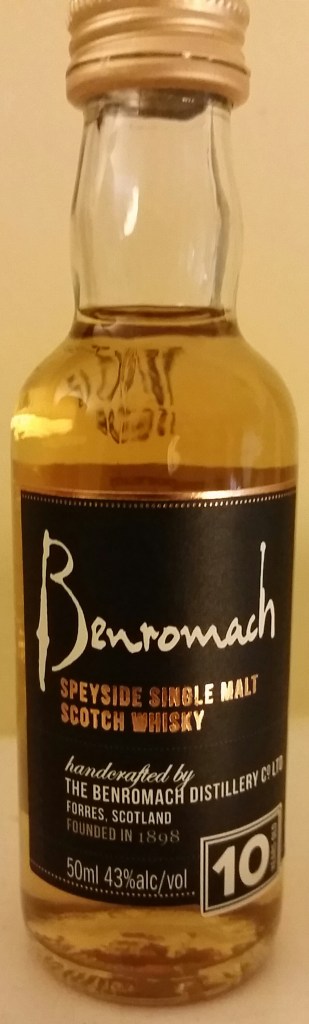
Benromach 10 y/o

Maker: Benromach, Forres, Moray, Scotland, UK (Gordon & McPhail)20160310_190411-1.jpg

Region: Speyside (Northwest)

ABV: 43%

Michigan State Minimum: $63

Appearance: Medium copper with medium legs.

Nose: Big malt, new leather, alcohol. As it sits, the leather settles into an old oak aroma.

Palate: Full bodied and medium sweet. Toffee, brown butter, dried red chili.

Finish: Warm and a little chewy.

Parting words: Given the expense of decent single malts, I’m always on the lookout for miniature bottles of SMS for blogging purposes. I picked the one the I used for this review at Vine & Table in Carmel, Indiana (I think).

I like Benromach labels and liked most of G & P’s private bottlings I’ve had, so I was looking forward to opening this bottle. When I first opened it, I wasn’t impressed. It seemed unbalanced and sulphury, especially in the nose. As it sat (or as my palate adjusted itself) I came to enjoy it quite a bit. It’s simple, but the toffee flavor is really hitting the spot for me. Benromach 10 is a simple, affordable dram suitable for after-dinner sipping with friends. Recommended.

The Exclusive Malts- Cambus, 1988

Maker: Cambus, Cambus, Clackmannanshire, Scotland, UK (Diageo)

Style: Grain whisky

Age: 26 y/o

ABV: 48.1%

Price: $180 (K & L)

Thanks to Marshall for this sample.

Appearance: Old gold with thick, very slow legs.

Nose: Old oak, butterscotch pudding, serrano chili, alcohol

Palate: Banana pudding, then burn. With water the burn and banana fades into creamy vanilla custard.

Finish: Sweet and custardy, banana cream pie. Similar with water but with oak on the back end.

Parting words: Cambus was one of the first grain whisky distilleries in Scotland, and possibly the first to use a column (aka Coffey or patent) still. Its early history is fuzzy, but it may have been founded in 1806. What is known for certain is that it began at its current site in 1836 and was one of the founding members of Distiller’s Company Limited (DCL) a corporate ancestor of Diageo. When UDV (one of Diageo’s parents) was formed in 1993, Cambus was shuttered. This being Scotch, Cambus-distilled grain whisky has hung around for a long time.

A little ironically, The Exclusive Malts bottled this grain (not malt) whisky as a part of a big batch of vintage single cask Scotches they released last year. This one is the oldest. The others are all mid 1990s vintage. They include casks from nearby Deanston, Ben Nevis, Glen Keith, Glen Garioch, and Allt-A-Bhainne (no, that last one isn’t made up).

I love Twitter. One of the reasons is that it enables me to meet whiskey enthusiasts from all over the world and chat with them. One of the persons I’ve met that way is Marshall. We met in person back around Christmas (or was it Thanksgiving?) and he generously gave me a sample of this at that time. Earlier this week I was thinking of a special Scotch to review for the Friday before Burns Night and this one seemed perfect. It is delicious. It’s also surprisingly bourbon-like, specifically it’s like old bottles of Old Taylor, Very Old Barton or Old Charter Proprietor’s reserve (slope-shoulder Louisville version) that I’ve had. Big butterscotch and tropical fruit flavors, but perfectly balanced with wood, sweetness and vanilla. $180 isn’t chump change but it’s not unreasonable for a whisky of this quality and age from a closed distillery. Cambus 1988 is recommended.

Gordon & Macphail Vine & Table Selection- Coal Ila 8 y/o, cask strength.

Bottler: Gordon & MacPhail, Elgin, Moray, Scotland.2015-12-23-15.16.36.jpg.jpeg

Distiller: Caol Ila, Port Askaig, Argyll, Scotland, UK

Region: Islay

Age: 8 y/o (distilled July 2006, bottled August 2014)

ABV: 58.8%

Price: $65 Exclusive to Vine & Table, Carmel (CAR-muhl), Indiana, USA

Notes: Single cask, natural color, not chill filtered. Aged in a refill sherry hogshead, cask #306213. One of 260 bottles. At cask strength, this whisky was all peat and smoke to me, so I diluted it to around 50% ABV for this review.

Appearance: Medium copper with thin, irregular legs.

Nose: Peat, smoke, black tea, drop of sherry.

Palate: Full bodied and hot. Some tropical fruit and vanilla in the beginning then the burn grows as does smoke, but without a lot of peat.

Finish: Ashy. Fireplace, old ashtray at grandma’s house back in the 1980s when people smoked inside. A belch after drinking this is the closest we humans will come to knowing what it’s like to be a dragon.

Parting words: Diageo’s Caol Ila is best known as a supplier of smoky malt for a myriad of independent bottlers and makers of blended malts. There’s also a 12 y/o distillery bottling that I reviewed here and friend of the blog My Annoying Opinions reviewed here. There was at one time a Distiller’s Edition, but I’m not sure how available that was in the US. In recent years there have also been a number of young, cask strength, independent bottlings like this one making the rounds. Most single malt Scotch doesn’t get bottled at anything less than ten years of age, but smoky malts often do because the smoke is more prominent at a younger age.

If fire is what you crave, this is the malt for you. A belch after drinking this is the closest we humans will come to knowing what it’s like to be a dragon. There’s not much else going on, though. There’s a hint of sweet malt and sherry, but it is hard to find behind the inferno. This Caol Ila is one dimensional, but it is only $65 and at cask strength which makes it more attractive than it might be at a standard proof. A volcano like this is especially good if you enjoy making your own blends at home. I mixed a little bit in with some Craigellachie 13 and some 16 y/o grain whisky and it added a nice extra bit of smoke to both of those.

If you enjoy smoky whisky like I do or if you’re looking for some smoke in your personal blending lab, Vine & Table’s 8 y/o, cask strength Caol Ila from V & T is a good choice. Recommended.

Craigellachie 13

Maker: Craigellachie (Aberlour), Craigellachie, Moray, Scotland, UK (Bacardi)wpid-2015-10-30-20.16.53.jpg.jpeg

Region: Speyside (BenRinnes cluster)

Notes: Not chill filtered. The Last Great Malts series.

ABV: 46%

Michigan State Minimum: $55

Appearance: Dark straw with clingy evenly spaced legs.

Nose: Leather, apricot jam, alcohol, lavender, dried date.

Palate: Full-bodied and medium sweet. Ripe red peaches, oak, butterscotch, ground coriander seed.

Finish: Sweet malt, oak, then a light burn.

Parting words: Craigellachie named for a bluff overlooking the River Spey and there is a Craigellachie bridge (built in the early 19th century) and a Hotel Craigellachie that is often recommended as a good place to stay while exploring the Speyside area. The distillery itself has a remarkably boring history which I will not recount. It’s currently owned by Bacardi’s Dewars & Sons division and forms the heart of Dewar’s blends. It has been only rarely seen in independent or distillery bottlings over the years, but that may be changing with its two entries in Dewar’s The Last Great Malts series.

Craigellachie’s neighbors are more famous than it, like Macallan, Glenfiddich, Glenlivet and Aberlour. Unlike most of those, this is not a light and flowery malt. It’s got heft to it, like Balvenie and Mortlach. It’s often described as sulphury and waxy but I have trouble detecting either one here, though I have trouble detecting them anywhere, frankly. The heft and alleged sulphur come from the large stills (allowing for reflux), use of cast iron worm tubs to cool the spirit, and the relative dearth of copper in the worms, so I’m told.

Unlike Balvenie and Mortlach, there is no beef here. This is all thick custard, fruit and oak. Ex-bourbon casks take the lead here, but there may be a few sherry butts in the mix as well. If so, they are used judiciously. This is an exquisitely balanced, but flavorful and well-craft whisky. It pairs great with homemade shortbread too.

Considering all the garbage that is out there at twice the price, Craigellachie 13 is a steal. Considering how good this is has made me loose even more respect for Bacardi/Dewar’s. How can your blend taste so bad when your malt is so good? I don’t know, but I do know that Craigellachie 13 is great. Highly recommended.

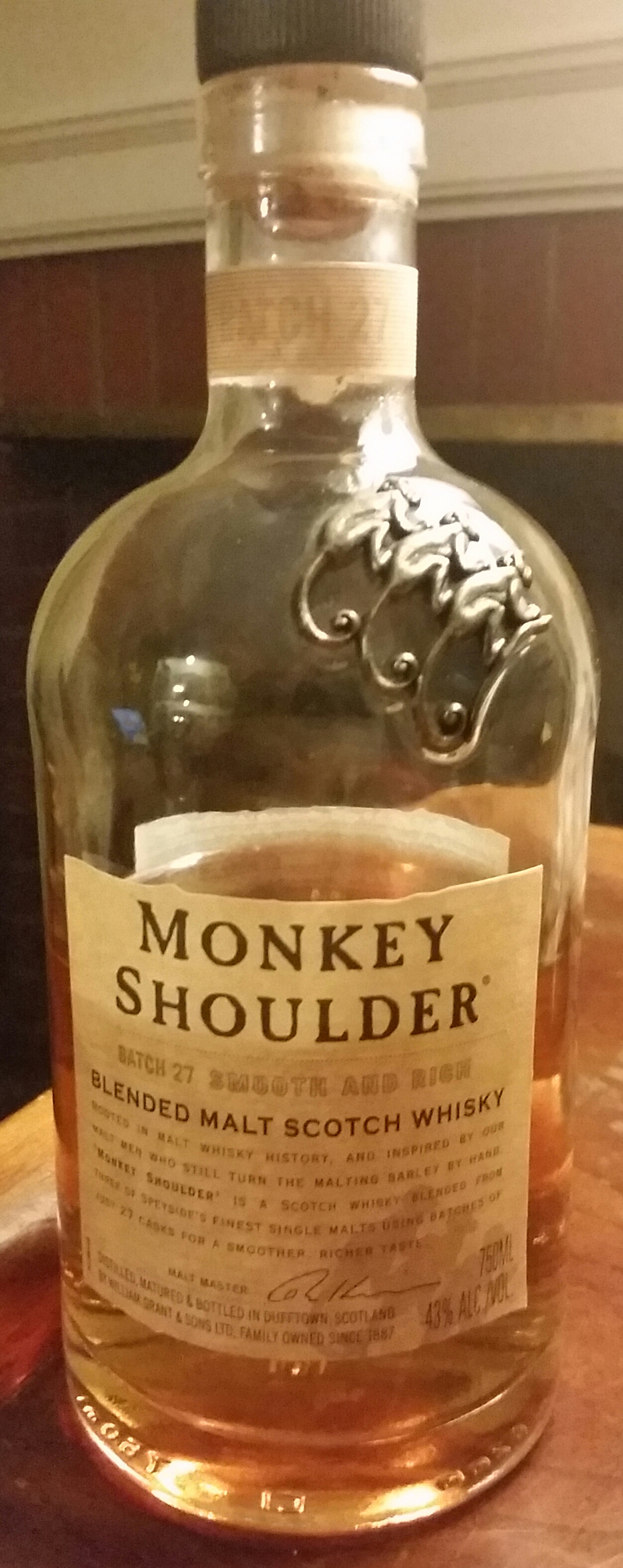
Monkey Shoulder

Maker: Wm. Grant & Sons, Dufftown, Banffshire, Scotland, UKwpid-2015-08-28-20.57.35.jpg.jpeg

Style: Blended Single Malt Scotch (Glenfiddich, Balvenie, Kininvie)

Age: NAS

ABV: 43%

Michigan state minimum: $33

Appearance: Medium copper with a lot of necklacing and legs.

Nose: Sweet malt, vanilla, sage, alcohol, old oak, serrano peppers.

Palate: Medium bodied and semi-sweet. Vanilla buttercream, strawberry, butterscotch, sweet cinnamon.

Finish: Dry and long lasting. Crème brûlée, alcohol, oak.

Parting words: The success of blended malts like Sheep Dip and especially Compass Box’s offerings led older, older companies to take notice. Monkey Shoulder, released in the UK in 2005 was Wm. Grant & Son’s response, and it’s a dammned good one. A blended malt (formerly known as a vatted or pure malt) is a blend of all single malts. This is different from a standard blended Scotch because it contains no grain whisky, only malts.

The family resemblance to Grant’s blended whisky (the last Scotch I reviewed) is evident, but it’s much more complex, as one might expect. Like Grant’s, this is a very tasty whisky at a good price. For a top notch blended malt, it’s impossible to beat. Grant’s marketing folks keep pushing it as a mixer but it’s so good neat that I couldn’t bring myself to mix it with anything.

Monkey Shoulder is highly recommended.

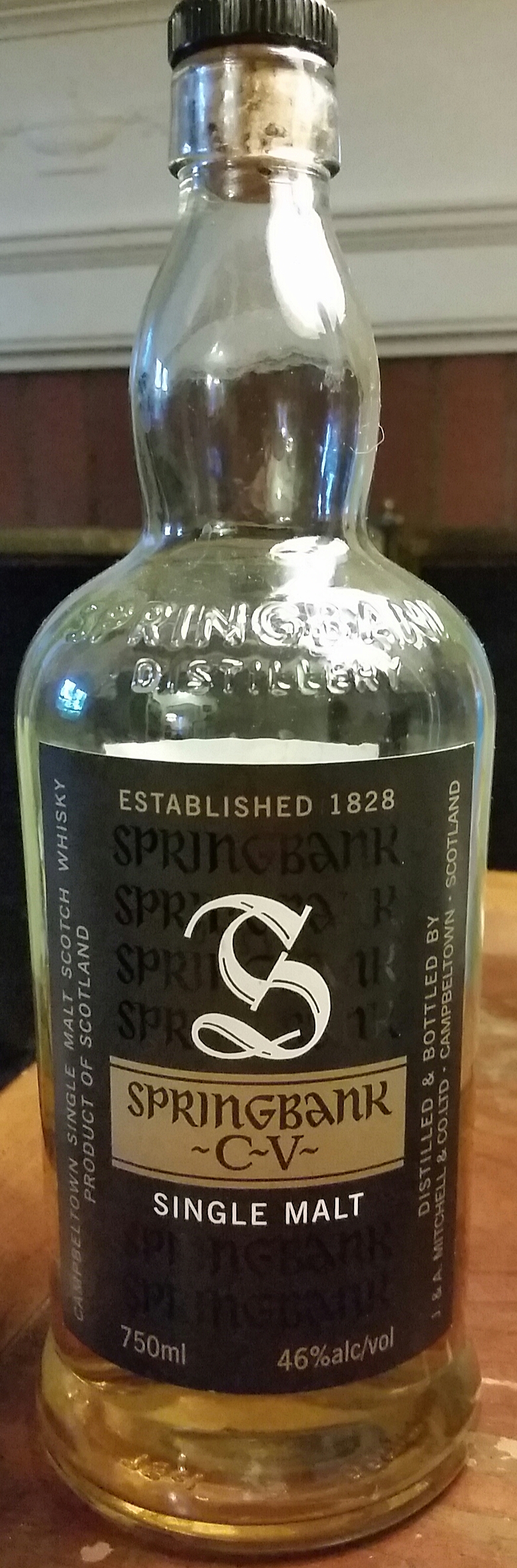
Springbank CV

Maker: Springbank, Campbeltown, Argyll & Bute, Scotland.wpid-2015-05-22-20.29.13.jpg.jpeg

Region: Campbeltown

Age: NAS

ABV: 46%

Appearance: Old gold with evenly spaced legs.

Nose: Peat, damp humus, seawater, leather, sweet malt.

Palate: Full bodied and hot. A little water calms it down. Dates, brown butter, butterscotch candy, roasted pecans, brine, smoke.

Finish: Warm and smoky. More earthiness, wet firewood.

Parting words: I fell in love with Springbank 10 at first sip so I then quickly moved on to the 15 y/o expression. I didn’t realy care for it. It had a tired, murky quality to it that I didn’t care for. So I sadly refrained from buying any Springbank until I bought this in an effort to reacquaint myself with the distillery. What better way is there to get to know Springbank than by drinking its CV?

None, that’s what. This is a fantastic whisky. It has the sweet, nutty characteristics of the 10, but with the added depth of earthiness and smokiness that whiskies from the neighboring island of Islay exihibit. I’m usually a skeptic when it comes to the influence of the ocean on Scotch, but there are aromas and flavors that come across as maritime in this whisky.

The complexity is very much by design. The CV is a marriage of malts of a variety of ages and styles all from the Springbank Distillery in Cambeltown, the smallest recognized single malt Scotch region. My bottle is from the second edition (the first got mixed reviews) and I love it, as you can probably tell. Unfortunately it seems to be out of stock at the usual major retailers, but I paid around $70 for mine and it was worth every penny. I’m sure there are quite a few of these still in the wild. Pick one up if you can. Springbank CV (second edition) is highly recommended.

Spice Tree

spicetree_bottle-sm
from http://www.compassboxwhisky.com/images/trade_press/bottle_shots/spicetree_bottle-sm.jpg

Maker: Compass Box, Edinburgh, Scotland, UK

Style: Blended malt in American oak with toasted French oak barrel heads (see here for more information: http://www.compassboxwhisky.com/pdf/TheSpiceTree.pdf)

Region: Northern Highlands

Note: Not colored or chill-filtered.

ABV: 46%

Michigan state minimum: $62

Appearance: Medium gold with long thin legs

Nose: Sweet malt, vanilla, nutmeg, pinch of ginger.

Palate: Soft with a hint of spice. Custard, cassia, allspice, mace, ginger, clove.

Finish: Spice followed by a hit of vanilla fading into alcohol heat.

Parting words: The original edition of Spice Tree was aged with French oak barrel inserts. The Scotch Whisky Association threatened legal action against Compass Box because of this process. Compass Box decided not to fight the SWA and changed their process to one utilizing French oak barrel heads instead of the inserts.

I never got a chance to taste the old controversial version but this one is very good. I enjoy the Northern Highland whiskies very much on their own and the French oak process has nicely enhanced the spicy flavors of these malts. One would also be hard pressed to get a malt from any of those distilleries at this price that tastes this good. Spice Tree is recommended.

Gordon & MacPhail Mortlach 15 y/o

Maker: Mortlach, Dufftown, Moray, Scotland, UK (Diageo)

Bottled by Gordon & MacPhail, Elgin, Moray, Scotland, UK

Region: Speyside- Dufftown

ABV: 43%

Price: $75 (Binny’s)

Appearance: Dark gold

Nose: Sweet malt, wildflowers, oak, caramel.

Palate: Thick mouthfeel. Brown butter, wildflower honey, beef bullion, alcohol.

Finish: alcohol, butterscotch, vanilla cream, toasted oak.

Parting words: Mortlach was one of the malts that made me reconsider my dislike of Speysiders. This bottling is an excellent example of why I fell in love with this distillery. Meatiness is a house characteristic of Mortlach and it’s in evidence in this bottling. It’s not heavy-handed, though. There’s plenty of sweetness and oak to round it off nicely. It’s complex without being busy. The price is high (for me) but not completely out of whack for a high-quality single malt and cheaper than the new distillery bottlings are going for. If you like the heavier Speyside style and see one of these pick it up. G & M’s 15 y/o Mortlach is recommended.