Craft Whiskey Tasting with Blind Barrels: A Review

Several months ago, Davis Armstrong and Bobby DeMars of Blind Barrels reached out to me with an offer to send me a complimentary box of their craft whiskey samples for review. Last summer was  busy, so it took me a while to respond. I had never heard of the company, but the concept sounded interesting.

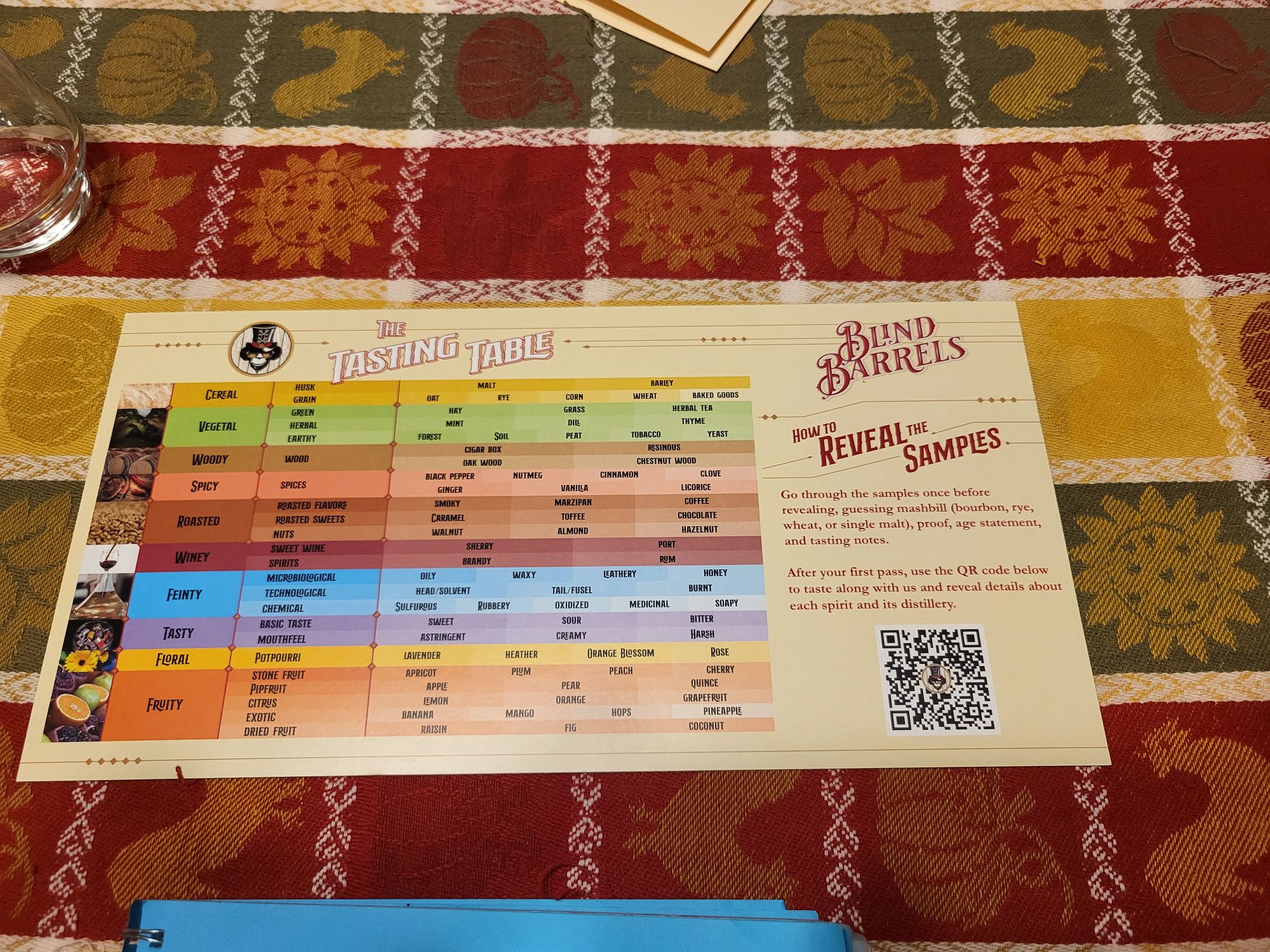
The concept is this: Blind Barrels ships you four 50 ml bottles of whiskey in a plush, classy-looking black box with a golden chimp wearing sunglasses and a steampunk-style top hat for some reason. Included are two letters (at least in my case) from Davis & Bobby, and a “tasting table” of flavors and aromas. Each bottle has the chimp logo, the ABV % of what’s inside, and a QR code. How one distributes the whiskey is up to the tasters, but the materials recommends to pour a little of A in everyone’s glass, take notes, discuss and repeat for B, C, and D. That’s what we did.

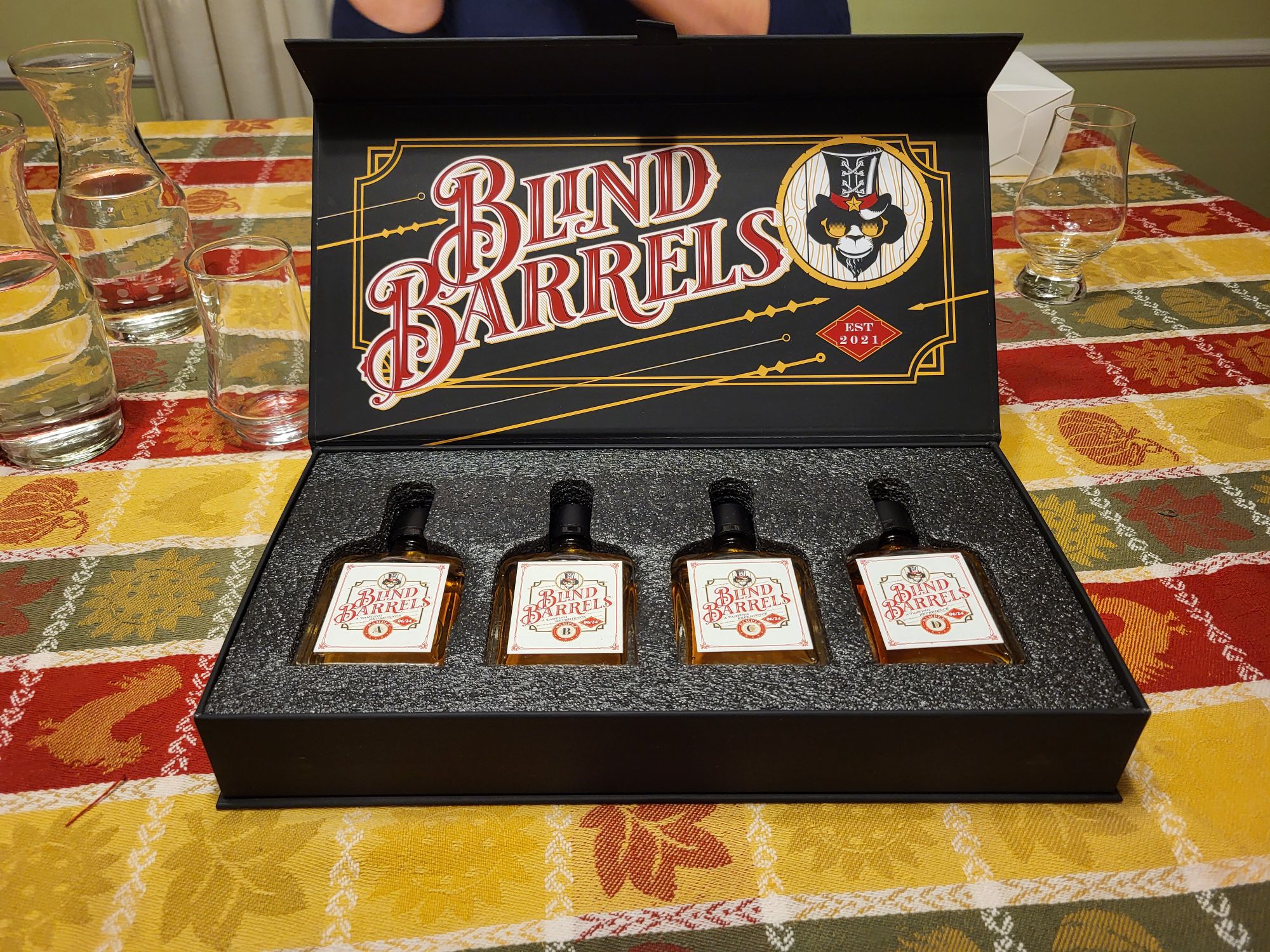
Individual boxes cost $70 each, plus $15 shipping. Subscriptions are a much better deal. Quarterly billing is $60, plus $15 shipping per box ($300/year plus tax). Annual rebilling is the best value for money at $50 per shipment, plus $12.50 shipping ($250/year plus tax). The subscriptions have the added benefit of giving the subscriber a discount on the full bottles of whiskey being sold. All the whiskeys in the various shipments are from small distilleries with limited distribution, so long time whiskey nerds should be prepared for some off-beat selections.

 Different boxes have different themes. Ours was Box X (the tenth one). It was released around Father’s Day last year and had a theme of father and (adult) child distillery partnerships. There is also a special Fred Minnick (friend of the blog) box one can order for $70. According to the website, it comes with special guidance from Fred himself. This might be a good option for people who are looking to use a Blind Barrels shipment to jump start their entry into craft whiskey enthusiasm.

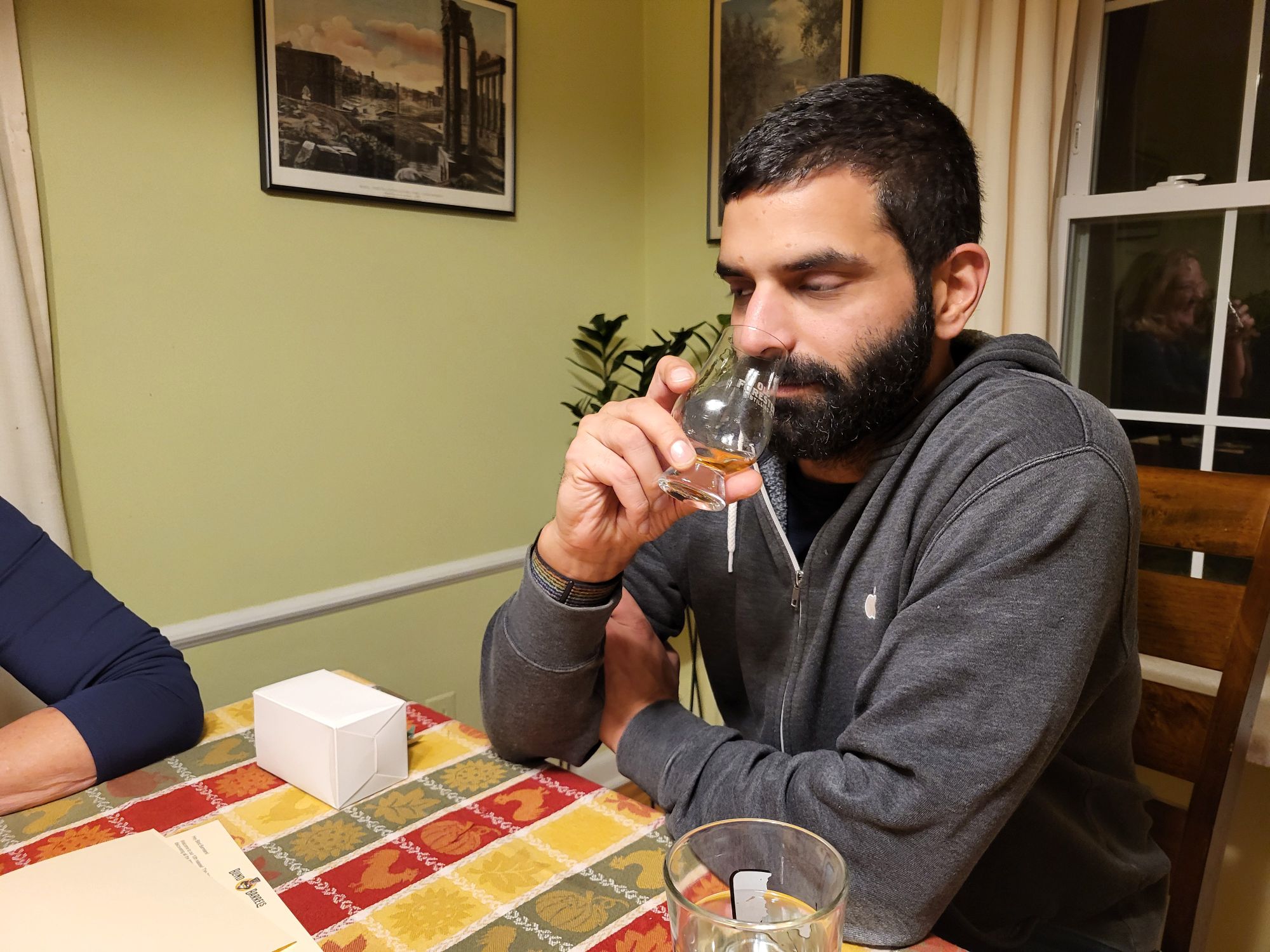
My box arrived in September. In October I rounded up a few friends (Amy, her neighbor Nick, and my wife Liz), and we tasted through the four samples together.

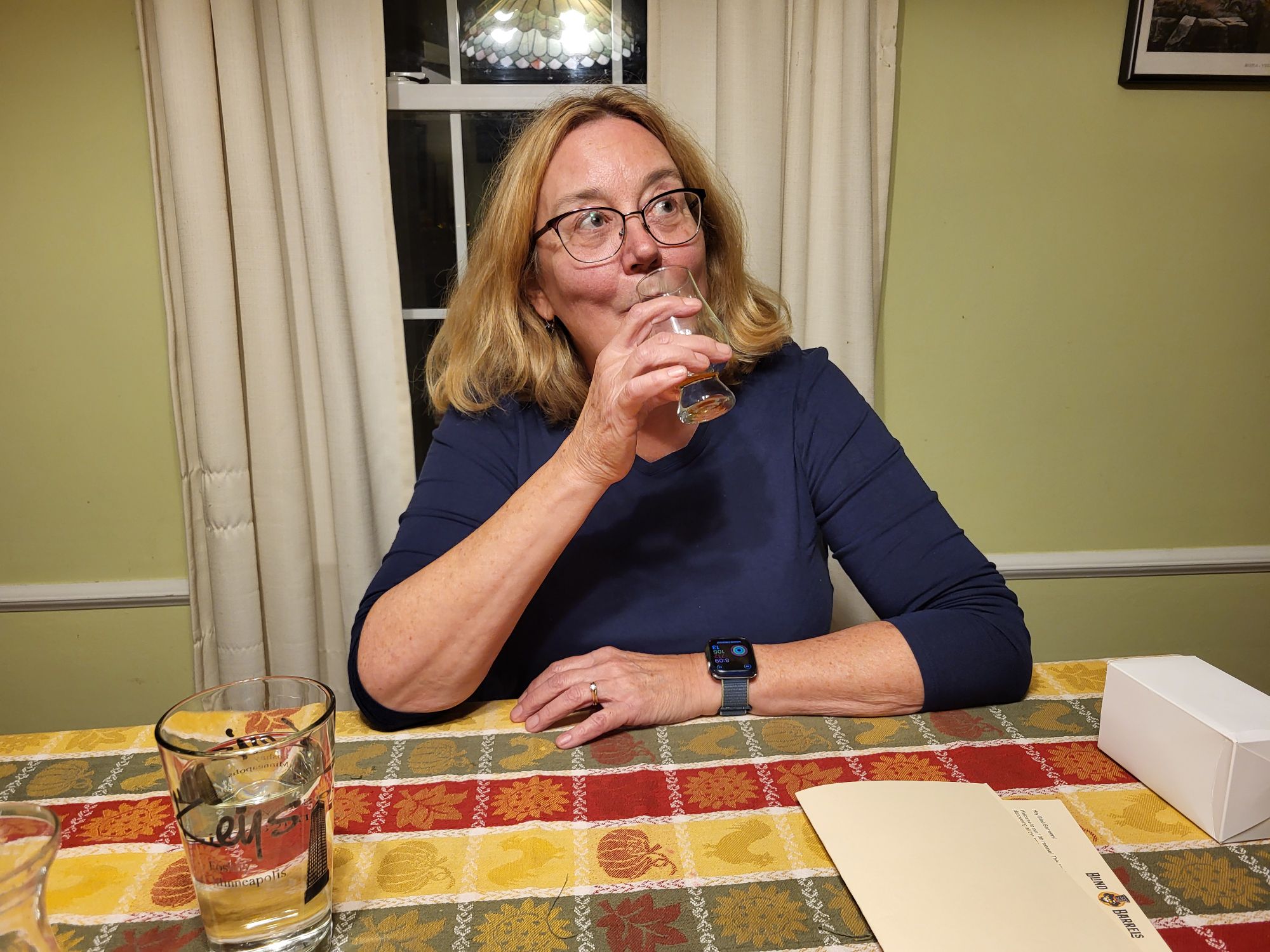
Here’s what we thought of them at first taste:

A: Pretty good, probably a rye.

B: A little weird, A wheater, maybe.

C: Even weirder. Oat whiskey or oat bourbon?

D: Wow, stunning. A well-aged bourbon.

 At least that’s what I think we thought of them. In an all-to-common bout of unprofessionalism, I lost all the notes I took that night. Drinking may have been involved.

Anyway, we were almost entirely wrong. Here’s what they really were (the first price listed is the MSRP, the second is the subscriber price):

A. Axe Hole Single Malt, Calwise Spirits, Paso Robles, California. 84 proof, $90/$75.

B. UNBendt Straight Rye BiB, Bendt Distilling, Lewisville, TX. 100 proof, $70/$55.

C. Old Monongahela Full Proof Rye, Liberty Pole Spirits, Washington, PA. 108 proof, $85/$65.

D. Doc Holliday 10 y/o Straight Bourbon, World Whiskey Society, Pendergrass, GA. Distilled at Ivy Mountain Distillery, Mount Airy, GA. 122 proof, $200/$130.

As you can see, D was the clear standout. Nick, a whiskey novice, pointed out that a part of concept with this is a marketing/sales play. While all the whiskeys were interesting, D was the standout, and it also has the biggest discount. He concluded that the primary aim of this box was to sell Doc Holliday 10 y/o.

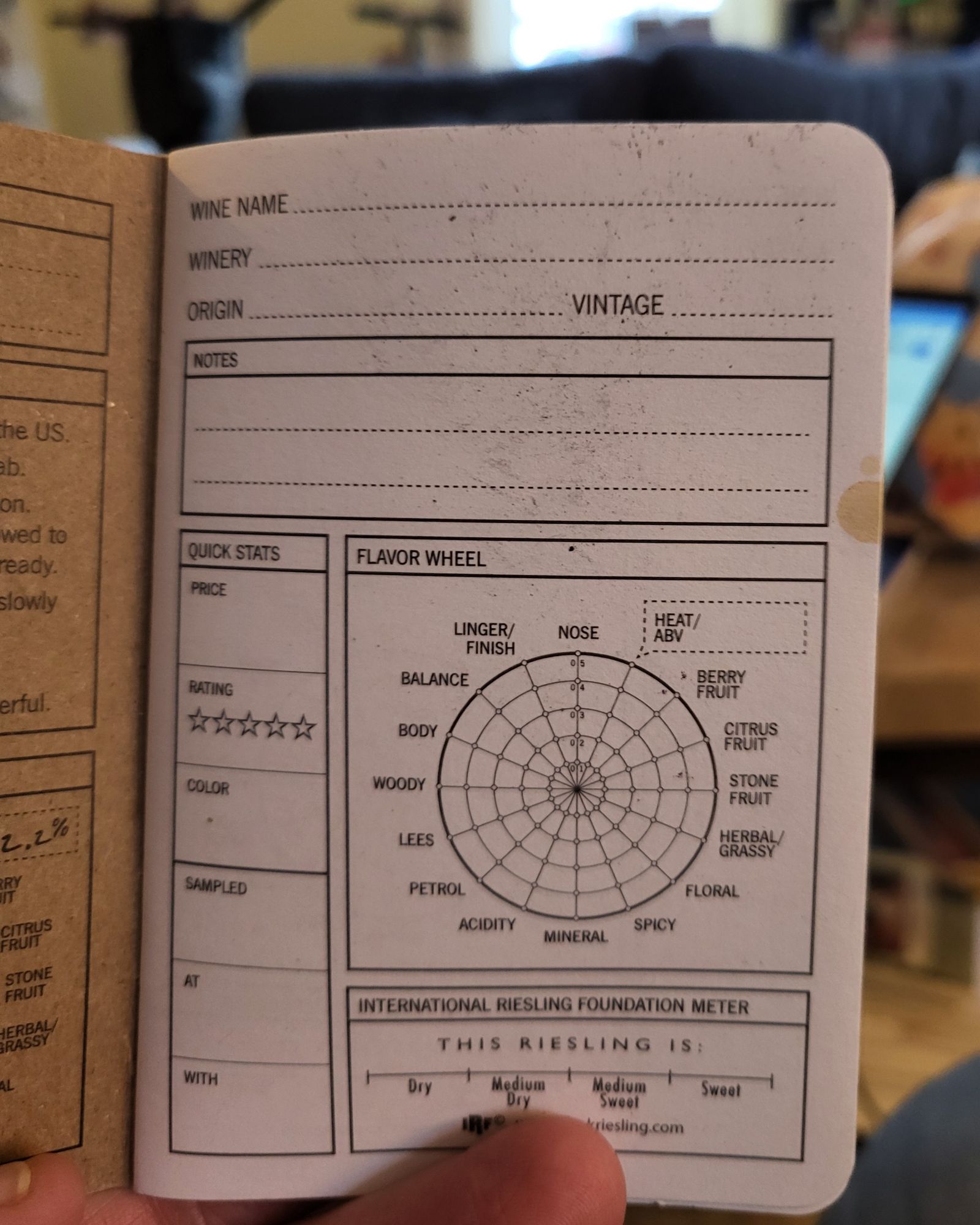
Nick also had a suggestion. Rather than the tasting table with its collection of terms, tasting sheets that can be filled out by each taster might make the experience even easier. Perhaps something like the Riesling tasting booklet pictured to the right. It also might make the tasting notes less likely to be lost.
Anyway, we had a lot of fun! I’ve hosted blind tastings before, and keeping them blind is always a problem. The innovation of the QR code on the back of the bottle takes all the annoyance out of that. Being able to taste whiskeys one might not be able to taste otherwise also makes things more fun. Whether you’re a grizzled whiskey vet or a newb, I think you’ll find a box from Blind Barrels to be an enjoyable way to spend an evening or weekend afternoon. They make great gifts as well. Blind Barrels is recommended.

Rye World

Maker: Krogman’s, Bloomington, Indiana, USA

Distiller: Ross & Squibb (formerly MGPI), Lawrenceburg, Indiana, USA

Style: Single Barrel Indiana High Rye Rye Whiskey.

Age: 4 y/o

Proof: 112 (56% ABV)

Notes: 95% Rye, 5% malt, #4 barrel char.

Price: $25 (Vine & Table)

Appearance: Medium copper.

Nose: Bold. Tarragon and leather.

Palate: Full-bodied and semi-sweet. Wintergreen, burn. More bitter with water. Char and peppermint.

Finish: Extra-minty toothpaste, apricot. With water, a little fruit but mostly faded starlight mint.

Parting words: As you may have guessed, Rye World is the Rye equivalent of the Bourbon World Vine & Table single barrel selections. That said, it’s a little less distinct than those two, since it’s basically just the standard high rye rye whiskey recipe from Ross & Squibb. That’s fine, though, since it’s a good example of that recipe, high proof, and cheap. If you like Bulleit Rye (apparently the best selling rye in the US at the moment!), you’ll love this. It’s aggressively herbaceous and minty, but take it easy with the water. It wasn’t able to withstand as much as I thought it would.

If you like Indiana Rye, Bourbon World is recommended.

Thistle Finch Small Batch, Batch 09

Maker: Thistle Finch, Lancaster, Pennsylvania, USA

Style: Wheated (!) Straight Rye Whiskey

Age: 2 y/o

Bottle date: November 13, 2019.

Proof: 90 (45% ABV)

Purchased for $47 (PLCB Monroeville-Northern Pike)

Appearance: Light copper.

Nose: Sawdust, cut grass.

Palate: Medium bodied and sweet. Allspice, hay.

Finish: Grass, dark chocolate, burn.

Parting words: I knew nothing about Thistle Finch before I saw this bottle on the shelf at the PLCB store I stopped at while coming home from a family vacation in Somerset Pennsylvania last summer. I’ve heard Pennsylvanians complain about the PLCB stores for years but I had never experienced one until then. Folks, it’s all true. They’re terrible. I went to that store to pick up some Dad’s Hat Rye and I had a list of Pennsylvanian wines I wanted to look for. They had none of those wines, and I was only able to find Dad’s Hat after wandering around the store for twenty minutes. It was in a special “made in Pennsylvania” section next to Pumpkin vodka, and several bottles of sickly sweet plonk. Bad selection, bad prices, poorly organized, it was awful. Like a LCBO store but much worse.

I picked up this bottle of Thistle Finch Rye from the bourbon section where it was lurking for some reason. I mostly picked it up because I was afraid I wouldn’t be able to find Dad’s Hat, but since they didn’t have any of the wine I was looking for I went ahead and bought Thistle Finch too. I’m glad I did. It has a lot of typical young rye flavors but has a roundedness that was nice, maybe due to the wheat in the recipe, highly unusual for American ryes.

It’s ok neat, but it really shines in cocktails, where it works well in drinks that might usually call for higher proof rye, on account of its aromatic nature. It did very well in a Manhattan, with ginger ale and orange bitters, and in a couple of cocktails I have named the Sterling Hayden (2 oz rye & 1/2 oz Aquavit), and a Skink (2 oz rye & 1/2 oz green Chartreuse). Both of the latter play up the rye’s herbaceousness.

I know next to nothing about the Thistle Finch folks, but this is a solid rye, that should only be getting better in later batches, if they let some rest, like they say they will. The distillery is located next to a brewery in an old tobacco warehouse in Lancaster. It’s one of these bar/distillery operations, and a pretty successful one by all appearances.

$47 isn’t cheap, but think of it as an investment in the future. Thistle Finch Small Batch Straight Rye Whiskey is recommended.

Ezra Brooks Straight Rye

Maker: Lux Row, Bardstown, Kentucky, USA (Luxco)

Distiller: MGPI, Lawrenceburg, Indiana, USA

Style: Indiana high-rye straight rye.

Age: 2 y/o (“24 months”)

Proof: 90 (45%)

Michigan State Minimum: $15

Appearance: Light copper.

Nose: Butterscotch, tarragon, woodruff.

Palate: Full-bodied and fruity. Apricot, leather, serrano chili.

Finish: Hot, sweet and herbaceous.

Mixed: Yes.

Parting words: It’s cheap but not terrible. Ezra Brooks Straight Rye Whiskey is recommended.

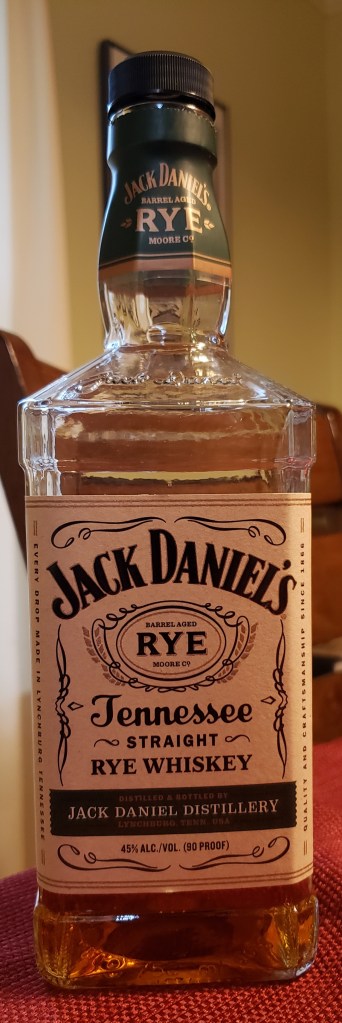
Jack Daniels Rye

Maker: Jack Daniels, Lynchburg, Tennesee, USA (Brown-Forman)

Style: High rye (70%) straight rye whiskey

Age: NAS (at least 4 y/o)

Proof: 90 (45% ABV)

Michigan state minimum: $25

Appearance: Medium copper.

Nose: Potpurri, leather, tarragon.

Palate: Full-bodied and medium sweet. Spearmint, cinnamon disks.

Finish: Shamrock Shake.

Mixed: Performed adequately in a Manhattan, Old Fashioned and in a highball.

Parting words: Long time readers will know that, generally speaking, I don’t like anything with Jack Daniels on the label. Despite that fact, perhaps in an effort to punish myself or as a service to you, dear readers.

Despite my poor expectations, this rye isn’t bad. It’s much better than the George Dickel rye, which was slapped together by running aged MGP rye through a large vat of charcoal. The result was a confused, maple-flavored mess. Brown-Forman took their time putting this rye whiskey together and it shows. Not that it’s great, but it’s a perfectly servicable rye, on par with Jim Beam or Rittenhouse rye at about the same price. For once I gotta hand it to JD. Jack Daniels Rye is recommended.

Knob Creek Cask Strength Rye, 2018

Maker: Jim Beam, Boston/Clermont, Kentucky, USA (Beam Suntory)20191108_192435.jpg

Style: Kentucky-style Rye (low rye rye)

Age: 9 y/o (? barreled 2009, released 2018)

Proof: 119.6 (59.8% ABV)

Purchased for $70 ( Holiday Market)

Appearance: Medium copper

Nose: Oak, black pepper, cayenne, tumeric. With water, a little more sweetness. Caramel and anise.

Palate: Full-bodied and creamy, then hot. Still creamy, but with toffee, a little citrus and clove.

Finish: Heat and not much else except a little sweetness at the end. With water: Red pepper, oak, brown sugar.

Parting words: I love Knob Creek rye, so I was very excited when I saw this limited edition release. I was less excited when I started drinking it. KCR is already very bourbon-like but this edition is even more so. I like bourbony ryes, but at a certain point you have to ask yourself why you’re not just drinking bourbon (which is usually cheaper).

The strength of this editon of Knob Rye is its lucious mouthfeel. It’s a show-stealer, and it even holds up with a generous does of water. Aside from that, there’s not much here that isn’t in the standard Knob Creek Rye. I think I might like the standard edition better, even without factoring in the much higher price. It’s pleasant, but I really can’t recommended it at $70, even mildly. Hopefully the next edition of cask strength Knob Creek Rye will be better.


Old Forester Rye

Maker: Brown-Forester, Louisville, Kentucky, USA20190329_214938.jpg

Style: Kentucky style “barely legal” straight rye whiskey.

Age: NAS

Proof: 100 (50% ABV)

Michigan state minimum: $25

Appearance: Medium copper.

Nose: Alcohol, tarragon, cut grass, catmint, lime jello.

Palate: Medium-bodied, dry and herbaceous. Peppermint, lavender, ghost pepper, alcohol.

Finish: Semi-sweet, woodruff, and a little sweetness. No oakiness at all.

Mixed: Did well everywhere: with ginger ale, in a Sazerac, in a Manhattan, a Monte Carlo, a Normandy Cooler and with a dash of akvavit.

Parting words: This is the first rye made at the Brown-Forman distillery in a very long time. Sort of. When Heaven Hill’s Bardstown distillery was destroyed by a fire in 1996, they contracted the production of their whiskey to other Kentucky distillers, including B-F. They produced the 1998 and 1999 vintages of Evan Williams Single Barrel and, most importantly for this review, they also took over production of Rittenhouse Rye. The Bottled-in-Bond became a cult favorite (look for DSP 354), and I would argue that its success helped kick off the current rye boom. There was a bit of mystery around it, though. Heaven Hill claimed that it was made from their recipe, but sources at Brown-Forman claimed that it was an old recipe that they had dug out of their files. Given the big difference between the current Rittenhouse and the old B-F distilled version, I tend to believe the second story.

When production of Rittenhouse moved to Heaven Hill’s new distillery in Louisville, there was no B-F made rye on the market until this year. Old Forester Rye is made with a recipe that is unusually high in malted barley. The result is a fruity, slightly spicy rye that is in the same vein as Old Forester bourbon. It mixes very well, is 100 proof and the price is right for a macro-distilled rye. Old Forester Rye is highly recommended.

For another perspective, check out Friend of the blog Gary’s review over at Whisk(e)y Apostle!

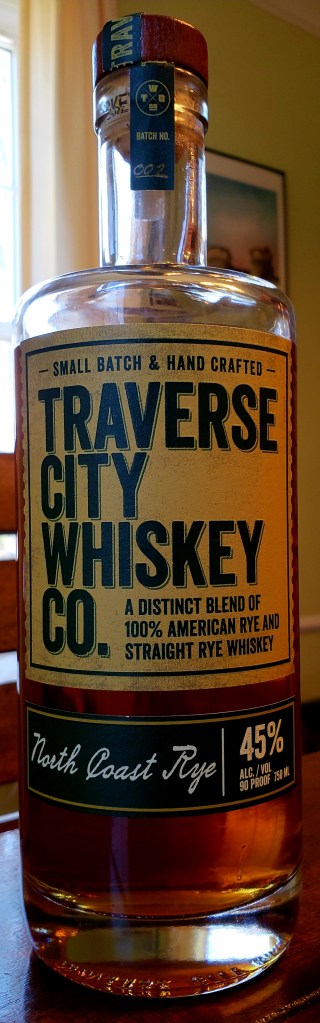
Traverse City Whiskey Co. North Coast Rye

Maker: Traverse City Whiskey Company, Traverse City Whiskey Co., Michigan, USA20181114_115315.jpg

Style: High-rye blended rye.

Age: NAS

Proof: 90 (45% ABV)

Michigan state minimum: $40

Appearance: Burnt orange.

Nose: Oak, peppermint, woodruff, alcohol, basil.

Palate: Toffee, butterscotch, burn.

Finish: Starlight mints, oak.

Mixed: Adds a pleasant minty note to classic cocktails like the Sazerac, Manhattan and Brooklyn. Undistinguished with ginger ale.

Parting words: When sourced Traverse City Whiskey Co. whiskey first hit shelves, I was very skeptical of whether they would ever actually distill anything, let alone anything good. I’m glad to see my skepticism was unfounded! I reviewed their first release, Traverse City Whiskey Co. Bourbon back in 2012, with friend-of-the-blog Amy, on the shores of Walloon Lake. Watch it here.

If you like Bulleit Rye, you’ll like this. It’s in the same minty style. The label says that it was distilled by TCWC themselves and is a blend of 100% (non-straight) rye and straight rye. My first suspicion was that this was a blend of Indiana rye and TCWC’s own distillate, but I’ll take the label at its word.

Assuming it’s all accurate, more micro-distillers should be making good blends like this instead of rushing underaged bourbons and ryes to the market for inflated prices. Speaking of the price, it’s not terrible when one factors in the usual micro-distiller inflation, although Bulleit is $13 less. North Coast Rye is recommended.