Review: Elijah Craig 18, Single Barrel (Binny’s select)

Age: 18 (+)

                Barreled: 4/2/1991

                Barrel: 2932

Proof: 90

Distillery: Heaven Hill, Bardstown, KY

Color: dark copper

Nose: Pecans, oak, bit of sweetness

On the palate: dry, light, then sweet, then a long, lingering, luscious, with walnutty wood.

Finish:  dry oak, but balanced with a soft, sophisticated sweetness.

Parting Words

This is an upper shelf bourbon that I never really cared for before this bottle.  The other ones I had were much too dry and woody.  Why is this one so much better?  Maybe it’s my palate changing, the actual age of the barrels going into these releases (according to a second-hand source, the earliest bottles of Elijah Craig 18 were actually from barrels that were 21 years old), or more likely, Brett and the other whiskey wizards at Binny’s know how to pick ‘em!  It’s well under $50 too, a great bargain for a bourbon this age.  I don’t know how many of these are left, but if you can track one down, get it!
Head to Head: Buffaloed

More private bottlings, this time, Buffalo Trace.  These two are from Binny’s beverage depot in Chicago, and Kahn’s Fine Wines in Indianapolis respectively.  Both do numerous private bottlings.  Binny’s are almost always excellent.  Kahn’s are frequently very good but some are pretty indistinguishable from the standard offering.  But without further ado…

1)      Kahn’s

2)      Binny’s (purchased mid October 2010)

Color

1)      Light copper

2)      Slighly Darker.  More like a dark amber

Nose

1)      Assertive alcohol, wood, char

2)      Slightly more mellow, creamy caramel, bit of clove

On the palate

1)      Sweet caramel, toasted marshmallows, bit of oak

2)      Silky, sweet, much less char, sophisticated

Finish

1)      Lingering marshmallow, a bit of barrel char, low, long burn

2)      Dark caramel, sweetness, tiny hint of that marshmallow, very long, sensual finish

Parting words

I was surprised at the outcome of this tasting.  In the end, I think I preferred the Kahn’s bottle.  It was a great balance of sweetness and spice.  The Binny’s bottle was too dry.  According to my pal at Binny’s, they created their own Buffalo Trace small batch with barrels they selected from BT themselves.  It’s yummy, don’t get me wrong, I just think some of those barrels were too old and dry.

Head to Head: Oh Weller

On trips to Chicago, Binny’s Beverage Depot is always on my itinerary.  Not only do have a friend who works at the South Loop Store, and the store have a great selection, but they always have some great private barrel selections, be they bourbon, Scotch or something else.

Binny’s barrels of Weller 12 y/o (a wheat bourbon made at Buffalo Trace in Frankfort, KY) are always very, very good, so I always pick up a bottle for myself and usually one for somebody else too.  A few weeks ago I picked up a bottle of the latest edition and since I happened to have a little bit left from my previous visit, I seized the opportunity and did a head to head.

Binny’s Weller 12 head to head

1)      Binny’s Weller 12, purchased 3/2009

2)      Binny’s Weller 12, purchased 10/2010

Color

1)      Copper

2)      Same color, but maybe slightly darker

Nose

1)      Granny Smith apple, lavender, a bit of alcohol.

2)      Peanut Butter, fresh roasted peanuts, wood.

On the Palate

1)      Silky, tart, a touch floral

2)      Same silkiness, but woodier and drier.  Much drier.

Finish

1)      Tangy, fills the cheeks, then some slow burn and slight sweetness

2)      Raspberry jam, then fading and slightly sweet and woody.

Parting Words:

I was surprised at the difference between these two bourbons.  Most suprising were the floral aromas and flavors, particularly lavender in the 2009 edition.  This is a characteristic that is most closely associated with high-rye bourbons like Four Roses Single Barrel, not wheat bourbons (which contain no rye at all) which are usually dominated by vanilla and sweet caramel flavors. 

The powers that be at Binny’s have done an excellent job in selecting barrels with distictive profiles that bring out different aspects of this rich and complex (and affordable) bourbon.

Now Drinking

Old Forester Birthday Bourbon 2010

Age: 12 y/o

Proof: 95 (42.5%)

Maker: Brown-Forman, Louisville/Shively, Kentucky

Not to toot my own horn (though I would if I could), but to my knowledge, this is the first review of the latest edition of Old Forester Birthday Bourbon  online.

The 2010 is vastly different from the 2009 (see above).  It’s a cinnamon bomb.  The nose is bright and spicy, like opening up a new jar of high-quality, sweet cinnamon and getting a big schnozz-ful of the stuff.  A bit of dark chocolate lurks in the shadows, just enough to balance the bright spice with an earthy bitterness.

For 95 proof, it slides over the lips mighty easy.  After a second or two of light sweetness, the cinnamon bomb detonates.  It reminds me of how I used to stuff my mouth full of red-hot candies as a child and feel the burn engulf my tongue.  The fire  settles in but lets a little wood sneak into the party.

The finish is long and as big as the whiskey itself.  The burn hangs on as long as possible and the wood influence grows slightly but never takes over.  After what seems like an hour, the finish fades into a slightly spicey sweetness that doesn’t want to leave.

This is a remarkable bourbon.  It’s unlike any other Birthday Bourbon I’ve tasted, or anything else I’ve had.  I bought two bottles today.  I may have to buy a case.

Review

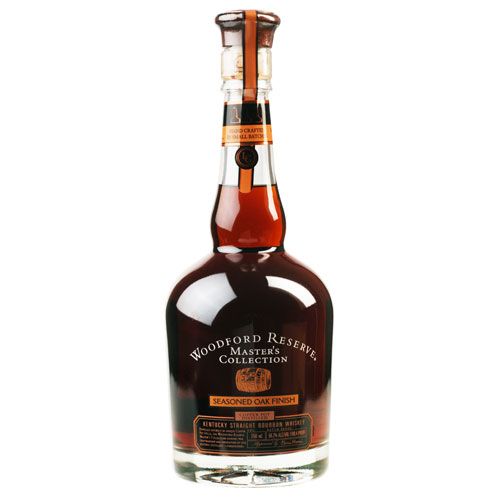
Woodford Reserve Master’s Collection Seasoned Oak Finish

Age: 7-8 y/o +around 8 months “finishing

Proof: 100.4 (50.2%)

Maker: Woodford Reserve/Labrot & Graham, Versailles, Kentucky (Brown-Forman)

Woodford Reserve is (partially) made at a beautifully restored and quite old distillery in Versailles (ver-SAYLES) Kentucky, in Woodford county, west of Lexington.  The oldest building on the site dates to 1838.  Brown-Forman acquired it (for the second time) in 1994 and restored it into the beautiful tourist attraction it is now.

Standard Woodford Reserve is made of a combination of whiskey distilled on site in huge pot stills and whiskey distilled at B-F’s plant in Louisville, home to Early Times and Old Forester.  It is then aged at Woodford Reserve.  For their special annual Master’s Collection releases, they only use whiskey distilled at Woodford and do something interesting with it.  Not always good, but always interesting.

For 2009, they took a standard batch and after it was fully aged, they transferred it to barrels that had been lightly toasted (as opposed to the deep char used on standard bourbon barrels) after having been seasoned for an extremely long time.  Most bourbon barrel staves are seasoned (dried) outdoors for a few months before being charred and made into barrels.  The barrels used to finish this whiskey were seasoned for a few years.  This created a very unusual bourbon.  And a pretty good one too.

It’s dark, even for a bourbon.  Chestnut brown.  The nose is dry, dry oak, black walnut, with a hint of sweetness.  On the palate it continued dry, with a heavy wood influence, but in an unconventional way.  It’s tannic and chewy, like chewing on a damp oak stave.  In a good way, kinda.

The finish is dry, but not as heavy as one might expect.  Tannic, but never quite shifting into bitter.  This is a whiskey teetering on the edge.  But in an odd way, it achieves a nice balance.  My only real complaint is that it costs $90 for one bottle.  Luckily I was able to split one three ways with a couple other enthusiasts.

For a list of the upcoming releases visit Chuck Cowdery’s blog here.

Now Drinking

Virginia Gentleman Straight Bourbon Whiskey

Age: NAS (6-9 y/o ?)

Proof: 90 (45%)

Maker: A. Smith Bowman, Fredricksburg, Virginia (Sazerac corp.)

Viriginia Gentleman (VG) is a unique bourbon in a number of ways.  First, it is a great way to win a bar bet.  There is an urban (rural?) legend that bourbon whiskey can only be made in Kentucky.  In fact, it can be made anywhere in the U.S.  Some who will concede that point, instead believe that Kentucky is the only state allowed to put its name on the label of a bourbon.  This, too, is wrong.  So there’s two bets won right there.  It is also, as the label says, distilled both in Kentucky and Virginia.  The A. Smith Bowman distillery is now owned by Sazerac, who also owns the Buffalo Trace distillery in Frankfort, KY.  Bowman takes unaged proto-bourbon from BT and redistills it in their copper pot still (maybe, the info is a bit muddled here), then barrels, ages and bottles it.

VG was already of rather limited distribution (Virginia and surrounding states and districts) when it was announced last year that it would be discontinued.  It has been replaced by John J. Bowman Single Barrel bourbon, which is only for sale at state-run liquor stores in Virginia.  I think it’s a shame that such a long-time, refreshing, summertime sipper like this one has been discontinued, but luckily I have a sister in DC, so I do have a source for the new stuff, which is pretty good, and maintains the tradition of having a beautiful bottle.  The 90 proof VG has been nicknamed “The Fox”, since the label features a beautiful painting of a fox hunt, and the logo on the back is a fox head and the letters VG.

The nose is delicate for a bourbon.  To me it smells like a freshly sliced granny smith apple, one that has been rolled in cinnamon and sugar.  On the palate, it’s almost creamy.  It has a medium-light body and the apple has been replaced by caramel, but the hot cinnamon is still there too.  Wood finally shows its face in the finish, which wraps everything together very nicely.  In the end, I feel refreshed, but dangerously so.  It’s great in mint juleps and manhattans as well. 

VG is gentlemanly to be sure, but before you know it, you’ve spent a little too much time with him and you wake up wondering how you ended up in his rose garden next to his maid and whatever happened to your pants.  To me, nothing says summer like VG.

Last Night

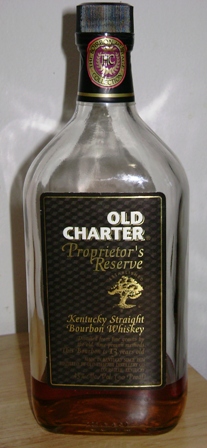
Old Charter Proprietor’s Reserve (Bourbon Heritage Collection) Kentucky Straight Bourbon Whiskey

Age: 13 y/o

Proof: 90 (45% ABV)

Maker: Belmont Distillery (?), Louisville, KY (United Distillers)

So that I don’t have to pretend like I’m getting all boozed up in the daytime, I’ve added a “Last Night” catgory.  This is what I was drinking last night.  Get it?  Good.

The Bourbon Heritage Collection (BHC) was a collection of whiskeys put out by United Distillers back in the 1980s and 1990s (I think).  There were five of them, representing the five biggest brands of American whiskey owned by UD at the time.  UD has a long conplicated history, but it is a descendent of the Guiness company and the Schenley whiskey company, and was itself an ancestor of international alcohol conglamorate Diageo.  The 5 were: Old Charter Propritor’s Reserve (OCPR), I.W. Harper 15 y/o, Weller Centennial (10 y/o, 100 proof), Very Special Old Fitzgerald (12 y/o) and George Dickel Special Barrel Reserve (a Tennesee Whiskey, 10 y/o).  Of these, the Weller Centennial and the and the OCPR are the best regarded, although all of them are very good whiskeys.

In the 1990s when UD was becoming Diageo, they decided to sell off their bourbon distilleries and most of their bourbon brands.  Old Charter and Weller went to Buffalo Trace and Old Fitzgerald went to Heaven Hill.  They kept Harper (now only sold overseas) and Dickel.  Of the BHC whiskeys, the only one that is still made is the Very Special Old Fitzgerald (VSOF).  The Centennial and OCPR continued being made by Buffalo Trace for several years after their acquisition, and they can still be found on shelves, but they are becoming increasingly rare, especially the highly sought-after Centennial.  The older OCPRs are easily distinguished by their “sloped shoulders” as opposed to the squat bottles (similar to Elmer T. Lee and the Centennial bottles) used by Buffalo Trace after they took over the brand.  All the BHC members also have a BHC neck band that was only used when they were made by UD.

As for the whiskey, the color is a light copper.  It has thin, light legs.  A good deal of wood comes through on the nose.  This smells older than 13 years old.  There must be a fairly high preportion of older whiskeys in this baby.  The predomiant aroma here is of butterscotch or toffee.  What it reminds me of the most is Werther’s Original hard candies.

On the palate it is light and sweet, with a big hit of wood upfront, like Sideshow Bob getting hit in the face with a rake.  Ok, that was kind of silly.  Sweetness follows on quickly, then some good, old fashioned alcohol burn.  It fades away into a faintly sweet finish, with some more of that light, sweet butterscotch.

What I like about this whiskey is that it is not a butterscotch monster like some of its younger kin.  It is very well-balanced.  It’s soft and sweet, but it still has plenty of character.  Again, I’m not too much of a fan of the other products of this distillery, but this one is truely an excellent whiskey, a classic.  Track one down if you can.

Jim Beam Signature ?

Something weird is going on in Europe.  Straightbourbon.com’s lead Swede, Leif, discovered something odd on German ebay.  This.

According to friend-of-the-blog Ben Kickert’s google translation, the ebay page translates to something close to the following:

“Jim Beam Kentucky Straight Bourbon Signature Six Grains Whiskey 1 liter with 44.5% vol in a distinctive leather bag. This limited bottling is 6 years old. The six different grains distilled bourbon is very soft and vollaromtisch. Caramel and vanilla accents dominate the taste until his velvety and warm long finish. It is the first bottling of a beginning series of Jim Beams, the short run the market will come in only.”

What’s weird is that nobody, not even those who make their living writing about bourbon (well, at least some of their living) has heard anything about this.  It claims to be made from six grains, which is bizarre.  Four-grain bourbons have been made from time to time, most infamously the Woodford Reserve Master’s Collection Four Grain (for a fun read consult this SB.com thread), but this is unprescendented.  The bottle seems to be genuine, but releasing a new expression overseas, apparently through duty-free shops, is highly unusual.

Speculation on the six grains (beyond the usual suspects of corn, barley, rye & wheat) has ranged from oats and millet to triticale and candy corn.  One possibility is that multiple varieties of corn (or something else) are being counted as seperate grains.  Woodstone Creek (a winery/distillery in Cincinnati) used two varieties of corn to make their bourbon, and claimed it as a 5 grain bourbon.

Anyway, a lot of heads are being scratched right now.  I’ll keep you posted.