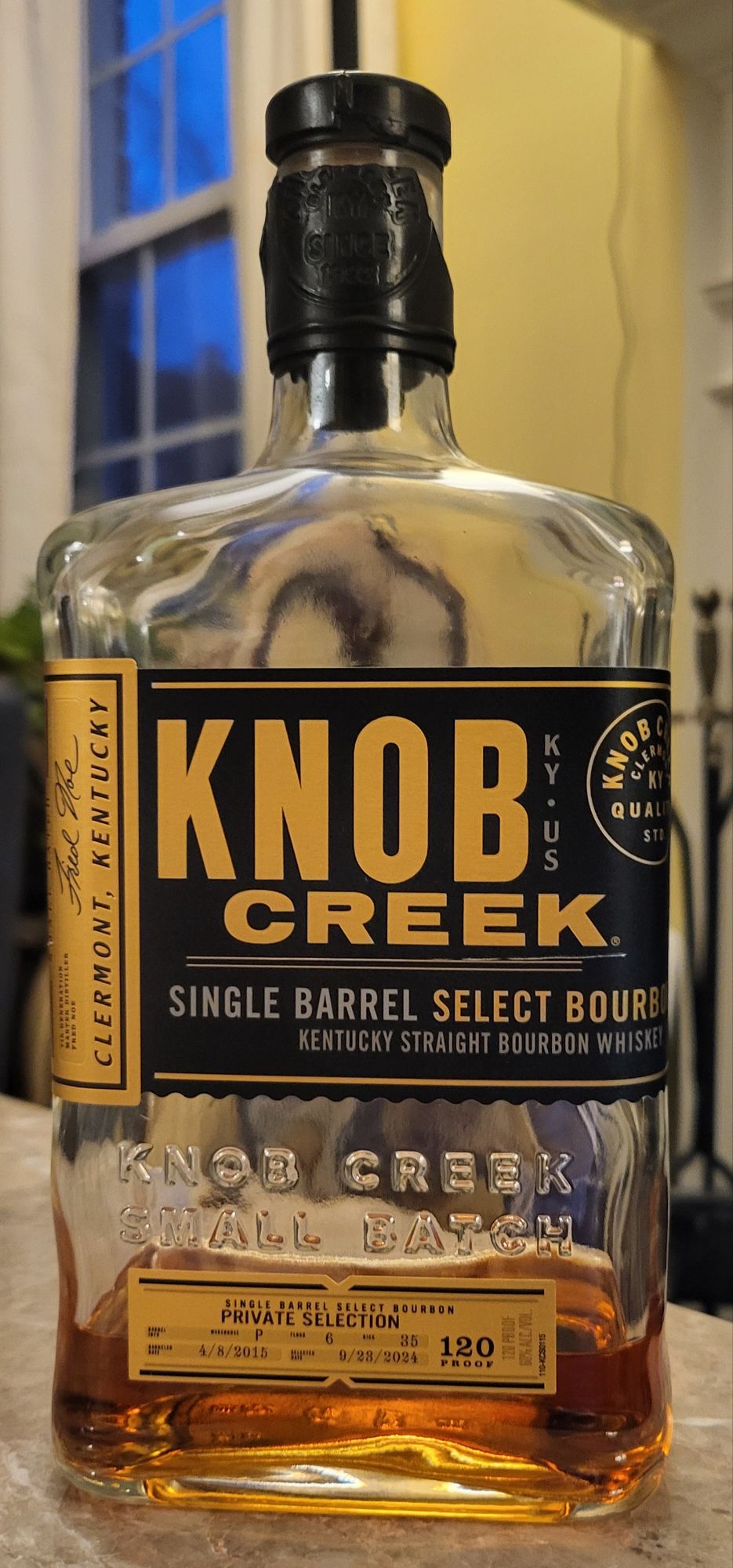
Maker: Jim Beam, Claremont, Kentucky, USA (Suntory)
Style: Rye recipe Single Barrel Kentucky Straight Bourbon Whiskey.
Age: 9ish years old (barreled 4/15, selected 9/24)
Proof: 120 (60% ABV)
Michigan state minimum: $65
Tasted with a splash of water.
Appearance: Medium gold.
Nose: Cut lumber, Beam yeast.
Palate: Sawdust, street corn, green chili.
Finish: Char, brown sugar.
Parting words: Knob Creek Single Barrel is one of my most reviewed bourbons. I reviewed the Georgia Bourbon Society pick I helped select here, and here’s a goofy video review from me and friend of the blog Amy. I review it a lot because I’m a big fan of Knob Creek in general, and barrel selections are a fun way to explore the multitudes that KC contains.
This one was good, but like most Holiday Market selections, it is a good example of itself, but it doesn’t really offer anything new. There’s little difference between this and the median bottle of a non-select KCSB. The Beam funk is maybe a little more prominent, but that might very well be the state of my palate. It’s far from bad, just a little disappointing. Still, it’s better than a dozen other bourbons at that price point. Knob Creek Single Barrel, Holiday Market Selection (9/24) is recommended.
Maker: Jim Beam, Clermont, Kentucky, USA (Suntory)
Style: Rye recipe bourbon.
Age: 12 y/o
Proof: 100 (50% ABV)
Michigan state minimum: $70
Appearance: Dark Copper.
Nose: Charred oak, leather, old wet lumber.
Palate: Brown sugar, acorns, burn. Water brings out a little more complexity, adding eucalyptus and clove.
Finish: Hot and oaky.
Parting words: The standard 9 y/o Knob Creek has been one of my favorite bourbons for many years. I love it because it’s easy to find, high proof, affordable ($37 in Michigan), and mature but not over oaked. To my palate, 6-9 years is peak maturity for most bourbons. Exceptional ones, or ones aged on the ground floor of the rickhouse can go longer, but for most, 6-9 is the sweet spot. Before that, the whiskey can be rough and uncouth. After that, it can become one dimensional and fall into the “beaver bourbon” category, a term I coined to describe bourbons that only a creature accustomed to chewing on trees could enjoy.
Unfortunately, Knob Creek 12 is a product for the beaver market. Oak isn’t the only thing going on here, but it dominates the palate, nose, and finish. I had hoped that a distillery with stocks the size of Beam’s would be able to select a few balanced barrels for this expression, but apparently not. I can’t imagine what the newer 15 and 18 y/o expressions taste like. Even the beavers might object at that point.
If you’re the type who like a woodier bourbon, you might enjoy this, but I did not. The price isn’t too bad, considering what some bourbons at half the age go for the days, but Knob Creek 12 y/o old is still not recommended.
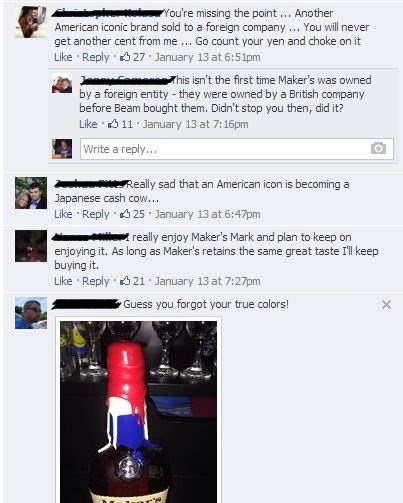
It was announced earlier this week that Suntory, a privately held Japanese whisky company, will purchase Beam Inc. (owner of Jim Beam, Knob Creek, Old Grand Dad, Maker’s Mark, Laphroaig, Canadian Club, Teacher’s and many other brands) this summer for somewhere between $13 and $16 billion dollars. Online reaction was swift and passionate, to put it kindly. While the response from enthusiasts has been nearly all positive, most of the non-enthusiast response was negative. Much of the negative was xenophobic and some of it was flatly racist. Most of those critical voices can and should be written off as cranks. People claiming that they will no longer drink Maker’s Mark or Jim Beam because their grandfathers fought against the Japanese in the 1940s shouldn’t taken seriously and neither should people who don’t know the difference between China and Japan.
My first reaction was was that this news signals a big restructuring in the spirits industry. It is technically an acquisition, but the result will look more like a merger. Suntory already owned two Japanese distilleries, three single malt distilleries in Scotland and the McClelland’s single malt Scotch brand. With Beam’s holdings, Suntory is poised to become the third largest spirits company in the world behind Diageo and Pernod-Ricard. Consolidation has been the theme of the booze world from the 1930s to the present and that won’t be changing any time soon. Beam Inc. itself is the result of a series of mergers and acquisitions over the past few decades. As an enthusiast I was excited about the possibility of new ownership of Beam’s brands, especially since the management of some of those brands has been poor in recent years.
Why was the reaction so negative among non-enthusiasts? It’s because they believed what Beam told them.
Bourbon marketing is something that most enthusiasts become immune to quickly. A little knowledge goes a long way to dispel the yarns the bourbon industry spins. Yarns like the one that Jim Beam has been made by the same family with the same recipe since the eighteenth century. Or that Maker’s Mark was first whipped up in Bill Samuel’s kitchen and has been a quaint, family-oriented, backwoods operation ever since. There may be tiny threads of truth in both yarns, but they are not true in any real sense. A few minutes reading a book or searching on the internet is enough to dispel most myths like those. The harder ones might take a few hours. Enthusiasts have the inclination to do that . Most drinkers don’t.
Those drinkers who don’t are the ones who are angry. They’ve grown emotionally attached from years of hearing those myths. Hearing that their favorite little family business is actually a multinational corporation that is about to be swallowed up by another multinational makes them feel like they’ve been played for suckers. Which makes them angry, which makes them look for someone to direct that anger toward, which is where Suntory and Japan come in.
Something that is not a myth is the American-ness of bourbon. By federal and international treaty it can only be made in the U.S. It is mostly made from what we call corn and the rest of the world calls maize, a New World grain, and aged in American white oak. Congressional proclamations have been made about how American bourbon is. Bourbon producers use an appeal to patriotism in their marketing in the U.S. and even overseas advertising and labels themselves stress how American a drink it is. Bourbon producers aren’t the only ones who use this kind of marketing. American automakers have used this angle to sell cars and especially trucks over the years. Like the yarns about the producers themselves, these messages get repeated and work their way into the consciousness of the uncritical whiskey drinkers. For them, drinking becomes a patriotic exercise. What they drink shows how much they love their country. So when they discover that the maker of their patriotic beverage is owned by a Japanese or Italian or British company, they feel, again, played for suckers. Which makes them angry.
Where does this leave us? This whole ugly mess should lead drinkers, producers and their marketers to do more thinking about what they’re doing. The producers need to think about if they are setting themselves up for backlash further down the road with short-sighted marketing focused on myth-making or patriotism. For their part, drinkers (and consumers in general) need to take a little more time to know what they’re drinking, how it’s made and who makes it. This means moving beyond skimming the label, it means picking up a book or at least a few web searches. I recognize that most people don’t have the time to do a lot of digging into what they drink, but knowledge is viral. If one person take the time to dig up some good information, that person tells another and that person tells another who might be inspired to do a little more digging herself. Let’s hope that’s what’s happening now.


 Sipology