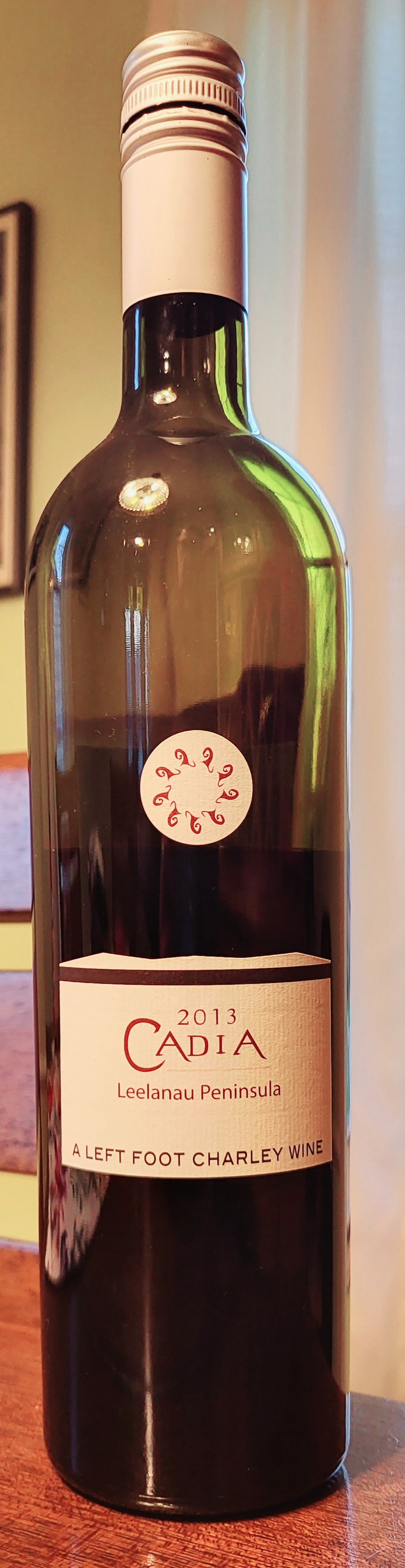
2013 Cadia: Gill’s Pier

Maker: Left Foot Charley, Traverse City, Michigan, USA.

Grower: Gill’s Pier, Northport, Michigan, USA

Grapes: 53% Merlot, 47% Cabernet Franc. Field blend.

Place of origin: Gill’s Pier estate, Leelanau Peninsula AVA, Northport, Michigan, USA.

Vintage: 2013 (final year for Gill’s Pier)

ABV: 12.5%

Purchased for $33 (Holiday Market)

Appearance: Dark purple.

Nose: Blackberry, blueberry, amaretto, tiny bit of oak.

Palate: Medium bodied. Dry with fruit jam. with some tannic grip on the back end.

Finish: Light, drying. Acid and oak.

Parting words: My first review of 2013 Gill’s Pier Cadia was a video review back in April of 2020. I liked it then and I like it now even more! Bottle aging has mellowed the tannins even further, allowing the fruit to become even more prominent, and the wine even more balanced. There were clear changes to the wine over three years, despite it being under a screw cap. This puts to rest any doubt in my mind as to whether screw top wine ages in the bottle or not. It clearly does.

Sadly, Gill’s Pier is now an alpaca and yak (!) farm, but I do still have a couple more bottles from them to taste as a part of the 2012 Project. I had planned for the project to wrap up around now, but 2023 was a very busy year for a variety of reasons, so I’m behind. Never fear, though, we will finish the project in 2024!

Left Foot Charley’s 2013 Gill’s Pier Cadia is recommended.

Dablon Estate Red, 2017

Dablon Estate Red Blend 2017

Maker: Dablon Winery & Vineyards, Baroda, Michigan, USA.

Grapes: 60% Cabernet Sauvignon, 25% Merlot, 10% Malbec, 5% Petit Verdot (per winemaker Rudy Shafer).

Place of origin: Dablon estate, Lake Michigan Shore AVA, Michigan, USA.

Vinatge: 2017

ABV: 13.1%

Price: $50 (2018 vintage website price)

Appearance: Dark ruby.

Nose: Cherry Jam, blueberry, sweet roasted red pepper.

Palate: Dry, reticent. White mulberry, mace, leather.

Finish: Jammy, but with grip.

Parting words: I have a good number of wines in my cellar currently, and I don’t always remember where or when I got them. Cellar tracker is helpful in this regard, but I don’t always check it before I pop a cork. I remember seeing it on a rack in one of the long term areas of my cellar and thinking, “This blend looks like it would hit the spot! I wonder why it was here?” As soon as I took a sip of it, I realized why it was there.

Although this wine is perfectly suitable for drinking any day of the week, Estate Red is not your average weeknight blend. It’s a fine, age-worthy Bordeaux style blend. It was very good at six years old, but I found myself wishing it had stayed in that place in my cellar a little longer to develop even more complexity and depth. Oh well, live and learn!

Even at a mere (!) six years old, this is a very good wine that is worth seeking out. 2017 was an excellent vintage, but so was 2020. When that one comes out, or if you manage to fine a 2017 on the shelf, I recommend that you buy it!

Nathaniel Rose Left Bank, 2012

Maker: Nathaniel Rose, Suttons Bay, Michigan, USA.

Grapes: Cabernet Sauvignon (85%), Merlot (12%), Cabernet Franc (3%).

Place of Origin: Abigail’s Vineyard, Domaine Berrien Estate, Lake Michigan Shore AVA, Berrien Springs, Michigan, USA.

Vintage: 2012

ABV: 13.6%

Purchased for $120 with trade discount from winery. Original price $150.

Notes: 20 months in French oak. 82 cases produced.

Reviewed as a part of The 2012 project.

Appearance: Brick red.

Nose: Fruit of the forest pie, clove, oak.

Palate: Dry, chewy, and a little tart. Blueberry, wild blackberry, leather.

Finish: Tart, but with a tannic backbone.

Parting words: This was the wine that this whole 2012 Project was all about. OK, that’s a slight exaggeration, but it’s not too far from the truth. It’s the bottle I’ve looked forward to opening the most, and it did not disappoint.

Abigail’s vineyard is named for Abigail Fricke, mother to Katie Mauer, co-founder (with husband Wally) of Domain Berrien. As long-time readers will know, Domaine Berrien is known one of the premier producers of red wine in the state of Michigan. A big part of their success is their vineyards. Those vineyards attracted the attention of young, ambitious winemaker Nathaniel Rose, who was able to get access to them to make his Right Bank and Left Bank blends. My review of the Right Bank (also a part of the 2012 project) is here.

Allow me to briefly quote myself , from this post from 2018:

“Rose is rightfully very proud of [Left and Right Bank], especially the Left Bank. He loves to tell the story of the tasting he attended with several sommeliers (including  Master somm Brett Davis), winemakers, writers and other experts in which his 2012 Left Bank Blend went up against a group of Second Growth Bordeaux and cult California Cabs, including Cardinale (~$270), Ridge Monte Bello (~$250), and Jos. Phelps Insignia (~$190), all of the 2012 vintage. Left Bank won. None of the experts could pick Left Bank out of the lineup blind and tasters could not tell the difference between it and the 2012 Cardinale Cab at all. In fact, they believed they had mistakenly been poured the same wine twice.”

The last time I talked to him, Nathaniel said that he considers this vintage of Left Bank to be the best wine he ever made. I’ll say that it’s the best Michigan Bordeaux-style red blend I’ve ever had (and I’ve had a lot of very good ones) and in the short list of best red wines I’ve ever tasted. It’s elegant, sophisticated, excellent with food, and never overly boozy or over oaked. It’s proof that with the right vintage, vineyard, and winemaker, Michigan wines can stand alongside any comparable wines on the planet.

It’s also proof that a well-made Michigan wine can grow with age. I’ve had wines (yes, even some from The Great Lakes State) that fell apart after five or more years in the bottle. The 2012 Left Bank still has everything in the right place, and I think it could taste as good for at least five more years in the right cellar.

$120 is close to twice my upper limit for wine under normal circumstances, but I didn’t regret what I spent for one second that this wine touched my lips. Everyone else I served it to loved it just as much as I did too. Nathaniel Rose Left Bank 2012 is highly recommended.

Nathaniel Rose Right Bank, 2012

Maker: Nathaniel Rose, Suttons Bay, Michigan, USA

Grapes: Merlot (50%), Cabernet Franc (50%).

Place of origin: Abagail’s Vineyard, Domaine Berrien Estate, Lake Michigan Shore AVA, Michigan, USA.

Vintage: 2012

ABV: `13.5%

Note: 20 months in oak. 140 cases produced.

Purchased for $90 (Red Wagon of Rochester Hills)

Appearance: Brick red

Nose: Black currant jelly, allspice, toasted oak, cherry juice, ancho chili.

Palate: Juicy. Mulberry, then wild blackberry, then a growing leathery grip.

Finish: Delicate. Juice, then tannin, then fades.

Parting words: The time has finally arrived! The 2012 project has begun! Our first entry is the Right Bank blend from friend-of-the-blog Nathaniel Rose. For the post on my visit to his winery back in 2018, click here. For a review of his one-off Find Wild Fruit Traminette, click here.

Right Bank is modeled on right bank red Bordeaux blends, which tend to have a larger proportion of Merlot compared to Left Bank blends, which have more Cabernet Sauvignon in the mix. Right Bank wines tend to have more Cabernet Franc as well. Nathaniel’s wines come from the best vineyards around the state, which includes those at Domaine Berrien, of course. Both the Right and Left Bank 2012 blends were made from grapes grown at Domaine Berrien.

At any rate, the hallmarks of typical Michigan Merlot/Cab Franc blends are all here: berries, oak, and spice. Time has done interesting things to it, though. It’s “darkened” the fruit, for one, moving from cherry and blueberry to black currant and blackberry. For another, it’s smoothed out the edges and created a wine that shifts more on the palate from one taste to another, rather than everything popping out at once. Right Bank takes my palate on a nice little journey from aroma to aroma and flavor to flavor. There’s nothing for my brain to disentangle. Everything reveals itself in time. A big reason for that seems to be that the acid has mellowed considerably, even compared to similar wines at seven years old.

What it lacks in tangy punch, it more than makes up in sophistication. 2012 Right Bank may not be as hard to find as one might assume, if one lives close to a Red Wagon store. Last time I went to both of them, there were 2012 Right and Left Bank blends on the shelf.

The purpose of the 2012 Project is to taste through these wines and see how they age, so price is less of a factor in my review. Nevertheless, this is a very good wine that I don’t regret paying $90 for. It’s not a weeknight pizza wine, but I didn’t buy it to be that. I think the key with many of these wines is to buy them when they’re young and less expensive, then let them hibernate for several years in a well-regulated cellar.

At any rate, Nathaniel Rose’s 2012 Right Bank is recommended.

Tempesta, 2016

Maker: Bel Lago, Cedar, Michigan, USA.

Grapes: Cabernet Franc, Regent, Merlot, Marquette, “and more (?).” Label calls it a “vineyard blend”.

Place of origin: Bel Lago estate, Leelanau Peninsula AVA, Leelanau County, Michigan.

Vintage: 2016

ABV: 13.5% ABV

Notes: Spent 34 months in oak barrels.

Purchased for $44 from Michigan by the Bottle Tasting Room, Royal Oak.

Thanks to Cortney Case for the information on the grapes that went into this wine!

Appearance: Brick red.

Nose: Cherry jam, lightly toasted oak, anise, mace.

Palate: Blackberry jam, mulberry, leather.

Finish: Chewy with a little tang.

Parting words: I bought this wine about a year ago. At the time, I’m sure I took note of what the composition of the wine was, but over the months, that knowledge drifted out of my mind. So in preparation for this review, I emailed friend-of-the-blog Cortney Casey (co-owner of Michigan by the Bottle) and asked if she had any information on the grapes in this wine. She wrote back promptly with the above information but noted that Bel Lago co-founder “Charlie [Edson] is notoriously difficult to get full blend lists out of since a lot of his wines are field blends.” Since that is the case, I’m going to assume the term “vineyard blend” on the label means field blend.

I didn’t have that information at my fingertips when I tasted this wine, though, so I went in assuming this would be a Bordeaux/Meritage style blend like many of the “flagship” red blends in Michigan. I was therefore surprised at the “fruit of the forest” flavors of Tempesta at first taste, but with Regent and Marquette in the mix, it makes a lot more sense. That is not intended as a knock in any way, though. Tempesta is an excellent food wine, pairing well with just about anything except shellfish, which it would overwhelm.

$44 is pretty expensive. Not Bel Lago’s most expensive (that would be the Riesling ice wine), but it is in the top four. I’ve had the second most expensive one, sibling wine Tempesta Cabernet Franc, but I think I actually prefer this over that!

I vacillated between a full and a mild recommendation because of the price, but I’ve settled on full. Even though Regent and Marquette are pretty easy to grow in Northern Michigan, Merlot is not (even in a hot vintage like 2016), and Cab Franc can be a pain from time to time. If it is indeed a field blend, that’s worth a bit more as well. All in all, I feel comfortable recommending 2016 Bel Lago Tempesta.

Crown of Cab, 2017

Maker: Domaine Berrien, Berrien Springs, Michigan, USA.

Grapes: 42% Cabernet Sauvignon, 29% Cabernet Franc, 25% Merlot, 3% Petit Verdot, 1% Malbec.

Place of origin: Domaine Berrien estate, Lake Michigan Shore AVA, Michigan, USA.

Vintage: 2017

ABV: Undisclosed (table wine exception).

Purchased for $21 (Michigan by the Bottle Tasting Room, Royal Oak).

Appearance: Brick red.

Nose: Cherry juice, toasted French oak, wild blackberry.

Palate: Medium bodied. Tart and a little chewy. Tart cherry, blackberry, leather.

Finish: Chewy like a good Bordeaux.

Parting words: Crown of Cab is the crown jewel of Domaine Berrien’s cellar. It’s produced every year from a blend of red Bordeaux varieties. In odd numbered years, winemaker and co-owner Wally Maurer aims for a Left Bank Bordeaux, producing a Cab Sauv-forward blend like this one. In even numbered years, he goes for a Right Bank, Merlot & Cab Franc heavy blend.

Although Wally encourages his customers to drink his wines promptly, they are some of the most age-worthy wines produced in the Mitten State. That fact is even more astounding when one factors in how affordable they all are.

At five years old, this blend is just starting to get going. 2017 was an especially fine vintage in Michigan as well, so this wine will probably end up having a long, fulfilling life for anyone who can wait a while.

Speaking of aging, I have a fun series of reviews planned for this winter and spring that involve aging Michigan wine. Watch this space for more information soon!

At any rate, 2017 Crown of Cab is recommended for cellaring and for drinking right now!

Laurentide Reserve Meritage, 2016

Maker: Laurentide, Lake Leelanau, Michigan, USA.

Place of origin: Leelanau AVA, Leelanau County, Michigan, USA (at least 85%)

Grapes: Cabernet Franc & Merlot.

Vintage: 2016

ABV: Undisclosed.(labed as table wine).

Purchased for $45 (MBTBTR wine club).

Appearance: Dark ruby.

Nose: Cherry jam, clove, white pepper, toasted oak.

Palate: Semi-sweet and medium bodied. Mixed berry jam, allspice, oak.

Finish: Well balanced. Sweet, tangy, and tannic.

Parting words: Laurentide is one of my favorite Leelanau wineries. They’re good people making good wine. The name is a celebration of the Laurentide glacier that shaped so much of the present landscape of Northwestern Michigan.

I’d been celaring this wine for a couple years, since I got it in my Little Sipper package from Michigan by the Bottle Tasting Room, Auburn Hills. When I saw the Laurentide Instagram account post a picture of an open bottle of this vintage, I figured the time had come to open it!

This wine is sweeter than I expected in a “Meritage” blend. That’s not a knock by any means, you, dear readers, know that I am no sweetness snob. It’s just more of a heads up. There is nothing unharmonious about, though. It fits in that fun little pocket of wines that are beautiful and well made but also very quaffable.

At $45 a bottle, one needs to pace one’s self, though. I would like it better at a lower price but that applies to any wine, really. There’s nothing not to like, so 2016 Laurentide Reserve Meritage is reccomended.

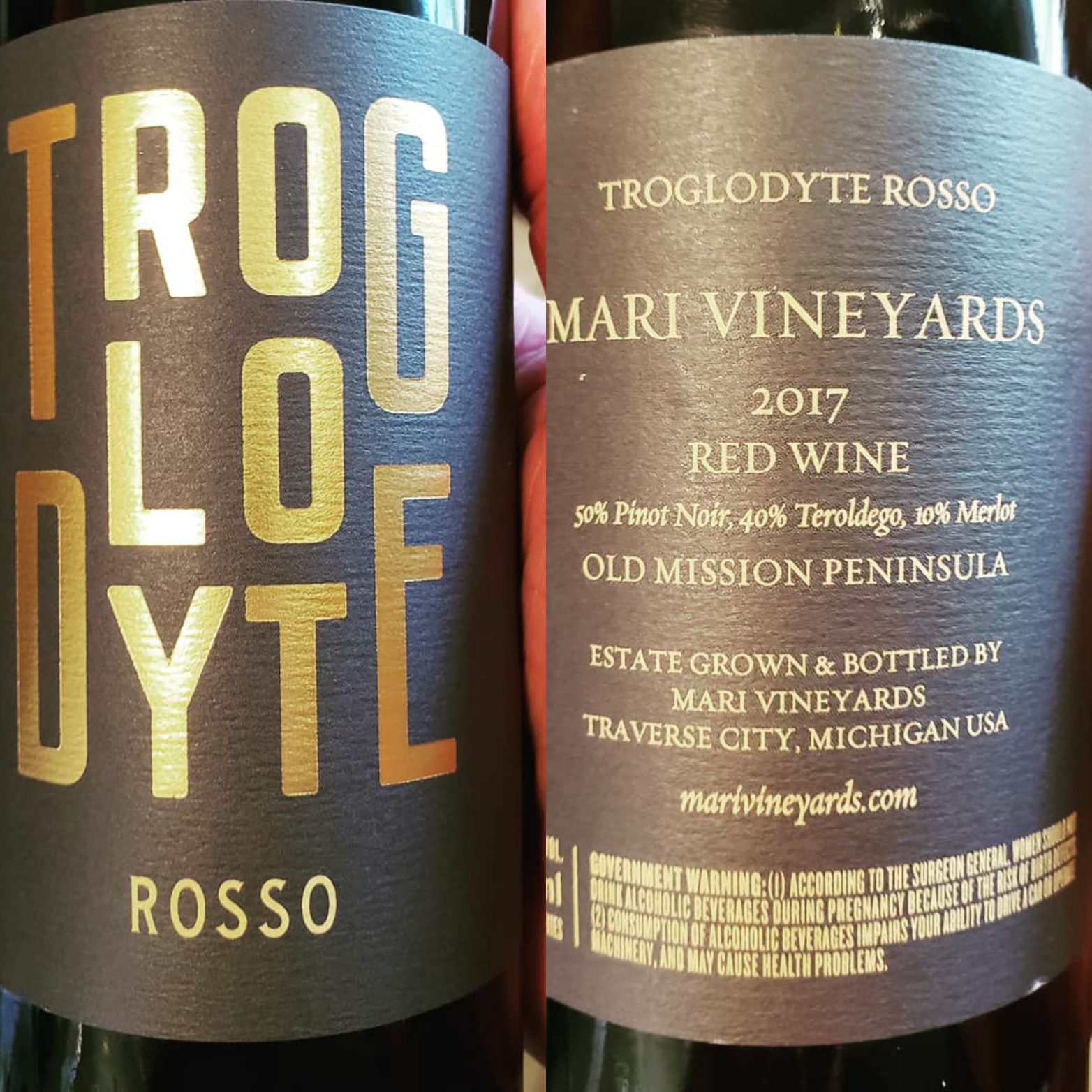
Troglodyte Rosso

Maker: Mari Vineyards, Traverse City, Michigan, USA

Grapes: 50% Pinot Noir, 40% Teroldego, 10% Merlot

Place of origin: Mari Vineyards Estate, Old Mission Peninsula AVA, Traverse City, Michigan, USA

Style: Dry red blend.

Vintage: 2017

ABV: 13%

Purchased for $26 (Red Wagon, Rochester Hills)

Appearance: Slightly overdone fruit of the forest pie.

Palate: Medium bodied. Wild blackberry, black currant, clove, a little smoke.

Finish: Medium chewy, a little acid, a little fruit.

Parting words: Teroldego is a grape grown mostly in the Alpine vineyard areas of Northern Italy. It produces wines that are sometimes compared to Zinfindel, but it also bears more than a passing resemblance to its nephew Syrah. I don’t know how much Teroldego is grown in Michigan, but I’m guessing that it’s not a lot. I don’t know enough to say whether it should be grown more widely in Michigan, but I do like it in this blend. It brings a spicy, tarry (in a good way) punch to this wine that makes it food-friendly and well-rounded. For a grape this rare, and a wine this good, $26 is more than fair. Troglodyte Rosso is recommended.

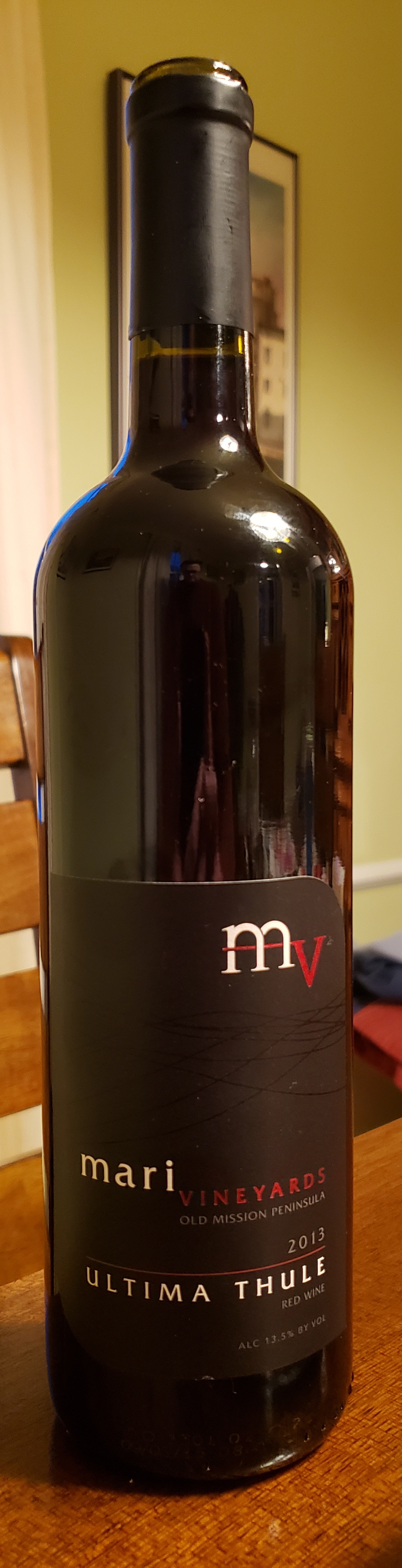
Ultima Thule, 2013

Maker: Mari Vineyards, Traverse City, Michigan, USA

Grapes: 45% Nebbiolo, 35% Cabernet Sauvignon, 20% Merlot

Place of origin: Mari Estate, Old Mission Peninsula AVA, Traverse City, Michigan, USA

Vintage: 2013

ABV: 13.5%

Purchased for $60 at winery (minus 18% [IIRC] media discount)

Thanks to Sean O’Keefe and everyone else at Mari for the generous media discount.

Appearance: Brick red.

Nose: Plum, black currant jam, blackberry, white pepper, leather.

Palate: Full-bodied and tart. Raspberry, black currant, mulberry, tart cherry, oak.

Finish: Acidic and relatively short. Chewy on the back end.

Parting words: The islands of Thule were first mentioned by the Greek geographer Pytheas of Massalia (died c. 285 BCE). It was as six days sail north of Great Britain and was the most northern point known to people of the ancient Mediterranean. It’s unclear what, if any, real place Thule was. Iceland, Greenland, Orkney, Shetland, or some island off Norway have all been suggested. One later geographer suggestions the name may come from an old name refering to the Polar night, the sun never sets for weeks or months on end in high latitudes. When we were in Orkney, locals refered to it as the “simmer (summer) dim” when the sun never completely sets but just hangs around the horizon all night. We actually experienced a bit of this ourselves during our brief time there. I remember waking up around 2 am or so to see sunlight peaking through the blinds in our B & B.

On ancient and Medieval European maps, Ultima Thule became a fixture in the northwest, representing the northernmost inhabited bit of land. While the Old Mission Peninsula is much closer in latitude to Bordeaux or Torino than to Orkney or Iceland, Mari’s vineyards are at the northernmost point of Old Mission and this wine represents the ultimate expression of their nellaserra (hoop-house) system. Northern Michigan has enough sun to ripen Nebbiolo, but the cold springs present a big problem for the grape, which needs a relatively long time to ripen. The hoop-houses act as large cold frames and enable Nebbiolo to get the head start it needs to ripen.

As for the wine itself, it’s complex but not busy. It’s more acidic than I expected, but 2013 was a very cool vintage that saw pretty tart and but very long-lived wines. It’s not bracing or pucker-inducing by any stretch, though. The acid is firmly grounded in the fruit, and rounded off with judicious oak and spice.

$60 is a lot of money for a Michigan wine, or any wine period, really. I think it’s worth the money, however, and I think there’s three reasons why. First is rarity. To my knowledge there are no other Nebbiolo vines in Michigan besides those belonging to Mari Vineyards. Second is longevity. Cab Sauv and Nebbiolo are known for their ability to age for long periods of time so I originally planed to open this wine in the fall of 2023 but I just couldn’t wait that long. I have no regrets about opening it when I did but I think it could have gone for two or three more years at least. This is born out by how good it still tasted one and even two days after open.

Finally, this wine is worth at least $60 because it’s just so good. It’s good with food, by itself, in a box, with a fox, however you want to drink it. Mari Vineyards Ultima Thule, 2013 is recommended!

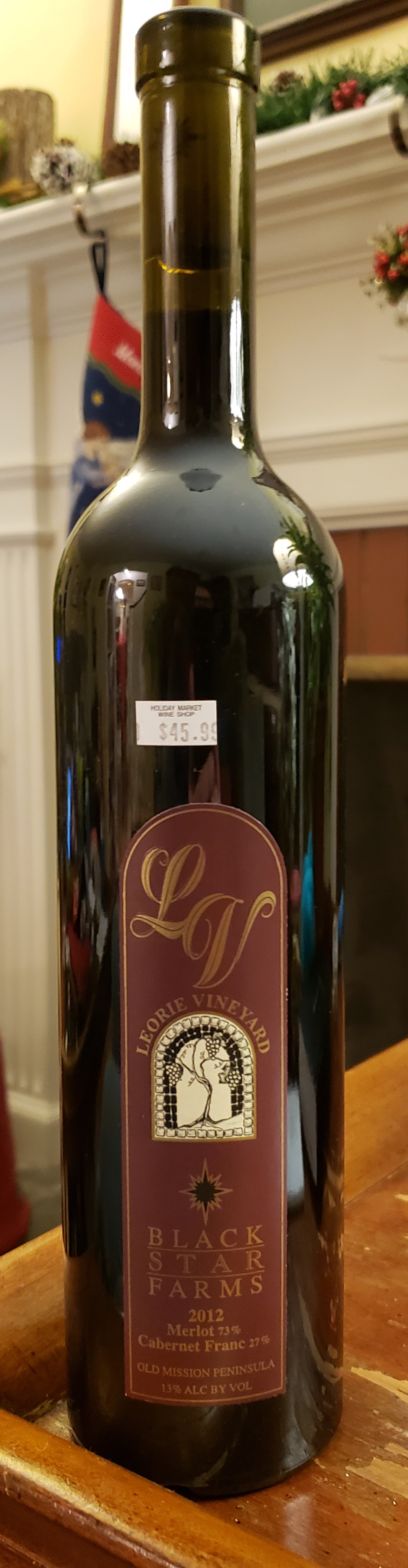
Leorie Vineyard Merlot/Cabernet Franc, 2012

Maker: Black Star Farms, Suttons Bay, Michigan, USA.

Grapes: 73% Merlot, 27% Cabernet Franc

Place of origin: Leorie Vineyard, Old Mission Peninsula AVA, Michigan, USA

Vintage: 2012

ABV: 13%

Purchased for $46 (Holiday Market)

Note: for more information on this wine and vineyard, read this post on Black Star Farms’ Blog.

Appearance: Dark red.

Nose: Cedar, black currant jam, clove, smoke.

Palate: Juicy but structured. Full bodied. Black currant, cherry juice, blueberry pie.

Finish: A little chewy, with some acid.

Parting words: Leorie Vineyard is in an old gravel pit on Old Mission Peninsula that has become one of Black Star Farms’ finest vineyards, especially for reds. It consistently produces ripe (a challenge for Merlot in Northern Michigan), disease-free Merlot that finds its home under this label year after year.

I’m afraid my notes don’t really do this wine justice. It’s fruity for sure but nicely balanced with spice and tannins producing an elegant but not austere red worthy of the Right Bank of the Gironde. It cellars well too, obviously. I’m looking forward to cracking my other bottle of Leorie in 2022 or sometime after that. $46 is expensive by Michigan standards, but that’s a good price for a quality Merlot blend from one of Michigan’s finest vineyards made by one of Michigan’s finest wineries. 2012 Leorie Vineyard Merlot/Cabernet Franc is recommended.