Parting words: This is the final bottle from Nathaniel Rose that will make an appearance in our 2012 project on aged Michigan wines from the 2012 and 2013 vintages. Thanks again to Nathaniel for the bottle.
Blending Syrah and Viognier may seem strange at first, but it’s actually been done in the Northern Rhone valley for quite some time. It stabilizes the color of the wine through the magic of chemistry, and it has an impact on the taste and smell of it too, of course. Nobody online seems to agree on that impact, though. Based on this wine, I would say it adds an aromatic fruitiness that balances out the classic robust spice of Syrah.
I would not put this on a level with Nathaniel’s other reds, like the Left and Right Bank blends, or his double barrel Syrah. It’s not as complex as those. Nevertheless, it’s a very good wine, and worth seeking out. It’s held up very well, too. Nathaniel Rose Syrah LaBlonde 2013 is recommended!
Maker: Nathaniel Rose, Suttons Bay, Michigan, USA.
Grapes: Cabernet Sauvignon (85%), Merlot (12%), Cabernet Franc (3%).
Place of Origin: Abigail’s Vineyard, Domaine Berrien Estate, Lake Michigan Shore AVA, Berrien Springs, Michigan, USA.
Vintage: 2012
ABV: 13.6%
Purchased for $120 with trade discount from winery. Original price $150.
Notes: 20 months in French oak. 82 cases produced.
Reviewed as a part of The 2012 project.
Appearance: Brick red.
Nose: Fruit of the forest pie, clove, oak.
Palate: Dry, chewy, and a little tart. Blueberry, wild blackberry, leather.
Finish: Tart, but with a tannic backbone.
Parting words: This was the wine that this whole 2012 Project was all about. OK, that’s a slight exaggeration, but it’s not too far from the truth. It’s the bottle I’ve looked forward to opening the most, and it did not disappoint.
Abigail’s vineyard is named for Abigail Fricke, mother to Katie Mauer, co-founder (with husband Wally) of Domain Berrien. As long-time readers will know, Domaine Berrien is known one of the premier producers of red wine in the state of Michigan. A big part of their success is their vineyards. Those vineyards attracted the attention of young, ambitious winemaker Nathaniel Rose, who was able to get access to them to make his Right Bank and Left Bank blends. My review of the Right Bank (also a part of the 2012 project) is here.
“Rose is rightfully very proud of [Left and Right Bank], especially the Left Bank. He loves to tell the story of the tasting he attended with several sommeliers (including Master somm Brett Davis), winemakers, writers and other experts in which his 2012 Left Bank Blend went up against a group of Second Growth Bordeaux and cult California Cabs, including Cardinale (~$270), Ridge Monte Bello (~$250), and Jos. Phelps Insignia (~$190), all of the 2012 vintage. Left Bank won. None of the experts could pick Left Bank out of the lineup blind and tasters could not tell the difference between it and the 2012 Cardinale Cab at all. In fact, they believed they had mistakenly been poured the same wine twice.”
The last time I talked to him, Nathaniel said that he considers this vintage of Left Bank to be the best wine he ever made. I’ll say that it’s the best Michigan Bordeaux-style red blend I’ve ever had (and I’ve had a lot of very good ones) and in the short list of best red wines I’ve ever tasted. It’s elegant, sophisticated, excellent with food, and never overly boozy or over oaked. It’s proof that with the right vintage, vineyard, and winemaker, Michigan wines can stand alongside any comparable wines on the planet.
It’s also proof that a well-made Michigan wine can grow with age. I’ve had wines (yes, even some from The Great Lakes State) that fell apart after five or more years in the bottle. The 2012 Left Bank still has everything in the right place, and I think it could taste as good for at least five more years in the right cellar.
$120 is close to twice my upper limit for wine under normal circumstances, but I didn’t regret what I spent for one second that this wine touched my lips. Everyone else I served it to loved it just as much as I did too. Nathaniel Rose Left Bank 2012 is highly recommended.
Palate: Medium bodied. Fruit of the Forest pie, clove.
Finish: Tart, but with grip.
Parting words: When it comes to Michigan Pinot, or other cool climate Pinots, one usually gets a light to medium bodied, pale (that’s not a bad thing!), high-acid, easy drinking wine. This is especially the case with the ones from Northern Michigan. Chateau Chantal’s Pinot Noir is a good example of the style. Even in Southwest Michigan, though, 2013 was a cool vintage that turned out a lot of high-acid wines.
That high acidity ended up doing a lot of favors for wines of that vintage, though. While they were slow to develop, the best ones developed beautifully, like this one. The acid is still there, but it’s moved into a supporting role with wild fruit and spice taking the lead. The result is a wine that has the sort of boldness one might expect from a 1er Cru or a beefier red village Burgundy. It did a great job sharing the table with both pork ribs, and lamb chops.
While 2013, wasn’t regarded as favorably as the previous two vintages were at first, time has shown that the cellar can elevate a well-made cool-vintage Michigan wine to some pretty lofty heights. Nathaniel Rose 2013 Pinot Noir is recommended.
Palate: Juicy. Mulberry, then wild blackberry, then a growing leathery grip.
Finish: Delicate. Juice, then tannin, then fades.
Parting words: The time has finally arrived! The 2012 project has begun! Our first entry is the Right Bank blend from friend-of-the-blog Nathaniel Rose. For the post on my visit to his winery back in 2018, click here. For a review of his one-off Find Wild Fruit Traminette, click here.
Right Bank is modeled on right bank red Bordeaux blends, which tend to have a larger proportion of Merlot compared to Left Bank blends, which have more Cabernet Sauvignon in the mix. Right Bank wines tend to have more Cabernet Franc as well. Nathaniel’s wines come from the best vineyards around the state, which includes those at Domaine Berrien, of course. Both the Right and Left Bank 2012 blends were made from grapes grown at Domaine Berrien.
At any rate, the hallmarks of typical Michigan Merlot/Cab Franc blends are all here: berries, oak, and spice. Time has done interesting things to it, though. It’s “darkened” the fruit, for one, moving from cherry and blueberry to black currant and blackberry. For another, it’s smoothed out the edges and created a wine that shifts more on the palate from one taste to another, rather than everything popping out at once. Right Bank takes my palate on a nice little journey from aroma to aroma and flavor to flavor. There’s nothing for my brain to disentangle. Everything reveals itself in time. A big reason for that seems to be that the acid has mellowed considerably, even compared to similar wines at seven years old.
What it lacks in tangy punch, it more than makes up in sophistication. 2012 Right Bank may not be as hard to find as one might assume, if one lives close to a Red Wagon store. Last time I went to both of them, there were 2012 Right and Left Bank blends on the shelf.
The purpose of the 2012 Project is to taste through these wines and see how they age, so price is less of a factor in my review. Nevertheless, this is a very good wine that I don’t regret paying $90 for. It’s not a weeknight pizza wine, but I didn’t buy it to be that. I think the key with many of these wines is to buy them when they’re young and less expensive, then let them hibernate for several years in a well-regulated cellar.
At any rate, Nathaniel Rose’s 2012 Right Bank is recommended.
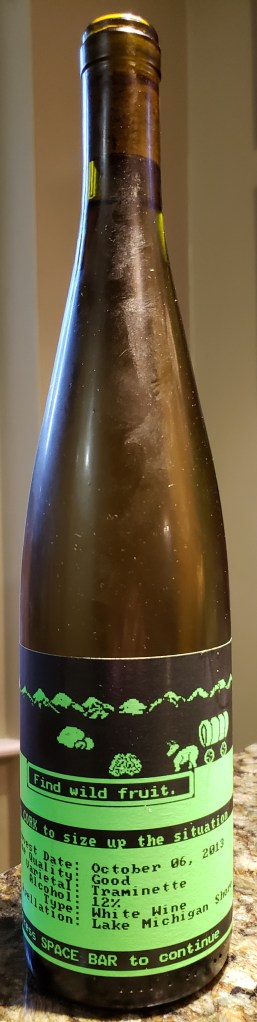
Place of origin: Lake Michigan Shore AVA, Michigan, USA
Vintage: 2013 (harvested October 6)
ABV: 20%
Purchased for $18 (Winery, received media discount)
Appearance: Pale lemon.
Nose: Funk, lychee, fresh Bartlett pear.
Palate: Full-bodied and dry. Limestone dust, bitter apple, pinch of ginger, cardamom.
Finish: Lychee. Fades fairly quickly.
Parting words: It would be weird to call this an Alsace-style Traminette, since Traminette is a hybrid, but that’s kind of what this is. Gewurztraminer is one of parents of Traminette, so it’s not really too much of a stretch. It has the body, funk and dryness one expects from Alsatian Gewurz. I was taken aback by those characteristics when I first opened the bottle but they grew on me quickly.
This wine comes from a batch of “wild fruit” Nathaniel was able to obtain and bottle. Its label is obviously inspired by the greatest educational DOS game of all time (sorry Number Munchers), Oregon Trail. Nathaniel always thought that finding wild fruit was the most interesting thing that happened on that game, so when he came accross some Traminette, he thought this label would be the perfect tribute to one of his favorite gaming moments.
This is a great wine from a great winemaker at a fair price. Find Wild Fruit Traminette is highly recommended. For more on Nathaniel’s operation see my visit to him here.
On Saturday, June 9, Liz and I headed up to Traverse City, Michigan for the fourth City of Riesling Festival (For my review of the first, click here). We had a great time. We drank wine, we walked on the beach, we drank more wine, we learned about wine. On Sunday we also visited Good Harbor and Chateau Fontaine wineries and drank and bought wine.
On Monday we had one more wine stop: Nathaniel Rose winery at Raftshol Vineyards. Nathaniel Rose has been running his own winemaking business since 2010 operating out of whichever winery he was working at the time, starting at Raftshol and ending up at Brengman Brothers, with several in between. Last year, he purchased Raftshol Vineyards in Suttons Bay in Leelanau and is now using it as his HQ (and homestead!).
The tasting room with its awards, photos and piano.
Warren Raftshol (top).
Raftshol is one of the oldest wineries and vineyards in Leelanau. It began at the turn of the last century as the dairy farm of Anders Raftshol. In 1930 the cows left home and the farm was converted to a cherry orchard. In 1975 the cherry business was bad so the trees had to go. Sometime after that, hybrid grape vines were planted. Anders’ grandsons, Warren and Curtis were not happy with the results so in 1985 they planted vinifera instead, being the first commercial vineyard on Leelanau to do so. Instead of the usual practice of grafting vinifera vines onto native rootstock, they grafted them onto the existing hybrid ones. Rose believes this unusual set up may contribute to the high quality of the fruit produced by the estate. When Warren decided to sell last year, Rose jumped at the chance to own some of the oldest vinifera vines in the state, including Cabernet Sauvignon. According to Rose, the vineyards had been neglected for the past ten years, but he’s in the process of whipping them back into shape using careful pruning.
Nathaniel behind the bar.
Liz in front of it, tasting the orange Marsanne.
Nathaniel Rose’s namesake project is mostly about making quality, single-vineyard red wines. They are currently sourced from vineyards in the Lake Michigan Shore AVA and almost entirely red except for an orange Marsanne and a dry Traminette (we bought a bottle of Traminette for $13 minus trade discount). Rose has worked at nine different wineries in various capacities over the years, including Raftshol and Brengman Brothers, which he operated out of until purchasing Raftshol. His extensive knowledge, experience and contacts in the Michigan wine industry allow him to get quality fruit from quality vineyards. His wines There may also be a Chardonnay in the works, but Rose says he doesn’t really have the proper equipment for whites at the moment.
Rows of Cabernet.
Pruned hunk of vine
The carefully pruned vines
Sandy vineyard soil.
Everything we tasted there was wonderful, but my favorites were his excellent Syrahs (we purchased a bottle of the single barrel #4 Syrah at $85 minus trade discount). They were the best Michigan Syrahs I’ve tasted and maybe the best Michigan reds I’ve tried overall. For the single barrel, Rose was aiming for a wine reminiscent of Côte-Rôtie in the northern Rhône valley, so he cofermented the Syrah with Viognier. When we were tasting, he helpfully provided a bottle of Côte-Rôtie for comparison and the two wines were indeed very close and I would be hard pressed to say which I liked better.
Left & Right Bank
Back labels featuring actual photo of Nathaniel performing a feat of strength.
His signature wines are his Cabernet Sauvignon blends, Left Bank and Right Bank. They were both very good. Rose is rightfully very proud of these, especially the Left Bank. He loves to tell the story of the tasting he attended with several sommeliers (including Master somm Brett Davis), winemakers, writers and other experts in which his 2012 Left Bank Blend went up against a group of Second Growth Bordeaux and cult California Cabs, including Cardinale (~$270), Ridge Monte Bello (~$250), and Jos. Phelps Insignia (~$190), all of the 2012 vintage. Left Bank won. None of the experts could pick Left Bank out of the lineup blind and tasters could not tell the difference between it and the 2012 Cardinale Cab at all. In fact, they belived they had mistakenly been poured the same wine twice. Rose believes that Northern Michigan and his new vineyard in particular (which is not the source of Left Bank) has a climate that is very similar to high elevation viticultural areas in California and is capable of producing reds of the same high quality.
Left Bank sells for $150 (we also purchased a bottle of this at a trade discount) which puts it at or near the top of the price range for Michigan wines, even higher than wineries like Brys Estate or Mari Vineyards. When I asked him if he thinks consumers will be willing to pay that much for Michigan wines, regardless of quality, he responded with a few points. First, that his wines are plainly worth the money as tastings like the ones he’s entered Left Bank into prove. Second, that he’s had no trouble selling any of his wines so far. Finally, he pointed out that, while he is selling it at the Raftshol tasting room, the primary purpose of a wine like Left Bank is to enter into contests and tastings to bring attention to the quality of his wines. In other words, he’s not expecting Left Bank to fly off the shelf. It’s intended as a showpiece, not pizza wine (although it would be good with pizza!).*
Nathaniel’s current residence. To know the grapes, one must live amongst them, or at least down the road from them.
Nathaniel Rose’s winery is one of the most exciting things happening in Michigan wine right now. I’m a cheap skate but his wines are as good or better than ones from more prestigious and expensive regions and if any wines deserve to push the price envelope in Michigan, Nathaniel’s do. A visit to Nathaniel Rose at Raftshol Vineyards is highly recommended! Joining his wine club is also recommended, so you can get the generous club discount!
*When I spoke to Nathaniel on August 29, 2018 he informed me that Left Bank has actually turned out to be his best seller! Collectors are stocking up.




 Sipology