Mixed: Good in an old fashioned, but Liz didn’t care for it in a Manhattan. I didn’t really see the point of trying it in Coke, as mild-tasting as it is. It’s ok on the rocks, though.
Parting words: As a brand, Green River has a long history, but the current Green River started life as the non TerrePURE brand from the Terresettia who took over and rebuilt the old Medley plant in Owensboro years ago. For those who have memory-holed this fiasco, TerrePURE was an attempt to speed up the aging of whiskey by means of vibrations and radiation or something. I don’t think I ever reviewed a TerrePURE whiskey, but I did taste a few and they were all terrible. I think it’s fair to say at this point that the experiment was a total failure. Father Time remains undefeated.
Anyway, The BBC (the whiskey one) purchased the brand and distillery in 2022 and has been producing there ever since. They’ve released a healthy number of iterations, including high rye and wheat bourbons, a rye whiskey, and high corn bourbon 1885 marketed toward cocktail bars, for reasons. All have been well-reviewed, to my knowledge.
I think this one is very enjoyable, especially for the $35 price. It’s not complex, but everything that is there tastes good and works well together. I liked it! Green River Wheated is recommended.
Several months ago, Davis Armstrong and Bobby DeMars of Blind Barrels reached out to me with an offer to send me a complimentary box of their craft whiskey samples for review. Last summer was busy, so it took me a while to respond. I had never heard of the company, but the concept sounded interesting.
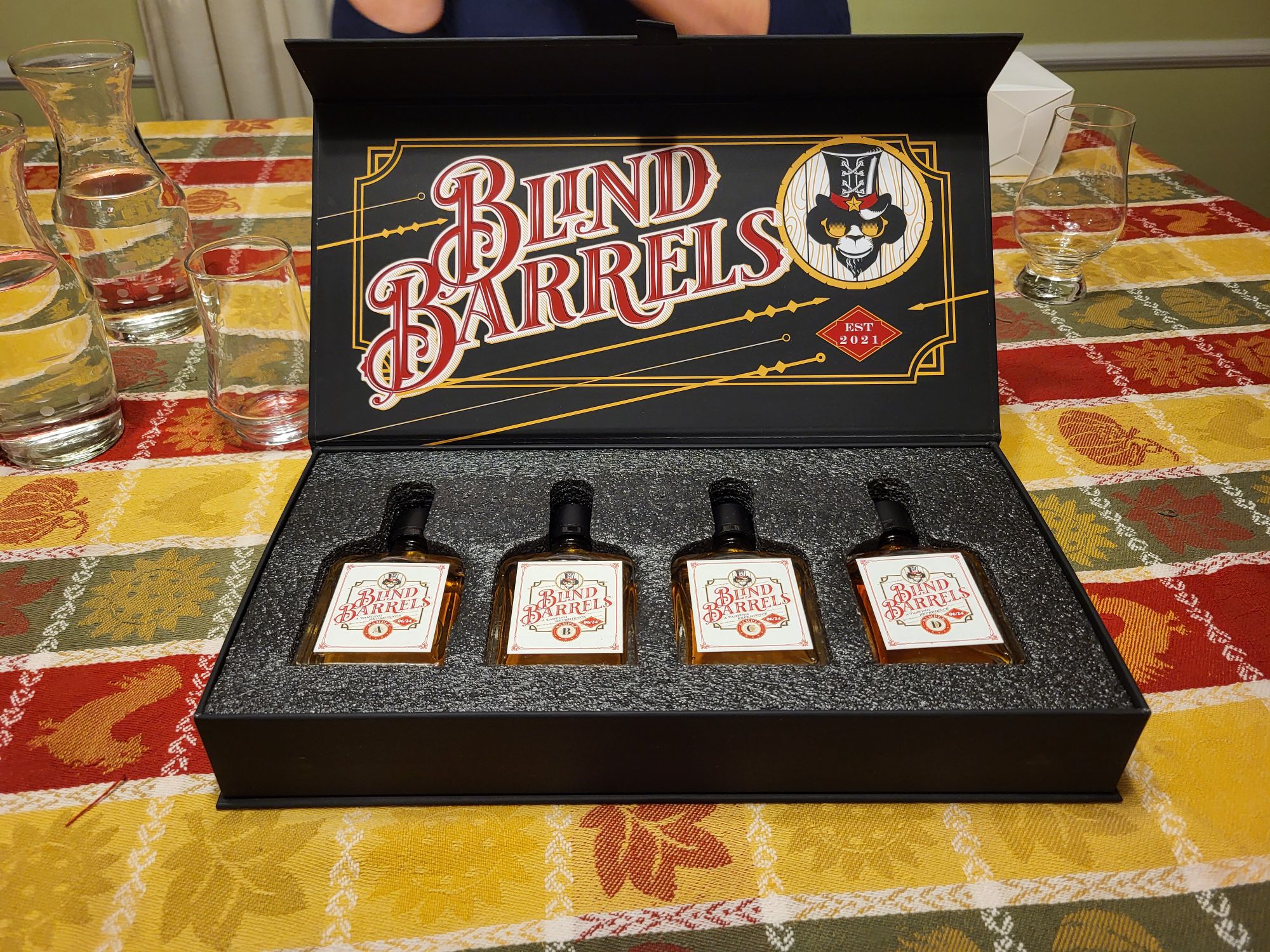
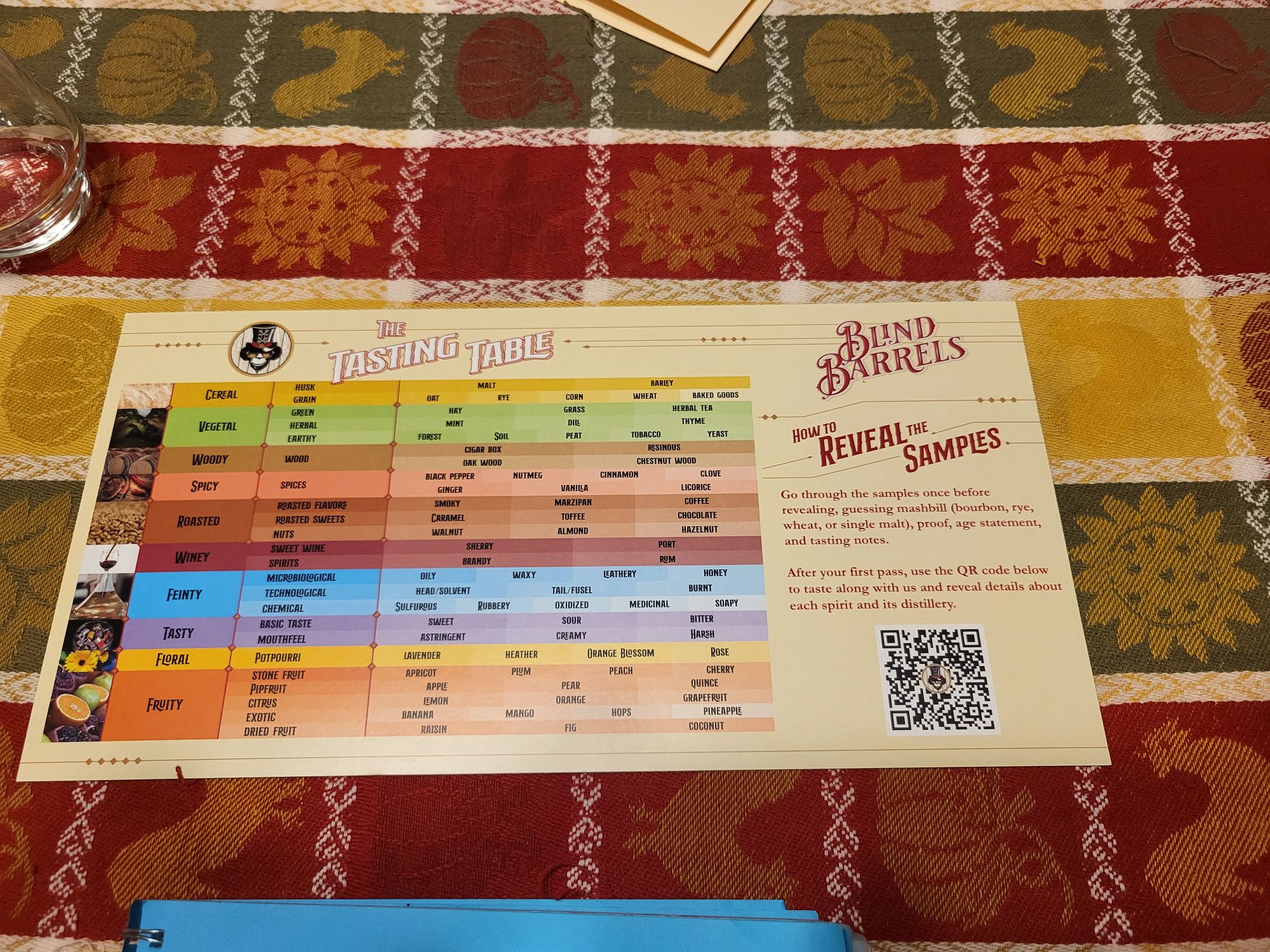
The concept is this: Blind Barrels ships you four 50 ml bottles of whiskey in a plush, classy-looking black box with a golden chimp wearing sunglasses and a steampunk-style top hat for some reason. Included are two letters (at least in my case) from Davis & Bobby, and a “tasting table” of flavors and aromas. Each bottle has the chimp logo, the ABV % of what’s inside, and a QR code. How one distributes the whiskey is up to the tasters, but the materials recommends to pour a little of A in everyone’s glass, take notes, discuss and repeat for B, C, and D. That’s what we did.
The BoxThe SamplesThe Tasting Table
Individual boxes cost $70 each, plus $15 shipping. Subscriptions are a much better deal. Quarterly billing is $60, plus $15 shipping per box ($300/year plus tax). Annual rebilling is the best value for money at $50 per shipment, plus $12.50 shipping ($250/year plus tax). The subscriptions have the added benefit of giving the subscriber a discount on the full bottles of whiskey being sold. All the whiskeys in the various shipments are from small distilleries with limited distribution, so long time whiskey nerds should be prepared for some off-beat selections.
Different boxes have different themes. Ours was Box X (the tenth one). It was released around Father’s Day last year and had a theme of father and (adult) child distillery partnerships. There is also a special Fred Minnick (friend of the blog) box one can order for $70. According to the website, it comes with special guidance from Fred himself. This might be a good option for people who are looking to use a Blind Barrels shipment to jump start their entry into craft whiskey enthusiasm.
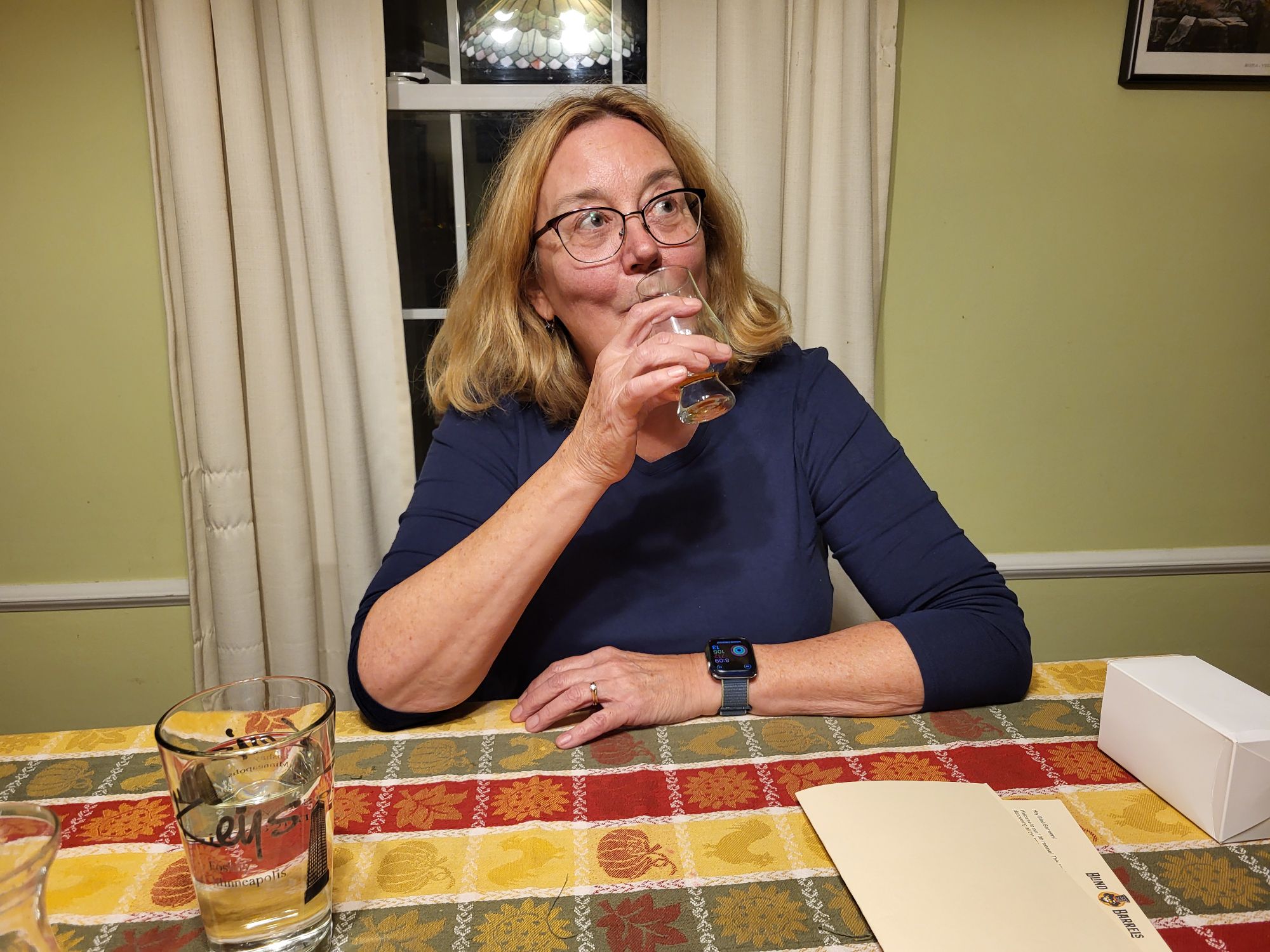
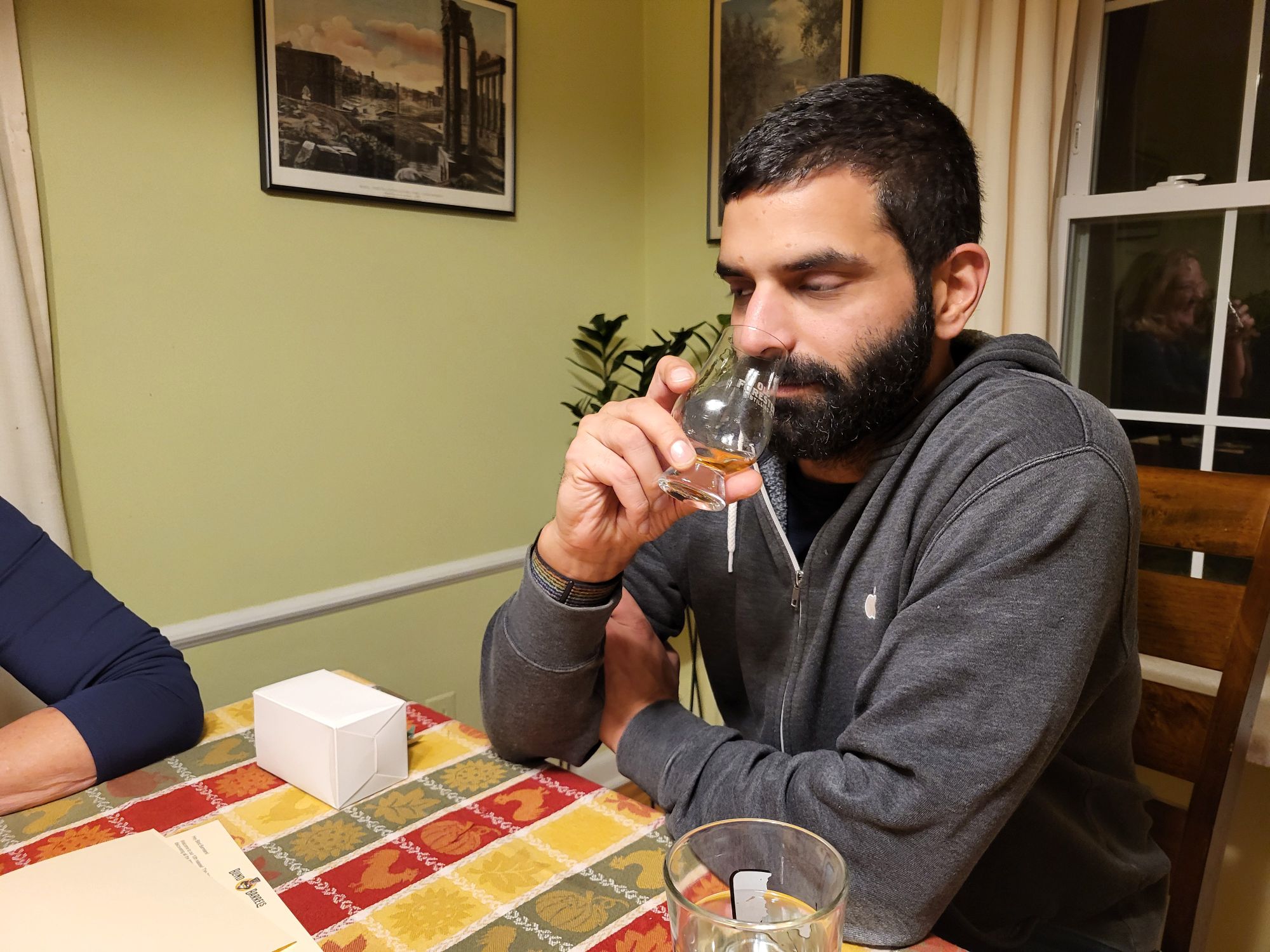
My box arrived in September. In October I rounded up a few friends (Amy, her neighbor Nick, and my wife Liz), and we tasted through the four samples together.
LizAmyNick
Here’s what we thought of them at first taste:
A: Pretty good, probably a rye.
B: A little weird, A wheater, maybe.
C: Even weirder. Oat whiskey or oat bourbon?
D: Wow, stunning. A well-aged bourbon.
At least that’s what I think we thought of them. In an all-to-common bout of unprofessionalism, I lost all the notes I took that night. Drinking may have been involved.
Anyway, we were almost entirely wrong. Here’s what they really were (the first price listed is the MSRP, the second is the subscriber price):
A. Axe Hole Single Malt, Calwise Spirits, Paso Robles, California. 84 proof, $90/$75.
C. Old Monongahela Full Proof Rye, Liberty Pole Spirits, Washington, PA. 108 proof, $85/$65.
D. Doc Holliday 10 y/o Straight Bourbon, World Whiskey Society, Pendergrass, GA. Distilled at Ivy Mountain Distillery, Mount Airy, GA. 122 proof, $200/$130.
As you can see, D was the clear standout. Nick, a whiskey novice, pointed out that a part of concept with this is a marketing/sales play. While all the whiskeys were interesting, D was the standout, and it also has the biggest discount. He concluded that the primary aim of this box was to sell Doc Holliday 10 y/o.
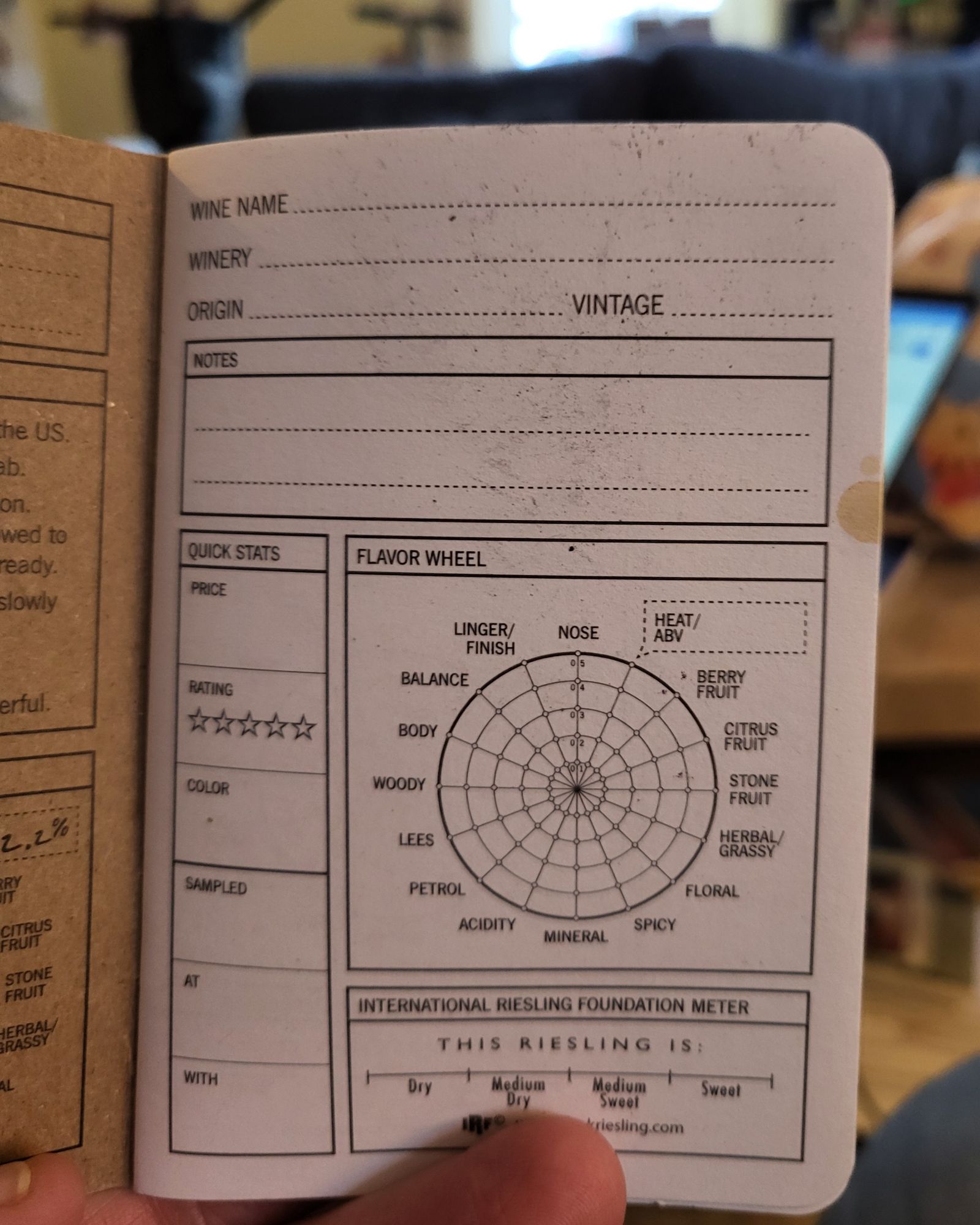
Nick also had a suggestion. Rather than the tasting table with its collection of terms, tasting sheets that can be filled out by each taster might make the experience even easier. Perhaps something like the Riesling tasting booklet pictured to the right. It also might make the tasting notes less likely to be lost.
Anyway, we had a lot of fun! I’ve hosted blind tastings before, and keeping them blind is always a problem. The innovation of the QR code on the back of the bottle takes all the annoyance out of that. Being able to taste whiskeys one might not be able to taste otherwise also makes things more fun. Whether you’re a grizzled whiskey vet or a newb, I think you’ll find a box from Blind Barrels to be an enjoyable way to spend an evening or weekend afternoon. They make great gifts as well. Blind Barrels is recommended.
Palate: Full bodied and sweet. Caramel, chocolate covered cherries, heat. Water takes away the heat, but leaves the candy behind.
Finish: Dry and tingly. Oak, hot chilis. Much the same with water, but a little nutty too.
Mixed: At $50 a bottle, I’m hesitant to mix this, but it did well in an old fashioned.
Parting words: This is the first Bardstown Bourbon Company product I’ve reviewed. I almost took a tour there once with my Georgia Bourbon Society comrades (I was named president of the Mitten Chapter), but I had a conflict, so I missed out.
That was before BBC had released any of its own product. I heard the tour was great, but, frankly, I wasn’t too interested in them back then. The point at which I begin taking micro distillers seriously is usually at the point when they release a bonded whiskey (or brandy or whatever). Bottled-in-Bond (from the company’s own distillery) is the test to make it into a regular spot in my liquor cabinet. If you can do that well then you’ve proven that you are worth my time.
BBC has done it well. They’ve actually done it better than they needed to. This six year old tastes like an eight year old from a large distillery. The depth of flavor and complexity was a big, welcome surprise. You can mix it or drink it on the rocks and it will be just fine, but it’s best neat or with a little water.
The entirety of BBC’s line is currently in the Michigan price book. That includes the Origin (100% BBC distilled), Discovery (BBC + sourced whiskey), Collaborative (finished), Distillery (collaborations?), and Fusion (marriage of different mashbills) series. Origin is the most affordable, which is convenient because it’s the series I’m most interested in. The Collaborative series interested me before I saw the prices. Paying well over $100 for finished, sourced whiskey doesn’t make a lot of sense to me.
At any rate, THIS bourbon is reasonably priced for its quality and proof. Bardstown Bourbon Company Origin Series, Bottled-in-Bond is recommended!
Palate: Caramel, white chocolate, ancho chili powder.
Finish: A bit of leather, a lot of chili powder.
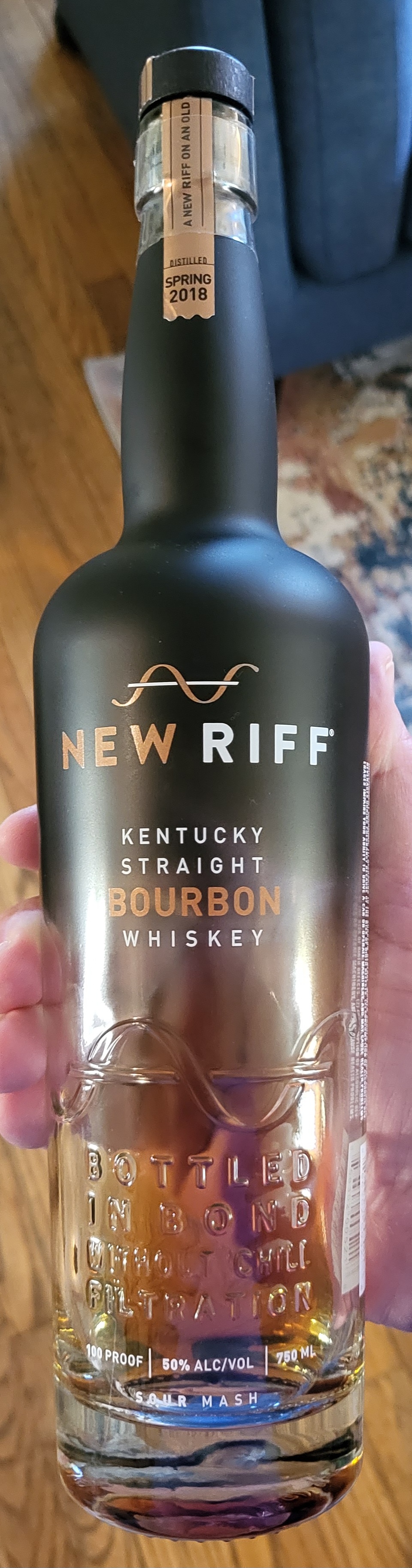
Parting words: I last reviewed a New Riff bourbon in June of 2021, when I reviewed a Red Wagon selection of the single barrel, barrel proof expression. I liked it (eventually), but I thought it was strange. Very herbal, even for a high rye bourbon, and there was that cut lumber aroma I get out of a lot of young, “craft” whiskeys. The lumber isn’t completely gone, but the basil and tobacco are. The result is a much more conventional, but still tasty, bourbon.
Of all the macro-distilled bourbons on the market, it reminds me of Old Grand Dad the most. It lacks the yeastiness, but the spice and char is similar. I’ve had a few single barrel Four Roses expressions with a similar profile too.
$40 isn’t too bad for a quality BiB in 2023, either. Factoring in “craft” beverage inflation, it’s almost a bargain. While it’s not a Glen Buxton Riff, it’s still a solid Joe Perry one. New Riff Bottled-in-Bond is recommended.
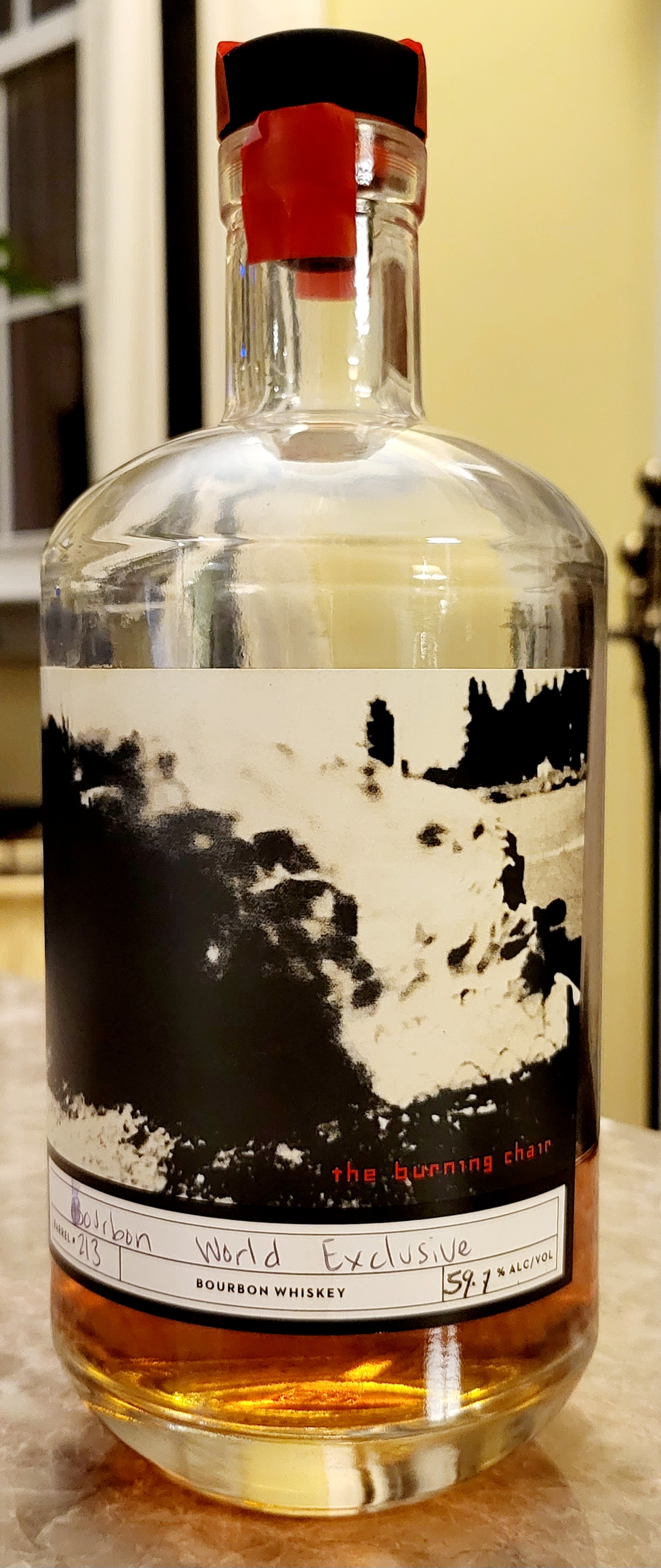
Maker: Savage and Cooke, Vallejo, California, USA.
Distillery: Ross & Sqibb, Lawrenceburg, Indiana, USA.
Style: Bourbon whiskey finished in Zinfandel and Grenache (70/30%) barrels.
Age: NAS
Proof: 119 (59.7 ABV)
Barrel: 213
Purchased for $70 (Vine and Table)
Tasted with a little water.
Appearance: Medium copper.
Nose: Big spice, char, cayenne, oak, and sweet red wine.
Palate: Full-bodied with a velvety, sweet opening. Wild cherry Lifesavers, then oak, spice, and burn that slowly grows until it burns the roof of my mouth like a hot slice of pizza.
Finish: Burn and cherry wine. Not quite cough syrup but right on the edge.
Parting words: Savage & Cooke is a restaurant/distillery in Vallejo, California. It was founded and is owned by Dave Phinney, known as “the The Prisoner Guy” in wine circles. It’s another case of a rich guy getting into the micro-distilling business, and also another case of a distillery that seems to be more of a distillery-themed restaurant than what normally passes for a distillery.
As cheesy as all that sounds, this is one of the better finished bourbons I’ve tasted. One of the keys is starting with good, already aged whiskey. Too many producers, large and small, try to use finishes to cover up flaws in the spirit. That almost never works, so I’m glad Savage & Cooke didn’t try. This has a solid whiskey base. The finish is noticeable, but not overwhelming, and well-integrated. It’s everything a wine-finished bourbon should be.
The price, on the other hand, is higher than it should be. I knew $70 was too much when I paid for it, but it is barrel strength, unavailable in the Mitten State, an exclusive retail bottling, and Dave Helt was pouring samples of it at the time. So I paid it, and I haven’t really been disappointed. As a result, Burning Chair (barrel 213) is recommended.
Style: Single barrel, barrel strength, straight bourbon.
Age: NAS (at least four years old).
Proof: 121.28 (60.64% ABV)
Michigan state minimum: $70
Appearance: Medium copper.
Nose: Spicy. Caramel, hot pepper jam, mace, cassia.
Palate: Full bodied and lucious. Caramel and cream, with big burn on the end. Water calms things down a bit, but doesn’t rob it of its richness. It also brings out the char and a little chocolate.
Finish: Sweet and oaky, in the “dusty” bourbon way.
Parting words: Woodinville is a farm-to-bottle distillery in the wine country near Seattle. Like many micro distilleries around the US, they claim the late Dave Pickerell as a formative influence on their business. After parting ways with Maker’s Mark in 2008, Pickerell went into business as a travelling consultant and worked with scores of start up distilleries over the next ten years, Woodinville included.
I’m not very well acquainted with Woodinville, and this is the first bottle I’ve purchased, so I had no expectations upon opening it. When I first opened it, I drank it mostly on the rocks, and I was not particularly impressed. Once I started drinking it in a Glencairn glass with a splash of water, my opinion changed immensely.
It has a richness that reminds me a lot of some of my favorite old “dusty” discontinued bourbons. I don’t remember how old it is, but I don’t really care, frankly. It’s one of the best “craft” bourbons I’ve had. $70 is a perfectly reasonable price given the quality and proof. I really like this, and I can’t wait to try more Woodinville selections. Woodinville Private Select, Holiday Market selection (barrel 4884) is highly recommended.
Style: standard recipe, pot distilled straight bourbon.
Age: Not disclosed but at least 4 y/o by law.
Proof: 100 (50% ABV)
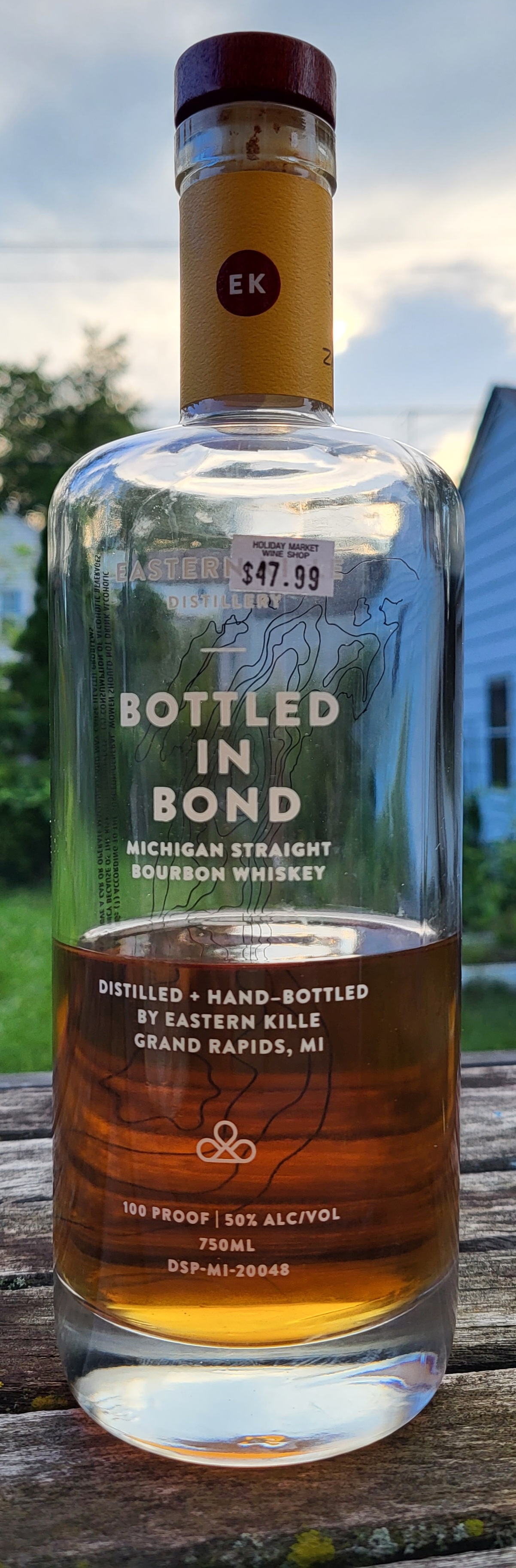
Purchased for $48 (Holiday Market)
Appearance: Medium copper.
Nose: Sawdust, anise, over-roasted almonds.
Palate: Full-bodied and mild. Caramel, barrel char, dark chocolate, dash of amaretto.
Finish: Hot and woodsy.
Mixed: Performed pretty well in Manhattans, Old Fashioneds, with Coke, and with Cherry Coke.
Parting words: To me, the moment when a new bourbon distillery comes of age is when it can release a bottled in bond bourbon. So I was very excited to try this from Michigan’s own Eastern Kille. It feels like they’ve arrived.
But where have they arrived? I’m split. The nose and finish have that sharp sawdust note that I used to associate with small barrel bourbon, but I’m not so sure that’s where it’s from anymore (mashing maybe?). I don’t fine that aspect very pleasant, and it occasionally interfered with mixers. The palate is silky and chocolatey and very good, though, so I don’t know where to land.
Water turns the sawdust down but it also turns down the chocolate and char. So I think I’m going to give Eastern Kille’s BiB a recommendation, with a few drops of water or with strong mixers (boulevardier, Manhattan with good vermouth, or Cherry Coke!). There are some really nice things going in this bourbon, and I hope they continue refining it until it’s highly recommended!
Palate: Semi-sweet, medium bodied. Vanilla, grape soda, toasted French oak.
Finish: Juicy and hot.
Parting words: When I first opened this brandy, I didn’t like it at all. I was reluctant to even review it, because I didn’t know if I wanted to post something that might serve as discouragement to Michigan brandy-makers. You see, I’ve been begging, pleading, and whining about Michigan brady for years now, and I didn’t want to complain about one of the few Michigan brandies currently being made!
I’m glad I didn’t review this brandy right when I opened it because it’s grown on me since then. It’s still not making any of my favorites lists, but it was pretty good mixed, and once I got past the sweetness, it was actually pretty good in a snifter.
A & G Reserve is not going to blow anyone away, but it’s a nice step up for someone used to Christian Borhters or Martell VS. It’s a little expensive for a mixing brandy but it does well mixed. It might make an interesting alternative to bourbon or rum in eggnog, too.
The standard craft distilling mark-up applies here, so I can’t really sneeze at $46. A & G Michigan Brandy Reserve is recommended.
Nose: Oak, sawdust, wood varnish, ash, whiff of amaretto.
Palate: More sawdust and toasted oak, with some sweet dessert flavors lurking somewhere in the background.
Finish: Sawdust, then burn.
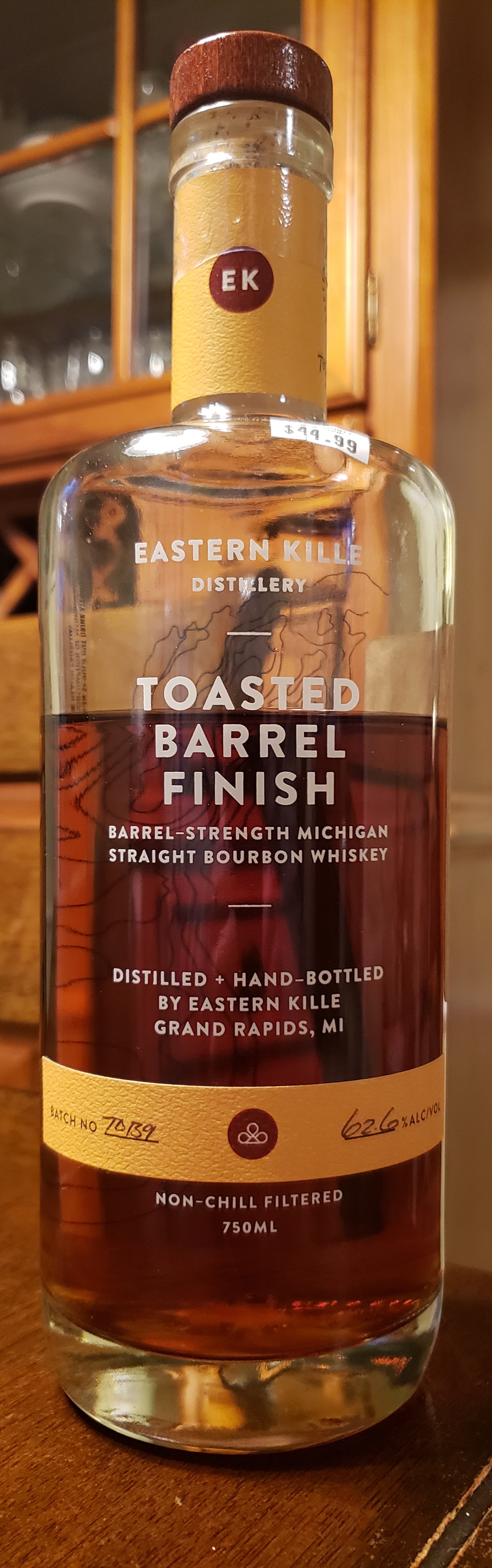
Parting words: Eastern Kille (Gray Skies until dumb Campari threatened them with a lawsuit over the word sky, which they apparently own now), is a distillery and bar in Grand Rapids, Michigan. Like many other businesses of the type, Eastern Kille also gets distribution around the state. I thought I had reviewed one of their products before, but it turns out I hadn’t.
They seem to be one of the distilleries that is trying to do things “the right way” so I jumped at the chance to try a single barrel selection from one of my favorite places to buy spirits. The toasted barrel appealed to me because rebarreling can sometimes be a good way to give young whiskeys a little more depth and oak character. The downside is that if the whiskey is left in the second barrel too long or the finishing barrel is too small (or both) the wood can overwhelm the spirit, and turn it into what I call “beaver bourbon.”
Sadly, the latter is what has happened here. Eastern Kille Toasted Barrel Finish is an overly woody, unbalanced whiskey. There are some interesting things going on under all that oak, but they fade as soon as that finish hits like a 2×4. I tried mixing it with some success in a boulevadier, but that was all it was good in. The oak quickly overwhelms everything else, even a Manhattan made with a bold vermouth.
Eastern Kille Toasted Barrel Finish is not recommended. That said, I’m not giving up on this distillery. There’s a good, solid base here so I’m eager to try their standard bourbon. Watch this space for that review!
Maker: Thistle Finch, Lancaster, Pennsylvania, USA
Style: Wheated (!) Straight Rye Whiskey
Age: 2 y/o
Bottle date: November 13, 2019.
Proof: 90 (45% ABV)
Purchased for $47 (PLCB Monroeville-Northern Pike)
Appearance: Light copper.
Nose: Sawdust, cut grass.
Palate: Medium bodied and sweet. Allspice, hay.
Finish: Grass, dark chocolate, burn.
Parting words: I knew nothing about Thistle Finch before I saw this bottle on the shelf at the PLCB store I stopped at while coming home from a family vacation in Somerset Pennsylvania last summer. I’ve heard Pennsylvanians complain about the PLCB stores for years but I had never experienced one until then. Folks, it’s all true. They’re terrible. I went to that store to pick up some Dad’s Hat Rye and I had a list of Pennsylvanian wines I wanted to look for. They had none of those wines, and I was only able to find Dad’s Hat after wandering around the store for twenty minutes. It was in a special “made in Pennsylvania” section next to Pumpkin vodka, and several bottles of sickly sweet plonk. Bad selection, bad prices, poorly organized, it was awful. Like a LCBO store but much worse.
I picked up this bottle of Thistle Finch Rye from the bourbon section where it was lurking for some reason. I mostly picked it up because I was afraid I wouldn’t be able to find Dad’s Hat, but since they didn’t have any of the wine I was looking for I went ahead and bought Thistle Finch too. I’m glad I did. It has a lot of typical young rye flavors but has a roundedness that was nice, maybe due to the wheat in the recipe, highly unusual for American ryes.
It’s ok neat, but it really shines in cocktails, where it works well in drinks that might usually call for higher proof rye, on account of its aromatic nature. It did very well in a Manhattan, with ginger ale and orange bitters, and in a couple of cocktails I have named the Sterling Hayden (2 oz rye & 1/2 oz Aquavit), and a Skink (2 oz rye & 1/2 oz green Chartreuse). Both of the latter play up the rye’s herbaceousness.
I know next to nothing about the Thistle Finch folks, but this is a solid rye, that should only be getting better in later batches, if they let some rest, like they say they will. The distillery is located next to a brewery in an old tobacco warehouse in Lancaster. It’s one of these bar/distillery operations, and a pretty successful one by all appearances.
$47 isn’t cheap, but think of it as an investment in the future. Thistle Finch Small Batch Straight Rye Whiskey is recommended.








 Sipology