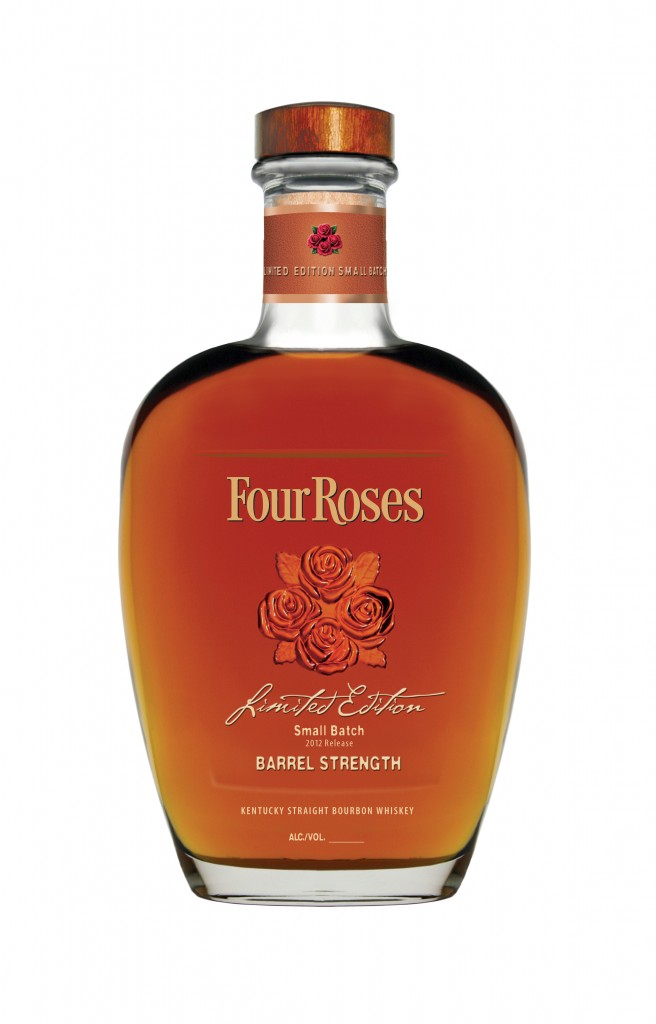
Four Roses 125th Anniversary Limited Edition Small Batch (2013)

Maker: Four Roses, Lawrenceburg, Kentucky, USA (Kirin)4R Ltd Ed Small Batch 2013
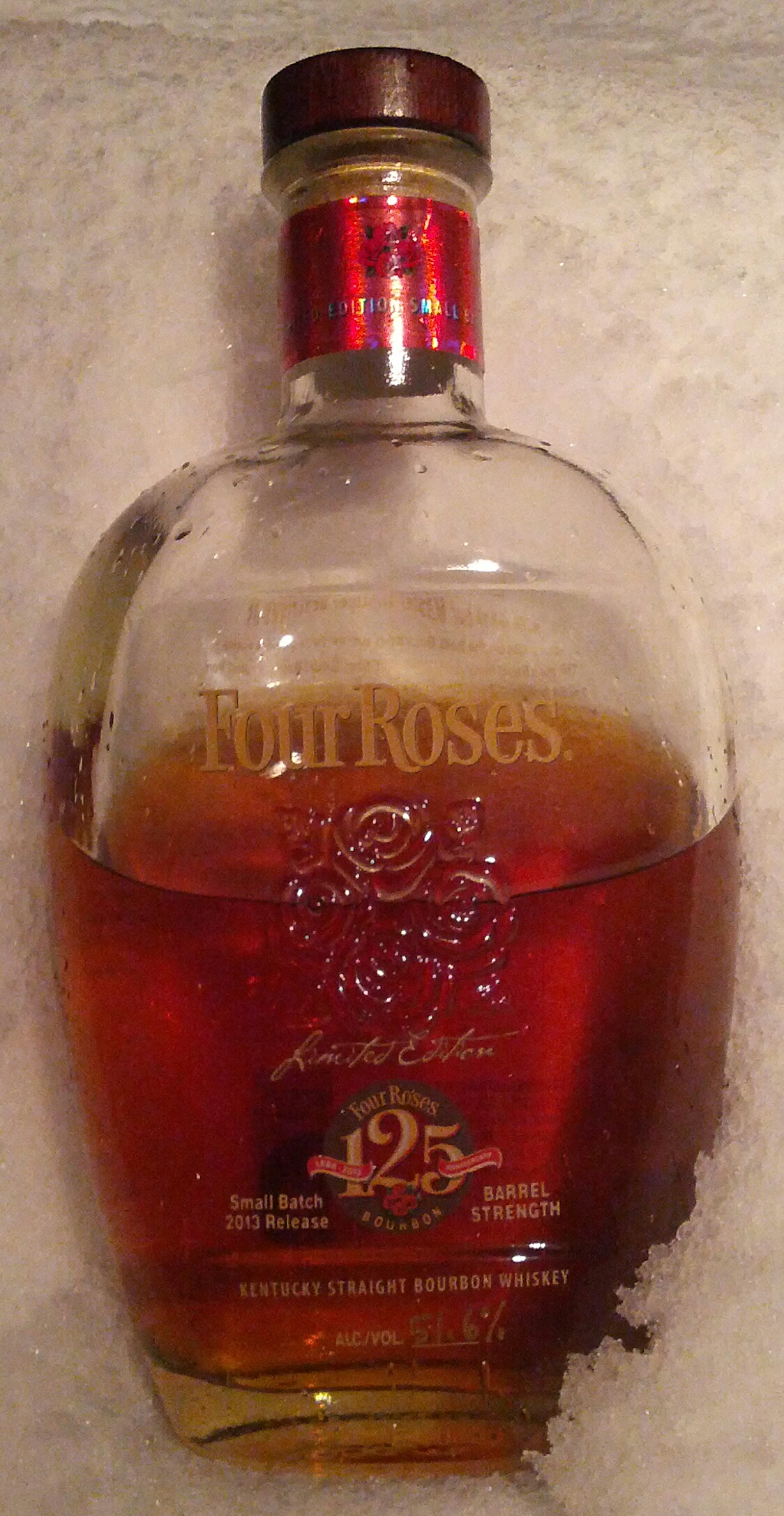
Age: 13 y/o

Recipes: OBSV (18 y/o), OBSK & OESK (both 13 y/o)

Proof: 103.2 (51.6% ABV)

Appearance: Medium Copper with thick persistent legs.

Nose: Alcohol, leather, pomegranate juice, habanero chili. After a while in the glass it settles into a more conventional high-rye bourbon profile. Caramel, jalapeno, and leather continues.

On the palate: Surprisingly easy to drink at barrel/bottle proof, but then again it’s a surprisingly low proof out of a barrel. Cherry juice, oak, sweet corn, blackberry, white mulberry, burn. Water brings out sweetness and fruity notes.

Finish: Alcohol, caramel, leather. As on the palate, water brings out the fruity sweetness in the finish and tones down the alcohol.

Parting words: For the second year in a row, the Four Roses Limited Edition Small Batch has won Whisky Advocate’s American Whiskey of the Year, and with very good reason. Last year’s was very very good, the best since 2009, but this one is even better. It’s a very similar mix of recipes, but with a higher (probably) proportion of bourbon made with the K yeast. It’s older too, which makes its balance of barrel and fruit even more remarkable. As bourbons get into the double digits, they usually get dry and oaky. This one has all the fruit of a young bourbon like Very Old Barton at close to three times the age. It’s a neat trick. It’s balanced, complex, sophisticated and bold all at the same time and it’s one of the best bourbons I’ve ever tasted.

These limited edition Four Roses releases are the 21st Century’s answer to Very Very Old Fitzgerald. Four Roses is the Stitzel-Weller of now. Unfortunately for those of us who have loved them for a long time, they are starting to be snatched up like S-W. I was able to get several bottles of last year’s release fairly easily, but this year the prices are much higher and the bottles are harder to find, even though they are more widely distributed. If you see one, buy one. If you can get more, get more. If you break your budget buying them, I’d be happy to take a few off your hands. I paid around $90 for mine which is a lot, but worth every penny. Four Roses 125th Anniversary Limited Edition Small Batch is highly recommended.

Lagavulin 12, Limited Edition 2012

Maker: Lagavulin, Port Ellen, Islay, Scotland, UK.Lag 12

Region: Islay

ABV: 56.1% (cask strength)

Michigan State Minimum: $120 (I bought it when the price was $90)

Appearance: Pale gold.

Nose: Peat, smoke, dried flowers, alcohol. Softens up a bit with water, but the peat is still front and center.

On the palate: Full bodied and aggressive. Burn, smoke, peat. Sweeter and more balanced with water. Butterscotch candy, fireplace, peat, amaretto.

Finish: campfire smoke, vanilla custard, burn. With water I get hardwood ash, vanilla pudding, and burn.

Parting words: Lagavulin 16 y/o (reviewed here) is still my favorite single malt Scotch, but this one has come very close. It’s not nearly as refined as its older sister but it has a powerful smokiness that rivals Laphroaig or Ardbeg. I’m getting into Malt Imposter territory here, but if Lagavulin were the Clash, the 16 year old would be London Calling and the 12 year old cask strength would be The Clash. The former is more polished and complex, but the latter has an urgency and power that is compelling.

The state minimum price in Michigan unfortunately went up by $30 recently so it is much less of a value than it used to be. Still, it’s a wonderful, delicious whisky worth trying and buying if it fits into your budget. I love and recommend Lagavulin 12 y/o Limited Edition 2012, Cask Strength.

Stagg Jr.

Maker: Buffalo Trace, Frankfort, Kentucky, USAIMG_20130913_120455

Age: NAS (8-9 y/o?)

Style: High corn bourbon

Proof: 134.4 (67.2% ABV)

Michigan State Minimum (rounded to the nearest dollar): $50

Appearance: Dark copper, necklacing and thin quick legs.

Nose: Alcohol, hay, wood, pralines. Water turns down the alcohol but turns the grassiness up to 11. Some caramel still comes out but the grass dominates.

On the palate: Wood, amaretto, caramel, alcohol. With water, the nutty flavors come out and make themselves known, but the grass does to. It’s kept in check by the nuts and caramel and a creamy background. The oak is not really discernible with water added.

Finish: Quick and hot with lingering amaretto flavors. The finish has a bit more oak and candy when water is added but the two clash and leave an unpleasantness in the finish.

Parting words: Stagg Jr. is a brand, spankin’ new product from Buffalo Trace. It is a younger (about half the age) version of George T. Stagg, the barrel proof centerpiece of the annual Buffalo Trace Antique Collection (BTAC). The plan is for it to be easier to find and cheaper than its father (the latter is certainly true already). It is about 10 proof points lower in alcohol than its papa too, but still very much in the “bruiser” range at over 134°.

When I was tasting Sagg Jr., I poured myself an ounce of a recent edition of Stagg Sr. (I guess we’ll have to call it that now) for the same of comparison. The contrasts were striking. Jr. lacked the complexity and powerful elegance of Sr. Frankly, Jr. drinks more like a barrel proof edition of Buffalo Trace than the bourbon with which it shares a name. I don’t mind Buffalo Trace. I’ve had some very tasty retailer selections of it and I think it does very well in cocktails, but sometimes the grassiness is just too much for me. Stagg Jr. is all the things I dislike about Buffalo Trace amplified: the grass, and way the other flavors clash with it. Stagg Jr.’s saving graces are the lack of a strong barrel char influence (one of the clashing elements in Buffalo Trace) and the mitigating role played by the nutty, liqueur-like flavors in the nose and on the palate.

If we’re comparing Stagg Jr. to Buffalo Trace ($25), it’s not much of a bargain even when one factors in the proof. When one compares it to other products of the same distillery in that price range (none of which are bottled at anywhere close to this proof or are unfiltered), it starts to look a lot better, at least on paper. This is another one I’m on the fence about, but I’m going to err on the side of generosity this time and give Stagg Jr. a recommendation.

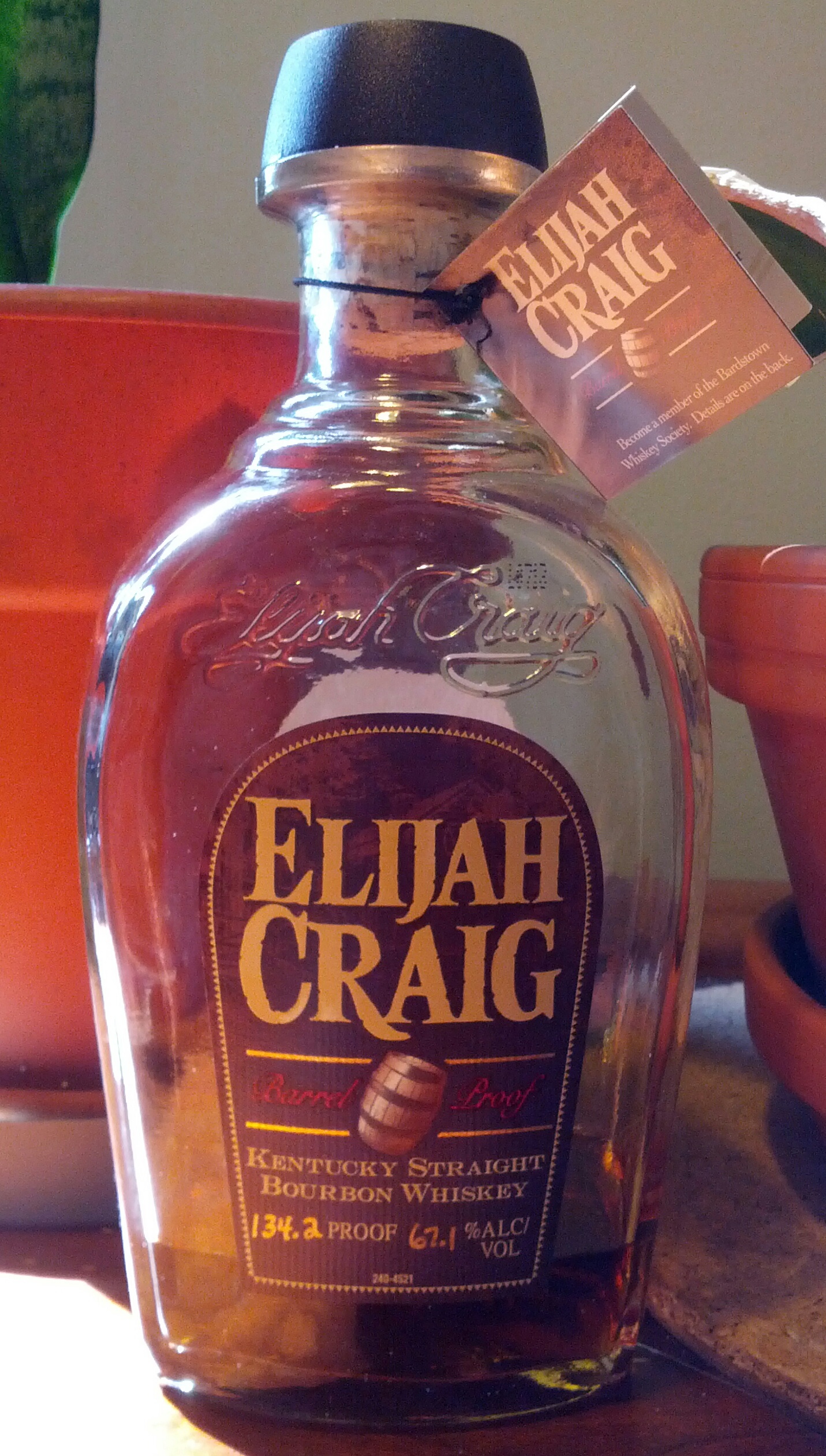
Elijah Craig Barrel Proof

Maker: Heaven Hill, Bardstown, Kentucky, USAECBP

Age: 12 y/o (not on the front label but on the back)

Proof: 134.2 (67.1% ABV)

Notes: Not chill-filtered. First edition reviewed.

Appearance: Dark brown, like root beer.

Nose: Alcohol, leather, caramels. With a little bit of water, it opens up considerablly. Heaven Hill’s signature herbaceousness comes through, this time as tarragon and lavender, with a big hit of oak joining the party.

On the palate: Hard caramel candy, and lots and lots of burn. Much more drinkable with a bit of water. The herbal notes come through firmly alongside the candy but it’s still quite hot. With a little more water, it opens up into crème brulee, licorice, oak, and more candy.

Finish: Neat, it’s very short and hot, evaporating off the tongue almost immediately. With water, a little or a little more, it leaves a pleasant combination of peppermint, caramel, oak and of course alcohol.

Parting words: This is one of my favorite whiskeys ever. It is very much in the Heaven Hill mold, but the complexity and depth of flavor is unsurpassed for a product of that distillery. It’s much better balanced than the old Elijah Craig Single Barrel 18 y/o and of course much higher proof. It is much closer to the standard 12 y/o Elijah Craig, but even more so to the better vintages of Evan Williams Single Barrel, again at much higher proof. Perhaps an even more apt comparison is to George T. Stagg. This is drinks like Heaven Hill’s answer to Stagg. It is an older, more powerful, richer unchillfiltered edition but one very much in the house style. In the case of Buffalo Trace (the maker of Stagg), that’s sweet vanilla and a little bit of grassiness. In the case of Heaven Hill, that’s caramel, mint and affordability.

The only downside is that for me it was undrinkable at bottle/barrel proof. There will always be the macho men and macho women who will drone on about how they never add water and how that ruins the flavor and so on. Good for them and their gullets, but this whiskey just begs for water. All this and it’s under $50 before tax. You’d be stupid NOT to buy it. Elijah Craig Barrel Proof is highly recommended.

Four Roses Limited Edition Single Barrel, 2013

Maker: Four Roses, Lawrenceburg, Kentucky, USA. (Kirin)4R SB 2013

Style: High rye bourbon

Recipe: OBSK

Age: 13 y/o

Warehouse/Barrel No.: BS/3-3Q

Proof: 121 (60.5% ABV)

Appearance: Dark copper with some necklacing.

Nose: Alcohol, bubble gum, leather, rose petals, lavender. Not too different with water, a bit clearer. On the palate: Medium bodied. Burn, candy, caramel, roses. With water it becomes big and sweet. Cotton candy, rose hips, oak, grape soda.

Finish: Evaporates quickly off the tongue leaving a soft leathery flavor, some fruit punch and a lot of burn. Fruitier and more delicate with water.

Parting Words: About twelve hours after writing up these notes (right after I opened the bottle) I did a comparison tasting against the 2012, of which I have several bottles. The 2012 was a different mashbill but the same yeast strain and a year or so younger. There are clear similarities, but big differences as well. The 2012 I tasted (52.6% ABV, SN/81-3i) was much more balanced and desserty (if that’s a word) with loads of caramel and similar flavors. The comparison also brought out a capsaicin note in the 2013, similar to ghost peppers or habaneros. I didn’t think the 2013 fares well in comparison to the 2012, but I do like it better than the 2011 I had and the 2010 100th anniversary bottling (cue Whiskey Wonka). The 120th Anniversary Single Barrel (2008) is also OBSK but it’s been so long since I’ve had it that I don’t feel comfortable comparing the two.

In summary, the 2013 Four Roses Limited Edition Single Barrel is a very good bourbon but not as good as some of its predecessors. Not counting the 40th (2007) and 120th anniversary for reasons of memory (see above), I would rank 2013 squarely in the middle of the pack of Four Roses limited edition single barrel releases. Being in the middle of that pack is better than being at the top of any other pack, though. The Michigan state minimum of $80 is high for a bourbon of its age but given the high proof, unchillfiltering and the unmatched quality of Four Roses across the board, it’s worth it. Four Roses Limited Edition Single Barrel, 2013 is recommended.

Russell’s Reserve Small Batch Single Barrel

Maker: Wild Turkey, Lawerenceburg, Kentucky, USA (Campari)RR-Single-Barrel-2

Age: NAS

Proof: 110 (55%)

Appearance: Burnt orange with a nice robe and thick, slow legs.

Nose: Oak, caramel, alcohol, cayenne, plum. Classic turkey profile, but a hint of fruit.

On the palate: Sweetness, then big burn. With water the burn dies down and an unexpected fruity note comes forward. Wine grape jelly, a bit of oak and caramel.

Finish: Sweet but fiery like cinnamon disks. Fades to a pleasant, slightly fruity sweetness. With water the fruit is firmly in charge in the finish. A light jammy flavor lingers and slowly fades.

Parting words: For a Wild Turkey, this is a odd duck. I have never had a bourbon that was this fruity, ever. I have heard people mention a note of grapes in some Wild Turkey products before, but all I had ever gotten was typical caramel sweetness and WT’s characteristic char and oak notes. It’s pleasant, but not very well integrated into the rest of what’s going on here.

Those who thought the Russell’s Reserve Single Barrel would be the second coming of Russell’s Reserve 101 proof will be disappointed. It’s not that, but it is good. I’m not sure if it’s good enough to justify the price (close to $50), especially with another perfectly good barrel proof bourbon (Rare Breed) around $10 less already in the Turkey coop. With all that in mind Russell’s Reserve Single Barrel is mildly recommended.

A brief postscript about the label: In an era in which superfluous words have overrun whiskey labels like ants on an unattended slice of cherry pie, the label on this new expression stands out as one of the most absurd recent examples of the phenomenon. The label calls it a “Small Batch Single Barrel Kentucky Straight Bourbon Whiskey”. A single barrel is the smallest possible batch of barrels so the label isn’t wrong per se, but it is comically redundant and raises serious questions about the minds behind Sky/Campari’s marketing and management of Wild Turkey. My advice to Campari (not that anyone there asked for it) is to remove the “small batch” and save a few pennies on ink while making the label appear less stupid.

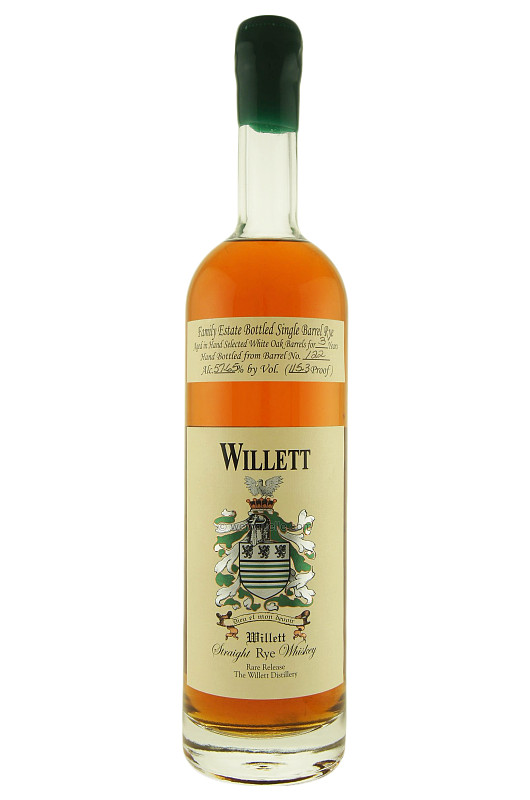
Willett Family Estate Rye

Maker: Willett/KBD, Bardstown, Kentucky, USAWillett Rye

Distiller: MGPI, Lawrenceburg, Indiana, USA

Style: High rye rye whiskey (I am now dubbing this Indiana style rye)

Barrel: 132

Age: 4 y/o

Proof: 110 (55% ABV)

Appearance: Fairly dark copper with thick legs.

Nose: Pine sap, oak, caramel, tarragon, alcohol, woodruff.

On the palate: Full bodied. Sweet and herbaceous, then hot. With a splash of water, the resemblance to Bulleit rye is very apparent. Sweet caramel, hay and spearmint.

Finish: Burn and a little caramel, then it’s all starlight mints. Lasts for almost as long as one of those would in the mouth! With some water,  tarragon and basil come out and settle into licorice before gently fading away.

Parting words: The Willett ryes being released at increasing ages every year are from the same Indiana distillery supplying Bulleit Rye, Templeton Rye, Redemption Rye and many others. The differences being that the Willetts are all at barrel proof and are single barrel selections. They are not available in Michigan, but are fairly easy to find in Kentucky and Indiana. At over $30, they’re not cheap but these are at barrel strength so one is getting more for one’s money. If 110 proof is too high for you, that’s why God made water.

Anyhow, Willett Family Estate Rye is the finest example of Indiana Rye I have tasted to date.  For something that is almost entirely rye and is only 4 years old, it has a good deal going on. I wouldn’t call it complex, but it’s more balanced than many of its siblings and it is a much better value than Templeton or High West’s Double Rye. I enjoy Kentucky “barely legal” style rye better, but if rye character is what you crave, Willett Rye is recommended.

Ardbeg Uigeadail

Maker: Ardbeg, Islay, Scotland, UK (LVMH)Ardbeg_Uigeadail

Region: Islay

Age: NAS

ABV: 54.2% ABV

Appearance: Medium copper with thin, clingy legs.

Nose: Smoldering campfire, cinnamon, peat, citron, old oak.

On the palate: Full bodied and rich. Hardwood ash, caramel, fruit gum, honey.

Finish: Heat, then ash, then more heat with a background of fruit.

Parting words: Uigeadail, named after the loch from  which the distillery draws its water, is the next step up from the 10 year Ardbeg. Most of Ardbeg’s expressions lack age statement, partially because the distillery was shut down for a few years in the 1980s and produced very little in the 1990s, but Uigeadail is clearly older than 10 years, at least on average.

If one loves smoky single malts, there is nothing not to love about Uigeadail. It’s hardy and smoky but with more finesse and balance than its younger stable mate. My only complaint is the price. The Michigan state minimum of $75 is high, especially when compared to its direct competition like Laphaoaig Quarter Cask ($57) and the limited edition Lagavulin 12 y/o cask strength which was also in the $75 range. That said, Uigeadail has more finesse and more power than those two respectively, is non-chillfiltered, natural color and cask strength, all of which are big plusses. While I’d like to see it at a lower price, it’s probably worth what I paid for it. Ardbeg Uigeadail is recommended.

Four Roses Limited Edition Small Batch 2012

Maker: Four Roses, Lawrenceburg, Kentucky, USA (Kirin)

Age: 11 y/o

Composition: OBSV- 17 y/o & 11 y/o, OBSK 12 y/o, OESK 12 y/o

Proof: 111.4 (55.7% ABV)

Appearance: Dark copper.

Nose: Oak, caramel, toffee, tarragon clove, jalapeno. With a splash of water, bubblegum, leather, fennel, nutmeg.

On the palate: Dark caramel, taffy, aniseed candy. With water, soft and fluffy mouth feel. Caramel, oak, toffee again, allspice, table grapes.

Finish: Heat, then fruit, then oak, then a long tingle.

Parting words: If you’re expecting me to rave about how great this is, like I do with all the Four Roses annual releases, then you obviously read this blog and know me very well. Continuing the symphonic metaphor from the review of the 2011 release, this is Beethoven’s seventh symphony. If you’re not familiar with Beethoven’s 7th, it may be his best after the 9th. It has the power of the fifth symphony and the richness and texture of the sixth. The 2012 Ltd Ed Small Batch has the power of the 2010 release and the complexity and elegance of the 2011 release. The result is a flawless whiskey, like the seventh is a flawless symphony. Mariage 2009 is still the ninth, though. It transcended the genre and broke new ground that still hasn’t been completely mined.

At any rate, this is one of the best bourbons I have ever had. It’s as good as the 2012 single barrel, and is an improvement on the 2010 and 2011 Ltd Ed Small Batches. Four Roses Limited Edition Small Batch, 2012 is highly recommended.

Four Roses Limited Edition Small Batch 2011

Maker: Four Roses, Lawrenceburg, Kentucky, USA

Age: 11 y/o (mean age 12.25 y/o)

Recipes: OBSK, OESK, OESV, OESQ

Proof: 110.2 (55.1% ABV)

Appearance: Coppery auburn

Nose: Oak, alcohol, caramel, butterscotch, raw almonds, antique roses.

On the palate: Full-bodied and hot. With water, cassia, caramel, vanilla toffees, oak, amaretto.

Finish: Hot, rosewater, roasted almonds, oak and christmas spice at the end. Tingles all over for an obscenely long time.

Parting words: As always, Four Roses delivered a remarkable bourbon for its Ltd Ed Small Batch in 2011. The 2010 was an agressive, brash, punk rock sort of whiskey. 2011 is much more Classical, as in Haydn, Mozart and early Beethoven. It’s a leather armchair, sipping bourbon.

2011 is beautiful and has its complexity, but it’s not the breathtaking masterpiece that Mariage (the predecessor to Ltd Ed Small Batch) 2009 was. It’s Hayn’s 100th Symphony, not Beethoven’s ninth. But that doesn’t mean it’s not great in its own right. It is. It is one of the best bourbons I’ve had. It is probably the second best bourbon in this Ltd Ed Small Batch/Mariage series. Four Roses Limited Edition Small Batch 2011 is highly recommended.