…is over!
I had some business to take care of so my time and writing chops were devoted to another project. But now I’m back! New entry tonight or tomorrow!

…is over!
I had some business to take care of so my time and writing chops were devoted to another project. But now I’m back! New entry tonight or tomorrow!
Highland Park Single Malt Scotch Whisky
Age: 12 yrs.
Proof: 86 (43% ABV)
Maker: Kirkwall, Orkney, Scotland (Edrington Group)
It’s Whiskey Friday. For those of you who are whiskey fans and on twitter, check out Whiskey Friday. Or just type #Whiskey Friday and then something else.
A note on spelling. In spite of popular opinion, there is no difference between whiskey and whisky. Whisky is how the word is spelled in the U.K. and Canada. Whiskey is how the word is spelled in the U.S. and Ireland. Both spellings indicate a spirit made from grain and aged (with the exception of corn whiskey, which may be unaged). To confuse matters more, some brands of American whiskey, like Old Forester, Maker’s Mark and George Dickel, use the e-less spelling. So, in short, it’s not worth getting too worked up about spelling.
It’s no secret that bourbon is my spirit of choice. But when I first started exploring the world of spirits, I drank quite a bit of Scotch. I moved away from it, but from time to time I do find myself feeling the urge for Scotch.
Highland Park is my kinda Scotch. It has a little bit of all the things that make Scotch Whisky special. It has all these things, but instead of being busy, all the elements hang in beautiful balance.
The color is light, like honey that has siezed up in the bottle. I like that a lot. I like it beacause it shows that it is free from the pencious caramel coloring that many Scotch distilleries add to their product. One of the differeces in American whiskeys and Scotch whiskeys is that Scottish makers are allowed to add coloring and flavoring to their product, other than that which comes from the barrel. In the U.S., no bourbon or rye is allowed to add anything artificial to the whiskey and still call it bourbon or rye(unless they label it bourbon + X flavoring, for example). Also, any whiskey called a “straight” whiskey in the U.S. must be aged in new charred oak barrels, while almost all Scotches are aged in used oak barrels, many of them old bourbon barrels! This makes straight American whiskeys naturally darker than their European cousins. So a light color indicates a young bourbon, while the same indicates an additive-free Scotch.
At any rate, the nose on this whisky is a typical Scotch nose (much like my own) but not obnoxiously so. The smoke hits my hooter first, then a bit of peat, then a lucious flowery sweetness, like wildflower honey. On the palate it is quite sweet at first, then peat rushes to the fore. It then does something very interesting. The sweetness fades to a long, quite dry finish. The wood begins to come through in the finish, but the smoke and peat maintain their forward position.
This is one of Scotland’s best, beloved by connoisseurs and dillatantes alike. I have a feeling that my cupboard will not be without it for very long after this bottle is gone.
St. Julian Pink Catawba
Maker: St. Julian, Paw Paw, Michigan
Grape: Catawba
Region: Lake Michigan Shore AVA
Catawba is perhaps the most American of all wine grapes. It was one of the most commercial grapes in the 19th century. Its domain was the eastern U.S. Ohio’s sparkling pink Catawba was once regarded as America’s finest wine.
The wine industry in the East, and the Catawba was almost destroyed in the late 19th century when the railroads made it possible for California wine producers, growing European grapes, to ship their wines to East. Many things were tried, but by the time of prohibition, the Eastern wine industry already had at least one foot in the grave.
Starting in the 1970s with the Farm Winery movement, the Eastern U.S. has been able to raise its wine industry from the dead. But many places in the East, like New York, are now almost exclusively growing European grapes. The Catawba has found its home in the midwest, though, in many places that are too hot or too humid for the finicky European grapes.
In my mind, St. Julian’s Pink Catawba is the standard. It is less pink than it is a pale orange. The nose is tart, with that strong scent and flavor described as “foxy”. Foxiness is that tangy taste unique to American grapes. It is that flavor that Americans love in Concord grape juice and grape jelly, and Europeans despise in anything.
On the palate it is much lighter than the nose would have you believe. Full-bodied and tart, but still sweet, it is above all, refreshing. Hardly anything tastes better on a hot, sweaty summer night in the midwest than a cool glass of Catawba. If you don’t like this wine, you’re unamerican. Or European.
All is true!
No details on U.S. release or much of anything else, but the Beam 6 grain bourbon is a real item. The six grains are: corn (i.e. maize), malted barley, rye, wheat, triticale (a rye/wheat hybrid), and brown rice.
Watch this space for more info!
UPDATE: Check out the Chuck Cowdery blog for more info and reflections.
Something weird is going on in Europe. Straightbourbon.com’s lead Swede, Leif, discovered something odd on German ebay. This.
According to friend-of-the-blog Ben Kickert’s google translation, the ebay page translates to something close to the following:
“Jim Beam Kentucky Straight Bourbon Signature Six Grains Whiskey 1 liter with 44.5% vol in a distinctive leather bag. This limited bottling is 6 years old. The six different grains distilled bourbon is very soft and vollaromtisch. Caramel and vanilla accents dominate the taste until his velvety and warm long finish. It is the first bottling of a beginning series of Jim Beams, the short run the market will come in only.”
What’s weird is that nobody, not even those who make their living writing about bourbon (well, at least some of their living) has heard anything about this. It claims to be made from six grains, which is bizarre. Four-grain bourbons have been made from time to time, most infamously the Woodford Reserve Master’s Collection Four Grain (for a fun read consult this SB.com thread), but this is unprescendented. The bottle seems to be genuine, but releasing a new expression overseas, apparently through duty-free shops, is highly unusual.
Speculation on the six grains (beyond the usual suspects of corn, barley, rye & wheat) has ranged from oats and millet to triticale and candy corn. One possibility is that multiple varieties of corn (or something else) are being counted as seperate grains. Woodstone Creek (a winery/distillery in Cincinnati) used two varieties of corn to make their bourbon, and claimed it as a 5 grain bourbon.
Anyway, a lot of heads are being scratched right now. I’ll keep you posted.
Round Barn Apple Demi Sec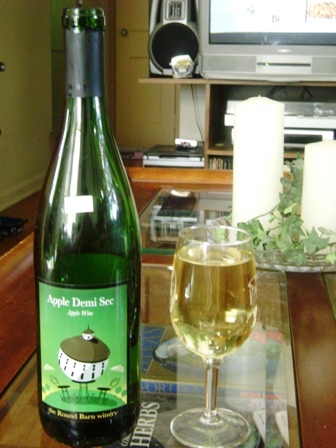
Region: Lake Michigan Shore AVA
Maker: Round Barn Winery, Baroda, MI
ABV: 12%
Round Barn is a jack-of-all-trades winery. Located in the heart of the SW Michigan Lake Michigan Shore AVA (American Viticultural Area), they cut their teeth on the white wines and fruit wines that are the lifeblood of the Michigan wine industry. They have branched out into brewing and distilling, producing (or at least bottling) a vodka made from their own grapes.
The concept of an apple wine still seems odd to me. Why not drop the prentense and call it a cider? But after a few drinks, I understand why they call it an apple wine. First of all, as you may have noticed, the alcohol content is much closer to a wine than a typical cider, which frankly is a little dangerous, I can already tell you. It is also more acidic than typical ciders and has a delicate dryness that is as close to a New Zealand Sauvignon Blanc as it is to a glass of Woodpecker, for instance.
Still, the apples are leading the charge. It is in the lighter, dry style of most British ciders. The smell reminds me of working my way through grad school in the childcare industry and the hordes of apple juice guzzling children I shepherded through their single digits. It lacks the robust body of my favorite ciders, but has a lightness that makes a good change of pace on a summer afternoon.
Four Roses Single Barrel Barrel Strength KSBW
Age: NAS, ca. 9 y/o
Proof: 112.8 (56.4% ABV)
Recipe: OBSO (For a breakdown of the 10 recipes, click here)
Barrel: GE 553C (bottle 1/172)
This whiskey is not available at your friendly neighborhood grab & go. This is what is called a “private bottling”. Where the law permits, certain liquor stores, clubs or even individuals will buy an entire barrel of whiskey (or brandy, rum, tequila, etc) and have it bottled for them by the producer. The producer will usually pour samples of the contents of a few different barrels, then the purchasers will try them and decide which barrel(s) to purchase. Binny’s Beverage Depot in Chicago is well known for its private bottlings of bourbon, rye and Scotch, for instance. The Bourbon Society of Louisville, KY is also known for its private bottlings for members. Two friends of mine even got together and bought a barrel of Four Roses single barrel that is very well regarded and very tasty. I know because I’ve had some.
Not all distilleries do private bottlings though. Four Roses, Willet (not really a distiller, but a producer of excellent whiskeys nevertheless) and Buffalo Trace are well known for their private offerings, but Heaven Hill has started doing them with their single barrel whiskeys too, and one will even find a private bottling of Wild Turkey’s Kentucky Spirit on occasion.
At any rate, in 2009, Four Roses decided to release some of their 10 recipes at barrel strengthas private bottlings to select liquor stores across the country. Binny’s, as usual, got some of the best barrels. This one, OBSO, is one of the constituent whiskeys in Four Roses Small Batch.
When sipped at barrel strength, it does that magical thing that high proof spirits do. The moment a drop hits your tongue, it vaporizes. This trick is amusing the first few times it happens. After that, you decide you would like to actually taste it, and you decide you don’t want to have heartburn all night. So you add a splash or two of water.
The whiskey itself is a dark amber, the proverbial copper penny color. The nose has a lot of caramel, but a sharp edge to it, too, as the barrel char punches through. Even with a splash of water, it’s still a hot whiskey. But it’s a mature heat, more Kim Cattrall than Megan Fox. The caramel is still there and even stronger on the palate. The char has retreated a bit, but adds depth to the sweetness and keeps this whiskey from becoming one dimensional. Not the best one of these Binny’s Four Roses bottlings I’ve had, but still worth the price of admission.
A great guest blog entry on an already great blog: Sam Komlenic talks about his experience with the legendary Michter’s distillery on John Hansell’s What Does John Know?.
Bloody Caesar Cocktail
Recipe: 2 oz vodka, 6 oz (or so) Clamato juice cocktail, dashes of hot sauce and worchestershire sauce.
Featured: Tito’s Handmade Vodka, Clamato, Lea & Perrin’s, Deathwish Habanero Hot Sauce
To celebrate the completion of my midterm in my class on the Roman Republic, I’ve decided to enjoy a Bloody Caesar. Because I have a feeling the class is going to end with one.
A bloody caesar is a bloody mary made with Clamato rather than tomato juice. Clamato is a tomato juice cocktail made with clam juice. It makes a much thinner, more mild drink than tomato or vegetable juice makes. So I always find myself putting more worchestershire and hot sauce into a Caesar than I do into a Mary. Especially this hot sauce which, despite the name, is less than deadly. I also forgot to add any prepared horseradish. Still, the clam came through.
At any rate, in my expereince pepper (black or red) or tomato infused vodka seems to work best with Clamato juice. It gives its mild flavor a good boost. At any rate, my Bloody Caesar was pretty tasty. A nice change of pace from the Mary, even if it does lack its richness and bite.
Friend of the Blog and Erin Andrews wannabe Chuck Cowdery breaks the news.
http://chuckcowdery.blogspot.com/2010/06/sale-of-hudson-whiskey-brand-gives.html
 Sipology