Review

Woodford Reserve Master’s Collection Seasoned Oak Finish
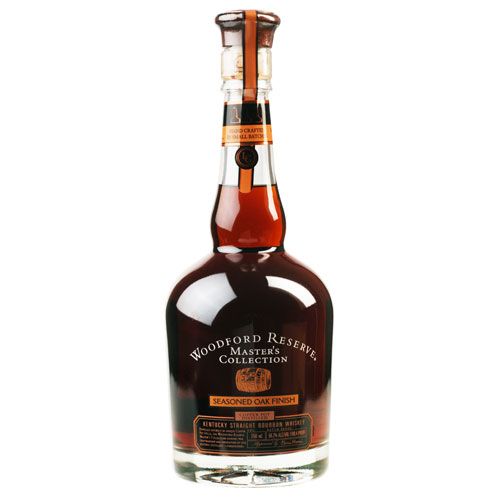
Age: 7-8 y/o +around 8 months “finishing

Proof: 100.4 (50.2%)

Maker: Woodford Reserve/Labrot & Graham, Versailles, Kentucky (Brown-Forman)

Woodford Reserve is (partially) made at a beautifully restored and quite old distillery in Versailles (ver-SAYLES) Kentucky, in Woodford county, west of Lexington.  The oldest building on the site dates to 1838.  Brown-Forman acquired it (for the second time) in 1994 and restored it into the beautiful tourist attraction it is now.

Standard Woodford Reserve is made of a combination of whiskey distilled on site in huge pot stills and whiskey distilled at B-F’s plant in Louisville, home to Early Times and Old Forester.  It is then aged at Woodford Reserve.  For their special annual Master’s Collection releases, they only use whiskey distilled at Woodford and do something interesting with it.  Not always good, but always interesting.

For 2009, they took a standard batch and after it was fully aged, they transferred it to barrels that had been lightly toasted (as opposed to the deep char used on standard bourbon barrels) after having been seasoned for an extremely long time.  Most bourbon barrel staves are seasoned (dried) outdoors for a few months before being charred and made into barrels.  The barrels used to finish this whiskey were seasoned for a few years.  This created a very unusual bourbon.  And a pretty good one too.

It’s dark, even for a bourbon.  Chestnut brown.  The nose is dry, dry oak, black walnut, with a hint of sweetness.  On the palate it continued dry, with a heavy wood influence, but in an unconventional way.  It’s tannic and chewy, like chewing on a damp oak stave.  In a good way, kinda.

The finish is dry, but not as heavy as one might expect.  Tannic, but never quite shifting into bitter.  This is a whiskey teetering on the edge.  But in an odd way, it achieves a nice balance.  My only real complaint is that it costs $90 for one bottle.  Luckily I was able to split one three ways with a couple other enthusiasts.

For a list of the upcoming releases visit Chuck Cowdery’s blog here.
Review

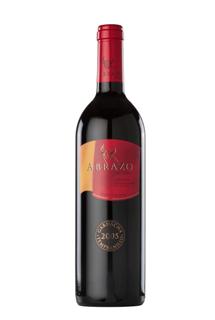
Abrazo Del Toro Reserva

Grapes: 40% Tempranillo, 60% Garnacha (aka Grenache)

Region: Cariñena, Aragon, Spain

Vintage: 2005

Producer: Covinca S. Co-op

ABV: 13.5%

I am not ashamed to say that I buy a lot of wine at Trader Joe’s.  When it comes to fine French wine, I wouldn’t bother with TJ’s.  Their California selections can occasionally be good buys but are a hit or miss.  Where TJ’s wine department shines is with Italian, Spanish, and South American wines.  One of the most consistently good Spanish wine I’ve purchased have been on the Abrazo del Toro label.  The reserva is my favorite and there are usually plenty of 5 y/o+ bottles on the shelf at my local store. 

The wine itself is one Richie Blackmore would be proud of, color-wise anyway.  It’s a deep, smokey purple.  The nose has the slightly tart aroma of raspberry jam.  I’ve had the uncanny urge to spread this wine on toast.  In the mouth it’s smooth and easy to drink, but not shallow.  On the tongue it’s red raspberry, and red currant jelly, with a bit of wood at the end.  And all this for a lot less money than most quality Spanish reds.

Baby Bourbon?

As some of you know, my recent hiatus is due to the birth of my daughter Virginia on August 10.  We’re starting to get into something of a rhythm, and I have a few reviews in the pipe, so I hope to be able to start posting again soon.  So look for some more shortly!

Last Night

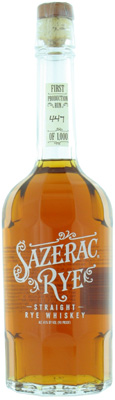
Sazerac Rye (Binny’s selection)

Age: 9 y/o? (standard edition c. 6 y/o)

Proof: 90 (45% ABV)

Maker: Buffalo Trace, Franfort, Kentucky (Sazerac Co.)

Rye whiskey was one of the first whiskeys made in the U.S.  It briefly took over from rum as American’s drink of choice after the Revolution cut the former colonies’ ties with the U.K.  Rye was long associated with Pennsylvania and Maryland, but sadly there are no major producers of rye left in either state, although the A. Smith Bowman distillery in Virginia does produce a rye available only in that state.

Sazerac is named for one of the first cocktails invented in the U.S., in New Orleans, to be precise.  It consisted of surgar, rye whiskey (or originally Cognac) and Peychaud’s bitters served in a glass that had been rinsed with absinthe.  Today, New Orleans is where Sazerac Co.’s headquarters still is, but their primary whiskey distillery is the large, historic distillery in Frankfort, Kentucky now known as Buffalo Trace (BT).  Although BT uses three different bourbon recipes, Sazerac is its only rye.  There are three editions of Sazerac Rye: Sazerac 18 y/o, Thomas Handy Sazerac (a barrel-proof version), and this one, nicknamed “Baby Saz” or “Saz Jr.”

It is a beautiful whiskey.  The color is that of a new copper penny.  There is possibly a little barrel char in the bottom of my glass, although that might be coffee grounds my dishwasher missed.  The nose reminds me of apple juice (not cider), with apricots, alcohol, and hint of wood.  In the mouth it is medium bodied, sweet, and rich.  Like a lot of youngish rye whiskeys I get hints of tropical fruit, like mango and papaya.  The finish is slightly dry, with a aweet and spicey cinnamon burn, then a touch of wood.  The finish is long, surprisingly long for a young whiskey. 

 This is a tasty, sophisticated rye.  Wild Turkey Rye, for instance, is more assertive and has more spicey rye character than Saz Jr., but Sazerac is hard to beat for a delicate sipping rye, or any other American style whiskey for that matter.

Now Drinking

McWilliam’s Hanwood Estate Riesling

Grape: Riesling

Region: Southeast Australia

Vintage: 2006

ABV: 12%

Maker: McWilliam’s, ???, Australia (owned by ???)

One of the great aspects of wine is something called terroir.  Basically, this means that the wine reflects, in some way, the place in which it was grown.  The vine takes up different nutrients in the soil, it reacts to the climate and the weather, etc.  This has an impact on the grapes, and thus on the wine.  Certain grape varieties simply grow better in different places, and don’t do well in other places.

Riesling is a grape that was traditionally grown in Germany, Austria and Eastern France, and now has been grown sucessfully in the Northwestern and Northastern U.S. and Southern Canada.  It is late to bud (good in places with late frosts) and does well in moderate climates like those around the Rhine and Mosel rivers in Europe and the Finger Lakes and Great Lakes and the Pacific Northwest in North America.

When one thinks of cool, moderate climates, the country of Australia does not come to mind.  Neither does the state of California.  I’ve sampled a couple California Rieslings with the thought that if they’re growing it there, surely it can’t be THAT bad.  Both times I was proved wrong.

When I saw this Australian Riesling in a grocery store bargain bin I thought the same thing.  Sure New South Wales has an average July (winter) high of 60 degrees, and January (summer) high of 95 degrees (compare the same for Strasbourg, France and Traverse City, Michigan), but they wouldn’t grow it or sell it if it wasn’t half bad!

It actually wasn’t half bad.  It was all bad.  When a first opened the bottle it was just kind of dull, and lifeless, like the fruit-flavored water my wife enjoys.  But the longer it sat and the more it opened up, the worse it got.

The nose is remiscent of state park shower stalls: an earthy combo of lake water and dirt with a faint hint of urine.  On the palate it’s weak and limp, like watery lemonade made from artificially flavored powder.  The finish is sharp, with notes of gasoline.

Some of McWilliam’s reds have gotten fairly good reviews online.  Maybe they’re ok, but as for the Riesling, terroir really does matter.  Avoid at all costs or serve to someone you despise.

Good News!

Good news for micro-brew lovers!  Milking It brewery in Royal Oak, MI now has its products in finer party and grocery stores in Southeastern Michigan, in pint CANS, no less.  I’m a big fan of the Axl Pale Ale.  Pick up a six pack.  Yes, now.

Now Drinking

Powers 12 yo/o Irish Whiskey

Age: 12 y/o

Proof: 80

Maker: Midleton Distillery, Midleton (Cork), Ireland (Pernod-Ricard)

I drink very little Scotch, but I drink even less Irish whiskey.  This is because most of the Irish I’ve tasted has been really, really boring.  But, encouraged by positive reviews of a few Irish whiskeys in my first issue of Malt Advocate a few months ago, I’ve decided to branch out.

I picked up a bottle of this a few weeks ago, as the beginning of a spot in my rotation for finer Irish Whiskeys.  I’ve had the standard Powers Gold Label before and while it does have some character, it was still very dull and had a nasty grain whiskey aftertaste.  Powers is made a the same distillery as Jameson, Midleton, Redbreast and Paddy’s. 

The extra years in the barrel have greatly improved this Powers.  I drank it with one ice cube, and now I’m doing it again.  There is a LOT of bourbon in the nose, but of course I think this is a very good thing.  Behind the bourbon is a nice fruitiness, lots of mango and buttery papaya.  It’s complemented by a bit of toffee.

On the palate the toffee jumps out at first, then it’s followed by more mango and some mandarin orange and a nice bit of burn (shocking in an Irish).  The finish is surprisingly dry, with a parting glance from the mango.  Another light, but flavorful, summer sipper.

Powers 12 only became available in the U.S. this year.  I hope it sticks around, because it’s not doing a very good job sticking around my house.

Now Drinking

Ecker-Eckhof Grüner Veltliner

Grape: Grüner Veltliner

Region: Wagram, Donauland, Austria

Maker: Ecker-Eckhof, Kirchberg am Wagram, Austria

Non-Vintage

ABV: 12%

Grüner Veltliner (nicknamed GruVe) is a grape with a mysterious history.  According to wikipedia it has been connected to the Traminer grape and a mysterious grape found in an ancient, overgrown Austrian vineyard.  At any rate, it is grown primary in Austria and the Czech Republic.

There are GruVe wines at all sorts of price levels and levels of age-worthiness.  This one is on the lower end, but still quite good.  When I first opened the bottle, I had to re-check the bottle to make sure I wasn’t drinking sparkling mineral water.  There is a good deal of fizz in this wine, not too far off from the young Portugese wine called Vinho Verde which is often a little “lively” as well.  The minerality is really what dominated the wine at first.  I felt like I was chewing on a piece of limestone.

The bottle is a liter bottle, so I naturally didn’t drink it all at one sitting.  After a day or so in my fridge, it began to settle down a bit.  The minerals retreated and a grapefruity acidity sauntered into the gap.  Now it tastes more like a New Zealand Sauvignon Blanc than a Vihno Verde, albeit a young Sauv Blanc.  At any rate, an enjoyable wine, but I’m not sure if I would buy it again.  If you like a stoney wine, though, I’m sure you’ll enjoy it more than I.

Now Drinking

Martini

Ingredients: Boomsma Jonge Genever, Noilly Pratt Original Dry Vermouth

Makers: Boomsma, Leeuwarden, Netherlands; Noilly Prat, Marseillan, France

Garnish: lime-stuffed olive

This a definately a different kinda martini.  Although made with gin and dry white French vermouth, there’s very little dry about it.  If it were a musical, it would be La cage aux folls; its Big, sweet and fruity.  Kinda of like a slightly herbal, higher abv kool-aid.  But in a good way.  Peaches, apricots, oranges, a bit of leftover licorice.  Too bad this this the last couple ounces of my Boomsma gin.  This is mad yummy.