Oberon

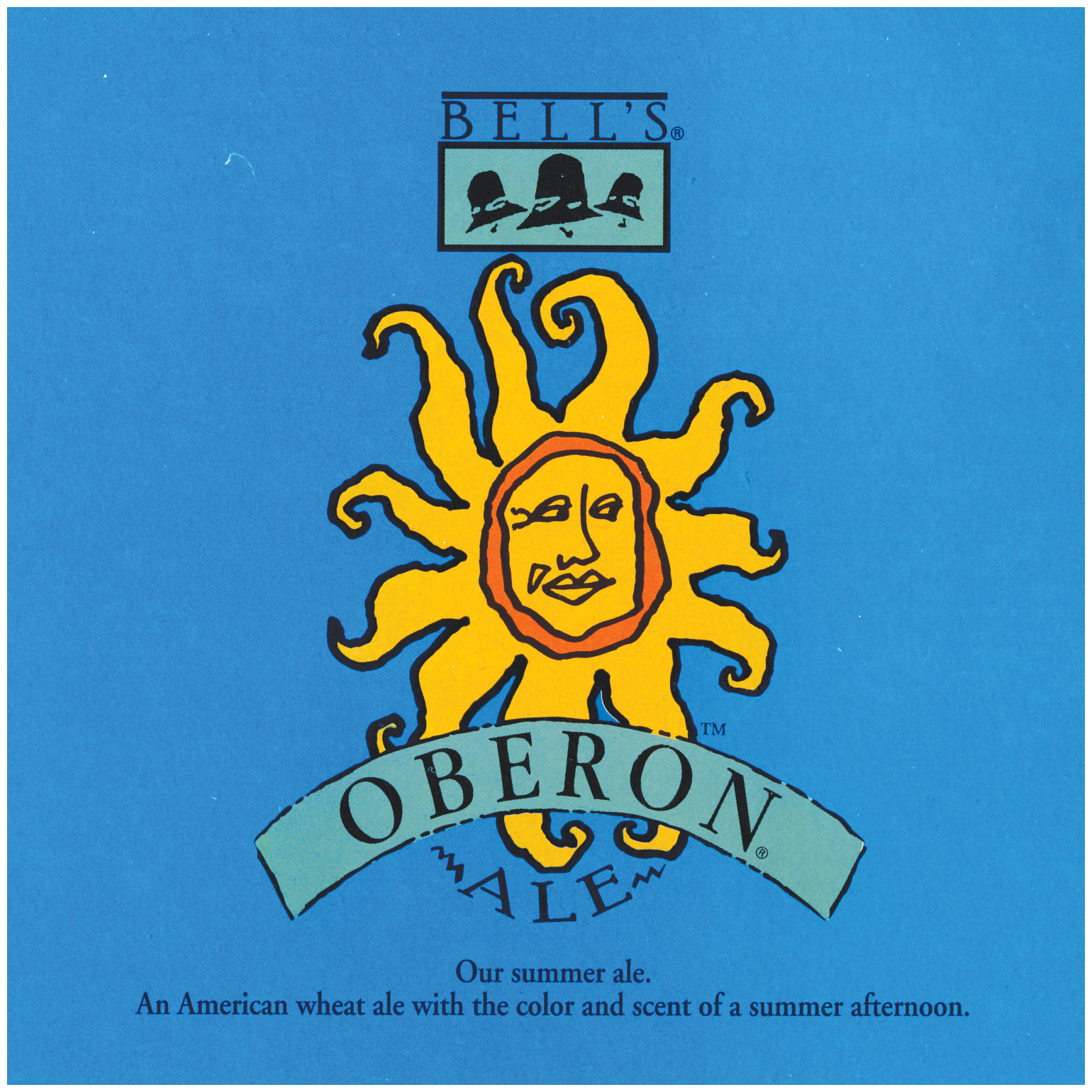
Maker: Bell’s, Comstock/Kalamazoo, Michigan

Style: Wheat Ale

ABV: 5.8%

Appearance: Cloudy gold with moderate head.

Nose: Sweet, floral.

On the palate: Medium bodied. Rounded and light, a little sweet and a little fruity but dry for a wheat ale overall. A nice hit of bitter hops on the back end.

Finish: the hops persist in the finish for a long time but eventually fade.

Parting Words: Oberon is Michigan’s best known and most celebrated beer. What makes it successful as a summer ale is that it does not have some of the off-putting (to some) aspects of wheat beers. It avoids being a “banana bomb”, like many wheat beers, with deft use of hops. The sweet fruitiness wheat brings to beer is present but kept in check. Oberon is old news to many Michigan microbrew enthusiasts but it remains one of America’s finest ales. Recommended. Summer wouldn’t taste like summer without it!

Ole Ore Dock Scottish Ale

Maker: Keweenaw, South Range, Michigan

Style: Scotch Ale

ABV: ???

Appearance: Medium hazy brown. Nice, but not obnoxious head.

Nose: Fruity and sweet but pretty mild.

On the palate: vVry tangy like tomato ketchup. Nearing the finish a bitter note runs out of the bushes, slaps you in the face and then
runs away laughing.

Finish: The finish is mercifully short and unremarkable.

Parting Words: First let me say that I have loved everything else I have ever had from Keweenaw. That said, this is an awful beer. It’s like drinking cheap, over-sweet, half-spoiled tomato ketchup, but worse. Buy loads of beer from Keweenaw, but don’t buy this until it gets fixed. Terrible.

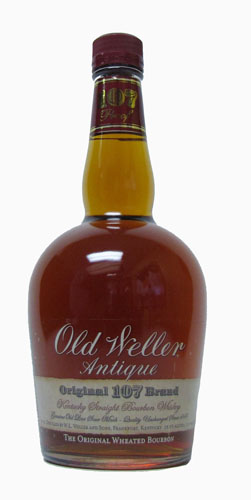
Gone Antiquing: Old Weller Antique Head to Head

Maker: Buffalo Trace, Frankfort, Kentucky

Age: NAS (Loch & K(e)y is around 9 y/o)

Style: Wheat Bourbon

Proof: 107 (53.5% ABV)

1)     Kahn’s

2)     Loch & K(e)y

Appearance:

1)     Dark Copper with big thick legs.

2)     Similar but seems lighter. Legs are a little thinner as well.

Nose

1)     Sharp and hot with char and homemade caramels.

2)     Not as sharp. The char comes through even more. The caramels are still there, but they now are studded with pecans.

On the palate

1)     Hot, but sweet. Assertive but not aggressive, more caramel and chewy vanilla toffees.

2)     Thinner, but milder belying its high proof. More complex than the Kahn’s. Wood, vanilla, toffee, caramels, pecans and walnuts.

Finish

1)     Big and hot especially on the lips, tempered by a growing sweetness in the form of the aforementioned vanilla toffees.

2)     Milder, but still bold. The sweetness leads more than in the Kahn’s bottle, but the tingle on the lips is still there and persists for what seems like a very long time.

Parting Words: These are both very good private bottlings. The Kahn’s drinks like an exceptionally good version of the standard bottling. The Loch & K(e)y bottling (associated with Julio’s Liquors in Westborough, Massachusetts) is more refined tastes closer to a Van Winkle wheater than the standard Old Weller Antique. Both these bottlings are sold out, but if you find a friend with one of them or you have an opportunity to buy a future private bottling of Antique from either of these retailers, I highly recommend you do so!

Scotty Karate

Maker: Dark Horse, Marshall, Michigan

Style: Scotch Ale

ABV: 9.75%

Appearance: Dark reddish brown with a moderate
head.

Nose: Sweet and a little tangy, with a hint of City Roast coffee but not quite Full City.

On the palate: Medium bodied, Surprisingly sweet and fruity. This is a more complex beer than Dirty Bastard, but lacks a bit in subtlety. The tang and bitterness both seem to be turned up to 11 instead of harmonizing.

Finish: The bitterness takes the lead in the finish. The sweetness perseveres in the form of a slight stickyness on the lips.

Parting words: Like I mentioned above Scotty Karate lacks in subtlety, but makes up for it in complexity and just overall interest. This is a very well-done beer, works well with or without food and is highly recommended.

Wild Turkey Rye

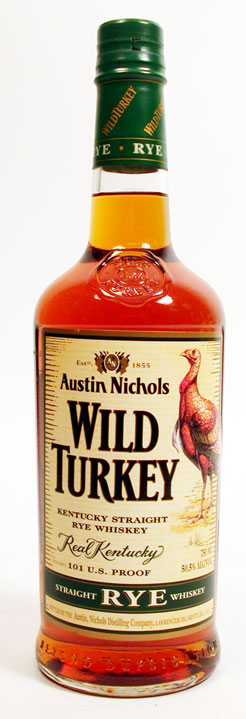
Maker: Wild Turkey, Lawrenceburg, Kentucky (Gruppo Campari)

Age: NAS

Proof: 101 (50.5% ABV)

Appearance:  Pale copper. Delicate pearl necklace in the glass.

Nose: Alcohol and maybe a bit of sweet corn, oak and hay.

On the palate: Hot and harsh. Thin body, burn out the wazoo. There’s a wimper of fruity rye character and then it just vanishes.

Finish: It actually starts to get interesting in the finish. Big burn at first, then a slow fade into a pleasant sweet tropical fruit flavor characteristic of young ryes. Too bad I had to drink it first.

Parting words: It had been a long time since I had purchased Wild Turkey Rye and I did not remember it being this bad, but I do remember it taking a long time to finish. I also tried it in a Sazerac cocktail to no avail, and it even ruined perfectly good ginger ale.

I have a friend who compares WT rye to diesel fuel. I wouldn’t go that far, but it’s certainly not very good at all. For a better look at what WT can do with rye, try the Russell’s Reserve Rye, or better yet get Sazerac rye or Rittenhouse BiB if they’re available in your area. Wild Turkey Rye is not recommended.

Dirty Bastard Scotch Ale

Maker: Founder’s, Grand Rapids, Michigan

Style: Scotch Ale

ABV: 8.5%

Appearance: Dark brown like over-steeped Ceylon tea.

Nose: I know it sounds bizarre, but my first thought was home-made French fries. A little bitter, a little burnt, but sweet and starchy.

On the palate: Full-bodied and rich. Well balanced with sweet toffee and caramel backed up by some of that bitter, burnt starch taste.

Finish: The bitterness teeters on the edge of unpleasantness but never quite falls into the abyss.

Parting words: This is a very dry Scotch Ale, but it still is able to maintain good balance between the bitter roasted flavors and the caramel and candy flavors. A good solid ale.

Head to Head- Lonely Islands: Talisker 10 vs. Jura Prophecy

  1. Talisker 10
  2. Jura Prophecy

Maker

  1. Talisker, Carbost, Isle of Skye, Scotland
    (Diageo)
  2. Jura, Craighouse, Isle of Jura (joo-rah), Argyll, Scotland (United Spirits)

Region: Highlands- Island

ABV

  1. 45.8%
  2. 46%

Appearance

  1. Pale gold with thin, quick, sticky legs.
  2. Middle-aged copper (caramel coloring?) with thin, but also sticky legs.

Nose

  1. Peat, smoke, your grandma’s medicine cabinet meets your grandma’s candy dish.
  2. Intense bonfire smoke, but a bonfire with some unusual woods in the mix, maybe a little cedar. Behind all that, though, lurks a touch of chewy vanilla taffy.

On the palate

  1. Full-bodied and creamy. Burn, then big sweetness. Very little sign of peat or smoke.
  2. Medium-bodied. Burn and then that vanilla taffy comes in a big way.

Finish

  1. A lovely light tingle on the lips, followed bydying cigarette or maybe disintegrating lump charcoal after grilling up a couple of pork chops. A hint of honeyed sweetness, but pretty far in the background.
  2. Campfire the morning after the night it rained. The caramel/vanilla flavor is turned up pretty loud after the embers have finally died. Somewhere in the middle appears a chipotle chili.

Parting Words: The “Island” sub-region is such a mish-mash that I didn’t expect these two to have much in common other than their use of peat. They do have a lot in common, though. Jura Phophecy drinks like a louder version of Talisker, if that makes sense. Talisker is assertive, to be sure. Smoke and peat drive  and sweetness takes a back seat. In Prophecy all the amps are turned up to 11, even the sweet candy flavors. The result is jarring, but not unpleasant. Both of these are recommended, although Talisker 10 is more refined than Prophecy. But sometimes I like them loud and unrefined.

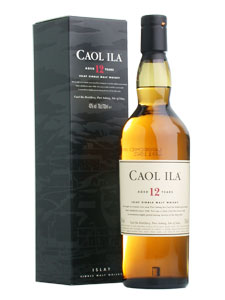
Caol Ila 12

This was originally going to be a video review but I did one and it was terrible. So it’s a text review now.

Maker: Caol Ila (cool eye-luh), Port Askaig, Isle of Islay, Argyll, Scotland (Diageo)

Region: Islay

Age: 12 y/o

ABV: 43%

Appearance: pale gold with long persistent legs that break up into clingy little bubbles on the Riedel Single Malt glass.

Nose: Big peat aroma with a faint whiff of smoke. Burnt butter, a bit of lavender, a bit of sea spray, and maybe heather, though I’m never quite sure what heather is supposed to smell like.

On the palate: Full-bodied and buttery. Sweet, creamy butter and wildflower honey, a bit of burn, then the smoke and peat come roaring in on motorcycles like the world’s fattest twins.

Finish: The twins barrel right through the finish. The burn follows close at hand and eventually fades into a sweetness in the cheeks and a tingle on the lips. A bit of tobacco smoke lingers in the throat for a long time afterwards.

Parting words: The name of this distillery, Caol Ila, means “the straights of Islay”, referring to the straight that seperates Islay from Jura to the east. On the Islay continuum, Caol Ila occupies the place between Lagavulin, which it is slightly milder than and Bowmore, which it is peatier and smokier than. It is also often the single malt which is used in “generic” bottlings of Islay malt. It is thoroughly enjoyable at any time of day (although afternoons work best for me) and I highly recommend it.

A Visit to Black Star Farms

I’m feeling like crap  today but I’m going to get this written up, dammit.

On Saturday, Jun 19, 2011 Frind of the Blog Amy and I and our spouses and my baby visited Black Star Farms Old Mission tasting room in Traverse City, Michigan. Black Star Farms is one of the best (if not the best) wineries in Michigan. They are well known for their exceptional late-harvest Rieslings, sur lie Chards and many other excellent wines and even cider. Their website is http://www.blackstarfarms.com/ Look for a review of the 2008 Late Harvest Riesling in the near future!

Anyway we had been there before but, what we were most interested in this time was their spirits program. They produce a number of them.

Red Grape Grappa
White Grape Grappa (I had this and it was excellent)

Spirit of…(eaux de vie)
Cherry
Plum (also very good)
Pear (also a version with the pear inside the bottle)
Raspberry

Apple Brandies
Spirit of Apple (NAS but about 12 mos. old)
10 y/o Apple Brandy (spectacular)

For the sake of full discosure, I had been communicating with their Twitterer Coryn and she waived the tasting fees for my party and me, a $25 value.

She also showed Amy and I around behind the scenes. Here are some photos Amy took:

Their press

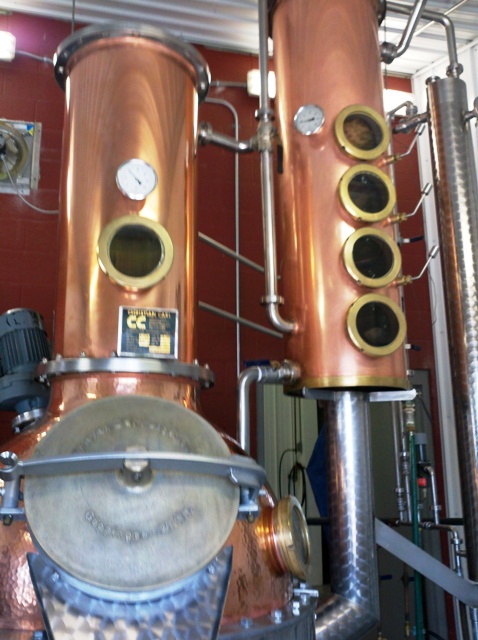
Their Still
According to Coryn:

The still is run 3-4 times a week

Quote:
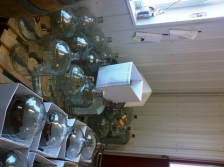
–          The clear fruit eau de vie brandies come off the still at approx. 75-80% (150-160 proof). They rest in the glass carboys and are then blended in the stainless steel tanks where they sit for approx. a month. They cut the brandy to be 40% (80 proof) and then bottle it.
–          The apple brandy comes off the still at 75% (150 proof) and goes into the barrel at 65% (130 proof) where it ages for approx 12 months. When it is bottled it is cut down to 40% (80 proof).

The carboys

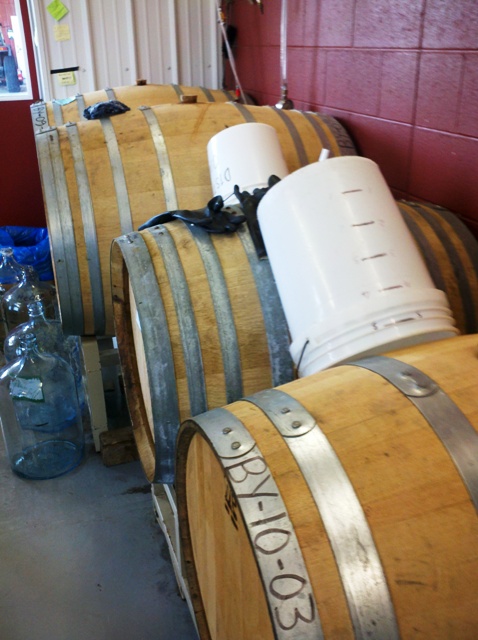
Their Barrels with aging Apple Brandy

Again, from Coryn:

Quote:
The barrels are a combination of French and American Oak. They were new when we purchased them and they are used for one rotation of aging for the apple brandy and then they get used to age the Sirius Maple Dessert wine. They are relatively low toasted oak barrels – this style was chosen b/c the idea is to accentuate the fruit of the apple.

Finally, their bottler:

The apple brandy is a very different beast from Laird’s which has so many fans among my fellow bourbon-fanciers. It is a much more delicate spirit than that or even Tom’s Foolery. Spirit of Apple was reviewed few months ago on this blog. When I first opened it I got a weird celery aroma in the nose, but that has calmed down now.

The 10 y/o is just great, great stuff. So complex and elegant, I’m having trouble wrapping my head around it. You all know what a cheap bastard I am, but I have not regreted paying $75 for it yet. A review of that will be forthcoming, hopefully a video review.

Anyway, it’s definately worth the trip if you ever make it “Up North” to Traverse City!

Lagavulin 16

Maker: Lagavulin, Port Ellen, Isle of Islay, Argyll, Scotland (Diageo)

Age: 16 y/o

Region: Islay (“eye-luh” or something like that)

ABV: 43%

Appearance: Old gold with an oddly pinkish hue from some angles. Pearl necklace with itsy-bitsy pearls.

Nose: Alcohol, peat, cigarette smoke, citron, almond extract.

On the palate: Good, fairly heavy body. Complex, but not busy. Sweet and citrusy (lemon and orange) at first, then an intense, smoky burn. Like eating a slice of lemon meringue pie at the counter of a diner next to someone smoking top shelf, unfiltered cigarettes. And maybe a guy who had just finished smoking pot is on the other side.

Finish: big and smoky. Burn with lots of smoke. Still some tobacco notes, but mostly like a campfire an hour or less away from burning out.

Parting Words: When I first opened this bottle, I was taken aback. On first sniff, I thought the was the best single malt Scotch I had ever encountered, at least the best Islay malt. That opinion hasn’t changed, but I’ve been able to overcome my awe and focus on what’s actually going on. Compared to Laphroaig and Ardbeg, Lagavulin is more balanced. Its balance should not be mistaken for mildness, however. Lagavulin will never be mistaken for a Speyside malt.