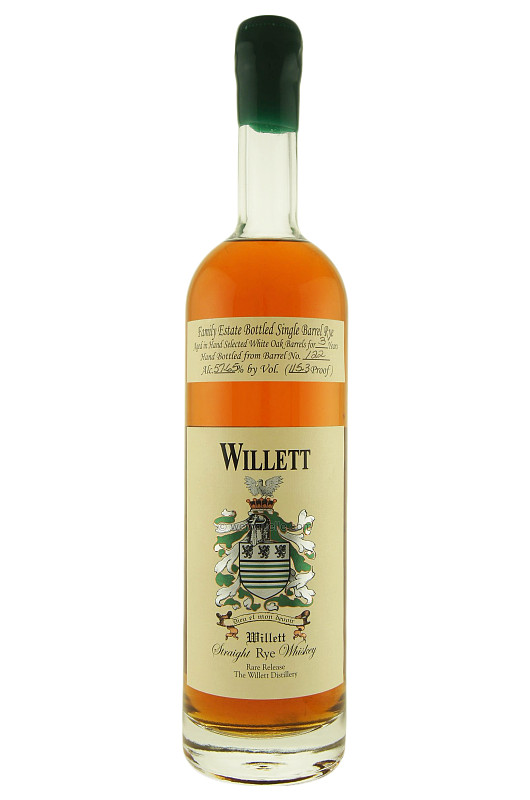
Willett Family Estate Rye

Maker: Willett/KBD, Bardstown, Kentucky, USAWillett Rye

Distiller: MGPI, Lawrenceburg, Indiana, USA

Style: High rye rye whiskey (I am now dubbing this Indiana style rye)

Barrel: 132

Age: 4 y/o

Proof: 110 (55% ABV)

Appearance: Fairly dark copper with thick legs.

Nose: Pine sap, oak, caramel, tarragon, alcohol, woodruff.

On the palate: Full bodied. Sweet and herbaceous, then hot. With a splash of water, the resemblance to Bulleit rye is very apparent. Sweet caramel, hay and spearmint.

Finish: Burn and a little caramel, then it’s all starlight mints. Lasts for almost as long as one of those would in the mouth! With some water,  tarragon and basil come out and settle into licorice before gently fading away.

Parting words: The Willett ryes being released at increasing ages every year are from the same Indiana distillery supplying Bulleit Rye, Templeton Rye, Redemption Rye and many others. The differences being that the Willetts are all at barrel proof and are single barrel selections. They are not available in Michigan, but are fairly easy to find in Kentucky and Indiana. At over $30, they’re not cheap but these are at barrel strength so one is getting more for one’s money. If 110 proof is too high for you, that’s why God made water.

Anyhow, Willett Family Estate Rye is the finest example of Indiana Rye I have tasted to date.  For something that is almost entirely rye and is only 4 years old, it has a good deal going on. I wouldn’t call it complex, but it’s more balanced than many of its siblings and it is a much better value than Templeton or High West’s Double Rye. I enjoy Kentucky “barely legal” style rye better, but if rye character is what you crave, Willett Rye is recommended.

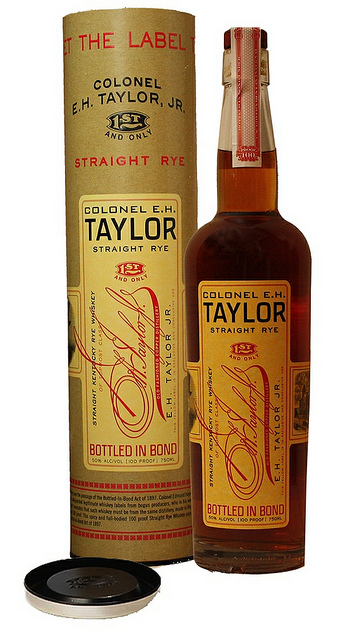
Col. E.H. Taylor Rye

Maker: Buffalo Trace, Frankfort, Kentucky, USAtaylor_rye

Style: High Rye Rye (Bottled-in-Bond)

Age: NAS

Proof: 100 (50% ABV)

Appearance: Burnt orange.

Nose: Caramel, alcohol, potpourri, pine.

On the palate: Medium bodied and a little hot. Caramel, tarragon, Thai basil, cumin, coriander.

Finish: Oak, alcohol, leather, dried flowers.

Parting words: This is Buffalo Trace’s stab at a high rye rye whiskey. It is made using rye and a small amount of malted barley, but no corn. The result is something spicier and with more rye character than their Sazerac line of rye whiskeys, but not as far over the line as the 100% rye whiskeys being sourced from Canada like Whistlepig, Jefferson’s, etc. It’s more elegant than those or the MGPI ryes like Bulleit and Willett. The caramel flavors (a bit surprising given the absence of corn) and oak keep the rye from overrunning things.

As with the rest of the Col. Taylor line, price is a problem. Even accounting for the relative scarcity of straight rye, $70 is too much for this. At $10-$20 less Taylor rye would be a sure-fire recommendation, but as it is, it’s only mildly recommended.

RIP Truman Cox

Recently I, as a (part-time) whiskey blogger, have been urged to take up the banner and “give Maker’s Mark shit” for lowering the proof of their bourbon. I’m not going to do that. The decision to lower the proof of Maker’s is unfortunate and disappointing, but the level of internet outrage regarding the proof change is completely out of proportion, surpassing even the Ebay/Pappy hysteria of 2012. I have no desire to contribute to this silliness any more than I already have.

Instead, I’m going to call attention to something much  more worthy of getting upset about: The death of A. Smith Bowman Master Distiller Truman Cox.

I didn’t know Truman very well. We were Facebook friends and I only recall meeting him once in person. He was the kind of guy who would greet you with a hearty handshake and a smile. As a friend of mine said, he was above all a genuine guy. He loved his family and he seemed to enjoy life immensely.

He was also a whiskey man through and through.  His prior position was at Buffalo Trace as chief chemist. He became Master Distiller at Bowman at a crucial time, as Bowman had recently moved to a new location, had a relatively new owner, Sazerac (also owner of Buffalo Trace), and was in the midst of a profound transformation. 10 years ago, Bowman was little more than a curiosity. It was the only large-ish bourbon distillery still operating in the state of Virginia and had only one (fairly) widely distributed brand, Virginia Gentleman. It came in 80 and 90 proof expressions.

When Truman moved to Virginia, the transformation of Bowman was well underway. The 90 proof VG had been replaced by Bowman Brothers Small Batch Bourbon at 90 proof  and a 100 proof single barrel bourbon, John J. Bowman, was also introduced (review coming soon). Also made are Abraham Bowman Rye (I review the TPS barrel-stength version here) and Sunset Hills Gin. Under the brief period of Truman’s leadership the transformation of Bowman was completed, and Bowman began putting out some of the most highly regarded and sought after private bottlings of bourbons and ryes among enthusiasts. They were able to have the best of both worlds. They operated like a micro-distillery in many ways, but they were also able to draw upon the resources of a large spirits company like Sazerac and a large distillery like Buffalo Trace.

Truman was one of the brightest rising stars in the world of American whiskey and his sudden death is a great loss for the industry and bourbon drinkers alike. Here are some links:

The Spirits Business Article on Truman’s death.

Lew Bryson on Truman’s passing.

Chuck Cowdery on Truman’s death

Truman’s famous barrel dance.

Truman tasting Pappy Van Winkle 20 y/o

Truman’s autobiographical bit on the Bowman website

Members of StraightBourbon.com congratulate Truman on becoming Master Distiller

Here’s hoping he gets that bottle named after him at last.

Vintage Rye 23 y/o

Maker: Kentucky Bourbon Distillers, Bardstown Kentucky, USAvintage 23

Distiller: ???

Age: 23 y/o

Proof: 94 (47% ABV)

Thanks to: Oscar for this sample

Appearance: Dark Auburn

Nose: Wood varnish, oak, peanut brittle, slightly musty, an elusive fruity note: sometimes purple Kool-Aid and sometimes orange Tang.

On the palate: Soft mouth feel. Toffee, butterscotch, oak, alcohol, clove.

Finish: Very dry, old oak, some alcohol and a touch of sweetness.

Parting words: I make no secret of my dislike of old American whiskeys. When even my beloved Four Roses distillery came out with a 17 year old bourbon a couple years ago I was not impressed. The Elijah Craig 18 y/o bourbons I have tasted and enjoyed are few and far between. KBD’s Vintage series of bourbons and ryes are all old whiskeys but have the advantage of being relatively affordable. The downside is that, if KBD got a hold of it, there’s a good chance the distillers didn’t think it was good enough to release under one of their own labels or even blend it into something else. Such is the risk of buying old whiskey from non-distiller producers.

So when Oscar gave me the sample I was skeptical. My skepticism proved to be largely unwarranted. This rye is very drinkable. I’ve had 20 y/o bourbons (from distillery-owned labels) that were not nearly as easy to drink as this. That said, Vintage 23 falls into the curiosity or vatting whiskey category for me. It’s something I might buy one bottle for to use for a tasting or to bring out when whiskey friends are over. Too woody and old to be a classic but interesting enough to warrant some interest. Vintage Rye 23 y/o is recommended.

Knob Creek Rye

Maker: Beam, Clermont, Kentucky, USA

Age: NAS

Style: Low rye, Kentucky-style, rye whiskey. Yes, I’m making that a thing.

Proof: 100 (50% ABV)

Appearance: dark copper.

Nose: Sweetness, aniseed, cumin, woodruff, lavender, caramel.

On the palate: Medium bodied with some alcohol bite. Dry with some good but well-balanced rye character.

Finish: Dry and clean. A nice, long, post-sip tingle.

Parting words: Jim Beam Rye (along with its sister-label, Old Overholt) has long been a whipping boy for American Whiskey enthusiasts. Underwhelming would be the best word for it. It lacks rye character or, frankly, much character at all. Still it has been a big seller in a small (but fast growing) segment. It is available almost everywhere Beam’s bourbons are available.

In 2008 Beam released a new product called Ri1 (Rye One, get it?) in a handsome, modern-looking bottle. The hope was to provide an upscale Beam rye for rye enthusiasts and especially mixologists. The rumor was that more Ris would follow, Ri2, Ri3, Ri4, etc. At this point, it’s probably safe to call Ri1 a flop. The stuff was/is over-priced and underpowered at $47 and 92 proof. No further numbers have been forthcoming either.

Knob Creek Rye is widely perceived as a replacement of sorts for Ri1. Knob Creek bourbon has been a very successful brand for Beam. Many whiskey lovers (like this one) considerit to be the best bourbon made from the Jim Beam mashbill (Beam also makes Old Grand-dad, but uses a different recipe and yeast).

Knob Creek rye is a great improvement on Ri1 and a welcome extention to the Knob Creek line. Like the bourbon, it is 100 proof and comes in an attractive, retro-styled bottle. It lacks an age-statement, but youth is not a problem here. If you enjoy Kentucky-style ryes, then you will probably enjoy this whiskey. It is well-balanced, unlike many of the newer high-rye ryes (a style I enjoyed at first but I am quickly tiring of), and very sippable. The higher proof does it a world of good. It brings out the complexity and spice that get muffled in the 80 proof Beam rye.

One problem Knob Creek Rye shares with Ri1 is the price. When it first arrived in Michigan, it sold for $40 a bottle. I thought it was expensive, but given the proof and the scarcity of rye, it was a fair price (barely). The state minimum price has since been hiked by $5. That pushes it over the edge for me. If you can find it for under $40, I recommend it. If over, leave it on the shelf.

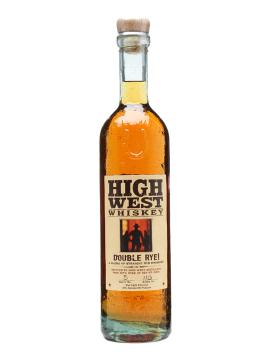
High West Double Rye!

Maker: High West, Park City, Utah, USA

Distillers: LDI, Lawrenceburg, Indiana & Barton-1792, Bardstown, Kentucky, USA

Age: 2 y/o (blend of 2 y/o and 16 y/o ryes)

Proof: 92 (46% ABV)

Appearance: Rich copper

Nose: Aggressive, minty, lavender, tarragon

On the palate: Sweet and hot, rock candy, spearmint sharpening into peppermint.

Finish: Starlight mints, peppermint heat with a sweet sugary background.

Parting words: This is the first High West rye I’ve reviewed. It tastes like a marriage of Bulleit and Fleischmann’s ryes and there’s a very good reason for that. That’s basically what it is. There’s been some confusion online as to whether the two year old rye in this is from LDI or High West’s own product. Judging by my taste buds, I would say that it’s definitely LDI, at least in this bottle. The resemblance to Bulleit rye is striking, but the undertones bear a strong resemblance to the Fleischmann’s.

I expected more oak, given the venerable age of the Barton rye, but it is completely absent. The young rye is so pungent that it almost overwhelms the older stuff, but old manages to keep the it in its place, barely. For sipping, it works well, and works well in cocktails, though the older component is completely overwhelmed in Manhattans and Sazeracs.

This is a good rye overall at a not unreasonable price. The bottle is also hand-blown (or at least looks like it) and beautiful, although the campy hangtags are a bit much. High West Double Rye! gets a recommendation.

Fleischmann’s Rye Whiskey

Maker: Barton-1792, Bardstown, Kentucky, USA (Sazerac)

Age: NAS

Proof: 80 (40% ABV)

Appearance: New copper penny with thick, clingy legs.

Nose: Lemongrass, spearmint, caramel, alcohol, white pepper, a bit of sharp oak.

On the palate: Rock candy, peppermint, oak, vanilla nougat.

Finish: light, very sweet, maple sugar candy, a touch of oak.

Parting words: Fleischmann’s Rye is part of a line of Fleischmann’s spirits, including a blended whiskey, brandy, vodka and gin. All are made by Sazerac at Barton-1792 and all are really cheap. They are made and marketed under license (or something like that, I’m not a lawyer) from the Fleischmann’s yeast people. Ironically they are not made using Fleischmann’s yeast.

For reasons that are mysterious to me, Fleischmann’s Rye whiskey is only available in Wisconsin. In many ways it is a typical Kentucky-distilled rye. It’s barely legal at 51% rye and is much closer to bourbon in flavor than high-rye rye whiskeys like Jefferson’s and Bulleit. Where it differs from its kin like is in its lack of sharpness, usually in the form of pine and potpourri scents in Rittenhouse, Sazerac, Wild Turkey and Beam ryes. Its closest rye relative may be the Van Winkle Reserve Rye. Not that Fleischmann’s has anywhere near the complexity or sophistication of the Van Winkle rye, but both exhibit darker, sweeter flavors than other ryes. If you ever find yourself in Wisconsin, pick yourself up a handle (they’re only sold in handles now) of Fleischmann’s Rye. It’s cheap fun. Works exceptionally well (for its age) in Manhattans and Sazeracs too. If you can find it, Fleischmann’s Rye is highly recommended.

My Two Ounces: What’s that mean? Whiskey Edition

All disciplines and hobbies have their own set of lingo. The world of whiskey is no exception. What makes this even more confusing is that all whiskey-producing countries have their own terms and laws. Here are some of the most common terms found on whiskey bottles of all types and the most basic definitions I could give them. I have only included terms used for Scotch, American, Irish, Canadian and Japanese whiskies. These are all I can think of for now. I hope it is enlightening. And please give me crap about it if I screw up. That’s what the internet’s all about.
ABV: Alcohol By Volume, in other words, how much of the volume of the liquid in the bottle is taken up by ethanol (the alcohol in alcoholic beverages). This is expressed as a percentage. If I knew more about chemistry, I’m sure I could explain it better. See proof below.

Age Statements: The age statement refers to the time between when the unaged spirit was put into the barrel and when it was removed from the barrel, usually rounded down to the nearest year. When there is an age statement on a bottle of whiskey of any country, the number refers to the age of the youngest whiskey in the bottle. Whiskeys without age statements are described as NAS (No Age Statement). They are usually, but not always, close to the minimum age allowed by law. That is four years old for American straight whiskeys and bonded whiskeys (see below), and three years old for all Scotch, Irish and Canadian whiskies.

Barrel Strength/Cask Strength/Barrel Proof/undiluted: The whiskey has been bottled at the same proof  it was when it left the barrel. No water has been added.

Blended Whiskey/Whiskey, a blend: All whiskey-producing countries have their own rules and practices regarding blending.

Blended Scotch: A blended Scotch is composed of two components, single malt (usually several of them, see below) and grain whisky (also see below). Generally, the more expensive the blend, the higher the proportion of single malt. If the blend has an age statement, it applies to the grain whisky component as well.

Irish Blends: Irish blended whiskey is usually a blend of whiskey made from malted barley in a pot still and unmalted barley. Generally, the more expensive the blend, the higher the proportion of malt. If the blend has an age statement, it applies to the grain whiskey component as well. Most Irish whiskeys are blends.

Canadian Blends: Canadian Blends are somewhere between Scotch/Irish blends and American blends taste-wise. The grain whisky element is distilled until it is almost, but not entirely, flavorless. The malt component in Scotch/Irish blends is replaced by flavorful whiskies similar to American rye, bourbon and corn whiskeys. Generally, the more expensive the blend, the higher the proportion of flavoring whisky. If the blend has an age statement, it applies to the grain whisky component as well. All but one or two Canadian whiskies are blends. See Canadian Whisky.

American Blends: Most American blends are basically vodka favored with whiskey. Bottles labeled blended bourbon or rye contain a blend of vodka (flavorless neutral spirit) with bourbon or rye. Some newer whiskeys that blend two or more types of whiskey (bourbon with rye, for example) also qualify as blends, but their makers tend to downplay that term since American blends have a bad reputation among enthusiasts. If the blend has an age statement, it applies to the neutral spirit component as well.

Japanese blends: Similar to Scotch blends above.

Blended Malt: Formerly known as vatted malts, blended malt Scotches are blends of multiple single malts. Unlike true blends they contain no grain whiskey element.

Bottled-in-Bond or Bonded: The Bottled-in-Bond law stipulates that any American spirit labeled as such must be at least four years old, bottled at 100 proof (50% ABV), and the product of one distillery in one distilling season. It is mostly used for bourbons, but also for rye and apple brandy and can even be used for vodka or gin. It was intended as a sort of quality control but now some bourbons that qualify as Bottled-in-Bond choose not to use the term because it sounds old fashioned.

Bourbon: An American Whiskey made from at least 51% corn and aged in a new oak barrel that has been charred on the inside. It must be made in the U.S. It does not have to be made in Kentucky, although the vast majority of it is.

Bourbon cask, sherry cask, port cask, etc: Scotch, Irish and similar whiskies are almost always aged in used barrels (casks). The former contents of the cask impart different flavors to the whisky. Most whisky producers use a variety of casks to age their product. Bourbon and sherry are the two most commonly used in Scotland and Ireland.

Canadian Whiskey: Whiskey made in Canada. Almost all of it qualifies as blended by American standards. Like Scotch and Irish, it must be at least three years old. Unlike in the British Isles and the U.S., under Canadian law non-whisky flavoring elements may be added to whisky. These include sherry, port, madeira and other wines, brandy, and even fruit juice. See Canadian Blends above.

Cask Strength: See barrel strength above.

Charcoal Filtered: The whiskey has been filtered through activated charcoal, similar to a home water filter, after aging. Some labels display the words more prominently than others, but most whiskeys are filtered in this way. This is different from charcoal mellowing and in addition to chill-filtering; compare chill-filtering and Tennesee Whiskey below.

Corn Whiskey: An American whiskey made from at least 80% corn (compare bourbon above) and either unaged or aged in a used oak barrel. There is a subtle difference between unaged Corn whiskey, which is meant to be consumed as is, and White Dog (see below) which has been distilled with the intent to be aged at a later date, at least in theory.

Diluted: Any whiskey (or other spirit) that is sold at under 80 proof/40% ABV in the U.S.

Finished: The whiskey has been transferred to a different barrel (or had oak chunks added to the barrel or the like) for a brief time at the end of the aging process. Bourbon and other American whiskeys are allowed to be finished in a used barrel as long as the bottle is labeled as “finished in X barrels” or something to that effect.

Grain Whisky: In the Scotch and Irish whiskey worlds, grain whisky is whisky usually made in a continuous still (as opposed to a pot still) and made from something other than malted barley. Usually it is just whatever grain is cheapest at the time with corn (maize) and wheat being the most common grains used. Grain whisky is typically blended with single malt whisky to produce blended whisky. It is occasionally bottled on its own as a curiosity. The term is not used in American whiskey circles.

Irish: Any whiskey made in Ireland. Traditionally, Irish whiskey is made from malted and/or unmalted barley and distilled three times before aging. By law it must be at least three years old.

Japanese Whisky: Whisky made in Japan. It is made in a similar style to Scotch single malt and blended whisky.

Natural Colo(u)r: No caramel coloring has been added. Adding caramel color is legal for Scotch, Irish, Japanese and Canadian whiskies.

Proof: Now only used for American whiskey. American proof is the ABV doubled. So 50% ABV= 100 proof and so on. American whiskey must be at least 80 proof to be sold in the U.S. Otherwise it must be labeled as diluted.

Pot Still: Implies that the whiskey was at least partially distilled in a pot still as opposed to a continuous still.

Regions: Single malt Scotches are classified according to where they were distilled. There are four traditional regions. These are often mentioned on bottles of Single Malt Scotch. They are Highland, Lowland, Islay and Campbeltown. The Highland region is the largest by far and is subdivided into other regions, like the Islands and Speyside. Speyside is the largest of those in terms of number of distilleries and is itself subdivided into smaller regions like Dufftown and the Livet valley. Region plays a much smaller role in the classification of Irish, Canadian, Japanese and American whiskies.

Reserve: Meaningless marketing term meant to convey the image of extra age or rarity.

Rye: A traditional American whiskey made from at least 51% rye and aged in a new oak barrel that has been charred on the inside. Same goes for other named whiskey types but with their respective grains. Wheat whiskey is at least 51% wheat, American malt whiskey is at least 51% malted barley, and so on.

Scotch: Any whisky made in Scotland. By law, all Scotch whisky must be aged for at least three years in a barrel or cask as it is more commonly called in Scotland. See Single Malt, Blend, Grain Whisky.

Single Barrel/Cask: All the whiskey in the bottle is from one barrel. Most whiskeys are a combination of the contents of different barrels.

Single Malt: Used for Scotch and Irish whiskies, a single malt is a whisky made from only malted barley in a pot still and is the product of a single distillery. It is usually blended with grain whisky to produce a blended whisky. Single Malts are also bottled on their own, either by the company that owns them or by a private bottler. Single Malt used on a bottle of American whiskey is only an indication that it qualifies as a malt whiskey by American law. Other whiskeys that call themselves Single Malts generally follow the Scotch usage.

Small Batch: From a smaller batch of barrels than bigger selling brands. It’s essentially a meaningless term meant to make the whiskey inside the bottle seem rare and desirable.

Sour Mash: The mash (distiller’s beer) is brought to a low Ph before distilling. Although some whiskey labels display the words more prominently than others, all major American whiskey brands are made using a sour mash.

Straight: American whiskey legal term. Any whiskey that is at least two years old and the product of a single U.S. state may be called straight whiskey. If it is under four years old, the label must bear an age statement.

Tennesee Whiskey/Whisky: Whiskey made in Tennesee. In practice, Tennesee whiskey is very similar to bourbon. It uses a recipe that is identical to a bourbon, but unlike bourbons it undergoes a process of charcoal mellowing, also known as the Lincoln County process. Before barreling, the white dog (see below) is run through a large vat of maple chunk charcoal. This removes some flavor compounds and adds a few others. It is then barreled and aged like bourbon and other straight whiskeys. Tennesee whiskeys could probably be sold as bourbons, but Tennesee whiskey makers prefer to sell it as Tennesee whiskey.

Unfiltered/Unchillfiltered/Non-chill filtered: The whiskey has not undergone a process called chill-filtering in which the whiskey is chilled to around zero degrees Celsius and then filtered. The process is performed after aging and is intended to reduce any haziness that the whiskey may exhibit. Chill-filtering produces a clean-looking spirit that looks good on the store shelf, but the process can also remove some flavor compounds. Whisky producers marketing themselves toward enthusiasts will often not chill filter their products and brag about that fact on the label. Unfiltered also implies that the whiskey has not been filtered through activated charcoal, a common practice (see above).

Vatted Malt: See Blended Malt above.

Wheated Bourbon: This style of bourbon is made with corn, malt and wheat instead of the more usual corn, malt and rye.

Whiskey: A spirit distilled from grain and then (usually) aged in an oak barrel. In layperson’s terms, a whiskey is a beer that has been run through a still. Most whiskeys are then aged in a barrel for a period of time. Whiskey with an e is the preferred spelling in the U.S. and Ireland, although some American brands like Maker’s Mark, Old Forester and George Dickel omit the e. Curiously, U.S. Federal regulations governing whiskey also use the e-less spelling.

Whisky: See whiskey above. Whisky without an e is the preferred spelling in Scotland, Japan and Canada. In spite of what some believe, there is no more difference between whiskey and whisky than there is between labor and labour or color and colour.

White Dog: A term from the American whiskey world meaning a clear spirit that is destined to be aged in barrels and become whiskey. The Scotch equivalent is new make. Many start-up and even established distilleries have been releasing their own white dog recently as a curiosity or to raise some quick cash in the case of the start-ups.

Confused about wine labels? So is everybody else. Check out the simple interactive guide to reading world wine labels from Delish.com here.

Abraham Bowman Limited Edition Barrel-Strength Rye

Maker: A. Smith Bowman, Fredericksburg, Virginia, USA (Sazerac)

Age: 9 y/o

Proof: 136.4 (68.2% ABV)

Notes: Lot 01-C-14, The Party Source barrel #1

Appearance: Dark, ruddy copper with thick, slow legs.

Nose: Surprisingly mellow, leather, caramel, mango, a little copper.

On the palate: Medium-bodied, sweet and hot. Cotton candy, butterscotch. When a splash of water goes in, more spice comes out. Jalapeno, paprika, and cassia join the party.

Parting words: This is an exclusive offering from The Party Source (TPS) in Bellvue, Kentucky. TPS is one of the only retailers outside of Virginia to carry the Bowman line of spirits. The whiskey is first distilled in Frankfort at Buffalo Trace, trucked to Fredericksburg where it is redistilled and then aged there in Virginia. This is good whiskey, much better than its barrel-proof sibling Thomas Handy, and rye of this age is very hard to come by. That said, it’s expensive at $73 and while it’s good, it’s not great, in spite of all the internet gushing over this stuff. Nevertheless, it’s worth a recommendation. Makes a pretty good Sazerac cocktail too (on the rocks or with a little water added).