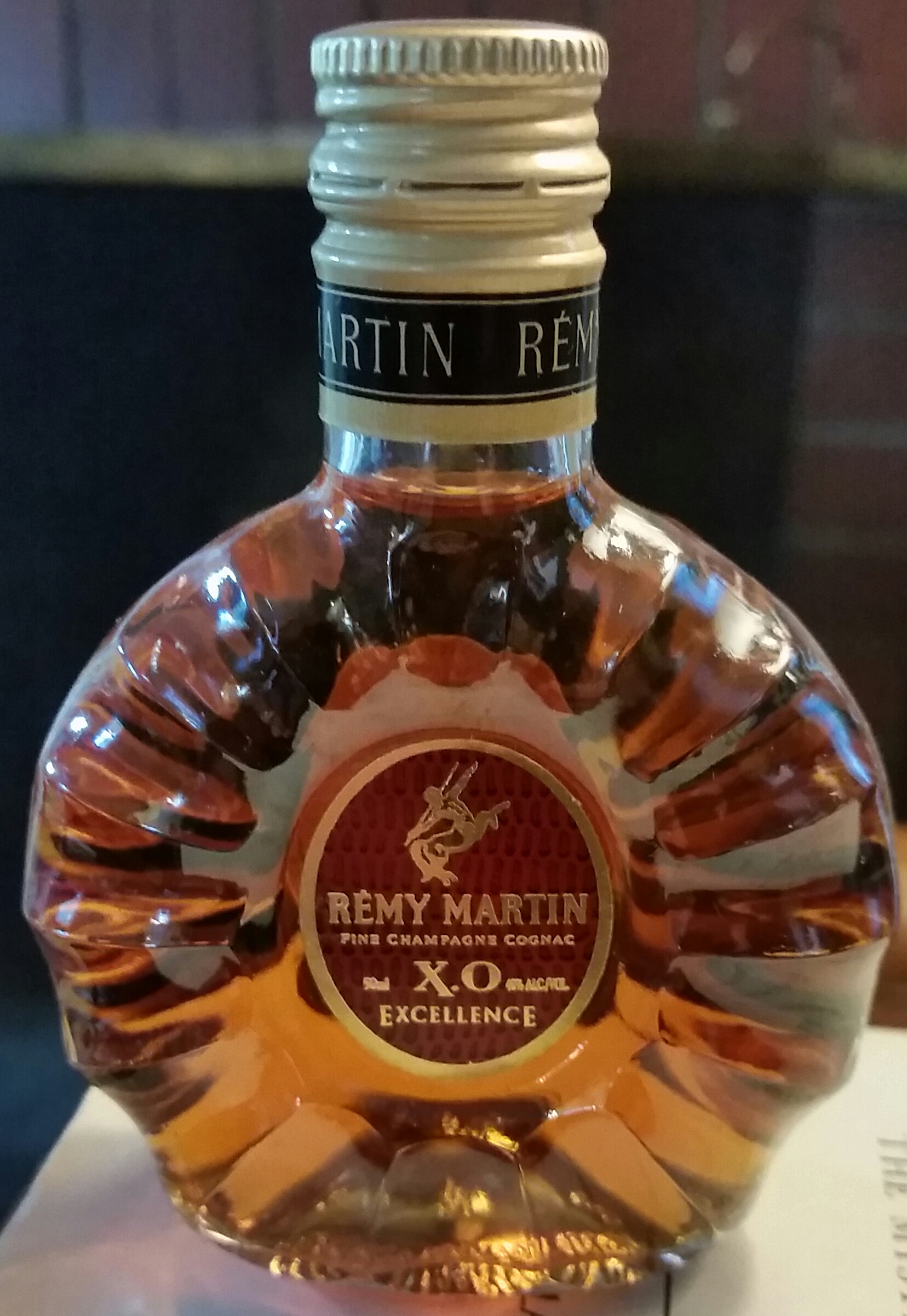
Rémy Martin XO Excellence

Maker: Rémy Martin, Cognac, Charente, Poitou-Charentes, France (Remy Cointreau)wpid-2015-07-14-17.52.08.jpg.jpeg
Place of origin: Champagne, Cognac (not to be confused with the wine region of the same name)

Age category: XO (6 y/o or older)

ABV: 40%

Michigan State Minimum: $150

Apparently: Reddish orange.

Nose: Alcohol, rancio, orange peel, almond extract, cherry, vanilla.

Palate: Full mouthfeel. Semi-dry. Roasted almonds, Queen Anne Cherries, white mulberries, white wine grapes.

Finish: Golden raisins, old oak, leather. Lingers for a very long time.

Parting words: I’m not in the habit of buying $150 bottles of anything, let alone Cognac. Luckily I was able to find a 50 ml bottle of this. I had to share it with you, of course, dear readers.

My biggest question is always, is it worth the money? My Cognac experience is limited but this is by far the best one I’ve ever had. It’s complex and well integrated. Fruity but not sweet. For 40% ABV, it has a lot of power too. If I were tasting blind, I would never guess that it was that low. As a bourbon guy, I would still appreciate a bigger proof at this price, but cask strength Cognac isn’t really a thing so it would probably be unfair to criticize this on that basis.

As elegant as it gets, Rémy Martin XO Excellence is recommended.

Calvados Coquerel Fine

Maker: Calvados Coquerel, Milly, Manche, Normandy, Francewpid-2015-05-26-11.35.46.jpg.jpeg

Age: 2 y/o

ABV: 40%

Price: $29 (The Party Source. It seems to have disappeared off the Michigan list)

Appearance: Golden auburn, a lot of necklacing, big thick legs.

Nose: Alcohol, dry apple cider, toasted French oak.

Palate: Thin, alcohol, dry apples, maple sugar, celery.

Finish: celery, oak, under ripe apple, Like Arkansas black or similar variety, white sugar, dash of vanilla.

Parting words: Calvados Coquerel was founded in 1937 by René Gilbert and remained in the hands of the Gillbert family until it was purchased by Asbach in 1971. Asbach became a part of Diageo in 1990 but Calvados Coquerel regained its independence when it was sold to Jean-François Martin in 1996 (not to be confused with the Remy-Martin Cognac house).

Fine is the bottom shelf, err “entry level”, apple brandy from Calvados Coquerel. The other grades are Vieux (3 y/o), VSOP(4 y/o) and XO (6 y/o). The line is capped off with the Marquis de la Pomme fifteen and twenty year old brandies. They also make a variety of other apple-related beverages including cider all using Norman apples.

This brandy has been savaged online, maybe a bit unfairly. It’s certainly not great, but as a mixer or casual sipper it’s good enough. The price is a bit hard to swallow, though. One can get the Laird’s 7 ½ y/o apple brandy for three dollars more and the 100 proof Laird’s for just one dollar more. Black Star Farms does make an apple brandy in a similar style but at $22 for a 375 ml bottle, it works out to be much more expensive per ml.

All that said, given European brandy prices, this product isn’t priced too far out of line but that doesn’t mean its worth the money either. Calvados Coquerel Fine is mildly recommended.

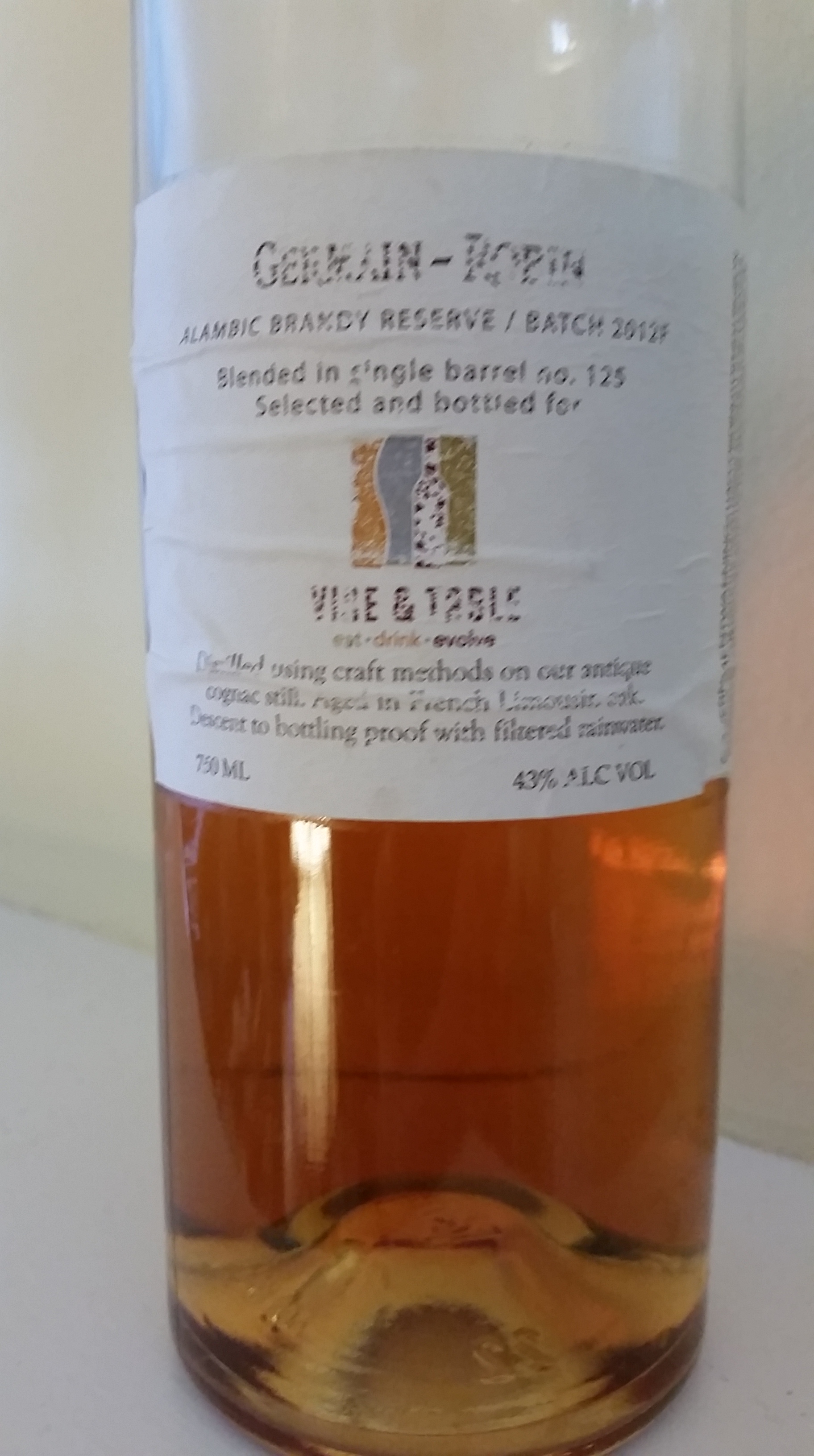
Germain-Robin Alembic Brandy Reserve Vine & Table batch 2012F

Maker: Germain-Robin, Ukiah, California, USAwpid-20150219_171845.jpg

Age: NAS

ABV: 43%

Price: $50

Appearance: Burnt orange with a long, persistent necklace.

Nose: Alcohol, raisins, prunes, mincemeat, black tea.

Palate: Full-bodied and rich. Prune juice, star anise, passito wine, oak.

Finish: Dry and spicy. Fruitcake or mincemeat spices, raisins.

Parting words: Co-founded by a man from a distilling family in Cognac, Germain-Robin is probably the U.S.’s finest producer of brandy. They’ve been in business since 1982 (an eternity in micro-distiller years) and were favorites of Ronald Reagan and Bill Clinton, among others.

This is very much in the style of Cognac but better than most in its price range. As a whiskey drinker primarily, it makes a very pleasant change of pace. I haven’t tried V & T’s other batch, 2012E but I have heard excellent things about it too. Something this tasty at this price is not something I would mix. It’s an excellent value from an excellent maker and an excellent retailer. Germain-Robin Alembic Brandy Reserve Vine & Table batch 2012F is highly recommended.

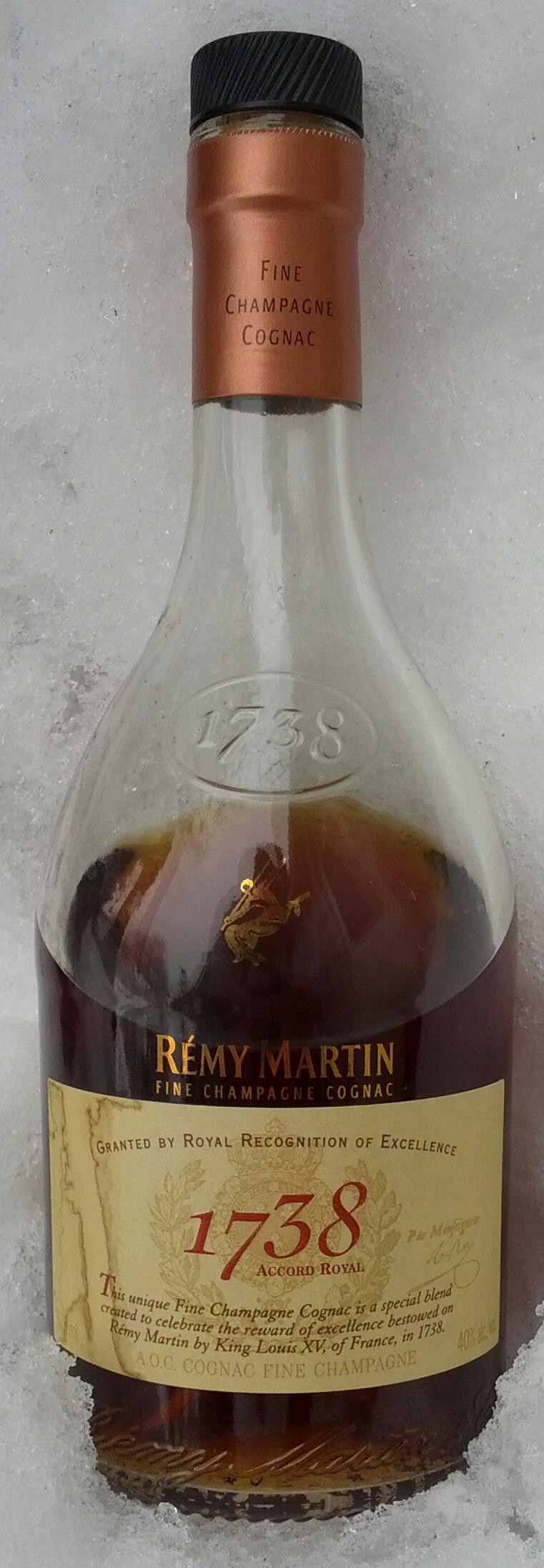
Rémy Martin 1738

Maker: Rémy Martin, Cognac, France (Rémy Cointreau)Remy 1738

Place of origin: Champagne, Cognac, France. (Not to be confused with the winemaking region of the same name).

Age: NAS (minimum 2 y/o )

ABV: 40%

Michigan State Minimum: $50

Appearance: Auburn with thick legs and necklace.

Nose: Fruity. Fresh wine grapes, cardamom, dried blueberries, saffron, ginger.

On the palate: Medium bodied and sweet. Panettone with raisins.

Finish: Golden raisins, hint of oak and alcohol. Fades fairly quickly.

Parting words: I believe this is the first Cognac I have reviewed for the blog, although I did review an Armagnac back in 2012. I decided that I needed to review a Cognac when I recently purchased a bourbon finished in a Cognac barrel and I realized I couldn’t pick out any specific Cognac influenced aromas or tastes.

For those who may not be familiar with Cognac, it’s a French brandy made from white wine made from grapes grown in and around the city of Cognac in western France, north of Bordeaux. There are six subregions within the Cognac zone: Grande Champagne, Petite Champagne, Borderies, Fins Bois, Bon Bois and Bois Ordinaire. Rémy Martin 1738 is a Champagne Cognac, meaning it was made with a blend of grapes from both Grande and Petite Champagne. According to the Rémy Martin website, it is composed of 65% Grande and 35% Petite. Cognac is distilled in an old style of pot still called an alembic still and must be aged for a minimum of two years in French oak before being sold. The grapes used to produce the wine used to produce Cognac are typically wines that don’t drink very well. Ugni Blanc (aka Trebbiano) is one of the primary varietals used

1783 (named for the date of a royal warrant the company was granted) is positioned in the middle of the Rémy Martin range and as such I thought it represented a good place to jump in to the Cognac. I was not disappointed. It contains no age statement or age grade (V.O., V.S.O.P., etc), but strikes what seems to be a good balance between fruity youth and oaky maturity. It’s worth the price, but if you’re still not sure, it is availble in 375 and 200 ml bottles as well. Rémy Martin 1738 is recommended.

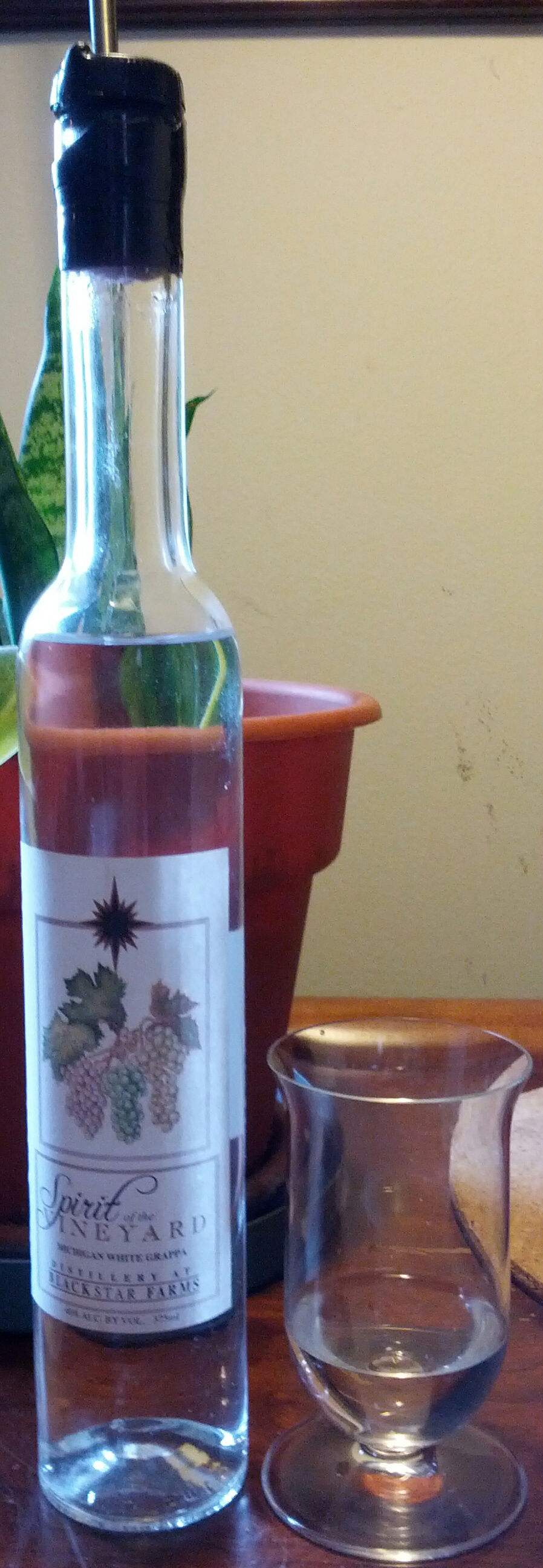
Spirit of the Vineyard Michigan White Grappa

Maker: Black Star Farms, Traverse City, Michigan, USAIMG_20130731_114726

ABV: 40%

Note: Made using white wine leftovers (skins, pulp, seeds, stems).

Appearance: Clear with big thick legs.

Nose: Fruity and pungent, but not unpleasant. Like a fruity perfume. Ripe pear, table grapes, a hint of fresh cut cedar and lemon grass.

On the palate: Mild but full bodied. Sweet and mildly grapey.

Finish: delicately fruity and woody with more of that cut cedar aroma rolling around the mouth.

Parting words: For those who may not know, grappa is a brandy distilled from a fermentation of the left over byproducts of the wine making process collectively called pomace or marc. Grappa is the Italian word for such a beverage. Other versions of the same thing include marc (French), orujo (Spanish) and tescovină  (Romanian). The name grappa is restricted by the European Union to beverages of this type made in Italy, but has no such protection here in the U.S., hence this American grappa.

I haven’t had much grappa (or marc or the like) so the mental sample to which I am comparing this spirit is small. That said, this is very, very good. It’s not nearly as rough and raw tasting as the other grappas I have tasted and has a very pleasant nose that really shines in a Glencairn or Riedel Single Malt glass (I don’t own a grappa glass). It’s delicious chilled or at room temperature before or after a meal or on a hot afternoon.

Black Star Farms makes a wide variety of eaux-de-vie and brandies including a “red grappa” which is not actually red but made from red wine leftovers. It is also quite good, but the white has a very appealing perfumed nose, no doubt a reflection of the Riesling, Pinot Gris and other aromatic white wine grape varieties that lent their unused bits to the this spirit.

Spirit of the Vineyard Michigan White Grappa is highly recommended.

For further reading: https://sipologyblog.com/2011/07/08/a-visit-to-black-star-farms/

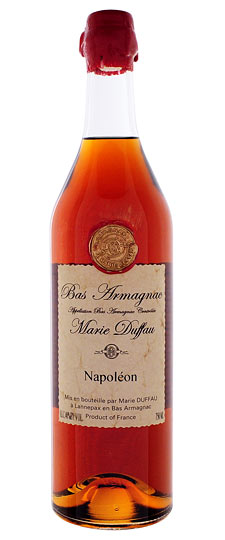
Marie Duffau Napoleon Armagnac

Maker: Delord Family, Armagnac, France

Region: Bas Armagnac, Gers, France

Age: 6 y/o

ABV: 40%

Appearance: Auburn with thick, heavy legs.

Nose: Pungent, rustic, but rounded nose. Solera sherry, prunes, plum eau de vie.

On the palate: Very full-bodied, boozy and sweet. Raisins, prunes, star anise, clove. A tiny tannic hit of oak.

Finish: Warm and dry with a little more oak. Plenty of heat that seems to get more intense after a swallow.

Parting words: Armagnac has long been Cognac’s lesser known older brother, but the upside of that is while Cognac is dominated by big foreign-owned producers (the product of the British love of Cognac), Armagnac is still filled with family producers like the Delords.

This is the first brandy I’ve reviewed for this blog, and it was a fun one. Brandy is not something I drink a lot of, especially in the warmer months, but even on an 80 degree day Marie Duffau was a pleasant companion. She’s brash and spicy, but I’ve always enjoyed the company of such ladies. The Delord family makes a full line of Armagnac, all of which are very good according to bandy-loving friends of mine. Being a younger expression, this one is also a good value and a nice introduction to the flavor profile of Armagnac. Marie Duffau Napoleon Armagnac is recommended.

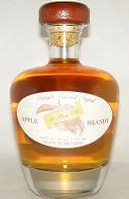
Black Star Farms 10 year old Apple Brandy

Age: 10 y/o

ABV: 42.7%

Appearance: Copper with thick clingy legs

Nose: alcohol, mulled cider, apple pie, cardamom, lemon juice, apple sauce with sweet cinnamon, brown butter

On the palate: full-bodied. Sweet brown sugar, a good amount of burn, cinnamon, coriander, cardamom and tart apples.

Finish: warm, dry, that sweet cinnamon again, reminding me of my grandmother’s homemade apple sauce.

Parting Words: This a fantastic spirit. The standard Black Star Farms Apple Brandy is a pleasant sipper that performs nicely in cocktails and in mulled cider. But this 10 y/o apple brandy reaches sublime hights. Black Star Farms’ 10 y/o apple brandy was aged in a new toasted oak barrel, like those used for wine. This results in a spirit that, even at 10 y/o, still has a lot of crisp apple character. It is on par with a fine cognac or Armagnac and is best sipped neat or with a little water in a snifter or Glencairn glass.

There are few micro-distilling outfits that have been in business long enough to offer a 10 y/o product that they made themselves. Even some that are approaching that number have not been putting any back for longer aging. Black Star Farms had the foresight to let this brandy lay. It’s not cheap, I paid $75 at the tasting room for my bottle, but unlike most $75 whiskeys, this stuff is worth every penny. Highly Recommended.

Hatter Royale Hopquila

Maker: New Holland, Holland, Michigan, USA

Age: NAS (unaged)

ABV: 40%

Appearance: pale, hazy yellow with decent legs.

Nose: Raw spirit, maybe a hint of flowers.

On the palate: light, creamy taste, then just burn.

The finish: This is where the resemblance to tequila really blossoms, no pun intended. Citrus, spice, sweetness. Not complex, but interesting.

Mixed: Does very well in a “hopquila sunrise” with oj, ice, grenadine and orange bitters. OK in a “hoprita”, no worse than a standard mixto tequila. With an ice cube and a squeeze of lime, the sweetness and citrus notes come to the fore, almost turning it into lemonade.

Parting words: Hatter Royale is an unaged barley spirit  infused with centennial hops, giving it a tequila-esque floral aroma. I’m not sure if it will ever be anything other than a novelty, but it works on that level. It does best as an interesting alternative to a white or mixto tequila in summertime mixed drinks. It will never work as a substitute for a fine sipping tequila, but I don’t think it was intended to. Recommended for mixing.

A Visit to Black Star Farms

I’m feeling like crap  today but I’m going to get this written up, dammit.

On Saturday, Jun 19, 2011 Frind of the Blog Amy and I and our spouses and my baby visited Black Star Farms Old Mission tasting room in Traverse City, Michigan. Black Star Farms is one of the best (if not the best) wineries in Michigan. They are well known for their exceptional late-harvest Rieslings, sur lie Chards and many other excellent wines and even cider. Their website is http://www.blackstarfarms.com/ Look for a review of the 2008 Late Harvest Riesling in the near future!

Anyway we had been there before but, what we were most interested in this time was their spirits program. They produce a number of them.

Red Grape Grappa
White Grape Grappa (I had this and it was excellent)

Spirit of…(eaux de vie)
Cherry
Plum (also very good)
Pear (also a version with the pear inside the bottle)
Raspberry

Apple Brandies
Spirit of Apple (NAS but about 12 mos. old)
10 y/o Apple Brandy (spectacular)

For the sake of full discosure, I had been communicating with their Twitterer Coryn and she waived the tasting fees for my party and me, a $25 value.

She also showed Amy and I around behind the scenes. Here are some photos Amy took:

Their press

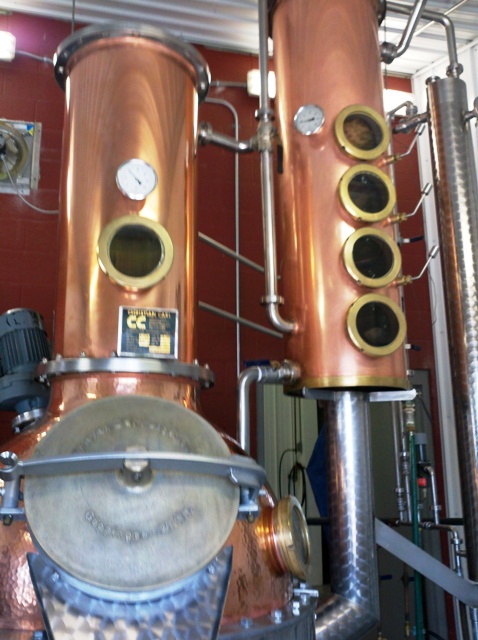
Their Still

According to Coryn:

The still is run 3-4 times a week

Quote:
–          The clear fruit eau de vie brandies come off the still at approx. 75-80% (150-160 proof). They rest in the glass carboys and are then blended in the stainless steel tanks where they sit for approx. a month. They cut the brandy to be 40% (80 proof) and then bottle it.
–          The apple brandy comes off the still at 75% (150 proof) and goes into the barrel at 65% (130 proof) where it ages for approx 12 months. When it is bottled it is cut down to 40% (80 proof).

The carboys

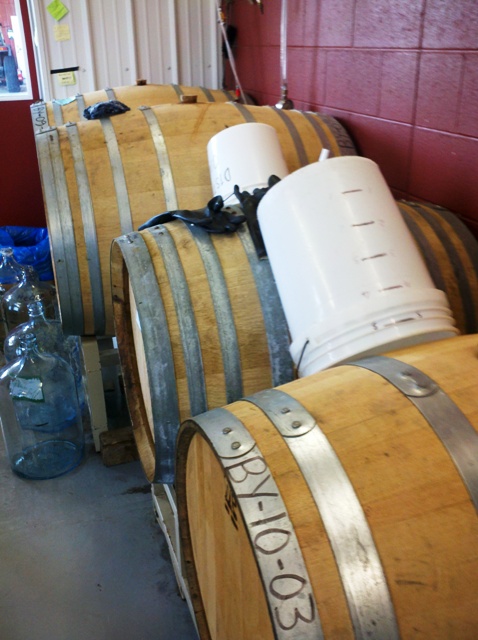
Their Barrels with aging Apple Brandy

Again, from Coryn:

Quote:
The barrels are a combination of French and American Oak. They were new when we purchased them and they are used for one rotation of aging for the apple brandy and then they get used to age the Sirius Maple Dessert wine. They are relatively low toasted oak barrels – this style was chosen b/c the idea is to accentuate the fruit of the apple.

Finally, their bottler:

The apple brandy is a very different beast from Laird’s which has so many fans among my fellow bourbon-fanciers. It is a much more delicate spirit than that or even Tom’s Foolery. Spirit of Apple was reviewed few months ago on this blog. When I first opened it I got a weird celery aroma in the nose, but that has calmed down now.

The 10 y/o is just great, great stuff. So complex and elegant, I’m having trouble wrapping my head around it. You all know what a cheap bastard I am, but I have not regreted paying $75 for it yet. A review of that will be forthcoming, hopefully a video review.

Anyway, it’s definately worth the trip if you ever make it “Up North” to Traverse City!

How ya like them apple (brandies)? Head to Head: Tom’s Foolery vs. Black Star Farms

1)      Tom’s Foolery Applejack

2)      Black Star Farms Spirit of Apple

Makers

1)      Tom’s Foolery (Chagrin Falls, Ohio)

2)      Black Star Farms (Sutton’s Bay, Michigan)

Proof

1)      80 (40% ABV)

2)      80 (40% ABV)

Age

1)      2 y/o

2)      NAS

Other Info:

1)      Batch 1, bottle 3.  Aged in used bourbon barrels.

2)      Produced at Black Star Farms Old Mission Peninsula facility, Traverse City, Michigan.

Color

1)      Pale gold

2)      Slightly darker, edging closer to copper

Nose

1)      Young, raw, buttery, sweet, but with a dry, slightly sour apple note

2)      Rich, spicy, baked apple stuffed with nothing but celery

On the palate

1)      Light mouthfeel, still a bit raw, but creamy and sweet with a bit of cinnamon

2)      Light, maybe a little too light.  The celery flavor is still there, but it is not unpleasant.

Finish

1)      Low, slow and voluptuous.  Rich toffee and brown sugar.   Apple crisp comes to mind immediately

2)      The celery gives way to a huge wallop of cassia.  The big hot finish lingers in the cheeks for a long time.

Parting Words

These are pretty different spirits, despite them both being apple brandies (“applejack” is a traditional American name for apple brandy).  The Spirit of Apple is obviously older than Tom’s Foolery, I would guess about twice as old.  The celery scent and flavor in the Spirit of Apple was pretty shocking at first, but it wasn’t really a deal-breaker in the end.  If you can find it, Black Star Farms put out a 10 y/o Apple Brandy last year.  Binny’s had it for $100 a bottle last time I was there.  Hopefully, it’s cheaper at the tasting room in Traverse City.  UPDATE: According to the official Black Star Farms twitterer the 10 y/o Apple Brandy sells for $75 at the tasting room.

Tom’s Foolery, while definitely very young and equally hard to fine, has loads of potential.  Even young, it had a sophistication the Spirit of Apple lacked.  In ten years or less, Tom’s Foolery is going to be an incredible, world-class spirit.  It’s already very close to that.