Old Scout Ten

Maker: Smooth Ambler, Maxwelton, West Virginia, USAOld Scout 10

Distiller: MGPI, Lawrenceburg, Indiana, USA

Batch: 3

Bottled: 5/2/2013 by Nikki.

Age: 10 y/o

Proof: 100 (50% ABV)

Price: $55 Michigan State Minimum (this bottle purchased in Kentucky for $50)

Appearance: Dark copper with thin, evenly spaced legs.

Nose: Almond extract, leather, alcohol, dried flowers. More leathery and herbal with water.

On the palate: Full bodied, sweet and rich. Caramel, burn, amaretto candy, cocoa powder. With water more sweetness and some lavender and tarragon.

Finish: Hot. Red pepper flakes, with a touch of oak and caramel as it fades. Less hot with water and sweeter with a touch of basil or tarragon.

Parting words: Smooth Ambler is a breath of fresh air when it comes to micro-distillers/bottlers. Unlike the smoke and mirrors that usually goes with sourced whiskey in this country, Smooth Ambler has always been very up front about the origins of their whiskeys. Their bourbons and ryes are even called “Old Scout” as a nod to the fact that they are indeed sourced, or scouted, from elsewhere. This may not seem like a lot, but even the best known NDPs (Non-Distiller Producers) are usually less than candid about their products.

At any rate, lest that sound like faint praise, their whiskey is damn good too. I’ve reviewed MGPI bourbon before with mixed results. This one is an unqualified success. It shows excellent balance and works well as a rich, creamy after-dinner, cold-weather sipper. The family resemblance to Four Roses is in evidence. Old Scout has a certain aromatic quality (yeast-driven if I were to guess) that I get in Four Roses but no other Kentucky bourbon.

This bottle proves to me once and for all that MGPI can indeed produce high quality bourbon. At $50-$55 it’s not cheap but it’s 100 proof and very tasty. That earns Old Scout Ten a recommendation.

Head to Head: Bourbon Supreme Rare vs. Cleveland Bourbon Black Reserve

BS= Bourbon SupremeBourbon Sup vs Cleve

CB= Cleveland Bourbon Black Reserve, Batch 004

Maker

BS: American Distilling, Pekin, Illinois, USA (facility now owned by MGPI and used in ethanol production)

CB: Cleveland Whiskey Co., Cleveland, Ohio, USA

Age

BS: NAS

CB: <6 mos.

Notes

BS: Tax-stamped, volume listed as 4/5 of a quart. In a bottle resembling Blanton’s with a gold tassel.

CB: Sourced whiskey treated with a patent-pending process intended to speed up aging. The process involves the use of high-pressure, “oxygen infusion” and “heat processed, charred white oak segments”.

Proof

BS: 86 (43% ABV)

CB: 100 (50% ABV)

Price

BS: Acquired for free (thanks Oscar)

CB: $30

Appearance

BS: Light orange. Slightly cloudy with “dusty” floaters. Some light necklacing.

CB: Mahogany with thin, clingy legs.

Nose

BS: Wood varnish, the lumber section at a hardware store.

CB: Dry erase marker, grape jelly.

On the palate

BS: Thin and light. Like sawdust-infused vodka.

CB: Medium bodied. Like sucking on a grape-scented marker.

Finish

BS: Resembles accidentally inhaling sawdust and then washing your mouth out with cheap vodka. Fades into a locker-room.

CB: Lots of burn, which covers up the taste nicely. Fades into a headache.

Parting words: This is a head to head I’ve been wanting to try for a long time. On the surface, these two whiskeys don’t have a lot in common. Bourbon Supreme is a “dusty” that was made in Illinois at an industrial alcohol plant and Cleveland Whiskey is a new product made in Cleveland by a startup company.

What they do have in common is that they are two of the most frequently mentioned names in discussions of the worst American whiskeys ever made. They live down to the hype.

Bourbon Supreme quickly belies its origins as industrial alcohol more suited to use as racing fuel than a beverage. The wood notes are very clear, but there is no integration and no balance with anything resembling traditional bourbon flavors like caramel, vanilla or spice.

Cleveland Bourbon resembles something kids might huff to get high. The headache mentioned in the finish came on just seconds after I swallowed the first sip. It was remarkable. I have never had that experience before, except for a Croatian Cabernet that gave me a headache at the moment I first smelled it. At least Croatian wine let me know how awful it was right off the bat.

Can anything good be said about either of these? Bourbon Supreme is still fairly easy to find on shelves (for obvious reasons) and the bottle would look attractive as a display piece on the back of a bar. Cleveland Bourbon also has an attractive bottle, is 100 proof and is only $30 which makes it cheaper than most “micro” products of similar age.

Still, these are both terrible products, worthy of their place in the “worst ever” discussion. I will say that I have tasted something worse than these two bourbons: these two bourbons vatted together. Neither Bourbon Supreme Rare or Cleveland Bourbon Black Reserve are recommended.

My Two Ounces: Suntory, Beam and Marketing

Cap from Maker's Mark Facebook Page
Cap from Maker’s Mark Facebook Page

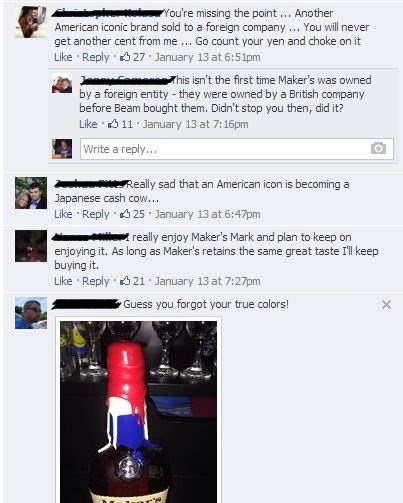
It was announced earlier this week that Suntory, a privately held Japanese whisky company, will purchase Beam Inc. (owner of Jim Beam, Knob Creek, Old Grand Dad, Maker’s Mark, Laphroaig, Canadian Club, Teacher’s and many other brands) this summer for somewhere between $13 and $16 billion dollars. Online reaction was swift and passionate, to put it kindly. While the response from enthusiasts has been nearly all positive, most of the non-enthusiast response was negative. Much of the negative was xenophobic and some of it was flatly racist. Most of those critical voices can and should be written off as cranks. People claiming that they will no longer drink Maker’s Mark or Jim Beam because their grandfathers fought against the Japanese in the 1940s shouldn’t taken seriously and neither should people who don’t know the difference between China and Japan.

My first reaction was was that this news signals a big restructuring in the spirits industry. It is technically an acquisition, but the result will look more like a merger. Suntory already owned two Japanese distilleries, three single malt distilleries in Scotland and the McClelland’s single malt Scotch brand. With Beam’s holdings, Suntory is poised to become the third largest spirits company in the world behind Diageo and Pernod-Ricard. Consolidation has been the theme of the booze world from the 1930s to the present and that won’t be changing any time soon. Beam Inc. itself is the result of a series of mergers and acquisitions over the past few decades.  As an enthusiast I was excited about the possibility of new ownership of Beam’s brands, especially since the management of some of those brands has been poor in recent years.

Why was the reaction so negative among non-enthusiasts? It’s because they believed what Beam told them.

Bourbon marketing is something that most enthusiasts become immune to quickly. A little knowledge goes a long way to dispel the yarns the bourbon industry spins. Yarns like the one that Jim Beam has been made by the same family with the same recipe since the eighteenth century. Or that Maker’s Mark was first whipped up in Bill Samuel’s kitchen and has been a quaint, family-oriented, backwoods operation ever since. There may be tiny threads of truth in both yarns, but they are not true in any real sense. A few minutes reading a book or searching on the internet is enough to dispel most myths like those. The harder ones might take a few hours. Enthusiasts have the inclination to do that . Most drinkers don’t.

Those drinkers who don’t are the ones who are angry. They’ve grown emotionally attached from years of hearing those myths. Hearing that their favorite little family business is actually a multinational corporation that is about to be swallowed up by another multinational makes them feel like they’ve been played for suckers. Which makes them angry, which makes them look for someone to direct that anger toward, which is where Suntory and Japan come in.

Something that is not a myth is the American-ness of bourbon. By federal and international treaty it can only be made in the U.S. It is mostly made from what we call corn and the rest of the world calls maize, a New World grain, and aged in American white oak. Congressional proclamations have been made about how American bourbon is. Bourbon producers use an appeal to patriotism in their marketing in the U.S. and even overseas advertising and labels themselves stress how American a drink it is. Bourbon producers aren’t the only ones who use this kind of marketing. American automakers have used this angle to sell cars and especially trucks over the years. Like the yarns about the producers themselves, these messages get repeated and work their way into the consciousness of the uncritical whiskey drinkers. For them, drinking becomes a patriotic exercise. What they drink shows how much they love their country. So when they discover that the maker of their patriotic beverage is owned by a Japanese or Italian or British company, they feel, again, played for suckers. Which makes them angry.

Where does this leave us? This whole ugly mess should lead drinkers, producers and their marketers to do more thinking about what they’re doing. The producers need to think about if they are setting themselves up for backlash further down the road with short-sighted marketing focused on myth-making or patriotism. For their part, drinkers (and consumers in general) need to take a little more time to know what they’re drinking, how it’s made and who makes it. This means moving beyond skimming the label, it means picking up a book or at least a few web searches.  I recognize that most people don’t have the time to do a lot of digging into what they drink, but knowledge is viral. If one person take the time to dig up some good information, that person tells another and that person tells another who might be inspired to do a little more digging herself. Let’s hope that’s what’s happening now.

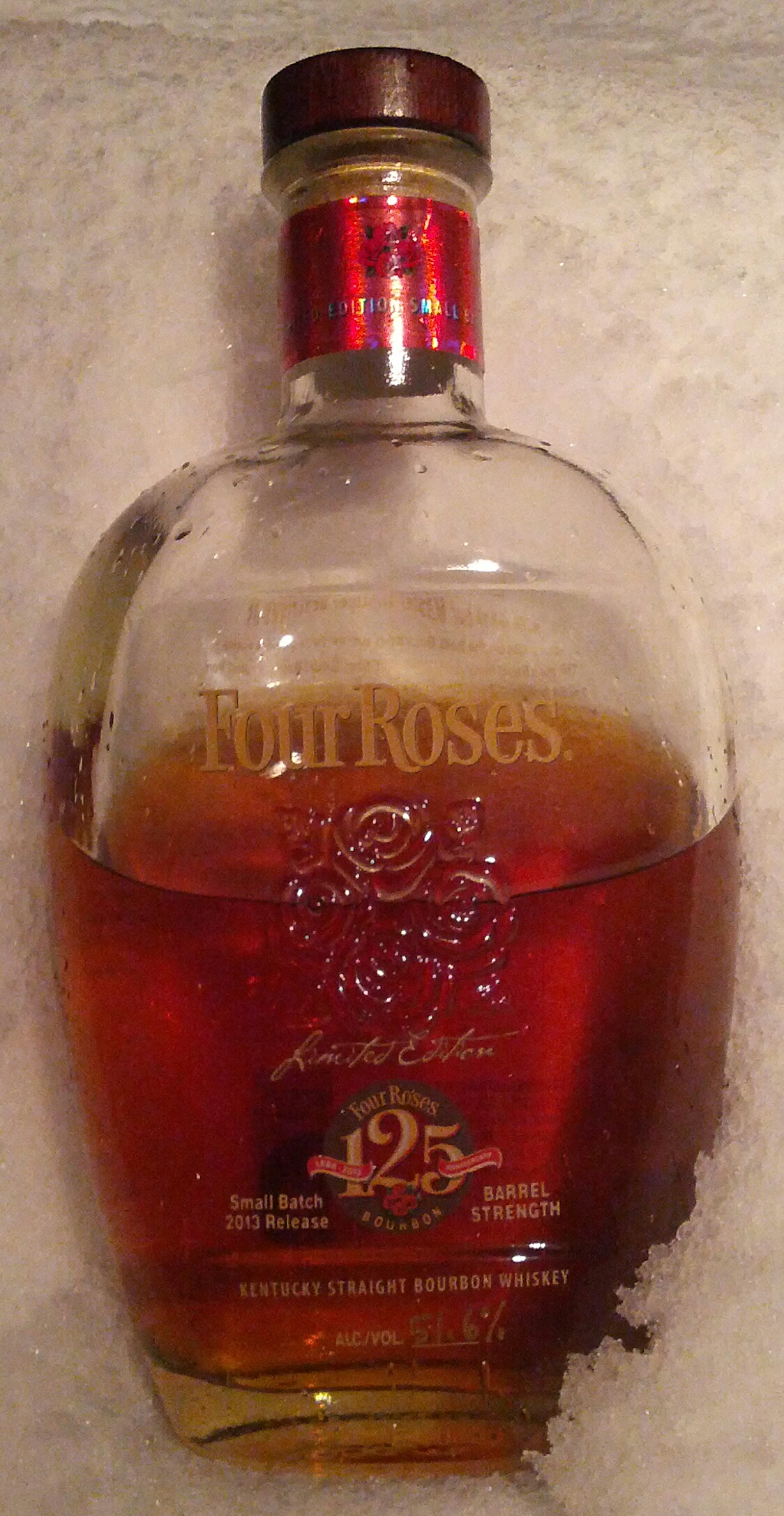
Four Roses 125th Anniversary Limited Edition Small Batch (2013)

Maker: Four Roses, Lawrenceburg, Kentucky, USA (Kirin)4R Ltd Ed Small Batch 2013

Age: 13 y/o

Recipes: OBSV (18 y/o), OBSK & OESK (both 13 y/o)

Proof: 103.2 (51.6% ABV)

Appearance: Medium Copper with thick persistent legs.

Nose: Alcohol, leather, pomegranate juice, habanero chili. After a while in the glass it settles into a more conventional high-rye bourbon profile. Caramel, jalapeno, and leather continues.

On the palate: Surprisingly easy to drink at barrel/bottle proof, but then again it’s a surprisingly low proof out of a barrel. Cherry juice, oak, sweet corn, blackberry, white mulberry, burn. Water brings out sweetness and fruity notes.

Finish: Alcohol, caramel, leather. As on the palate, water brings out the fruity sweetness in the finish and tones down the alcohol.

Parting words: For the second year in a row, the Four Roses Limited Edition Small Batch has won Whisky Advocate’s American Whiskey of the Year, and with very good reason. Last year’s was very very good, the best since 2009, but this one is even better. It’s a very similar mix of recipes, but with a higher (probably) proportion of bourbon made with the K yeast. It’s older too, which makes its balance of barrel and fruit even more remarkable. As bourbons get into the double digits, they usually get dry and oaky. This one has all the fruit of a young bourbon like Very Old Barton at close to three times the age. It’s a neat trick. It’s balanced, complex, sophisticated and bold all at the same time and it’s one of the best bourbons I’ve ever tasted.

These limited edition Four Roses releases are the 21st Century’s answer to Very Very Old Fitzgerald. Four Roses is the Stitzel-Weller of now. Unfortunately for those of us who have loved them for a long time, they are starting to be snatched up like S-W. I was able to get several bottles of last year’s release fairly easily, but this year the prices are much higher and the bottles are harder to find, even though they are more widely distributed. If you see one, buy one. If you can get more, get more. If you break your budget buying them, I’d be happy to take a few off your hands. I paid around $90 for mine which is a lot, but worth every penny. Four Roses 125th Anniversary Limited Edition Small Batch is highly recommended.

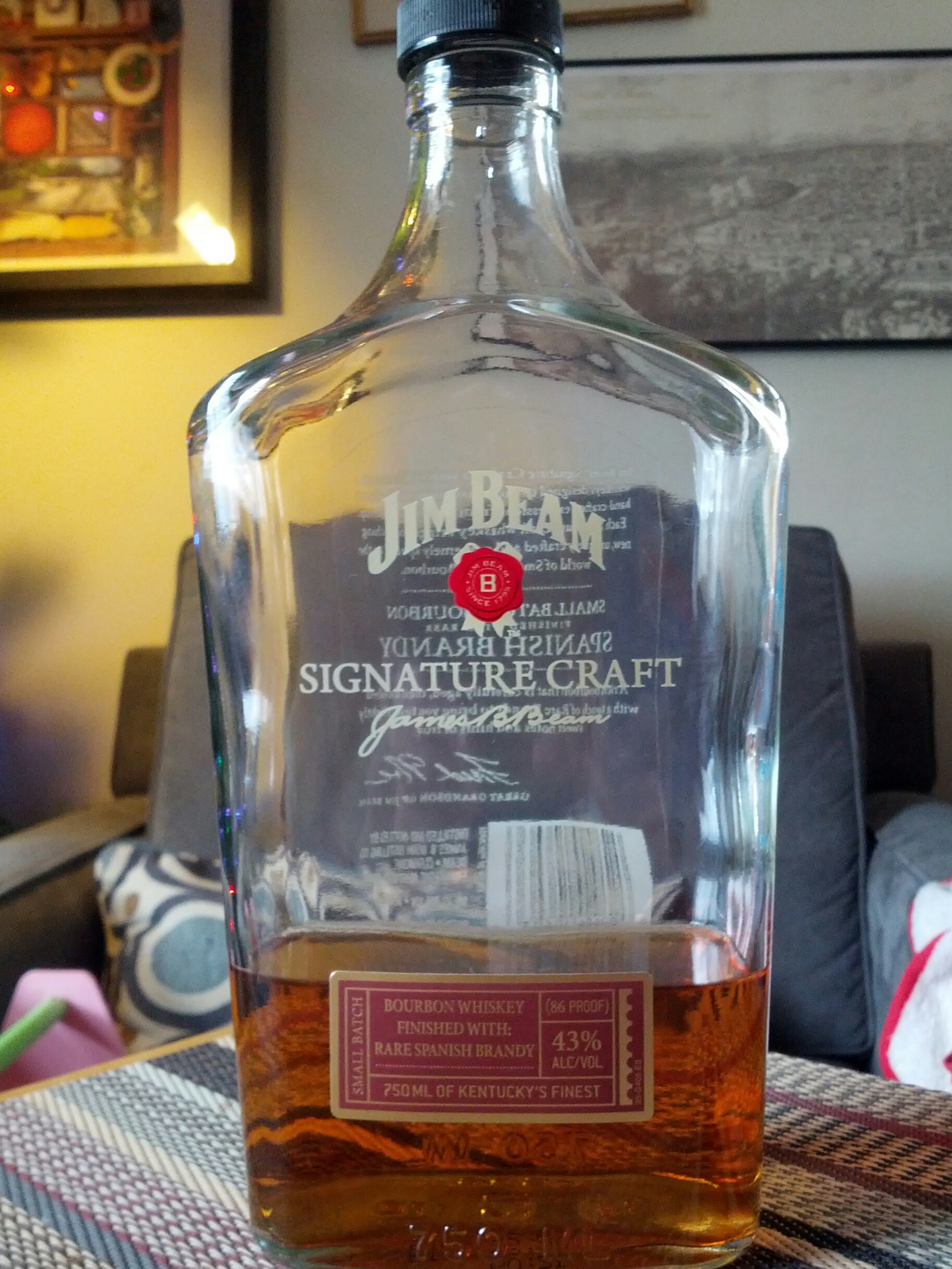
Jim Beam Signature Craft: Spanish Brandy Finish

Maker: Jim Beam, Clermont/Frankfort, Kentucky, USAJB Span Bran

Style: Bourbon finished with Spanish Brandy

Age: NAS

Proof: 86 (43% ABV)

Michigan State Minimum: $40

Appearance: Medium copper.

Nose: Cereal, alcohol, butterscotch, leather, old oak, yeast.

On the palate: Full bodied and sweet. Butterscotch candy, burn, yeast, a touch of jalapeno.

Finish: Hot but sweet. Lingers and tingles for quite some time with butterscotch, burnt caramel, dandelion stem.

Parting words: The Jim Beam Signature Craft series is a new line from Beam with two parts. One part is a 12 y/o, 86° Jim Beam recipe bourbon and the other is an annual release of a finished or otherwise unusually treated bourbon. The Spanish Brandy Finish is the first of that second piece. This is not a brandy barrel finish, this is finished with a touch of the brandy itself.

This whiskey has gotten mixed reviews from enthusiasts, but I think it’s pretty good. Except for the finish, the brandy does a good job of rounding out the rougher yeasty and vegetal characteristics of young Jim Beam. It brings a rich butterscotch sweetness to the nose and palate too.

Complaints have also been made about the price. Yes, better bargains can be found for $40, but it’s something different and I don’t mind paying a little extra for that. Beam has been doing a lot of experimentation over the past few years. Not all of it has been successful, but I think this is. It’s worth buying a bottle to have another option for sipping after a holiday meal. Jim Beam Signature Craft: Spanish Brandy Finish is recommended.

Head to Head: Woodford Reserve vs. Woodford Reserve Double Oak

WR: Woodford ReserveWR vs WRDO

WRDO: Woodford Reserve Double Oak

Maker: Brown-Forman, Louisville, Kentucky, USA

Style

WR: Standard Recipe bourbon

WRDO: Bourbon finished in a toasted then lightly charred oak barrel

Age: NAS

Proof: 90.4 (45.2% ABV)

Michigan Minimum Price (750 ml)

WR: $36

WRDO: $60 (purchased for $50)

Appearance

WR: Copper with thin legs.

WRDO: Slightly darker with pronounced necklacing.

Nose

WR: Alcohol, oak, dried oregano, homemade caramels.

WRDO: Leather, oak, black walnut, alcohol.

On the palate

WR: Full bodied and sweet. Burn, brown sugar, a touch of cayenne and not much else.

WRDO: Medium bodied and tannic. Alcohol, brown sugar, oak.

Finish

WR: Sweet and slightly oaky with some candy. Then lots of burn.

WRDO: Very oaky. Black walnut, fresh oak, fades into alcohol and then away fairly quickly.

Parting words: Woodford Reserve is a popular whipping boy for bourbon enthusiasts. The knocks on it are that it’s young, overpriced, underpowered and its success is all marketing and packaging and no substance. Knocks on the Woodford Reserve Master’s Collection, a series of experimental annual releases have been similar but even more harsh.

It’s hard to argue with those points. Woodford is expensive for an NAS of 90 proof with little in the way of distinctive tastes or aromas. Woodford Double Oak, a rebarreled version of Woodford with a strong resemblance to the Seasoned Oak Master’s Collection release, adds some needed oak, but not much in the way of depth, unfortunately.

Both fare well in manhattans, but I don’t recall trying them in any other cocktails.

When the Double Oak was released, it was a marginal buy at $50 but $60 is an absurd price for what this is. If it sold for $40-$50 it would be worth a full recommendation, but as it is it is mildly recommended. Standard Woodford was overpriced when it first came out, but as bourbon prices have risen around it, it doesn’t seem so bad. Still, it is dull and its sister brand Old Forester is a much better buy and available at 100 proof. Woodford Reserve is also mildly recommended.

Wild Turkey Tradition

Maker: Wild Turkey, Lawrenceburg, Kentucky, USAWT Trad

Age: 14 y/o

Proof: 101 (50.5% ABV)

Retail Price: $100 (Binny’s)

Michigan State Minimum (when available): $120

Appearance: Auburn with long, regularly spaced legs.

Nose: Alcohol, leather, barrel char, citrus blossom, Genoese basil.

On the palate: Full-bodied and rich. Burn, purple Kool-Aid, oak, ginger, mace, brown sugar.

Finish: Fruity in the cheeks, dry on the tongue and the actual palate.

Parting words: This is Wild Turkey at its finest, complex but still powerful. It strikes a lovely balance between fruity sweetness, spice, alcohol and oak, even without water. Compared to its siblings, I would rank Tradition above American Spirit (some of my friends might reverse that ranking), but not as good as Tribute. It’s a perfect holiday or special occasion sipping bourbon.

The packaging is absurdly complex with a display stand covered by a chestnut colored cover, but the bottle itself is simple and elegant. The over the top packaging does mean that it travels and ships well, so that’s something.

Tradition was released in 2009, but I was still seeing them on shelves as late as a year ago. The price is steep for a bourbon but these limited edition Turkeys rarely disappoint, and it is officially a dusty now so if you see it for $150 or less, buy it. Wild Turkey Tradition is recommended.

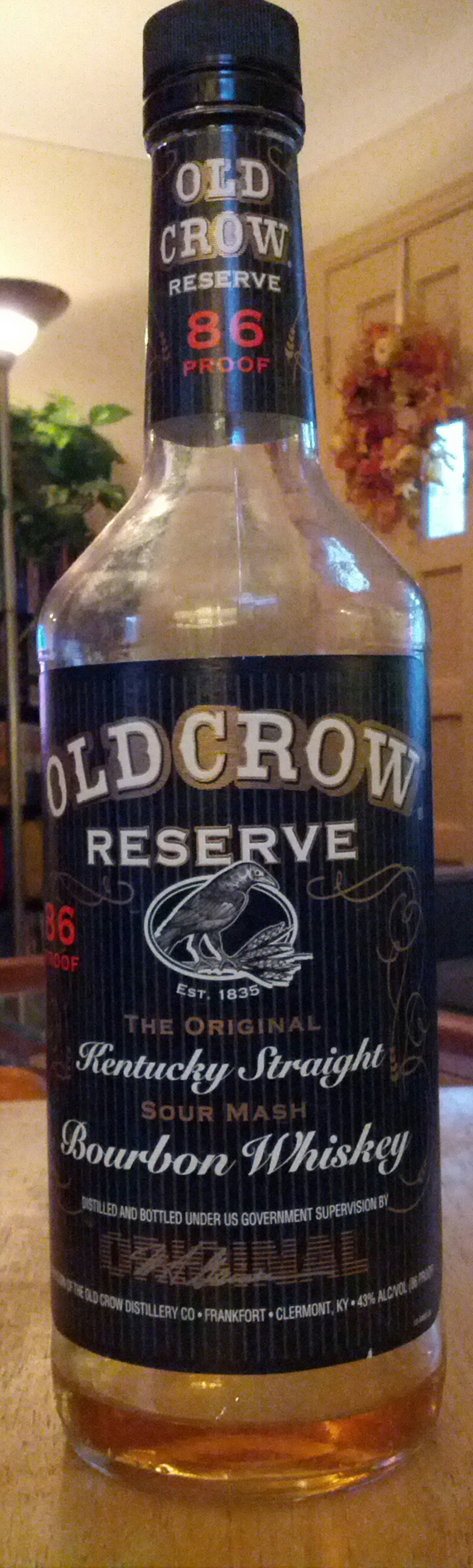
Old Crow Reserve

Maker: Jim Beam, Clermont/Frankfort, Kentucky, USAOld Crow Res

Age: 4 y/o

Proof: 86 (43% ABV)

Michigan State Minimum: $11

Appearance: pale copper, thin wispy legs.

Nose: Alcohol, cumin, dumpster, Romaine lettuce

On the palate: Soft, medium bodied. Alcohol, caramel, parsley.

Finish: Alcohol, more dumpster. Fades quickly, thank God.

Parting words: I wanted to give this a more positive review, I really did, but it’s just not good at all. I was planning on saying this was another missed opportunity for a good line extension of a heritage brand, much like Early Times 354. It is that, but while ET 354 was dull, Old Crow Reserve is just bad. Four years old is not very old for a bourbon, but it’s usually long enough for some of the funk to be taken off, but it actually seems to have increased in this case. I could say more, but nothing needs to be said. If you are desperate for alcohol to put into cola, this might be acceptable. Otherwise, it doesn’t work at all on any level. One of the worst bourbons I’ve had. Old Crow Reserve is not recommended.

Stagg Jr.

Maker: Buffalo Trace, Frankfort, Kentucky, USAIMG_20130913_120455

Age: NAS (8-9 y/o?)

Style: High corn bourbon

Proof: 134.4 (67.2% ABV)

Michigan State Minimum (rounded to the nearest dollar): $50

Appearance: Dark copper, necklacing and thin quick legs.

Nose: Alcohol, hay, wood, pralines. Water turns down the alcohol but turns the grassiness up to 11. Some caramel still comes out but the grass dominates.

On the palate: Wood, amaretto, caramel, alcohol. With water, the nutty flavors come out and make themselves known, but the grass does to. It’s kept in check by the nuts and caramel and a creamy background. The oak is not really discernible with water added.

Finish: Quick and hot with lingering amaretto flavors. The finish has a bit more oak and candy when water is added but the two clash and leave an unpleasantness in the finish.

Parting words: Stagg Jr. is a brand, spankin’ new product from Buffalo Trace. It is a younger (about half the age) version of George T. Stagg, the barrel proof centerpiece of the annual Buffalo Trace Antique Collection (BTAC). The plan is for it to be easier to find and cheaper than its father (the latter is certainly true already). It is about 10 proof points lower in alcohol than its papa too, but still very much in the “bruiser” range at over 134°.

When I was tasting Sagg Jr., I poured myself an ounce of a recent edition of Stagg Sr. (I guess we’ll have to call it that now) for the same of comparison. The contrasts were striking. Jr. lacked the complexity and powerful elegance of Sr. Frankly, Jr. drinks more like a barrel proof edition of Buffalo Trace than the bourbon with which it shares a name. I don’t mind Buffalo Trace. I’ve had some very tasty retailer selections of it and I think it does very well in cocktails, but sometimes the grassiness is just too much for me. Stagg Jr. is all the things I dislike about Buffalo Trace amplified: the grass, and way the other flavors clash with it. Stagg Jr.’s saving graces are the lack of a strong barrel char influence (one of the clashing elements in Buffalo Trace) and the mitigating role played by the nutty, liqueur-like flavors in the nose and on the palate.

If we’re comparing Stagg Jr. to Buffalo Trace ($25), it’s not much of a bargain even when one factors in the proof. When one compares it to other products of the same distillery in that price range (none of which are bottled at anywhere close to this proof or are unfiltered), it starts to look a lot better, at least on paper. This is another one I’m on the fence about, but I’m going to err on the side of generosity this time and give Stagg Jr. a recommendation.

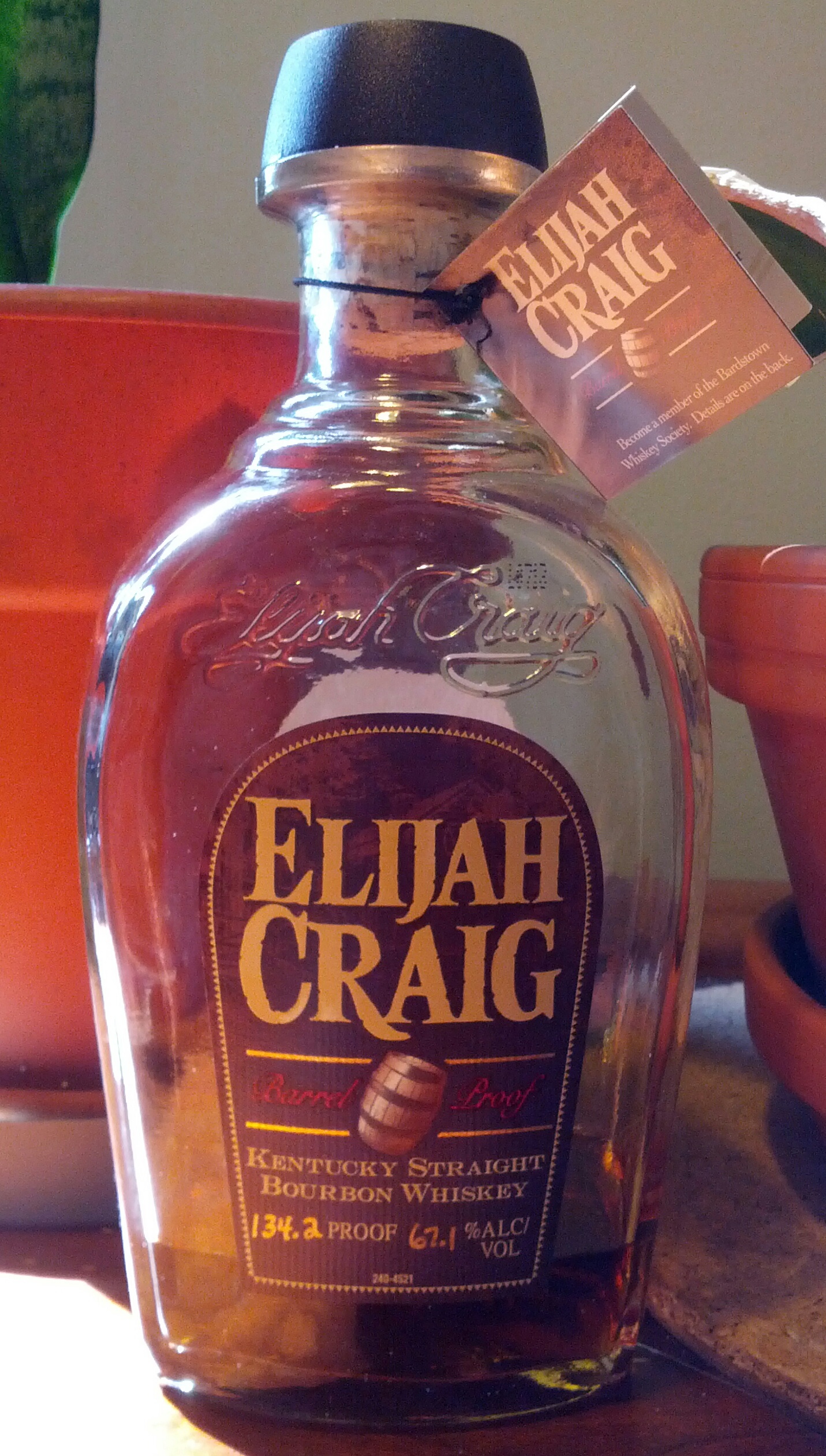
Elijah Craig Barrel Proof

Maker: Heaven Hill, Bardstown, Kentucky, USAECBP

Age: 12 y/o (not on the front label but on the back)

Proof: 134.2 (67.1% ABV)

Notes: Not chill-filtered. First edition reviewed.

Appearance: Dark brown, like root beer.

Nose: Alcohol, leather, caramels. With a little bit of water, it opens up considerablly. Heaven Hill’s signature herbaceousness comes through, this time as tarragon and lavender, with a big hit of oak joining the party.

On the palate: Hard caramel candy, and lots and lots of burn. Much more drinkable with a bit of water. The herbal notes come through firmly alongside the candy but it’s still quite hot. With a little more water, it opens up into crème brulee, licorice, oak, and more candy.

Finish: Neat, it’s very short and hot, evaporating off the tongue almost immediately. With water, a little or a little more, it leaves a pleasant combination of peppermint, caramel, oak and of course alcohol.

Parting words: This is one of my favorite whiskeys ever. It is very much in the Heaven Hill mold, but the complexity and depth of flavor is unsurpassed for a product of that distillery. It’s much better balanced than the old Elijah Craig Single Barrel 18 y/o and of course much higher proof. It is much closer to the standard 12 y/o Elijah Craig, but even more so to the better vintages of Evan Williams Single Barrel, again at much higher proof. Perhaps an even more apt comparison is to George T. Stagg. This is drinks like Heaven Hill’s answer to Stagg. It is an older, more powerful, richer unchillfiltered edition but one very much in the house style. In the case of Buffalo Trace (the maker of Stagg), that’s sweet vanilla and a little bit of grassiness. In the case of Heaven Hill, that’s caramel, mint and affordability.

The only downside is that for me it was undrinkable at bottle/barrel proof. There will always be the macho men and macho women who will drone on about how they never add water and how that ruins the flavor and so on. Good for them and their gullets, but this whiskey just begs for water. All this and it’s under $50 before tax. You’d be stupid NOT to buy it. Elijah Craig Barrel Proof is highly recommended.