Mixed: Excellent in Manhattans, Old Fashioneds, and in a sour.
Parting words: One of the bright spots of the bourbon revival has been the return of Willet to full time production. Consistency was always an issue during Willet’s days as a whiskey buyer, but as a distiller they have been putting out solid, classic style bourbons using their surprisingly large stable of brands.
The 90 proof Old Bardstown is in Michigan now, along with Johnny Drum, Pure Kentucky, Noah’s Mill, Rowans Creek, Willet rye, and possibly some others I forgot. The 90 proof Old Bardstown is perfectly fine, but the Bond is even better. It’s a good all-around whiskey that mixes just as well as it sips neat or on the rocks. Bonded Old Bardstown is recommended!
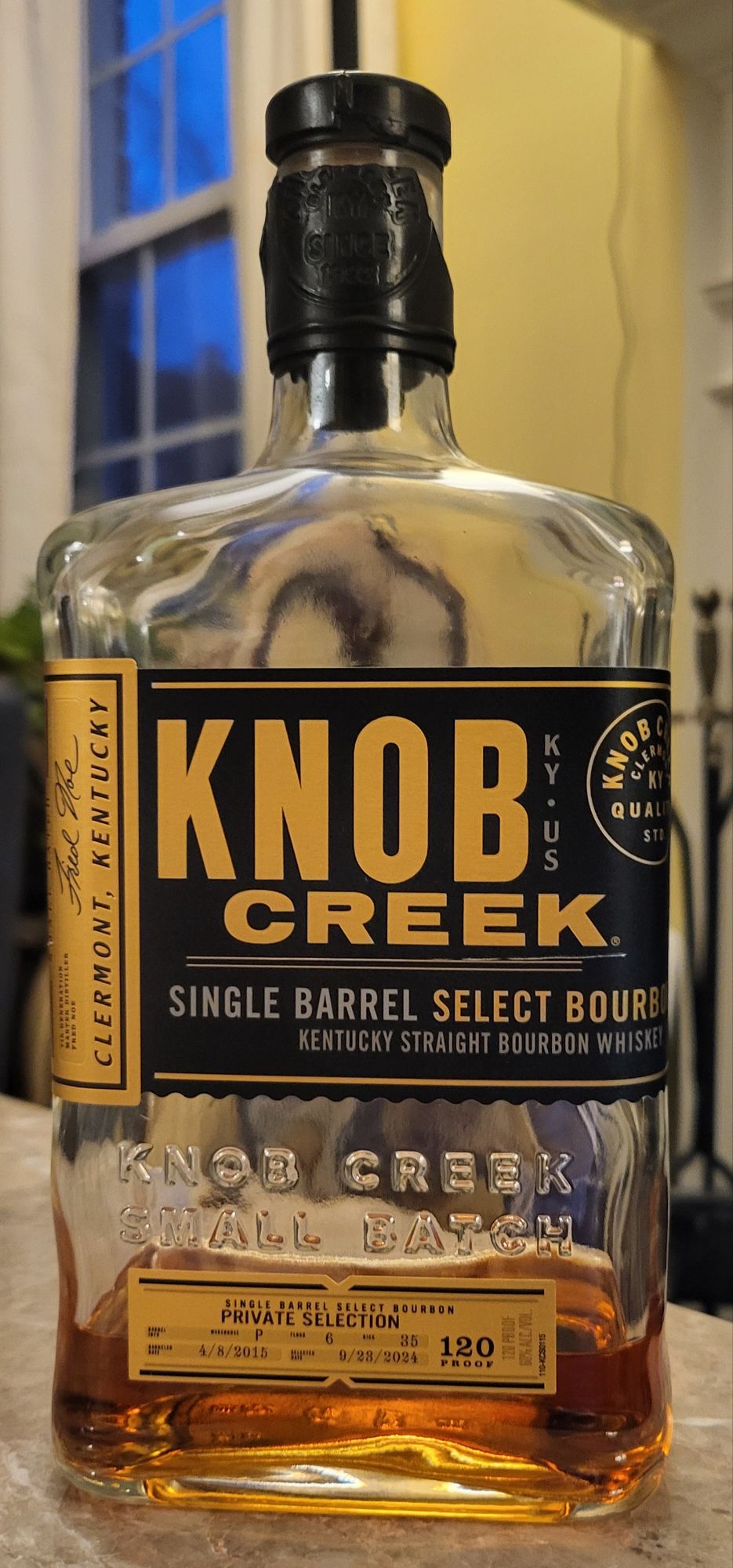
Maker: Jim Beam, Claremont, Kentucky, USA (Suntory)
Style: Rye recipe Single Barrel Kentucky Straight Bourbon Whiskey.
Age: 9ish years old (barreled 4/15, selected 9/24)
Proof: 120 (60% ABV)
Michigan state minimum: $65
Tasted with a splash of water.
Appearance: Medium gold.
Nose: Cut lumber, Beam yeast.
Palate: Sawdust, street corn, green chili.
Finish: Char, brown sugar.
Parting words: Knob Creek Single Barrel is one of my most reviewed bourbons. I reviewed the Georgia Bourbon Society pick I helped select here, and here’s a goofy video review from me and friend of the blog Amy. I review it a lot because I’m a big fan of Knob Creek in general, and barrel selections are a fun way to explore the multitudes that KC contains.
This one was good, but like most Holiday Market selections, it is a good example of itself, but it doesn’t really offer anything new. There’s little difference between this and the median bottle of a non-select KCSB. The Beam funk is maybe a little more prominent, but that might very well be the state of my palate. It’s far from bad, just a little disappointing. Still, it’s better than a dozen other bourbons at that price point. Knob Creek Single Barrel, Holiday Market Selection (9/24) is recommended.
Mixed: Good in an old fashioned, but Liz didn’t care for it in a Manhattan. I didn’t really see the point of trying it in Coke, as mild-tasting as it is. It’s ok on the rocks, though.
Parting words: As a brand, Green River has a long history, but the current Green River started life as the non TerrePURE brand from the Terresettia who took over and rebuilt the old Medley plant in Owensboro years ago. For those who have memory-holed this fiasco, TerrePURE was an attempt to speed up the aging of whiskey by means of vibrations and radiation or something. I don’t think I ever reviewed a TerrePURE whiskey, but I did taste a few and they were all terrible. I think it’s fair to say at this point that the experiment was a total failure. Father Time remains undefeated.
Anyway, The BBC (the whiskey one) purchased the brand and distillery in 2022 and has been producing there ever since. They’ve released a healthy number of iterations, including high rye and wheat bourbons, a rye whiskey, and high corn bourbon 1885 marketed toward cocktail bars, for reasons. All have been well-reviewed, to my knowledge.
I think this one is very enjoyable, especially for the $35 price. It’s not complex, but everything that is there tastes good and works well together. I liked it! Green River Wheated is recommended.
Several months ago, Davis Armstrong and Bobby DeMars of Blind Barrels reached out to me with an offer to send me a complimentary box of their craft whiskey samples for review. Last summer was busy, so it took me a while to respond. I had never heard of the company, but the concept sounded interesting.
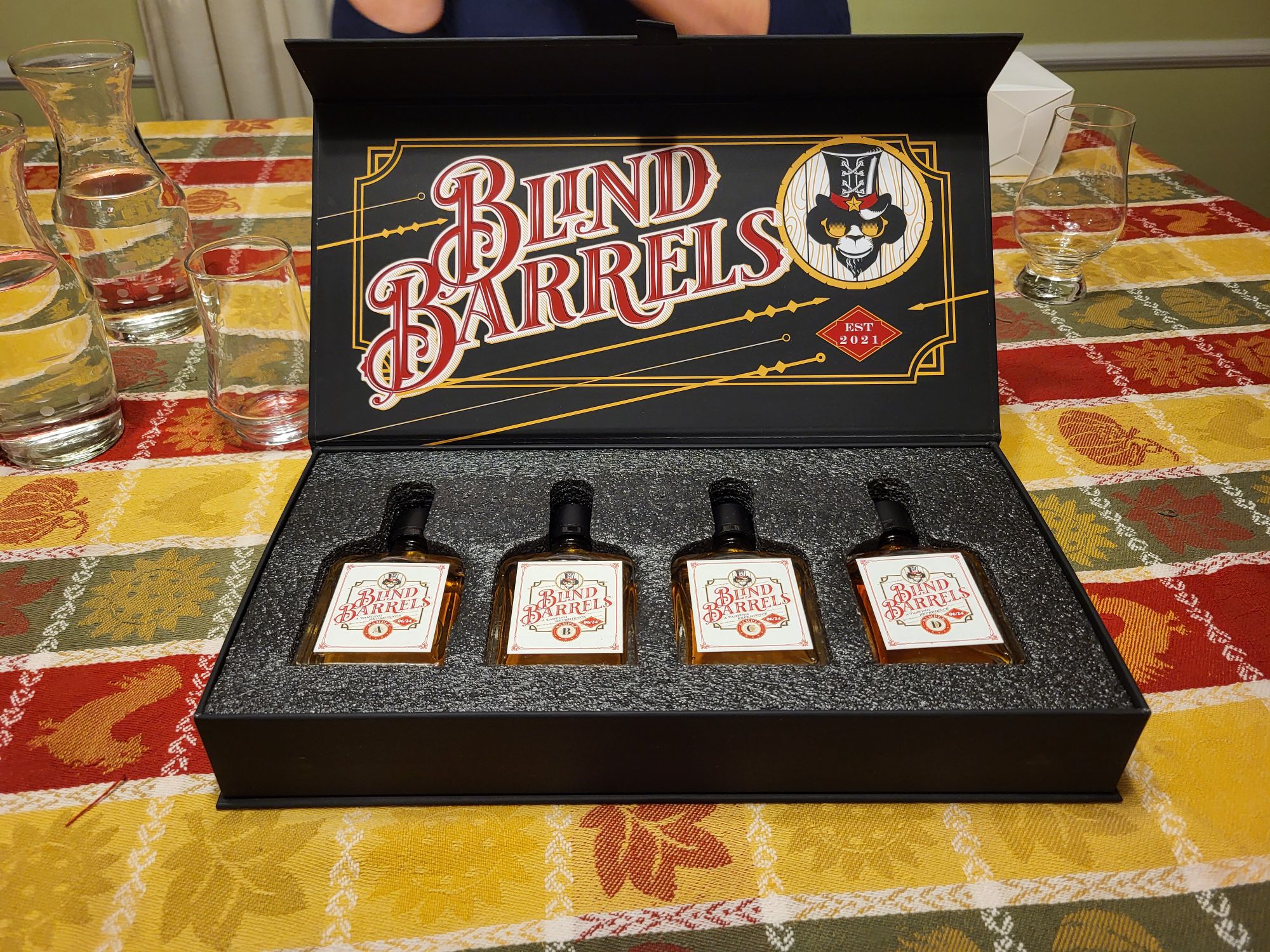
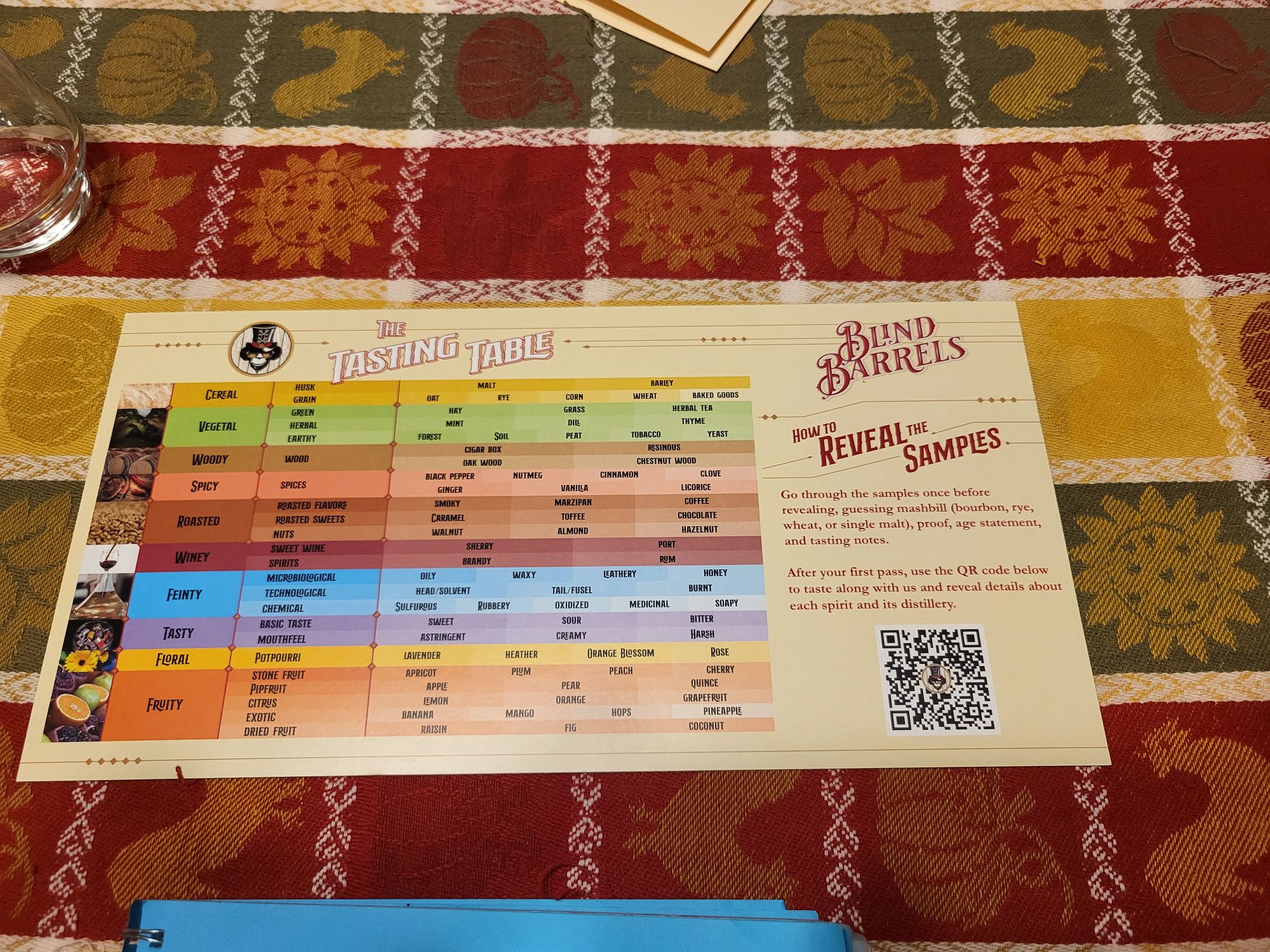
The concept is this: Blind Barrels ships you four 50 ml bottles of whiskey in a plush, classy-looking black box with a golden chimp wearing sunglasses and a steampunk-style top hat for some reason. Included are two letters (at least in my case) from Davis & Bobby, and a “tasting table” of flavors and aromas. Each bottle has the chimp logo, the ABV % of what’s inside, and a QR code. How one distributes the whiskey is up to the tasters, but the materials recommends to pour a little of A in everyone’s glass, take notes, discuss and repeat for B, C, and D. That’s what we did.
The BoxThe SamplesThe Tasting Table
Individual boxes cost $70 each, plus $15 shipping. Subscriptions are a much better deal. Quarterly billing is $60, plus $15 shipping per box ($300/year plus tax). Annual rebilling is the best value for money at $50 per shipment, plus $12.50 shipping ($250/year plus tax). The subscriptions have the added benefit of giving the subscriber a discount on the full bottles of whiskey being sold. All the whiskeys in the various shipments are from small distilleries with limited distribution, so long time whiskey nerds should be prepared for some off-beat selections.
Different boxes have different themes. Ours was Box X (the tenth one). It was released around Father’s Day last year and had a theme of father and (adult) child distillery partnerships. There is also a special Fred Minnick (friend of the blog) box one can order for $70. According to the website, it comes with special guidance from Fred himself. This might be a good option for people who are looking to use a Blind Barrels shipment to jump start their entry into craft whiskey enthusiasm.
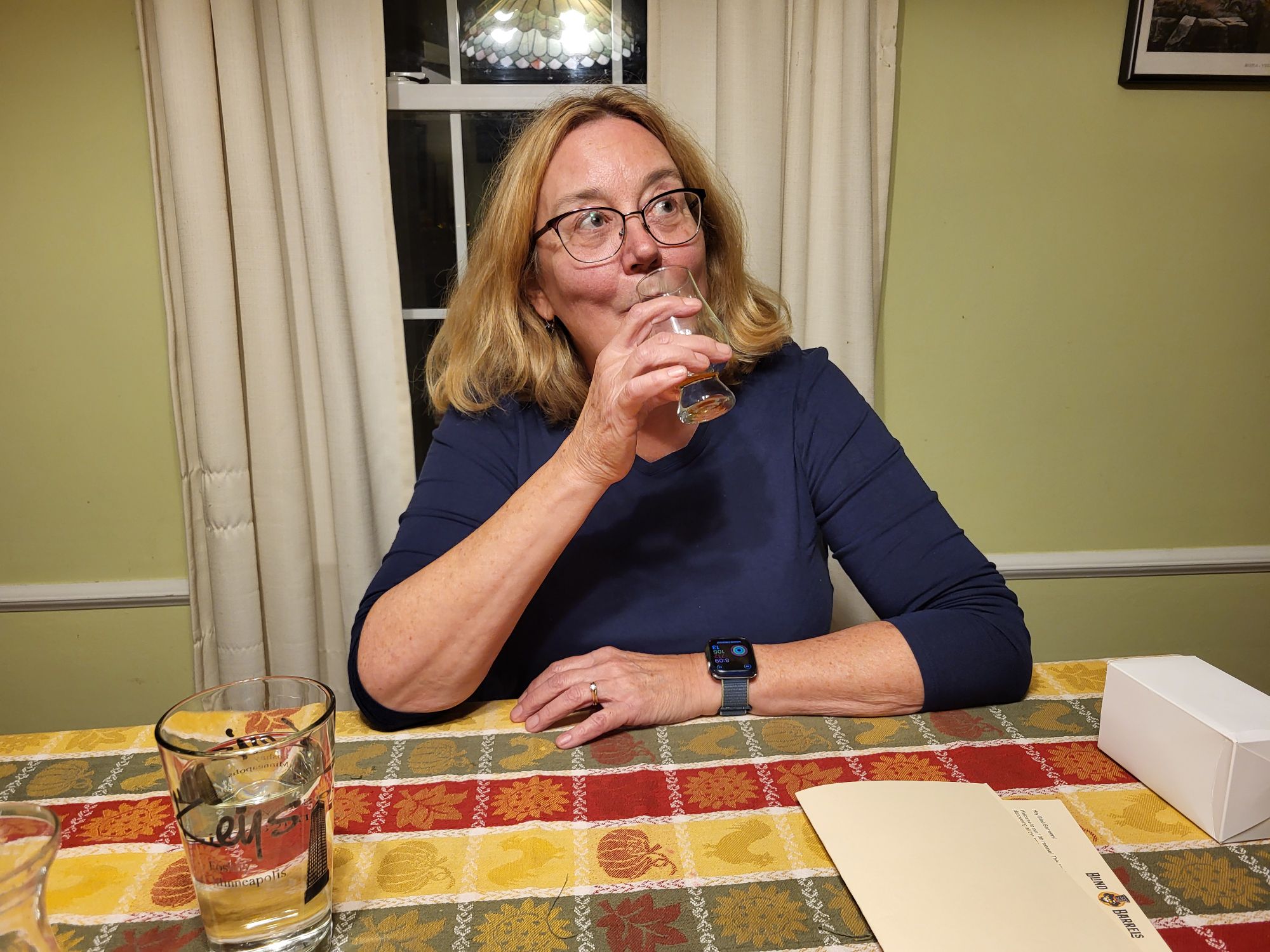
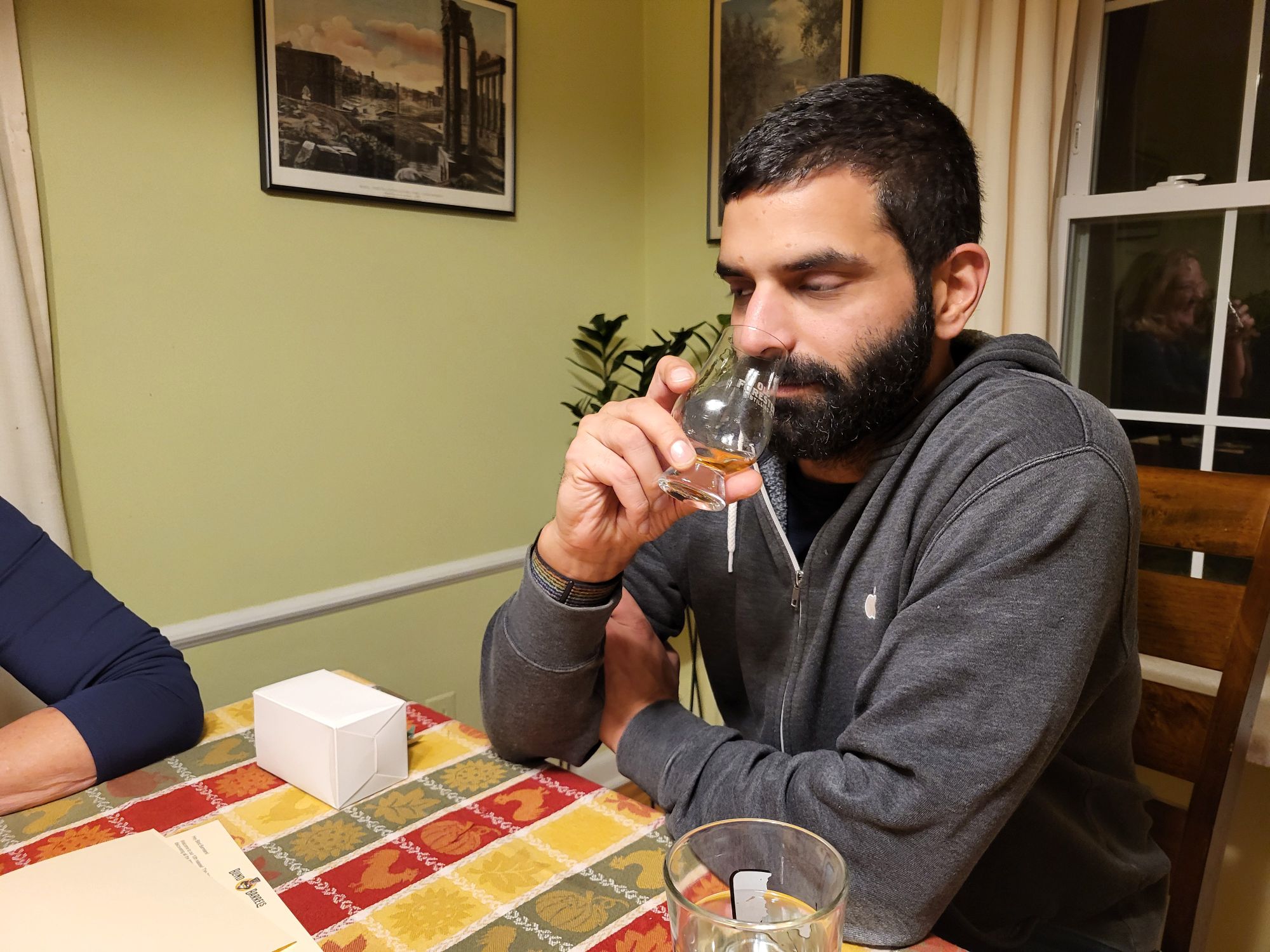
My box arrived in September. In October I rounded up a few friends (Amy, her neighbor Nick, and my wife Liz), and we tasted through the four samples together.
LizAmyNick
Here’s what we thought of them at first taste:
A: Pretty good, probably a rye.
B: A little weird, A wheater, maybe.
C: Even weirder. Oat whiskey or oat bourbon?
D: Wow, stunning. A well-aged bourbon.
At least that’s what I think we thought of them. In an all-to-common bout of unprofessionalism, I lost all the notes I took that night. Drinking may have been involved.
Anyway, we were almost entirely wrong. Here’s what they really were (the first price listed is the MSRP, the second is the subscriber price):
A. Axe Hole Single Malt, Calwise Spirits, Paso Robles, California. 84 proof, $90/$75.
C. Old Monongahela Full Proof Rye, Liberty Pole Spirits, Washington, PA. 108 proof, $85/$65.
D. Doc Holliday 10 y/o Straight Bourbon, World Whiskey Society, Pendergrass, GA. Distilled at Ivy Mountain Distillery, Mount Airy, GA. 122 proof, $200/$130.
As you can see, D was the clear standout. Nick, a whiskey novice, pointed out that a part of concept with this is a marketing/sales play. While all the whiskeys were interesting, D was the standout, and it also has the biggest discount. He concluded that the primary aim of this box was to sell Doc Holliday 10 y/o.
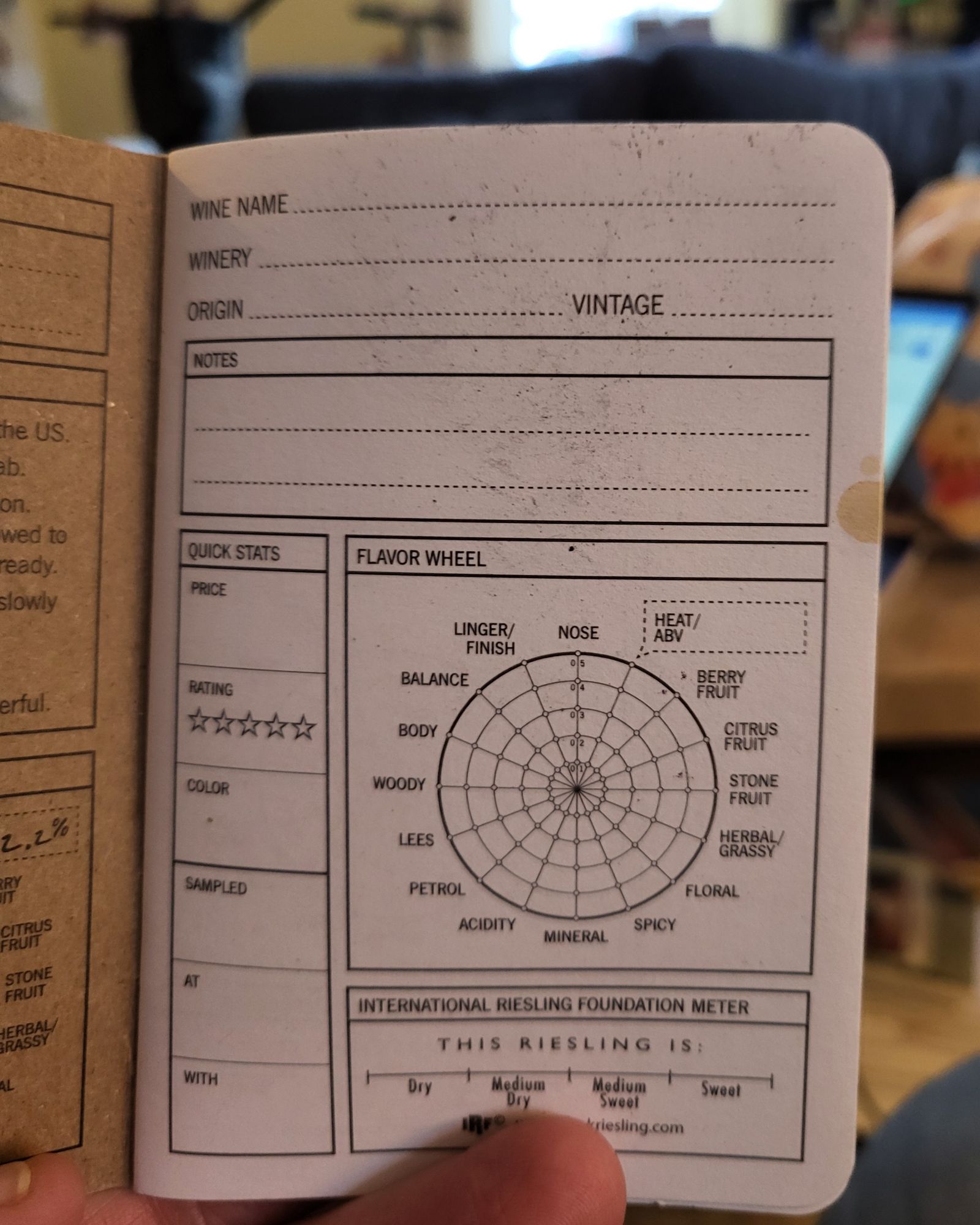
Nick also had a suggestion. Rather than the tasting table with its collection of terms, tasting sheets that can be filled out by each taster might make the experience even easier. Perhaps something like the Riesling tasting booklet pictured to the right. It also might make the tasting notes less likely to be lost.
Anyway, we had a lot of fun! I’ve hosted blind tastings before, and keeping them blind is always a problem. The innovation of the QR code on the back of the bottle takes all the annoyance out of that. Being able to taste whiskeys one might not be able to taste otherwise also makes things more fun. Whether you’re a grizzled whiskey vet or a newb, I think you’ll find a box from Blind Barrels to be an enjoyable way to spend an evening or weekend afternoon. They make great gifts as well. Blind Barrels is recommended.
Maker: Buffalo Trace, Frankfort, Kentucky, USA (Sazerac).
Style: High corn bonded bourbon (BT Mash bill #1).
Age: At least 4 y/o (by straight & bonded regulations)
Proof: 100 (50% ABV)
Price: $20 (Binny’s)
Appearance: Copper.
Nose: Ghost pepper, overdone creamed corn.
Palate: Full-bodied and sweet. Caramel, grape soda.
Finish: Hot with a little char.
Mixed: OK in every cocktail I tried it in, but unremarkable.
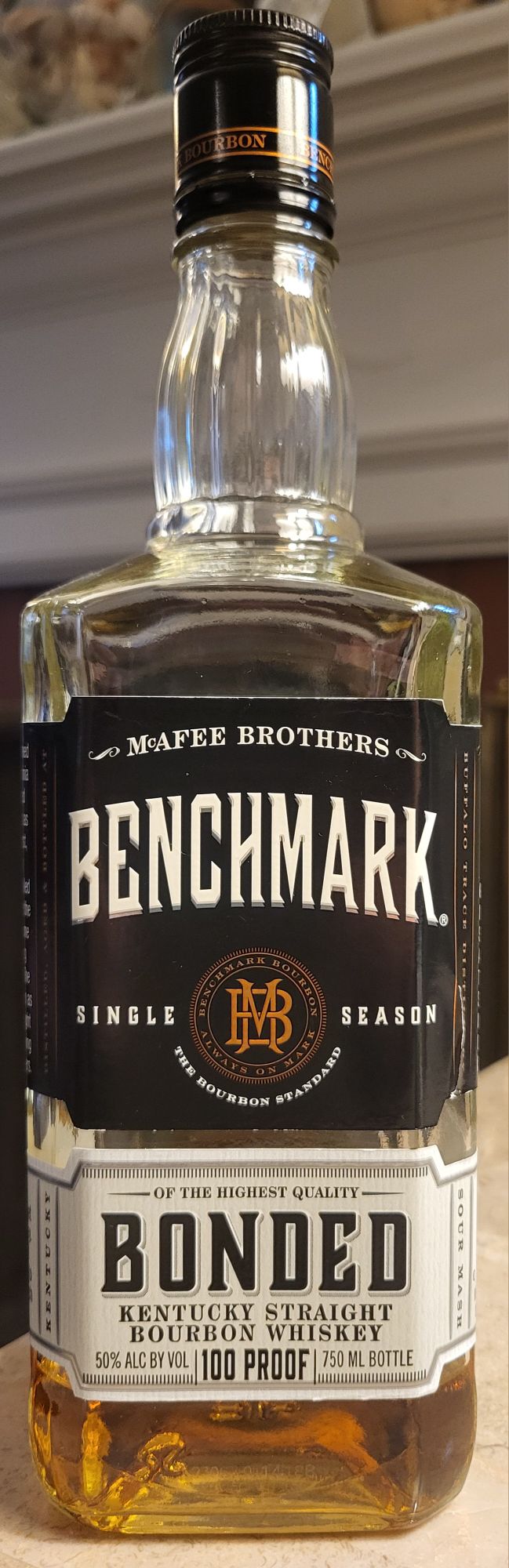
Parting words: Benchmark had been a punchline for me for many years. The “Old No. 8” is, to me, the worst bottom shelf bourbon available from a major distiller, with the possible exception of Ten High. I joked about it frequently in the old forum days. I never blogged about it for that reason, although it may have been worth it just for the mental exercise of coming up with gross tasting notes.
This bonded version isn’t too bad, though. I do struggle to justify buying it over, say Evan Williams white label at around the same price or Early Times BiB and Very Old Barton 100 proof at an even lower price. Plus it’s not even available in Michigan at the moment.
In the end, Benchmark Bonded is a decent mixer, but there’s not much of a reason to seek it out. It’s mildly recommended.
Maker: Jim Beam, Clermont, Kentucky, USA (Suntory)
Style: Rye recipe bourbon.
Age: 12 y/o
Proof: 100 (50% ABV)
Michigan state minimum: $70
Appearance: Dark Copper.
Nose: Charred oak, leather, old wet lumber.
Palate: Brown sugar, acorns, burn. Water brings out a little more complexity, adding eucalyptus and clove.
Finish: Hot and oaky.
Parting words: The standard 9 y/o Knob Creek has been one of my favorite bourbons for many years. I love it because it’s easy to find, high proof, affordable ($37 in Michigan), and mature but not over oaked. To my palate, 6-9 years is peak maturity for most bourbons. Exceptional ones, or ones aged on the ground floor of the rickhouse can go longer, but for most, 6-9 is the sweet spot. Before that, the whiskey can be rough and uncouth. After that, it can become one dimensional and fall into the “beaver bourbon” category, a term I coined to describe bourbons that only a creature accustomed to chewing on trees could enjoy.
Unfortunately, Knob Creek 12 is a product for the beaver market. Oak isn’t the only thing going on here, but it dominates the palate, nose, and finish. I had hoped that a distillery with stocks the size of Beam’s would be able to select a few balanced barrels for this expression, but apparently not. I can’t imagine what the newer 15 and 18 y/o expressions taste like. Even the beavers might object at that point.
If you’re the type who like a woodier bourbon, you might enjoy this, but I did not. The price isn’t too bad, considering what some bourbons at half the age go for the days, but Knob Creek 12 y/o old is still not recommended.
Age: 6 y/o (distilled autumn 2016, bottled January 26, 2023)
Warehouse/Floors: See photo below
Proof: 100 (50% ABV)
Michigan State Minimum: $60
Appearance: Medium reddish copper.
Nose: Spicy, with roasted corn, and a bit of caramel.
Palate: Caramel and amaretto chews, rock n rye soda, then cayenne. Water tames the spice and brings the sweet candy flavors to the fore.
Finish: Salted caramel, burn.
Parting words: The bourbon boom has seen a lot of new distilleries appear on the scene, and the last few years have seen the rise of a number of distilleries with promising futures, like (the new) Yellowstone, New Riff, Wilderness Trail, Woodinville, and many others. These folks are putting out great whiskeys right now, and are only getting better.
Something that has also happened is that a few old distilleries around the country have jumped back into the bourbon game, by releasing their own, new products. Ross & Squibb (FKA LDI/MGPI) is one example of that, and McCormick is another. When I first became interested in American Whiskey, I got to know McCormick as the making of Platte Valley corn whiskey, which comes in those distinctive stoneware jugs that used to have a cartoon Hillbilly on them. At 80 proof, it’s a bit weak, but a decent sip on a hot summer Saturday evening.
McCormick saw other distillers getting rich and asked themselves, “Why not us?” They already had the still, the corn, and the warehouses after all. They even found a historical mascot, Ben Holladay, a 19th century transportation mogul (hence the stagecoach) with ties to the distillery for the brand, So they distilled and aged some bourbon and released Ben Holladay Missouri Straight Bourbon Whiskey to the world in spring of 2022.
I had always assumed that Weston must be on the west bank of the Mississippi, just a stone’s throw from the Kentucky border. It’s not. It’s in the opposite part of the state on the northern edge of the Kansas City metro area. That makes it about 600 miles from Bardstown, Kentucky, and about 500 from Owensboro. The town’s population is about 1,700 people, which is not too different when the distillery was founded in 1856.
Missouri Straight Bourbon whiskey has more stringent standards than its Kentucky cousin. It must be made of corn grown in Missouri, and aged in a barrel manufactured in the state as well. That’s in addition to the requirements to mash, ferment, and distill instate.
Anyway, I like Ben Holladay 6 y/o. It’s sweet and spicy and mixes well too. My only complaint is the price. A bourbon from a venerable producer like McCormick shouldn’t be as pricy as a micro-distiller’s. That said, there are younger, less sophisticated bourbons being sold at twice the price right now, so I guess $60 isn’t too bad, but it could still be better.
Age: NAS (I don’t remember if the store disclosed the age), but at least four years old.
Barrel #8683
Proof: 125 (62.5% ABV)
Michigan state minimum for 1792 Full Proof: $47
Tasted with a splash of water (don’t be a hero when it comes to 125 proof bourbon)
Appearance: Dark copper.
Nose: Dark caramel, charred oak, Habanero chili.
Palate: Full-bodied and semi-dry. Caramel, white pepper, anise, allspice.
Finish: Dry with some sweet heat.
Parting words: This is my first review of any kind of Full Proof 1792. I did review 1792 Single Barrel from the pre-divorce Red Wagon alongside a selection from the Rural Inn. I believe that last bottle of Full Proof I owned, however, was a selection from the Rural Inn. It tasted good, but I always got a wicked headache afterwards. I’m not sure why, but unchill-filtered bourbons have a tendency to do that to me.
No such complaints for this Red Wagon (Rochester Hills) selection, though. It has big caramel flavors with some holiday spice in the background. It’s not particularly complex, but with a splash of water, it’s a very nice winter or autumn sipper. $47 isn’t chump change, but when the high proof is factored in, it’s a pretty good deal, especially compared to how much microdistiller or Potemkin distillery products go for these days. Red Wagon selections almost never disappoint. Full Proof 1792 Red Wagon Shoppe, Single Barrel Selection barrel #8683 is recommended!
Maker: Barton 1792, Bardstown, Kentucky, USA (Sazerac)
Style: Bonded rye recipe (high malt?) bourbon.
Age: At least 4 y/o.
Proof: 100 (50%) ABV
Michigan State Minimum: $36/1 liter (works out to $27/750 ml)
Appearance: Medium copper.
Nose: Alcohol, five spice powder, dark caramel, velvet.
Palate: Medium-bodied, semi-dry. Caramel, thyme, oak, white pepper.
Finish: Dry and lightly woody.
Mixed: Good with Benedictine, and in a Manhattan.
Parting words: I reviewed the Kirkland Small Batch last summer. Back then I expressed my hope that the bonded would come in soon. It came in a few weeks after that and I got three bottles. Unfortunately I wasn’t able to review it until today, and even more unfortunately, I’m only down to one more bottle.
As one would expect, this is a step up from the Small Batch, though not nearly as much as I had hoped. There’s more complexity and depth, for sure. The cinnamon candy had been replaced with five spice, and there’s more caramel and tannic grip to it. It cleans up nicely compared to its Small Batch sibling, but it’s still not quite what I would call elegant. I would rank it below Very Old Barton and 1792 bonds, but just barely.
Still, for a store brand at this price, it lives up to expectations. It’s good in traditional cocktails, but like the Small Batch, it’s at its best on the rocks. If this one every comes around again, buy it.
Kirkland Bottled-in-Bond: Barton 1792 is recommended.
Final parting note: I took the Pepsi Challenge with this (diluted to 90 proof), Very Old Barton 90 proof, and 1792 Full Proof (diluted to 90 proof) to attempt to determine which mashbill the Kirkland BiB was: VOB or 1792/Kentucky Tavern (supposedly a high malt bourbon). I’m only about 67.924% sure, but I think the current Kirkland BiB was made from the 1792 mashbill. It has a certain spicy, burnt note on the palate and finish that bears a resemblance to it. If I am ever able to get a hold of the Single Barrel (which is in the current price book, but I have not seen on a shelf), I will attempt the same exercise.
Palate: Full-bodied, and well balanced. Leather, caramel, chilies, pinch of tarragon.
Finish: Field mint, fading into cinnamon disks.
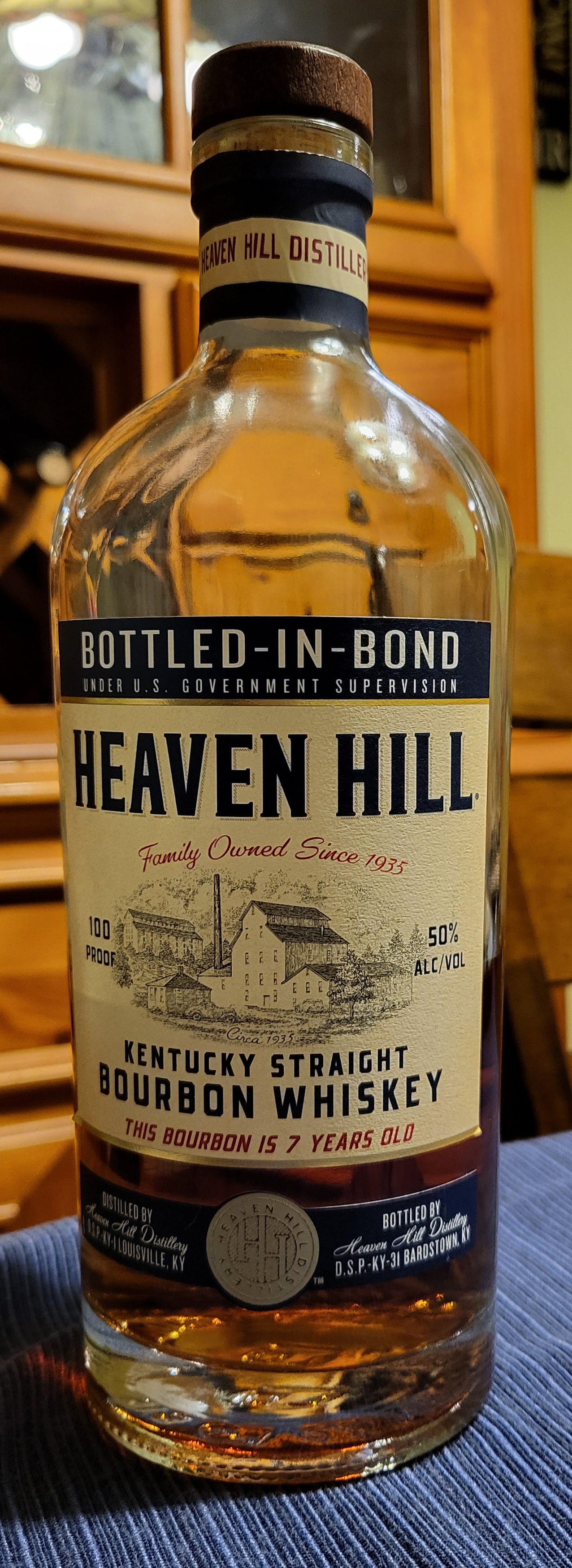
Parting words: This is not the first time I have reviewed Heaven Hill Bottled-in-Bond. The 6 y/o version was a favorite of mins for many years and I would stock up on it whenever I went to Kentucky, which was pretty frequent back then. I still have one bottle squirreled away in my basement for a rainy day or for some hopefully distant day when I get put into an old folks home. It was a pretty good bourbon, but it was an excellent value. 100 proof, 6 years of age, all for well under $20. It was my house bourbon for many years when company came over.
To their credit, when Heaven Hill decided to revamp their Heaven Hill line, they did add one year of age and give the label a fresh, modern (if a bit dull) look. Not to their credit, they more than doubled the price. HH was known for many years as the distillery of choice for cheapskates like me, because they offered a wide range of pretty good to very good bourbons at several dollars less than their competitors did at the same age/proof ranges. Now, they are unfortunately making a name for themselves by turning their ex-value bonds like Heaven Hill and Old Fitzgerald into super-premium products with prices to match.
All that said, there’s nothing wrong with this bourbon as it is. If it didn’t have the same name as one of the greatest bourbon values of all time, I might be more willing to cut it some slack. But with the almost always superior Henry McKenna 10 y/o single barrel bonded for only $10 more, it’s hard to recommend the current HH BiB. I’m not sure what the point of it is anymore, frankly. Heaven Hill Bottled-in-Bond 7 y/o is mildly recommended.








 Sipology