I'm a married white male. I like reading, writing, gardening, listening to music, teaching, cooking, drinking and wasting time.
MTS from Anderson University, MA in History (Medieval Europe) from Wayne State University. Currently taking care of my children and running a household.
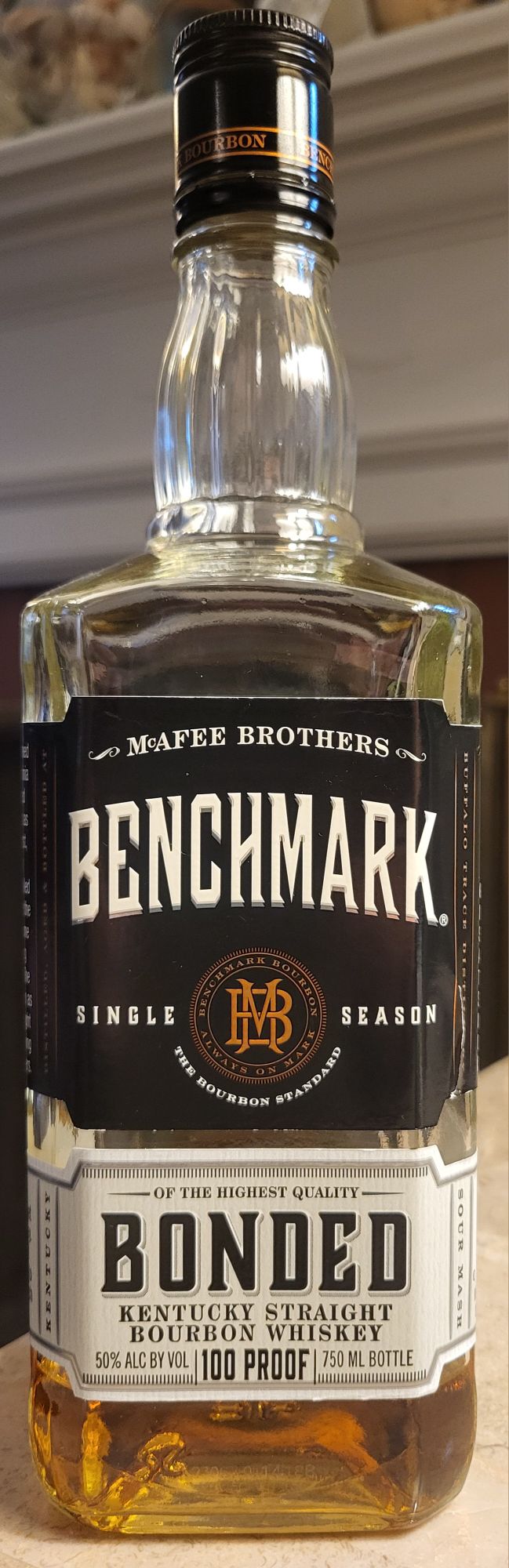
Maker: Buffalo Trace, Frankfort, Kentucky, USA (Sazerac).
Style: High corn bonded bourbon (BT Mash bill #1).
Age: At least 4 y/o (by straight & bonded regulations)
Proof: 100 (50% ABV)
Price: $20 (Binny’s)
Appearance: Copper.
Nose: Ghost pepper, overdone creamed corn.
Palate: Full-bodied and sweet. Caramel, grape soda.
Finish: Hot with a little char.
Mixed: OK in every cocktail I tried it in, but unremarkable.
Parting words: Benchmark had been a punchline for me for many years. The “Old No. 8” is, to me, the worst bottom shelf bourbon available from a major distiller, with the possible exception of Ten High. I joked about it frequently in the old forum days. I never blogged about it for that reason, although it may have been worth it just for the mental exercise of coming up with gross tasting notes.
This bonded version isn’t too bad, though. I do struggle to justify buying it over, say Evan Williams white label at around the same price or Early Times BiB and Very Old Barton 100 proof at an even lower price. Plus it’s not even available in Michigan at the moment.
In the end, Benchmark Bonded is a decent mixer, but there’s not much of a reason to seek it out. It’s mildly recommended.
Place of origin: Gill’s Pier estate, Leelanau Peninsula AVA.
Style: Semi-dry (verging on semi-sweet) Riesling.
ABV: 10%
Purchased for $18 (Michigan by the Bottle, 2015)
Appearance: Bright gold.
Nose: Apricot, lemon thyme, honey
Palate: Tart and medium bodied. Orange blossom honey, lemonheads.
Finish: Tart and clingy, with some lees influence.
Parting words: It’s the end of an era. This is officially the last bottle of wine from Gill’s Pier that I have in my cellar. Appropriately enough, 2013 was also the final GP vintage. I grew to love this little winery after discovering it through friends-of-the-blog Michigan by the Bottle. Gill’s Pier was one of the featured wineries at the Royal Oak location and I was a frequent buyer. It’s hard to say what I liked about them so much. I think it may have been that they were reasonably priced and well made with good terroir characteristics. The estate been an alpaca farm for over a decade now. I hope the alpacas have been enjoying it.
Anyway, this bottle once again proves that Michigan wines can stand the test of time. This was an $18 (around $24 in today’s money) Riesling from a small producer that is still tart and tasty ten years later. And in a screw-top, no less!
This is also our final entry in the wayyy too long 2012 Project series of reviews of ten year old and older Michigan wine. Almost all of them held up very well. Buying from a quality producer helps a lot, of course, but I think the acid in cool-climate wine like the ones produced in Michigan helps with age-worthiness. While I wouldn’t recommend cellaring White Heron for ten years, fine Michigan wines like the ones reviewed here on Sipology Blog will usually be suitable for the cellar, even if you didn’t pay top dollar for them!
Anyhow, 2013 Gill’s Pier Semi-dry Riesling is recommended!
Price: $15 each on the website for 2 oz. These were complimentary samples for review purposes.
Back on June 30, I received a cold email from Gene Cooper asking if I would be interested in some samples of some McMann & Tate Cocktail bitters for review purposes. I was a surprised, since I don’t get a lot of cold emails reaching out for sample purposes these days. The last one I received was from Tommyrotter back in 2019, and Union Horse before that way back in 2016. I think this is the first one I think I’ve received for mixers, which I don’t normally review. That may change in the near future though, since I’ve picked up a few interesting ones from craft producers recently.
Anyway, McMann & Tate’s name was inspired by the name of Darren’s firm in the 1960s sitcom of the Household Secret genre*, Bewitched. The marketing materials lean into that 1960s feel. For more on that, take a look at the email “interview” with founder Gene Cooper after the reviews.
They make a wide variety of cocktail supplies, including an interesting line of dried garnishes and, of course, bitters. Besides the three I received as samples, they also sell Citrus Grove, Cocoa Mole, English Lavender, Morning Coffee, No Foam Root Beer, and South Sea bitters (a limited release). McMann & Tate’s online shop is here.
My strategy with these was the use them in my go-to cocktails, then with a spirit on the rocks, and then try a cocktail suggested on the M & T website. Anyway, let’s get into it.
Nose: Cherry, cherry wood, and baker’s chocolate are the strongest aromas here, with the other, more delicate herbs and spices adding interest and complexity, but very much in the background.
Mixed: I used Bing Cherry Bitters in bourbon on the rocks, bourbon and brandy old fashioneds, a Manhattan, and in a bourbon and coke. I also tried the Rose’s Revenge cocktail from the McMann & Tate website. It held up well in all applications, even with the cola! Tasted like a Cherry Coke, but better.
This was my least favorite sniffed on its own, but it really came alive in the cocktails. I was pleasantly surprised. Recommended.
Nose: Bitter orange and baker’s chocolate lead the way, but the spices play a stronger role than in the cherry, each identifiable but working together.
Mixed with rye on the rocks, in an Irish whiskey cocktail called a Hearn (Irish, green Chartreuse, Absinthe) and a a cocktail from the website called a Fancy Free (also includes Wildly Aromatic bitters). It got lost in all of them. This was disappointing because I loved smelling it on its own. Bitters are for mixing, though, and while it didn’t hurt any of the cocktails, it didn’t elevate them either.
I decided to try it in some gin cocktails after that, thinking it would show up a little bit better. As occasionally happens, I was correct! I tried them in a cocktail called a Bijou (gin [I used barrel aged], red vermouth, Chartreuse), and then in a modified version of a kinda weird one I found online called Eeyore’s Requiem (gin [barrel aged again], white vermouth, fernet, and a lot of orange bitters). Moroccan Orange shone in these two. I can imagine they were do just as well with tequila or rum based cocktails.
McMann & Tate pride themselves on making lower proof bitters, but these might benefit from a bit more oomph when it comes to whiskey cocktails. For everything else, Moroccan Orange Bitters is recommended.
Nose: This one is the most complex. Uncooked cranberries are immediately identifiable, but the rest work together to give the impression of a spiced cranberry sauce.
I tried this in an Old Fashioned, a Manhattan, and in a cocktail called The Holdfast that I got from Dave Wondrich on Twitter years ago, and in the aforementioned Fancy Free. I loved it as a substitute for Angostura bitters. It’s more complex and more subtle on the nose, but in cocktails it elevates everything it finds its way into. I was very impressed. This is going to be a go-to for me. Sorry Angostura. Highly recommended!
Now for the “interview”. After I wrote up the reviews, I sent Gene a quick email with a few questions, to help fill in the blanks on the company and its history. He very generously gave full, thoughtful responses to all my questions. Instead of doing the hard work of trying to digest them, I thought I’d let him speak for himself (with a tiny bit of editing).
Josh:How did you get interested in cocktails?
Gene: When I was in high school my friend and I were pool boys at the Thunder Bird Hotel in Mantoloking NJ for a few summers (this was in the early eighties). My friend’s dad also owned the place so we were expected to work long hours but there were plenty of perks (the pay was pretty good and we stayed in his efficiency apartment to avoid the weekend commute back and forth to the beach). It was a pretty big hotel for the Jersey Shore, about 200 rooms, a restaurant, banquet room and an outdoor tiki style bar. The bar is where we spent most of our time, not drinking (of course) but hanging out with the bartenders, learning what they do and how they work with customers.
This eventually led to my friend and I becoming bar backs along with setting up and closing down the bar every day. The entire process of getting ready to work, creating something that people enjoy and receiving immediate feedback was really appealing to me (and getting cash tips seemed pretty cool too).
But my true fascination with making cocktails occurred after our last summer working at the hotel. It was the summer before my freshman year in college. My friend’s dad sold the hotel that summer to a developer and he told us, “take whatever you want because everything’s got to go”. So, we drove my mom’s station wagon to the hotel for that final weekend, woke up at dawn, entered the liquor room and filled case upon case with spirits, modifiers, barware, blenders, brand signs and even the tiki barstools. Fast forward to September, my dorm room pretty much resembled the Thunder Bird tiki bar, it was a pretty professional set up and I was “the” bartender for our weekend parties, parties that continued for several semesters. This is where my love for making cocktails got its start and thankfully I’ve continued the journey, trying to learn something new every day.
J:How did the company start?
G: I’ve always been a fairly creative person, I paint, have done improv and infused more spirits and made more syrups than I can count. So, here’s another Covid story. Having some additional time on my hands in 2020 I decided to make some bitters and shared them with my friends. Everyone said “these are pretty good you should sell them”. That got the entrepreneurial bug back in my ear.
I previously ran my own ad agency for a dozen years; it had its ups and downs but the downs outweighed the ups and I said I’ll never do that again. And as the saying goes, “never say never”. But this time I had twelve years of business insight in my pocket. So, I laid out my business plan and slowly pulled the trigger. I started by getting the recipes dialed in and then submitted them to the TTB (to be considered a non-beverage that contains alcohol you need to submit your formulas, starting weight, ending weight, ABV, density and samples) for approval (approval lets you sell the bitters in food stores and you don’t need to worry about the varying state liquor laws). Not being a chemist, it took me close to two years to get 9 formulas approved – this was the biggest challenge I’ve encountered to date. Once I had the formulas approved, I went into production and began tackling all of the related logistics. I’m simplifying it a bit but every day’s been a new challenge but fun ones to conquer.
J: Who runs it currently?
G: We’re small, I’m running the operations, sales and marketing. All of our creative, design and production work are handled by GoldSpark Design and our food production (since our bitters are a food extract) is overseen by the Food Corridor, a commercial kitchen.
J: Any plans for retail in the future?
G: Yes, in fact we just signed our first retail account with the Shady Lady Mercantile, an online cocktail shop and we have a few other retailers in our pipeline. Our original plan was to go directly to the consumer (our phase one), but we quickly realized it’s a challenge to quickly and organically grow an audience with limited funding so we pivoted pretty fast, set up a wholesale store on faire.com and began reaching out to retailers. Paying close attention to our costs prior to launch allowed us to maintain a high enough margin to go the retail route while still remaining profitable.
J:Anything else you think my readers should know?
G: People, those close to my age, often asked if the name of the brand came from the 1960s Bewitched TV series. It did. I grew up watching the show as a kid. If you’re not familiar with the show it was about a married couple, Samantha Stevens and her husband Darren. Samantha was a witch (the good kind) and her husband worked for an advertising agency named, you guessed it, McMann & Tate. For some reason I was more interested in Darren’s line of work than spells and potions. Hence, my 35-year career in advertising. So, the brand is really a nod to what inspired me to get into advertising. And it’s fun to leverage that 1960s vibe a bit – so many of the competitors are product focused. We’re more about the experience of making and sharing cocktails with your friends and family. And we think our products are pretty good too.
Thanks again to Gene for reaching out and for his thoughtful responses to my questions!
*My wife’s a witch, but no one must know! I’m cohabitating with a magical genie, but no one must know! My uncle is from Mars, but no one must know! My horse talks to me but no one must know!
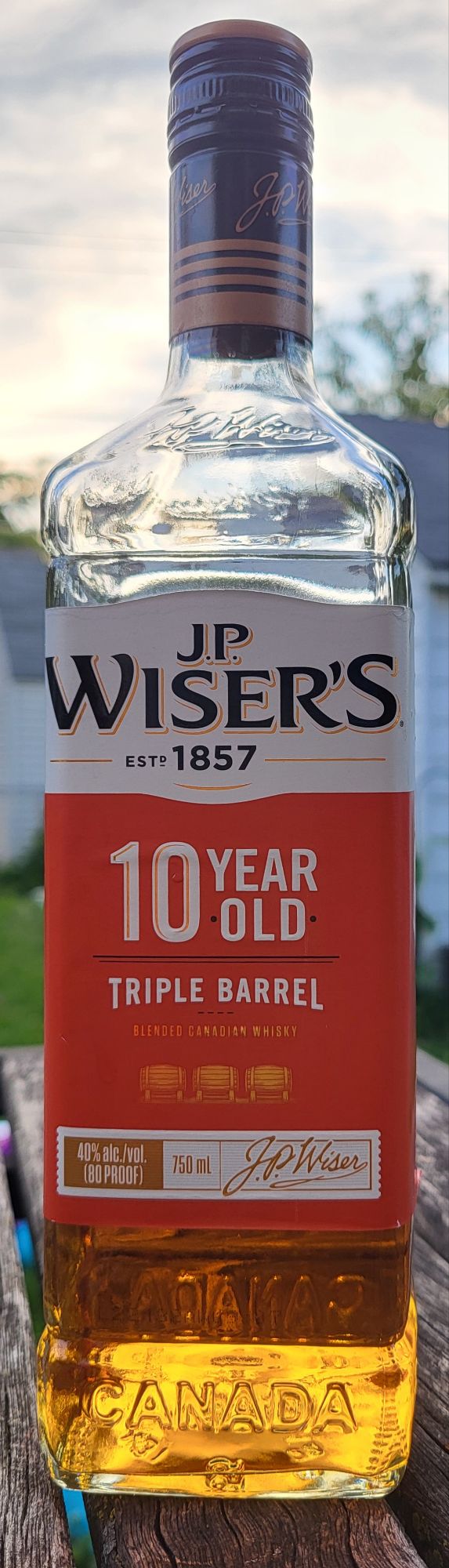
Style: Blended Canadian Whisky (blend of corn and rye), aged in new oak, ex-bourbon, and ex-Canadian barrels.
Age: 10 y/o.
ABV: 40%
Michigan state minimum: $25
Appearance: Orangy copper.
Nose: Roasted grain, leather, thyme, grape soda.
Palate: Full-bodied and creamy. Bourbon, vanilla custard, heat.
Finish: Anise, roasted sweet corn.
Mixed: Adequate in an old fashioned, but best neat or on the rocks.
Parting words: As long-time readers know, I’m a big fan of Wiser’s entire line of whiskies. It’s made at the biggest distillery (by far) in the Detroit Metro area, so even though it’s technically an import, drinking Wiser’s still counts as drinking local.
Anyway, this is a very fine sipper for the price. As I said above, and as the website recommends, Wiser’s 10 is best consumed neat or on the rocks. Its delicate, elegant personality can easily fall victim to bullying by strong mixers. It even had trouble standing up to the Angostura bitters in the Old Fashioned I’m currently nursing.
What better way to celebrate Canada Day than with a Glencairn of Wiser’s 10, a flavorful, balanced, and affordable whisky that represents some of the best spirits Canada has to offer. Wiser’s 10, Triple barrel is reccomended.
Maker: Jim Beam, Clermont, Kentucky, USA (Suntory)
Style: Rye recipe bourbon.
Age: 12 y/o
Proof: 100 (50% ABV)
Michigan state minimum: $70
Appearance: Dark Copper.
Nose: Charred oak, leather, old wet lumber.
Palate: Brown sugar, acorns, burn. Water brings out a little more complexity, adding eucalyptus and clove.
Finish: Hot and oaky.
Parting words: The standard 9 y/o Knob Creek has been one of my favorite bourbons for many years. I love it because it’s easy to find, high proof, affordable ($37 in Michigan), and mature but not over oaked. To my palate, 6-9 years is peak maturity for most bourbons. Exceptional ones, or ones aged on the ground floor of the rickhouse can go longer, but for most, 6-9 is the sweet spot. Before that, the whiskey can be rough and uncouth. After that, it can become one dimensional and fall into the “beaver bourbon” category, a term I coined to describe bourbons that only a creature accustomed to chewing on trees could enjoy.
Unfortunately, Knob Creek 12 is a product for the beaver market. Oak isn’t the only thing going on here, but it dominates the palate, nose, and finish. I had hoped that a distillery with stocks the size of Beam’s would be able to select a few balanced barrels for this expression, but apparently not. I can’t imagine what the newer 15 and 18 y/o expressions taste like. Even the beavers might object at that point.
If you’re the type who like a woodier bourbon, you might enjoy this, but I did not. The price isn’t too bad, considering what some bourbons at half the age go for the days, but Knob Creek 12 y/o old is still not recommended.
Parting words: This is the final bottle from Nathaniel Rose that will make an appearance in our 2012 project on aged Michigan wines from the 2012 and 2013 vintages. Thanks again to Nathaniel for the bottle.
Blending Syrah and Viognier may seem strange at first, but it’s actually been done in the Northern Rhone valley for quite some time. It stabilizes the color of the wine through the magic of chemistry, and it has an impact on the taste and smell of it too, of course. Nobody online seems to agree on that impact, though. Based on this wine, I would say it adds an aromatic fruitiness that balances out the classic robust spice of Syrah.
I would not put this on a level with Nathaniel’s other reds, like the Left and Right Bank blends, or his double barrel Syrah. It’s not as complex as those. Nevertheless, it’s a very good wine, and worth seeking out. It’s held up very well, too. Nathaniel Rose Syrah LaBlonde 2013 is recommended!
Maker: CJS Beverage Corp, New York, New York, USA.
Distilled: Castle & Key, Frankfort, Kentucky, USA.
Aged at Kentucky Artisan, Crestwood, Kentucky, USA.
Style: Rye recipe Kentucky Straight bourbon.
Mashbill: 75% corn, 15% rye, 10% malt.
Age: 3 y/o
Proof: 101.48 (50.74% ABV)
Purchased on sale for $30 at Vine & Table.
Appearance: Light copper.
Nose: Caramel apple, roasted almonds.
Palate: Sweet, and medium bodied. Fruity with green apple, then some berries, then burn. Water tames the burn.
Finish: Minty with a little blackberry.
Parting words: This is the “flagship” Pinhook release. Like every other Pinhook release, this one is paired with a racehorse. This is for marketing, not culinary, purposes. This 2023 release is paired with Bourbon Resolve, a fairly successful stallion born in 2020. So far his best finish was first at Keeneland in April of 2023. He’s earned around $111,000 so far. Pinhook is hardly the first bourbon brand to use horses in its marketing, and I’m sure it won’t be the last, but it’s currently the most specific.
Anyway, enough about the dang horse. The bourbon is only three years old, but, aside from a dimly remembered Willett release, this is probably the best 3 y/o bourbon I’ve ever had. That’s not the highest of praise, but it’s not nothing. It’s fruity, which isn’t something one encounters much in bourbon anymore. It’s best on the rocks, but does fine in an old fashioned, and with a splash of water.
As corny as the horsey gimmick is, I expected to be annoyed by this, but it was actually pretty good for the price. Pinhook Bourbon Resolve/orange wax/flagship/whatever is recommended.
Age: 6 y/o (distilled autumn 2016, bottled January 26, 2023)
Warehouse/Floors: See photo below
Proof: 100 (50% ABV)
Michigan State Minimum: $60
Appearance: Medium reddish copper.
Nose: Spicy, with roasted corn, and a bit of caramel.
Palate: Caramel and amaretto chews, rock n rye soda, then cayenne. Water tames the spice and brings the sweet candy flavors to the fore.
Finish: Salted caramel, burn.
Parting words: The bourbon boom has seen a lot of new distilleries appear on the scene, and the last few years have seen the rise of a number of distilleries with promising futures, like (the new) Yellowstone, New Riff, Wilderness Trail, Woodinville, and many others. These folks are putting out great whiskeys right now, and are only getting better.
Something that has also happened is that a few old distilleries around the country have jumped back into the bourbon game, by releasing their own, new products. Ross & Squibb (FKA LDI/MGPI) is one example of that, and McCormick is another. When I first became interested in American Whiskey, I got to know McCormick as the making of Platte Valley corn whiskey, which comes in those distinctive stoneware jugs that used to have a cartoon Hillbilly on them. At 80 proof, it’s a bit weak, but a decent sip on a hot summer Saturday evening.
McCormick saw other distillers getting rich and asked themselves, “Why not us?” They already had the still, the corn, and the warehouses after all. They even found a historical mascot, Ben Holladay, a 19th century transportation mogul (hence the stagecoach) with ties to the distillery for the brand, So they distilled and aged some bourbon and released Ben Holladay Missouri Straight Bourbon Whiskey to the world in spring of 2022.
I had always assumed that Weston must be on the west bank of the Mississippi, just a stone’s throw from the Kentucky border. It’s not. It’s in the opposite part of the state on the northern edge of the Kansas City metro area. That makes it about 600 miles from Bardstown, Kentucky, and about 500 from Owensboro. The town’s population is about 1,700 people, which is not too different when the distillery was founded in 1856.
Missouri Straight Bourbon whiskey has more stringent standards than its Kentucky cousin. It must be made of corn grown in Missouri, and aged in a barrel manufactured in the state as well. That’s in addition to the requirements to mash, ferment, and distill instate.
Anyway, I like Ben Holladay 6 y/o. It’s sweet and spicy and mixes well too. My only complaint is the price. A bourbon from a venerable producer like McCormick shouldn’t be as pricy as a micro-distiller’s. That said, there are younger, less sophisticated bourbons being sold at twice the price right now, so I guess $60 isn’t too bad, but it could still be better.
Produced for Costco by Peyrat (negociant), Cognac, Charente, France.
Distiller(s): Undisclosed.
Region: Cognac.
Age category: XO (at least 10 y/o). Label says spirit is at least 12 y/o.
ABV: 40%
Michigan State Minimum: $75
Appearance: Shiny auburn.
Nose: Toasted oak, anise.
Palate: Full bodied and silky. Toasted almond, dried apricot, date, white pepper.
Finish: Nutty and oaky, with smoldering embers in the back.
Parting words: When I first tried Kirkland’s XO Cognac years ago, I didn’t care for it. I thought it tasted too woody. As the years passed, I drank more brandy and got a better idea of what to expect, so I decided to give it another shot, as it were.
Maybe my palate has changed, or the Cognac has changed, but I like it a lot more now. It’s nothing earth-shattering, but it’s a pretty good brandy at a pretty good price (for an XO). I like it by the fireplace on a cold day or the firepit on a summer evening. Given its affinity for smoke it would probably be good with a cigar, if that’s your thing.
Palate: Full bodied and sweet. Caramel, chocolate covered cherries, heat. Water takes away the heat, but leaves the candy behind.
Finish: Dry and tingly. Oak, hot chilis. Much the same with water, but a little nutty too.
Mixed: At $50 a bottle, I’m hesitant to mix this, but it did well in an old fashioned.
Parting words: This is the first Bardstown Bourbon Company product I’ve reviewed. I almost took a tour there once with my Georgia Bourbon Society comrades (I was named president of the Mitten Chapter), but I had a conflict, so I missed out.
That was before BBC had released any of its own product. I heard the tour was great, but, frankly, I wasn’t too interested in them back then. The point at which I begin taking micro distillers seriously is usually at the point when they release a bonded whiskey (or brandy or whatever). Bottled-in-Bond (from the company’s own distillery) is the test to make it into a regular spot in my liquor cabinet. If you can do that well then you’ve proven that you are worth my time.
BBC has done it well. They’ve actually done it better than they needed to. This six year old tastes like an eight year old from a large distillery. The depth of flavor and complexity was a big, welcome surprise. You can mix it or drink it on the rocks and it will be just fine, but it’s best neat or with a little water.
The entirety of BBC’s line is currently in the Michigan price book. That includes the Origin (100% BBC distilled), Discovery (BBC + sourced whiskey), Collaborative (finished), Distillery (collaborations?), and Fusion (marriage of different mashbills) series. Origin is the most affordable, which is convenient because it’s the series I’m most interested in. The Collaborative series interested me before I saw the prices. Paying well over $100 for finished, sourced whiskey doesn’t make a lot of sense to me.
At any rate, THIS bourbon is reasonably priced for its quality and proof. Bardstown Bourbon Company Origin Series, Bottled-in-Bond is recommended!





 Sipology