Benchmark Bonded

Maker: Buffalo Trace, Frankfort, Kentucky, USA (Sazerac).
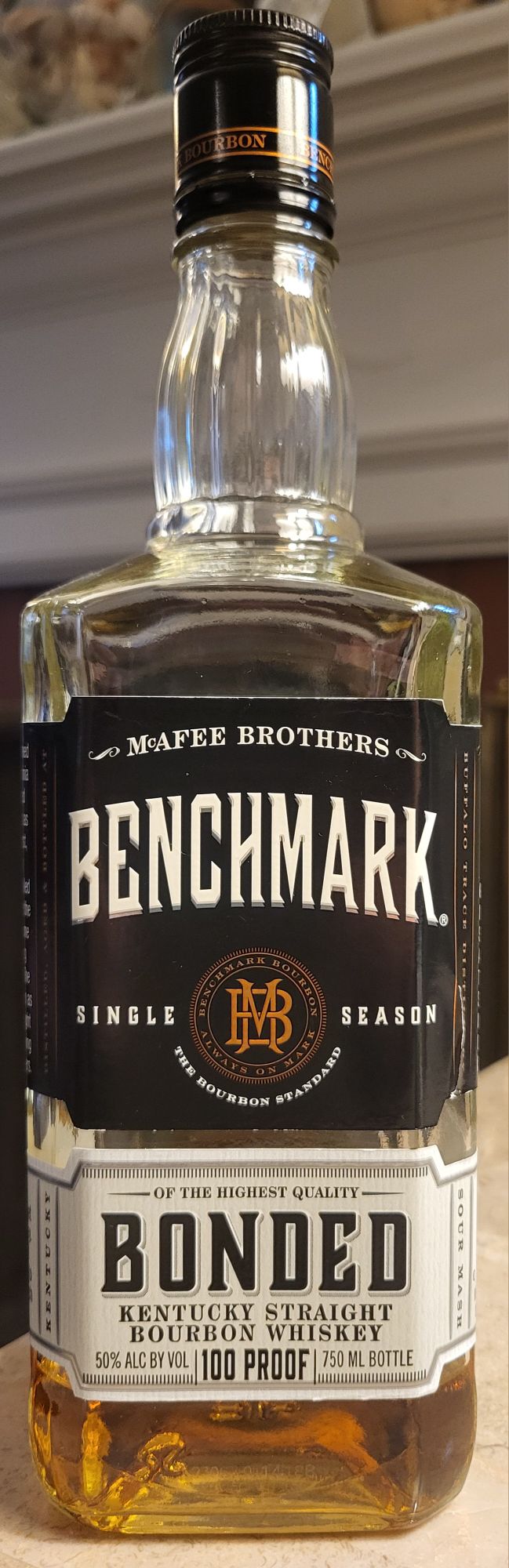
Style: High corn bonded bourbon (BT Mash bill #1).

Age: At least 4 y/o (by straight & bonded regulations)

Proof: 100 (50% ABV)

Price: $20 (Binny’s)

Appearance: Copper.

Nose: Ghost pepper, overdone creamed corn.

Palate: Full-bodied and sweet. Caramel, grape soda.

Finish: Hot with a little char.

Mixed: OK in every cocktail I tried it in, but unremarkable.

Parting words: Benchmark had been a punchline for me for many years. The “Old No. 8” is, to me, the worst bottom shelf bourbon available from a major distiller, with the possible exception of Ten High. I joked about it frequently in the old forum days. I never blogged about it for that reason, although it may have been worth it just for the mental exercise of coming up with gross tasting notes.

This bonded version isn’t too bad, though. I do struggle to justify buying it over, say Evan Williams white label at around the same price or Early Times BiB and Very Old Barton 100 proof at an even lower price. Plus it’s not even available in Michigan at the moment.

In the end, Benchmark Bonded is a decent mixer, but there’s not much of a reason to seek it out. It’s mildly recommended.

1792 Full Proof, Single Barrel Select, Red Wagon Shoppe.

Maker: Barton 1792, Bardstown, Kentucky, USA (Sazerac)

Style: Rye recipe straight bourbon whiskey (high malt?)

Age: NAS (I don’t remember if the store disclosed the age), but at least four years old.

Barrel #8683

Proof: 125 (62.5% ABV)

Michigan state minimum for 1792 Full Proof: $47

Tasted with a splash of water (don’t be a hero when it comes to 125 proof bourbon)

Appearance: Dark copper.

Nose: Dark caramel, charred oak, Habanero chili.

Palate: Full-bodied and semi-dry. Caramel, white pepper, anise, allspice.

Finish: Dry with some sweet heat.

Parting words: This is my first review of any kind of Full Proof 1792. I did review 1792 Single Barrel from the pre-divorce Red Wagon alongside a selection from the Rural Inn. I believe that last bottle of Full Proof I owned, however, was a selection from the Rural Inn. It tasted good, but I always got a wicked headache afterwards. I’m not sure why, but unchill-filtered bourbons have a tendency to do that to me.

No such complaints for this Red Wagon (Rochester Hills) selection, though. It has big caramel flavors with some holiday spice in the background. It’s not particularly complex, but with a splash of water, it’s a very nice winter or autumn sipper. $47 isn’t chump change, but when the high proof is factored in, it’s a pretty good deal, especially compared to how much microdistiller or Potemkin distillery products go for these days. Red Wagon selections almost never disappoint. Full Proof 1792 Red Wagon Shoppe, Single Barrel Selection barrel #8683 is recommended!

Kirkland Bottled-in-Bond: Barton 1792

Maker: Barton 1792, Bardstown, Kentucky, USA (Sazerac)

Style: Bonded rye recipe (high malt?) bourbon.

Age: At least 4 y/o.

Proof: 100 (50%) ABV

Michigan State Minimum: $36/1 liter (works out to $27/750 ml)

Appearance: Medium copper.

Nose: Alcohol, five spice powder, dark caramel, velvet.

Palate: Medium-bodied, semi-dry. Caramel, thyme, oak, white pepper.

Finish: Dry and lightly woody.

Mixed: Good with Benedictine, and in a Manhattan.

Parting words: I reviewed the Kirkland Small Batch last summer. Back then I expressed my hope that the bonded would come in soon. It came in a few weeks after that and I got three bottles. Unfortunately I wasn’t able to review it until today, and even more unfortunately, I’m only down to one more bottle.

As one would expect, this is a step up from the Small Batch, though not nearly as much as I had hoped. There’s more complexity and depth, for sure. The cinnamon candy had been replaced with five spice, and there’s more caramel and tannic grip to it. It cleans up nicely compared to its Small Batch sibling, but it’s still not quite what I would call elegant. I would rank it below Very Old Barton and 1792 bonds, but just barely.

Still, for a store brand at this price, it lives up to expectations. It’s good in traditional cocktails, but like the Small Batch, it’s at its best on the rocks. If this one every comes around again, buy it.

Kirkland Bottled-in-Bond: Barton 1792 is recommended.

Final parting note: I took the Pepsi Challenge with this (diluted to 90 proof), Very Old Barton 90 proof, and 1792 Full Proof (diluted to 90 proof) to attempt to determine which mashbill the Kirkland BiB was: VOB or 1792/Kentucky Tavern (supposedly a high malt bourbon). I’m only about 67.924% sure, but I think the current Kirkland BiB was made from the 1792 mashbill. It has a certain spicy, burnt note on the palate and finish that bears a resemblance to it. If I am ever able to get a hold of the Single Barrel (which is in the current price book, but I have not seen on a shelf), I will attempt the same exercise.

Kirkland Small Batch: Barton 1792

Maker: Barton 1792, Bardstown, Kentucky, USA (Sazerac)

Style: Standard recipe straight bourbon.

Age: NAS (at least 4 y/o)

Proof: 92 (46% ABV)

Michigan state minimum: $28/1 liter. Comes out to $21/750 ml

Appearance: Shiny copper.

Nose: Pretty hot for a 92 proofer. Cinnamon imperials, baking spice.

Palate: Cinnamon disks, cayenne pepper, oak.

Finish: More candy notes, but some oaky tannin and caramel.

Parting words: When Costco announced that they were going to be releasing a new line of Kirkland bourbons, all distilled at Barton 1792, I was excited, even though there were some who shrugged their shoulders. As you know, dear readers, I love Very Old Barton. Unfortunately, it’s highly allocated in the Great Lakes State where I live. As much as I love it, I find it hard to motivate myself to drive all over the metro area looking for a $14 bourbon. Kirkland Small Batch is slightly easier to find, but at least it comes in bigger bottles.

The question on my mind when this line was announced was which recipe was going to be used for it, Barton or the high malt 1792 recipe. After spending a couple months with this bottle, I can firmly say that I have no idea. If pressed on the matter, I would say Barton, given the sweetness and spice.

Either way, this is pretty much what I expect in a $21 bourbon. Some oak and spice, but a little thin. Strangely enough, I actually like this bourbon better on the rocks. Everything seems to be much more harmonious and integrated.

At any rate, Kirkland Small Batch: Barton 1792 is recommended! I really hope my local Costco gets some of the Bottled-in-Bond, or Single Barrel in soon!

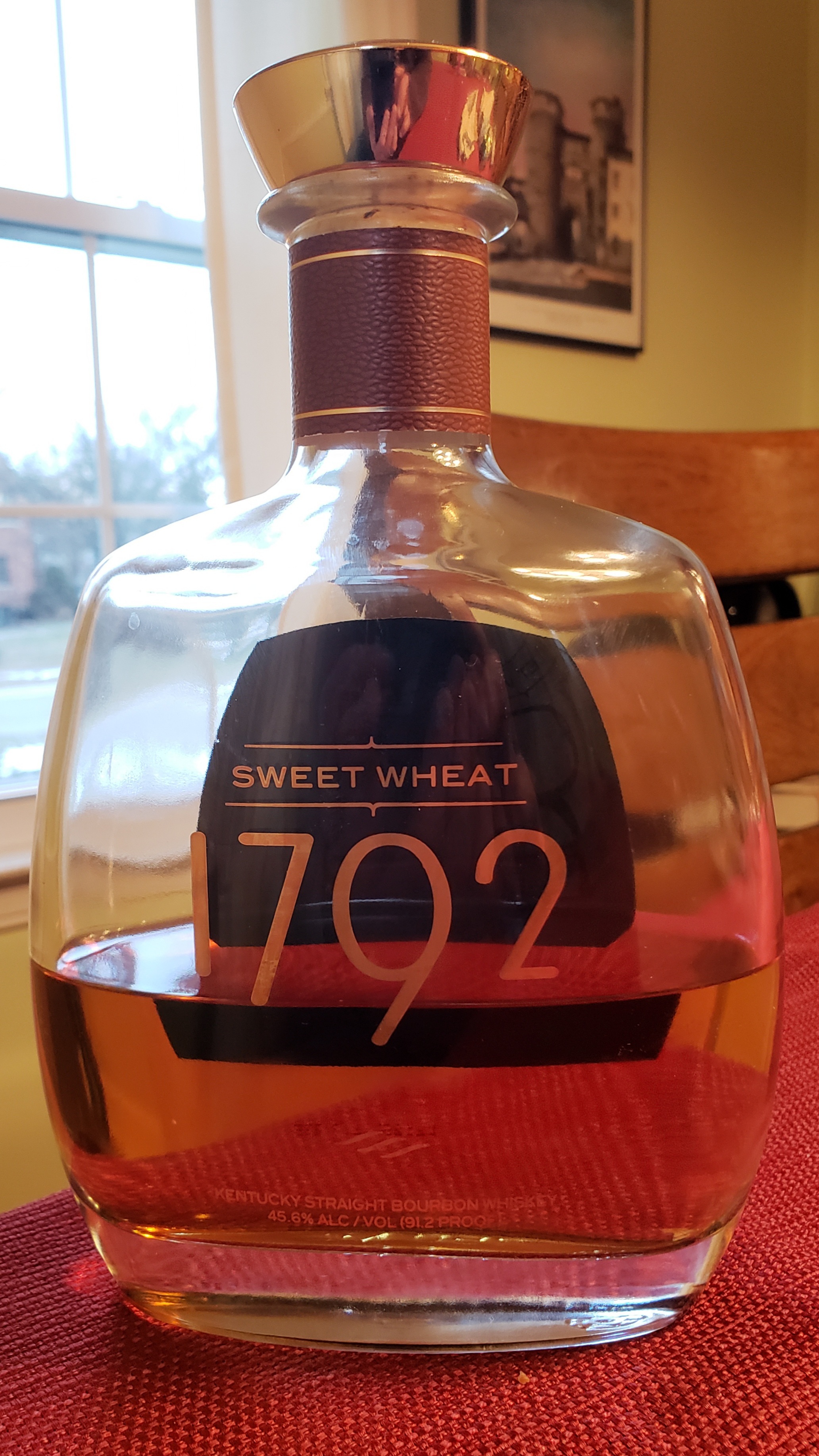
1792 Sweet Wheat

Maker: Barton 1792, Bardstown, Kentucky, USA (Sazerac)

Style: Wheated Straight Bourbon

Age: NAS (at least 4 y/o)

Proof: 91.2 (45.6% ABV)

Michigan state minimum: $36 (listed as “SWEAT WHEAT”)

Appearance: Medium copper.

Nose: Alcohol, vanilla, apricot, char.

Palate: Full bodied and sweet. Crème brûlée with apricot and vanilla bean.

Finish: Short and drying.

Parting words: 1792 Sweet Wheat is an extension of the 1792 Bourbon line of (originally) high malt bourbons. It is presumed by people who have looked into these sorts of things (like me) that it is the same recipe as the old Kentucky Tavern bourbons. Constellation took this recipe and used it to create 1972 back when it owned the Barton Distillery. When Sazerac bought the distillery, they gave the bottle a makeover and created a number of line extensions, the most successful of which have been the barrel proof and single barrel expressions.

Sweet Wheat is a different beast from those, though, because the recipe has been changed. The rye has been swapped out for wheat, putting it into the same category as Maker’s Mark, Larceny, Weller, and the notorious Van Winkle bourbons. It fits somewhere between Maker’s and Larceny/Old Fitzgerald in terms of flavor. It’s not as delicate as Maker’s and Weller, but not quite as sharp and yeast-driven as the Heaven Hill wheaters. I like it a lot at $36, but I like it less at what I paid for it.

If you can find it for <$45, buy it. Any more than that, and you’re overpaying. 1792 Sweat, err Sweet, Wheat is recommended.

Thomas S. Moore, Cabernet Sauvignon cask finish

Maker: Barton 1792, Bardstown, Kentucky, USA (Sazerac)

Style: Rye-recipe bourbon finished in Cabernet Sauvignon casks.

Age: NAS (at least 4 y/o)

Proof: 95.3 (47.65% ABV)

Michigan state minimum: $70

Appearance: Ruddy brown.

Nose: Overdone cherry pie, particle board, alcohol, anise.

Palate: Full bodied. Cherry juice, oak, then burn.

Finish: Cherry vanilla ice cream, alcohol.

Parting words: Sazerac has done a lot with the Barton distillery in Bardstown since they purchased the distillery from Constellation in 2009. The latest thing is the Thomas S. Moore line of wine barrel finished bourbons.

I’m not a purist when it comes to finished bourbon. I think a finish can be a nice addition to bourbon when applied judiciously and when the underlying bourbon is good quality. Fortified wine finishes are pretty common with whiskeys of all kinds, so I thought I’d try the Cab Sauv finish first. The finish adds some fun, fruity notes, but they’re quickly overcome by an underlying unrefined harshness. Water reduces the heat, but the harshness remains. It reminds me of going to my senior prom. I was wearing a tux and a sporting a fresh haircut, but underneath I was the same crude, rude teen.

If this were $20 cheaper, this harshness might be easier to overlook or I could write it off as an interesting mixer, but $70 is serious money for a bourbon from a major distiller. Sazerac can do better than this.

While I’m at it, I might as well mention the bottle and label, which are worse than what’s inside. The two tone horse picture, disjointed graphic design, and ugly, generic bottle, makes Thomas S. Moore look more like a prop from a mid-century movie set than a 21st century high-end bourbon.

Thomas S. Moore, Cabernet Sauvignon cask finish is not recommended.

1792 Bottled in Bond

Maker: Barton 1792, Bardstown, Kentucky, USA (Sazerac)

Style: High malt (?) bonded bourbon.

Age: At least four years old (all from one distilling season).

Proof: 100 (50% ABV)

Michigan state minimum: $38

Appearance: Medium copper.

Nose: Roasted corn, sweet malt, cayenne powder.

Palate: Cola, alcohol. With water. Caramel, cola, less burn.

Finish: Sweet and custardy. Sweet cola (yes again) with melted ice cubes.

Parting words: For many years, the Bottled-in-Bond category was a guarantee of quality among American whiskeys. Then, when I was getting into the hobby, it was most common as a sign of a good value. The pendulum has swung back a bit these days and premium bonds are making a comeback. The new, pricey Old Fitzgerald and Heaven Hill BiBs, Henry McKenna, and now 1792.

I like the standard expression well enough, and I have really enjoyed the single barrel and barrel strength editions I’ve had. Sadly, the Bottled-in-Bond doesn’t live up to those. It’s not bad, it’s just not enough of an improvement on the Small Batch to warrant $8 more dollars and the hard work of trying to locate a bottle. Ironically, it may be hampered by being bonded and restricted to one distilling season. There’s a lack of complexity that the addition of older bourbon might be able to fix.

1792 Bottled-in-Bond is only mildly recommended.

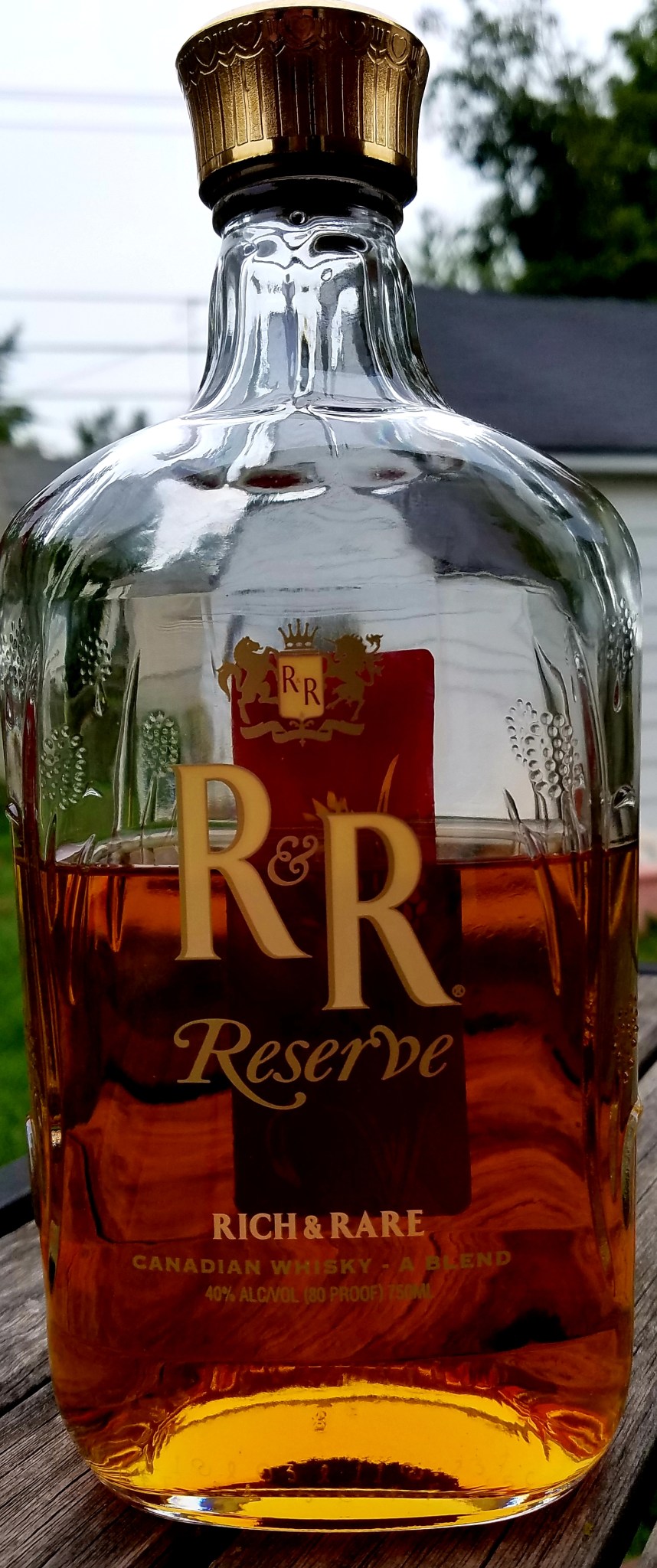
R & R Reserve

Distillery: Unknown. (Hiram Walker? Brand owned and bottled by Sazerac).20180907_191155.jpg

Style: Canadian blend.

Age: NAS (at least 3 y/o)

ABV: 40%

Michigan state minimum: $10

Appearance: Bright copper.

Nose: Alcohol, rye toast, grilled sweet corn.

Palate: Full-bodied and round. Creamed corn, burn, a touch of oak.

Finish: Burn, Red Pop, tiny touch of oak.

Mixed: Did well with Ginger ale, on the rocks and in an Old Fashioned.

Parting words: When I was writing this review, I went back to look at my notes on Rich & Rare to compare the two. What I noticed was that I forgot to write the tasting notes and only had the basic information and parting words. I dug into the depths of my tasting notebook and found my R & R notes and I have now updated that post.

Ahem. So, how does it compare? R & R was heavy on the dessert notes, especially vanilla and butterscotch. R & R Reserve is more balanced and has much more rye character and fruit than its cheaper sibling. R & R R is better suited to sipping than R & R, but R & R R mixes just as well or maybe even better. So while R & R is a good value, it’s worth your while to lay down an extra $2.50 for the Reserve.

The bottle is very pretty too, for what it’s worth. R & R Reserve is recommended.


Buffalo Trace, Holiday Market Selection

Maker: Buffalo Trace, Frankfort, Kentucky, USA (Sazerac)

Retailer: Holiday Market, Royal Oak, Michigan, USA

Age: NAS (true age unknown, but at least 4 y/o by law)

Proof: 90 (45% ABV)

Michigan state minimum: $27

Appearance: New penny.

Nose: Tabasco sauce, copper penny, allspice.

Palate: Full-bodied and round. Marshmallow, caramel, alcohol.

Finish: Caramel, burn.

Parting words: It’s been a while since I reviewed BT selections, but I really should do more. BT, even the standard remains a good value for sipping and mixing from a distillery best known for Pappy, Elmer T. Lee, George T. Stagg and other overhyped, often overpriced bourbons.

This selection reminds me a little of the Binny’s selection I reviewed in the link above. Marshmallow is the dominant flavor, although here its less roasted. The flavor is not assertive enough to make itself known in cocktails with strong mixers, but it does well enough. Buffalo Trace, Holiday Market Selection is recommended.

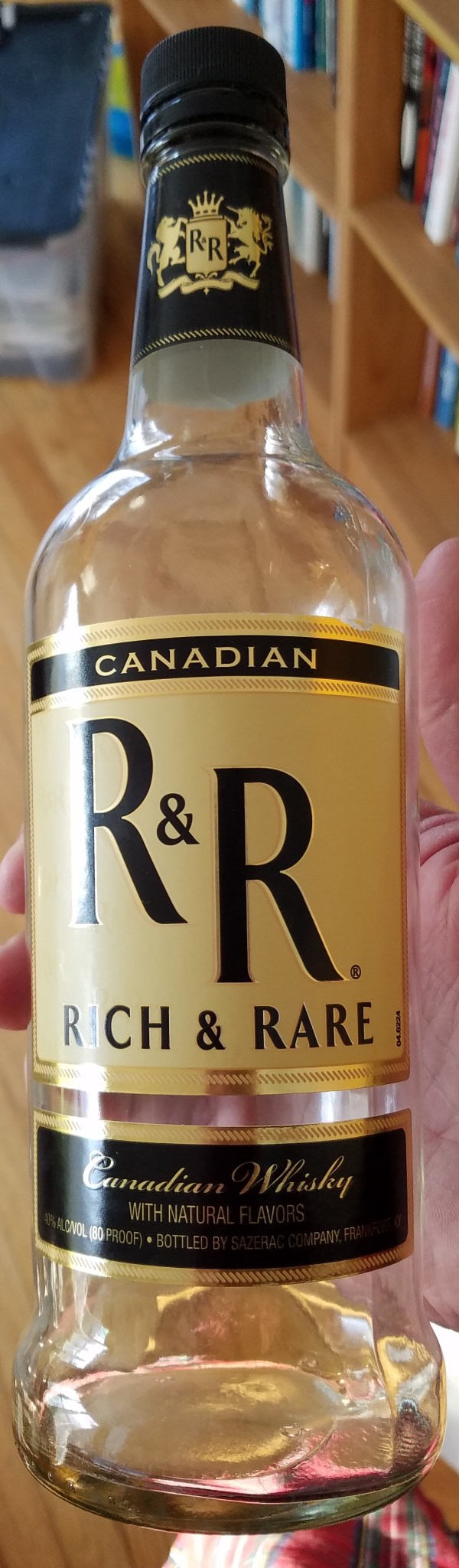
Rich & Rare

Distillery: Unknown. (Hiram Walker? Brand owned and bottled by Sazerac).20180105_160402.jpg

Style: Canadian blend.

Age: NAS (at least 3 y/o)

ABV: 40%

Michigan state minimum: $7.50

Appearance: Medium copper.

Nose: Caramel blondies, tarragon.

Palate: Medium-bodied. Hard toffee, alcohol, vanilla.

Finish: Creamy. Cherry juice drink.

Mixed: Did very well mixed. Brings fruit and vanilla to Manhattans, old fashioneds and even eggnogg. I didn’t care for it with ginger ale or on the rocks for that matter.

Parting words: Rich & Rare is a pretty old brand. It was founded in the 1920s by Harry Hatch of the Godderham and Worts distillery in Toronto. G & W stopped distilling whisky in 1950 and R & R was moved to the Hiram Walker plant in Windsor. Sazerac now owns the brand, but chooses not disclose the distiller. It seems reasonable to assume that it’s still being made at Hiram Walker, though.

I was pleasantly surprised at how good R & R was straight and in classic cocktails. In the <$10 category, Canadian blends tend to fall into one of two categories. Either they’re flavorless or have a sappy pungency that resembes burnt creamed corn or kitchen garbage that should have been taken out two days ago. R & R has a bit of that pungency, but it’s kept in check by vanilla and fruit. The result is a wonderful, full-bodied (and cheap) sipping and mixing whisky. H2O is not R & R’s friend, though, causing the whisky to virtually disappear. It can be a little hard to find here in Canadian Club country, but it’s worth picking up. There is also a Rich & Rare Reserve (R & R R) available for $2.50 more in Michigan that I hope to review soon. Rich & Rare is highly recommended.