Place of origin: Niagara Escarpment VQA, Ontario, Canada
Vintage: 2015
ABV: 13%
Price: $12.50 USD ($17 Canadian, LCBO)
Appearance: Dark burgundy.
Nose: Black pepper, earth, blackberry jam, peony.
Palate: Semi-dry and full-flavored. Reminiscent of Cru Chénas or Cru Juliénas. Earthy but fruity. Blackberry, mushroom.
Finish: Tart with a little spice. Fades pretty quickly.
Parting words: This is the last wine I have left from my last trip to the LCBO a few months ago. It was a part of my effort to give myself a crash course in Gamay. I expected it to be similar to the Gamay produced by Chateau Grand Traverse or Hawthorne on Old Mission Peninsula in Northern Michigan, but it was not like those at all. Cave Spring’s was fruity but “darker” and spicier than I expected. I found that quality off-putting at first, but I grew to enjoy it over the time it was open. That’s where the comparison to Chénas comes in. I remember the first time I tasted one, I was shocked at how unlike it was from any other Beaujolais I had tasted before. I was intrigued, though, and at that moment began planning the crash course.
At any rate, this is a Gamay that one can easily drink with any sort of cuisine and at $12.50 (plus border toll) it’s affordable enough to be in weeknight rotation. 2015 Cave Spring Gamay is recommended.
Maker: Domaine Berrien, Berrien Springs, Michigan, USA
Grape: Vignoles (at least 85%)
Vintage: 2015
Place of origin: Lake Michigan Shore (Berrien Springs)
Style: Semi-dry
Purchased for $16 from Michigan by the Bottle, Royal Oak (Sipper Club)
Appearance: Bright gold.
Nose: Honey, camomile, lychee.
Palate: Semi-dry and medium bodied. Peach nectar (without the sweetness), mineral water, woodruff.
Finish: Strong lychee, drying.
Parting words: Vignoles is one of what I have dubbed on Twitter the “noble hybrids”, hybrid wine grape varieties that are capable of being good even when bottled as a varietal. The others on my list are Traminette, Chardonel, Vidal Blanc, Chambourcin and Baco Noir.
Vignoles is often made in a sweet style but also does well in dry and off-dry styles, as in this wine. It’s not complex, but is very pleasant with food or for Saturday afternoon sipping any time of year. 2015 Domaine Berrien Vignoles is recommended.
Parting words: There are a lot of wineries located in tourist areas in Michigan. Some of them are bad and serve no purpose other than to suck money from the wallets of tourists with garbage palates. Some are ok and take care to produce enjoyable, accessible table wines. Others are more ambitious and seek to join the ranks of their more established cousins in Northwest and Southwest Michigan. Blue Water is one of those. They haven’t always been successful, in my opinion, but they continue to try to produce fine wines with varietal and terroir character.
This unoaked Chardonnay is one of their successes. It has loads of fruity Chard character, is well-balanced, and is great with chicken and vegetarian meals. Blue Water Winery Unoaked Chardonnay is recommended.
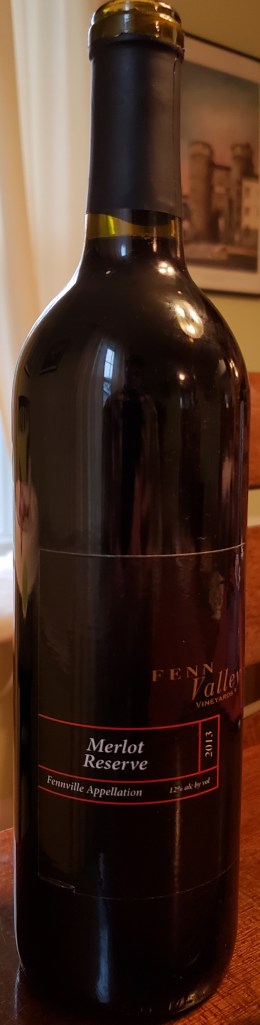
Maker: Fenn Valley Vineyards, Fennville, Michigan, USA
Grape: Merlot (at least 85%)
Place of origin: Fenn Valley estate, Fennville AVA, Lake Michigan Shore, Michigan, USA
Vintage: 2013
ABV: 12%
Purchased for $22 (winery)
Appearance: Dark reddish-purple.
Nose: Blackberry pie, clove, oak.
Palate: Medium-bodied and mostly dry. Baking spice, blackberry, mulberry.
Finish: Crushed blackberry, toasted oak.
Parting words: Fennville is Michigan’s only sub-appellation. It’s as old or older (sources conflict) than its parent AVA Lake Michigan Shore. It’s essentially a one winery appellation. That winery is Fenn Valley. It’s to the north and west of the big wineries in LMS, so it doesn’t get the same traffic as the others, but it’s very much worth a trip up the road to Fennville or to the tasting room in Saugatuck. Those are the only place one can reliably find Fennville wines. Judging by this one, it’s a prime spot.
This wine is a classic cool-climate Merlot. It has the chewy fruit one expects from Merlot, but with that cool climate (and cool vintage) tang that brings it all together and makes it a perfect match with pork chops, roast duck or sirloin steak. At $22, it’s worth every dollar and more. 2013 Fenn Valley Merlot Reserve is highly recommended.
Place of origin: Lake Michigan Shore AVA, Michigan, USA
Vintage: 2013 (harvested October 6)
ABV: 20%
Purchased for $18 (Winery, received media discount)
Appearance: Pale lemon.
Nose: Funk, lychee, fresh Bartlett pear.
Palate: Full-bodied and dry. Limestone dust, bitter apple, pinch of ginger, cardamom.
Finish: Lychee. Fades fairly quickly.
Parting words: It would be weird to call this an Alsace-style Traminette, since Traminette is a hybrid, but that’s kind of what this is. Gewurztraminer is one of parents of Traminette, so it’s not really too much of a stretch. It has the body, funk and dryness one expects from Alsatian Gewurz. I was taken aback by those characteristics when I first opened the bottle but they grew on me quickly.
This wine comes from a batch of “wild fruit” Nathaniel was able to obtain and bottle. Its label is obviously inspired by the greatest educational DOS game of all time (sorry Number Munchers), Oregon Trail. Nathaniel always thought that finding wild fruit was the most interesting thing that happened on that game, so when he came accross some Traminette, he thought this label would be the perfect tribute to one of his favorite gaming moments.
This is a great wine from a great winemaker at a fair price. Find Wild Fruit Traminette is highly recommended. For more on Nathaniel’s operation see my visit to him here.
Palate: Medium bodied and a little chewy. Fruit of the forest pie, vanilla, clove, aniseed.
Finish: A little sweetness and tannin in the cheeks.
Notes: Received complementary tour, free tasting and press discount at time of purchase. Grapes harvested October 21, 2013 at 20.5 brix. In French oak for 20 months.
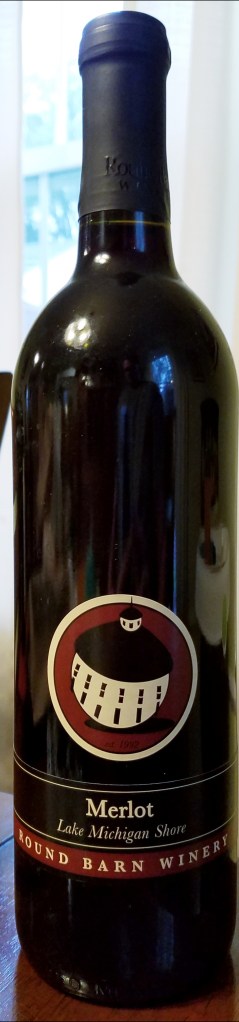
Parting words: Merlot isn’t a grape that is very closely associated with Michigan but it does pretty well here, especially (but not exclusively) in the LMS AVA. It is often used in red blends where it serves to balance out the bold, savory flavors of the widely grown Cabernet Franc, which I suspect may be rounding out the blend here.
Vintners will tell you that 2013 was a tough vintage in Michigan, mostly on account of it being a cool one, but that doesn’t mean there wasn’t a lot of very good wine made. Wines of 2013 in just took a little longer to mature than their 2012 (or 2016) compatriots. As a result, the 2013 Bordeaux variety reds are hitting their stride now, so dig into your cellar and drink up now!
This wine has the cherry and berry flavors one expects from Merlot, but with a touch of pork (yes, I know that sounds like a Pigs in Space porn parody) and spice with judicious use of oak. The price is too high, but not so high that I feel like I need to wag my finger at the folks in the Barn by only giving this a mild recommendation. 2013 Round Barn Merlot is recommended.
Maker: Good Harbor Vineyards, Lake Leelanau, Michigan, USA
Grape: 100% Marechal Foch
Place of origin: Good Harbor estate, Leelanau Peninsula AVA, Michigan, USA
Vintage: 2016
ABV: 11.7%
Purchased for $16 (winery)
Appearance: Very dark for a rosé. More light ruby Burgundy than pale Provançal pink.
Nose: Grape jelly, crushed mulberry.
Palate: Cherry soda, allspice.
Finish: Sweet and fruity.
Parting words: This is a simple but very tasty wine. It’s very fruity but not overly sweet. Goes down easy with food or on its own. I haven’t had a lot of Foch, but I think maybe the world needs to see more of it, at least in pink.
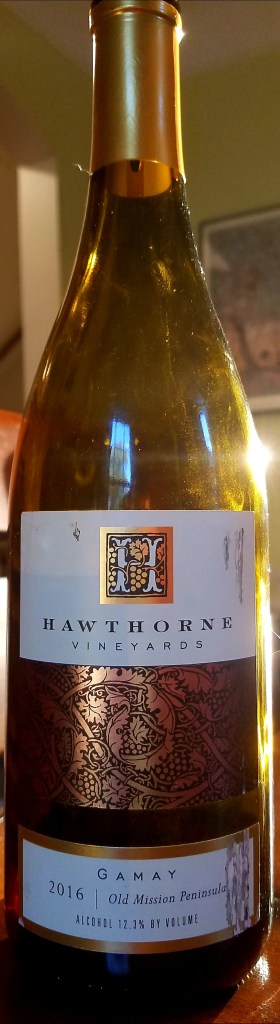
Maker: Hawthorne Vineyards, Traverse City, Michigan, USA
Grape: Gamay (at least 85%)
Place of origin: Old Mission Peninsula AVA, Traverse City, Michigan, USA
Vintage: 2016
ABV: 12.3%
Purchased for $14 (Meijer)
Appearance: Translucent ruby.
Nose: Fruit punch, toasted oak.
Palate: Raspberry, strawberry, black cherry, wood, clove.
Finish: Cherry juice, oak
Purchased: I love Gamay and I love this wine. It is a great example of what Gamay does best. It makes fruity, enjoyable wines that are great summer sippers or alongside the sort of food Pinot Noir usually accompanies. If I were to compare it to a red from Beaujolais (Gamay’s home base), I would say it most resembles a quality Beaujolais-Villages or a fruity Cru Beaujolais like Fleurie. It’s great to drink now, but it will probably deepen and grow more complex if cellared for another year or more. I recently finished a bottle of Chateau Grand Traverse Gamay Noir from 2014 that was still quite good, so don’t feel rushed. $14 is a very good price. 2016 Hawthorne Vineyards Gamay is recommended.
Parting words: I’m a fan of Laurentide, the wines, the people and the ice sheet, which shaped our beautiful Great Lakes. Emergence White is a well-balanced, easy-to-drink, food-friendly wine. A bottle is perfect for dinnertime on the patio. A case is perfect for a BBQ with grilled chicken. Emergence White is recommended.
The last time Liz and I were on Leelanau Peninsula we visited a winery we had long wanted to visit but hadn’t yet. We got a chatty, but professional pourer. I didn’t mention my blog, as usual. I usually don’t mention it at the beginning of a tasting because 1. I don’t want to get special treatment and 2. Nobody knows or cares who I am.
We were tasting through the menu and we came across a wine that had no appellation visible on the label. I asked our pourer whether the wine was American or Michigan or Leelanau. Our pourer replied by kindly asking me if I knew how to read a wine label. I said, yes, I asked because I didn’t see an apellation on the label. Pourer’s response was, “If you know how to read a wine label, then you already know the answer. Don’t make me lie.”
I was taken aback. Our pourer went on to explain how in 2014 and 2015 that winery, like many others in Michigan, did not have enough local grapes (due to the dreaded Polar Vortex) to produce their usual array of varietals and blends, so they had to buy out-of-state grapes to stay afloat. The owner of the winery felt weird about this, apparently, and so omitted any statement of origin on those labels at all. This is in contrast to most wine makers who put “American” on the label in the same place where the usual appellation appeared, since most bought grapes from Oregon.
That is annoying, but what our pourer told us next was shocking. They said that the owner had told them to lie about the wine’s origin to tasting room visitors who asked. “I wish I didn’t have to lie. I wish I worked for Charlie Edson. He’s very honest.”
The true view from Bel Lago, Charlie Edson’s winery.
Why would a winery want its employees to lie about the origin of its wines? One reason may be marketing. Many Michigan wineries, large and small, use local-ness as a large part of their marketing. If their grapes aren’t locally grown, that could be embarrassing. That said, many Michigan wineries aren’t embarrassed about that at all. Black Star Farms, Round Barn, Brys Estate, Mackinaw Trail and many others have regular offerings that use out-of-state grapes. I don’t have any data to back it up, but I don’t believe most Michigan wine customers care either. Personally, I’m less likely to buy a wine from a Michigan winery if it’s “American”, but I don’t think any less of wineries that do.
The lying and obfuscation in the realm of Michigan wine will probably die down with the recent run of two (and probably three) good, warm vintages in a row (2016, 2017, 2018?). With rising demand for Michigan wine and the inevitability of a few bad vintages every decade, the temptation to lie will rear its ugly head again, though.
Lying about place of origin is not confined to the wine world, of course. It’s quite common in whiskey, especially in the shady world of sourced “craft” whiskey. One of the most common ways of lying, or at least obfuscation, is for the bottler to “forget” to put the state of distillation on the label, as is required by law. A surprising number of producers make this mistake. When confronted about this they usually either ignore the warning or hide behind the fact that the label has been approved by the TTB. Approval by the TTB doesn’t mean the label is correct, though, as producers know. Like many other government agencies under the austerity regimes of the last thirty years, the TTB is understaffed and underfunded. It relies on consumers and the producers themselves for policing. There’s also this little bit on the bottom of the COLA (Certificate Of Label Approval) form:
Under the penalties of perjury, I declare; that all statements appearing on this application are true and correct to the best of my knowledge and belief; and, that the representations on the labels attached to this form, including supplemental documents, truly and correctly represent the content of the containers to which these labels will be applied. I also certify that I have read, understood and complied with the conditions and instructions which are attached to an original TTB F 5100.31, Certificate/Exemption of Label/Bottle Approval.
More egregious than that is the phenomenon of Japanese whisky that’s not actually made in Japan. Margarett Waterbury at The Whiskey Wash breaks it down here. Due to limited stocks and the unfriendly duopoly of Japanese whisky, Japanese distillers frequently import whisky from Scotland and Canada to stretch their stocks.
Why do whiskey producers lie? The reasons are not very different from why wine producers lie. It has to do with marketing. Some distillers do market themselves as local, even using a local place-name while buying their local product from elsewhere. It only takes a second or two of boredom for a consumer to look at the back label and see that their local hero was actually born and raised in Indiana. The “craft” aspect of craft spirits is also vulnerable to accurate labeling. Articles like this one from the Daily Beast have been drifting around the internet for a few years, explaining how many craft producers buy their product from MGP’s distillery in Lawrenceburg, Indiana. While these articles did blow the lid off of this practice for the general public, it may have made distillers even more afraid of producing accurate labels than they were before.
What can be done about this? One thing we can do as consumers is to warn and report whiskey label violators. Universally beloved* Texas bourbon enthusiast and blogger Wade Woodard has made it his personal quest to file complaints of whiskey labeling regulations. He’s been making progress, but many still ignore regulations. With so whiskey booming and so many new labels hitting the market every year, it’s hard to keep up.
People questioning what they are told.
Regarding wine obfuscators, I think it’s important to always ask where the grapes come from if no appellation is listed on the label. lf at a tasting room, ask your way up the chain of command. If not, call or send an email and ask. If you get lied to, then press the owners or managers in person, or on social media. Business owners who are unrepentant liars should be shamed.
It’s important that this is done responsibly, though. It’s counterproductive and just plain shitty to do so in a way that gets someone fired or punished at work. Tasting room employees aren’t responsible for marketing or labeling of the wines they pour. That’s why I haven’t named the winery in question. It would take a minimal amount of snooping around on social media and going over work schedules to figure out who our pourer was once I disclosed the winery.
What should producers do to avoid being reported or shamed? Pay close attention to what I’m about to say, folks: TELL THE TRUTH. Disclose what you’re supposed to disclose. Disclose even more than you have to even. If truth-telling and disclosure interfere with your marketing strategy, change your marketing strategy. Being truthful to your customers should always come first. Most people don’t like to give money to people they don’t trust.
As for me and this blog, even though I did buy some bottles at the winery, I will not be reviewing any of those bottles here anytime soon. Maybe I will if the winery in question shows that they have changed their ways when the next bad vintage rolls around, but without a change in ownership, I’m not holding my breath.






 Sipology