Head to Head: Vats Amore!

At my last trip to Binny’s Beverage depot, I picked up my first Blended Malt Scotch from Compass Box.  I had heard and read great things about CB and their products and one of the best reviewed was The Peat Monster.  It’s really great.  It’s a vatted malt whisky, or to use the new term, a blended malt whisky.  Blended malts, like vatted malts before them, are a blend of single malt whiskies.  In the cast of The Peat Monster, very little digging reveals that it’s a blend of single malts from the Caol Ila (cool eye-luh) and Ardmore distilleries.  The Caol Ila (from the island of Islay) brings a lot of smoke and peat to the party, while the Ardmore (from the Scottish Highlands) brings a creamy, elegant sweetness on the back end.

The blend is so well done that I decided to try and make my own peat monster using a peaty whiskey and a softer sweeter whisky.  I blended Laphroaig Quarter Cask (from Islay) and The Macallan 12 y/o (from the Speyside area of the Highlands) at a 1:1 ratio, and then did a head to head with The Peat Monster.  Here are the results!

1)      The Peat Monster

2)      50/50 Laphroaig Quarter Cask/Macallan 12

Color

1)      Pale Straw

2)      Medium Copper

Nose

1)      Peat, hint of smoke, alcohol, butter

2)      Alcohol, caramel, butterscotch, peat, smoke

Palate

1)      Silky, toffee, cinnamon, peat

2)      Creamy, some caramel and malt with a hit of peat and smoke at the end

Finish

1)      Big peaty finish, then burn, and a long one at that

2)      A long burn with lingering smoke and chocolate-covered toffee

Parting Words: I think my vatting held up well!  The Macallan is a single malt that uses sherry butts (barrels) in the aging process so I’m sure that accounted for all the candy notes in my blend.  But overall, The Peat Monster had a balance and sophistication that my own blend lacked.  That’s the hand of a master blender at work.  But it’s still fun to play at home sometimes.
Review: Signatory Vintage, Ledaig 1993

Signatory Vintage: Ledaig 1993

Age: 15

Cask: 401

ABV: 43%

Distillery: Tobermory (Isle of Mull, Inner Hebrides)

This is an independent bottling of the peated version of the Tobermory single malt.

Appearance: Very light straw

Nose: Rich, malty, brown butter, hint of lemon

Palate: sweet lemon tea, malty sweetness.

Finish: long burn plus a little hit of peat at the end.

Parting words: I was hoping to make hot toddys using this Scotch, but the I realized that would be redundant, since it already is a toddy in a bottle.  Tobermory has a bit of a bad reputation as a single malt distillery, but the peat here really pulls everything together.  Still, nothing earth-shattering but a nice afternoon, after work, single malt at a reasonable price.

Now Drinking

Having done a head to head with this one, I thought it was time to give it its own review.

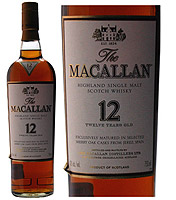
The Macallan 12  y/o

ABV: 43%

Maker: Macallan, Craigellachie, Banffshire (The Edrington Group)

Color: Dark amber, suspiciously so.  If I had to guess, I would say that caramel coloring was probably added

Nose: Malty, sweet, alcohol, creamy toffee

Palate: A note-for-note remake of the nose..  Malty, sweet, toffee, a little bit of wood.  A little bit of licorice on the tail end.

Finish: Sweet, with a bit of wood, and heirloom apple.  Yes, there is a difference.  It fades into a gentle sweetness with a touch of wood.

Parting Words:  The Macallan is a  fine, stately whisky.  It’s easy to drink, but it has enough going on to keep things interesting, at least for a while.  It’s lightweight for my taste, but makes a nice pre-dinner sip.

Head to Head #3: Oh Deer: Glenfiddich

Glenfiddich (actual font) is the best selling single malt Scotch in the world.  Along with Balvenie, Mortlach, and several others, Glenfiddich is located in Dufftown in Moray, Scotland.  Its name means “valley of the deer” literally, but a river called Fiddich (a tributary of the Spey) runs through Dufftown as well.  At any rate, this whole range is easy to find and popular.  So, making use of a set of three minis, here are my notes on Glenfiddich at 12, 15, and 18 years of age.

1)      12

2)      15

3)      18

Color

1)      Light, middle-aged Chardonnay

2)      Slightly darker, new copper penny

3)      Slightly darker than that, but barely

Nose

1)      Malt, lemonade, alcohol

2)      Caramel, lemon curd

3)      Lemon meringue, caramel, wood

On the Palate

1)      Lemonheads, burn

2)      Rich, caramel sweetness

3)      Lemon Poppy seed muffins, thick, rich caramel

Finish

1)      Lightly sweet, then surprisingly spicy

2)      Thick and sweet, caramel, then long, slow burn

3)      Creamy, sweet, soft

Parting Words

1)      Pleasant summer pour.  Will work at the bar in a pinch.

2)      More depth, but the distillery character still comes through.

3)      Almost indistinguishable from the 15, but with slightly more depth and sweetness.  Not sure if it would be worth the extra money to jump up to the 18.

I gotta say, I prefered the Balvenie line overall and I would rank any of those over any of these.  Still, my issue with Glenfiddich is a matter of taste, not quality.  It’s just not my cup of tea.

Head to Head Tasting #2: Bals Out

Having done a horizontal tasting of 12 y/o Speyside (and one Japanese) malts a couple days ago, today I’m doing a vertical one.  The distillery today is Balvenie, and I will be sampling three of their expressions.  These head to head tasting are, by their nature, quick and impressionistic, but I find that rattling off impressions keeps me from overthinking.

1)      Doublewood (12 y/o)

2)      Single Barrel (15 y/o)

3)      Portwood (21 y/o)

Color

1)      Light amber

2)      Shiny Copper

3)      Slightly darker, copper penny

Nose

1)      Fresh, malty, buttermilk, crème brulee, vanilla

2)      Rich caramel, toffee

3)      Strawberry, Valencia orange, fruit punch

Palate

1)      Sweet, bourbon, hint of spice, heavy cream

2)      Saltwater taffy, spice, toffee, bigger bourbon influence, butter cream icing

3)      Strawberry shortcake

Finish

1)      Light, wood, sweet, vanilla bean, then burn

2)      Rich, wood, vanilla, long and slow, clings to the tongue

3)      Very long, woody and slightly fruity finish.

Parting Words

1)      Comparatively dry, but still rich, and creamy.  The vanilla and bourbon influences are balanced with a stately sweetness

2)      Rich, sweet and carmely.  Big, bold after dinner malt

3)      Bigger, bolder after dinner malt.  Practically a dessert drink, like the former occupant of its cask.  The port and wood overwhelm the malt.  The dry fruit, coming through strongly as strawberry right now, is interesting, but could get old pretty quick.  Still, in moderation, a very enjoyable dram.

Head to Head Tasting #1: Kyoto-on-Spey

Having recently acquired two three-bottle sets of mini-bottles from Balvenie and Glenfiddich respectively, and a half-bottle of The Macallan 12, I’m going to sqeeze as many tastings out of these Speyside puppies as I can.  I also recently acquired a bottle of Suntory’s Yamazaki 12 y/o from a friend who was having a clear-out.  So without further ado…

1)      The Macalllan 12

2)      Glenfiddich 12

3)      The Balvenie Double Wood (12 y/o)

4)      Yamazaki 12

Nose:

1)      Malt, sherry, a bit of wood

2)      Big malt, sharp, pear, bit of wood

3)      Robust, honey, cream, bit of sherry

4)      Dark caramel, bourbon, alcohol

On the Palate:

1)      Honey, butterscotch, wood, bit of burn

2)      Light, sweet, tiny bit of wood, granny smith apple

3)      Thick, sweet, rich, light caramel, ripe peach

4)      Rich caramel, wood

Finish:

1)      Creamy sherry, burn, long and slow

2)      Sharp, burn, tiny tiny bit of wood, surprisingly long

3)      Woody, burn, fairly long, a bit of creamy sherry

4)      Sweet, dry, wood, fades fairly fast

Parting words:

1)      Solid, well crafted, enjoyable

2)      Bright, tart, but not shallow

3)      Beefy, but subtle with hidden depths

4)      Nice everyday sipper, but nothing too life-changing

Now Drinking

Highland Park Single Malt Scotch Whisky

Age: 12 yrs.

Proof: 86 (43% ABV)

Maker: Kirkwall, Orkney, Scotland (Edrington Group)

It’s Whiskey Friday.  For those of you who are whiskey fans and on twitter, check out Whiskey Friday.  Or just type #Whiskey Friday and then something else.

A note on spelling.  In spite of popular opinion, there is no difference between whiskey and whisky.  Whisky is how the word is spelled in the U.K. and Canada.  Whiskey is how the word is spelled in the U.S. and Ireland.  Both spellings indicate a spirit made from grain and aged (with the exception of corn whiskey, which may be unaged).  To confuse matters more, some brands of American whiskey, like Old Forester, Maker’s Mark and George Dickel, use the e-less spelling.  So, in short, it’s not worth getting too worked up about spelling.

It’s no secret that bourbon is my spirit of choice.  But when I first started exploring the world of spirits, I drank quite a bit of Scotch.  I moved away from it, but from time to time I do find myself feeling the urge for Scotch.

Highland Park is my kinda Scotch.  It has a little bit of all the things that make Scotch Whisky special.  It has all these things, but instead of being busy, all the elements hang in beautiful balance.

The color is light, like honey that has siezed up in the bottle.  I like that a lot.  I like it beacause it shows that it is free from the pencious caramel coloring that many Scotch distilleries add to their product.  One of the differeces in American whiskeys and Scotch whiskeys is that Scottish makers are allowed to add coloring and flavoring to their product, other than that which comes from the barrel.  In the U.S., no bourbon or rye is allowed to add anything artificial to the whiskey and still call it bourbon or rye(unless they label it bourbon + X flavoring, for example).  Also, any whiskey called a “straight” whiskey in the U.S. must be aged in new charred oak barrels, while almost all Scotches are aged in used oak barrels, many of them old bourbon barrels!  This makes straight American whiskeys naturally darker than their European cousins.  So a light color indicates a young bourbon, while the same indicates an additive-free Scotch.

At any rate, the nose on this whisky is a typical Scotch nose (much like my own) but not obnoxiously so.  The smoke hits my hooter first, then a bit of peat, then a lucious flowery sweetness, like wildflower honey.  On the palate it is quite sweet at first, then peat rushes to the fore.  It then does something very interesting.  The sweetness fades to a long, quite dry finish.  The wood begins to come through in the finish, but the smoke and peat maintain their forward position.

This is one of Scotland’s best, beloved by connoisseurs and dillatantes alike.  I have a feeling that my cupboard will not be without it for very long after this bottle is gone.