Hedonism

Maker: Compass Box, Edinburgh, Scotland, UKwpid-hedonism_bottle.jpg

Distillers vary by batch but often includes whisky from : Cameron Bridge (Fife), Carsebridge, Cambus , Port Dundas or Dumbarton.

Style: Blended Grain Scotch Whisky

ABV: 43%

Michigan State Minimum: $110

Appearance: Light gold with long moderately thick legs.

Nose: Vanilla, woodruff, white pepper, persimmon.

Palate: Medium sweet and full bodied. Vanilla pudding, alcohol, toffee, caramel, pecan.

Finish: Medium hot, creamy and herbaceous. Lasts a long time and gets sweeter as it goes.

Parting words: Grain whisky is Scotch whisky made from a grain other than malted barley. That grain can be anything, but wheat and corn are most common. It is distilled in a column still to a higher ABV than malt whisky, which is distilled in pot stills. Grain whisky is most commonly used to blend with single malt whisky to create blended Scotch. The malt component is used to give flavor to blends, while the grain is used to fill it out and round it off to create a very drinkable spirit.

Scotch grain whiskies are rarely bottled on their own, but Compass Box has decided to make this one a part of its core range. It’s round and rich with lots of character, giving the lie to the assertion that column distillation only produces bland, thin whisky (of course, bourbon gives the lie to this assertion as well). Aged mostly in ex-bourbon casks, it is a rich and complex as most single malts, if not richer. This is a wonderful whisky that is delicious all the way around. It’s expensive, though, and that keeps it out of the highly recommended category. Compass Box Hedonism is recommended.

Head to head: Jura 10 vs. Superstition vs. 16

10= Isle of Jura Origin, 10 y/owpid-2014-09-16-13.30.12.jpg.jpeg

S= Jura Superstition (NAS)

16= Isle of Jura, Diurach’s Own, 16 y/o

Maker: Isle of Jura, Argyll, Scotland, UK (?) (Whyte & Mackay/United Breweries)

Region: Islands

ABV: 43%

Michigan State Minimum

10: $48

S: $57

16: $71

Appearance (caramel color likely added)

10: New penny with long, well-spaced legs.

S: Slightly darker like a middle aged penny. Extensive necklacing.

16: Even darker. Old amber with long thick legs.

Nose

10: Light clover honey, heather, alcohol, hint of leather.

S: Light peat, alcohol, honey, alcohol.

16: Baklava, oak, alcohol.

Palate

10: Medium bodied. Golden apple, wildflower honey, chamomile tea.

S: Butterscotch, thyme, alcohol.

16: Toffee, butterscotch, vanilla custard.

Finish

10: Orange blossom honey but without any bitterness.

S: Smoke finally comes through followed by burn but it then settles down into a peat-infused sweetness.

16: Dark chocolate covered caramels with a little bitter oak on the tail end.

Parting words: I love mini sets like this, because they enable me to affordably give you the head to head tasting you so love, dear readers.

Isle of Jura (distilled and aged on the Isle of Jura, Islay’s neighbor to the northeast) was one of the first single malts I ever tried. Back then all I could find was the ten year old version. I always found it enjoyable but dull. Tasting it again now hasn’t changed my assessment too much. It’s still mild, but it’s enjoyable enough and works well as an entry level or weeknight malt.

Superstition was one of the first Jura line extensions available in the US. It is mildly peated, which adds a nice extra dimension to the malty, honeyed character of the standard Jura.

The 16 y/o is a big toffee-filled dessert dram. It’s not cheap compared to the others, but it’s more affordable than most single malt whiskies its age. Again, it’s not particularly complex but it does one thing and does it very well. In the state of Michigan it also comes in a gift pack with a pair of glasses (for your whisky, not your eyes), so factor that into the price.

All three are good values and recommended.

Wild Scotsman

Maker: Wild Scotsman, Cincinnati, Ohio, USA.wpid-20140904_135744-1.jpg

Distillers: Various (One cask each from five whisky regions)

Style: Blended malt whiskey (formerly known as vatted malt).

Age: 15 y/o

ABV: 46%

Price: $74 (The Party Source)

Appearance: Pale gold (no coloring)

Nose: Butterscotch, fig, vanilla, alcohol, oak.

Palate: Soft and semi-sweet. Apricot, vanilla bean crème brûlée, alcohol, gingerbread.

Finish: Fairly hot, sweet malt, toffee, white chocolate.

Parting words: I bought a mini bottle of The Wild Scotsman on a lark as I was checking out at a liquor store in Indianapolis. I had never heard of it before, but I have found it enjoyable.

Although the makers of Wild Scotsman blended malt claim that there are whiskies from five regions in each batch, it is quite Highland in character. Perhaps the Island and Islay components were unpeated because I detected no peat or smoke at all. At any rate, “wild” is a bit of a misnomer for this whisky but it still has plenty of character. It’s very fruity with lots of creamy dessert notes, but the relatively high proof and lack of chill filtering keeps it from being dull.

$74 is pricy for what it is, but vanishing age statements and tightening malt supplies being what they are, that’s probably a fair price. I wouldn’t pay much more than that, though. Wild Scotsman is recommended.

Head to Head: Wine Cask Finished Glenmorangie

LS: LasantaGlenmorangie 3 way

QR: Quinta Ruban

NO: Nectar D’Or

Maker: Glenmorangie, Ross-Shire, Scotland, UK (LVMH)

Age: 12 y/o

Style

LS: Sherry cask finish.

QR: Port cask finish.

NO: Sauternes cask finish.

Michigan State Minimum

ABV: 46%

LS: $52

QR: $53

NO: $62

Appearance

LS: Bright copper with thin sticky legs.

QR: Light auburn with thick legs.

NO: Pale copper with long thick legs.

Nose

LS: Roasting nuts, almond paste, alcohol. With water: Less alcohol.

QR: Alcohol, stewed prunes, oak. With water: A hint of fruit comes out but very little changes.

NO: Alcohol, golden apples. With water: Turns more grapey with light honey.

Palate

LS: Full bodied and soft. Hard caramel candy, toffee, then burn. With water: Brings out more sweetness. Apple sauce, butterscotch

QR: Heavy but light on flavor. Golden raisins, burn. With water: Velvety with mulberries, white currants.

NO: Medium bodied and sweet. Dried apricot, cane sugar, burn. With water: Clover honey, overripe peaches.

Finish

LS: Butterscotch, cashew brittle then burn. Lingers for a while. With water: Slightly rubbery, roasted almonds.s

QR: Raisins, oak, burn. With water: Dried figs, oak.

NO: Oak, sweetness, burn. With water: Tingles all around, angel food cake, golden raisins.

Parting words: This three-way was born out of a fun little four pack of 100 ml bottles of different Glenmorangie expressions. It includes the 10 y/o and these three expressions and sells for $32 in Michigan.

I wanted to do this tasting because I thought it would be a good opportunity to explore the influence of wine casks on malts because these are all the same age and from the same distillery. What was the most remarkable to me was how similar they actually were. The sherry cask in the Lasanta seems to have had the most influence on the final product. It had a clear, classic, nutty profile that screamed sherry. Nectar D’or also reflected its cask well, albeit subtly. The Sauternes showed up as a light, sweet grapey aroma and taste. Both were good and are recommended.

The only disappointment was the Qunita Ruban. Not to say that it wasn’t good. I liked it, but the port finish was much too subtle. If the bottle didn’t tell me it was finished in a port cask (or pipe, or whatever it’s called), I would never have guessed. I appreciate that they didn’t want to make it a strawberry bomb, and made sure that the malt character comes through, but when I see that a whisky is finished in a port cask, I go in expecting big fruit. This did not deliver. So why bother? Still, it tastes good and is not too expensive, and that’s more than one can say for a lot of single malts. Quinta Ruban is mildly recommended.

Highland Park 18 y/o

Maker: Highland Park, Kirkwall, Orkney, Scotland, UK (Edrington Group)HP 18

Region: Islands.

ABV: 43%

Michigan State Minimum: $120

Appearance: Light copper with long thin legs. No added coloring (to my knowledge)

Nose: Vanilla butter cream icing, oak, sherry, alcohol, a whiff of peat and a splash of sea spray. Water brings out more brine and peat.

Palate: Medium dry, full-bodied and well balanced. Some sweet malt and vanilla, apricot, followed by sherry and maritime notes. Opens up with a little water. Licorice and oak join the party and the mouthfeel becomes velvety soft.

Finish: Some vanilla and fruit, then burn and peat. Water gives the finish a big burst of peat, toffee and chocolate. Fades more quickly though.

Parting words: I’m fond of saying “nobody doesn’t like Highland Park”, and with HP 18, it’s easy to see why that is the case. Everything that can be in a single malt is here: Fruit, Vanilla, oak, peat, the sea, sherry, burn. It has something for everybody but doesn’t go off one end (smoke and peat) or the other (fruit and sherry). The 12 year old edition is a balance of all those elements. The 18 tilts the seesaw more in the direction of the barrel, which is not surprising considering it has spent six years longer in said barrel than its sibling. This is accomplished without diminishing sweetness or pungent peat, which is brilliant. It is the epitome of the style associated with the Isles, although it is made in a different set of isles (the Orkneys) than Jura, Talisker, Tobermory and the rest.

The hurdle for me is the price. At $120, it’s not bad for a Single Malt of its age and quality, but it’s a big bite for my budget to take. If it were even $20 cheaper it would be highly recommended but at its current price it is still recommended.

If you want don’t want to pay that much to taste HP 18, do what I did. Look for one of the HP 12 bottles with the special bonus 50 ml bottle of 18 attached. That should only set you back a total of $50. You’re welcome, world.

Glenfarclas 12 y/o

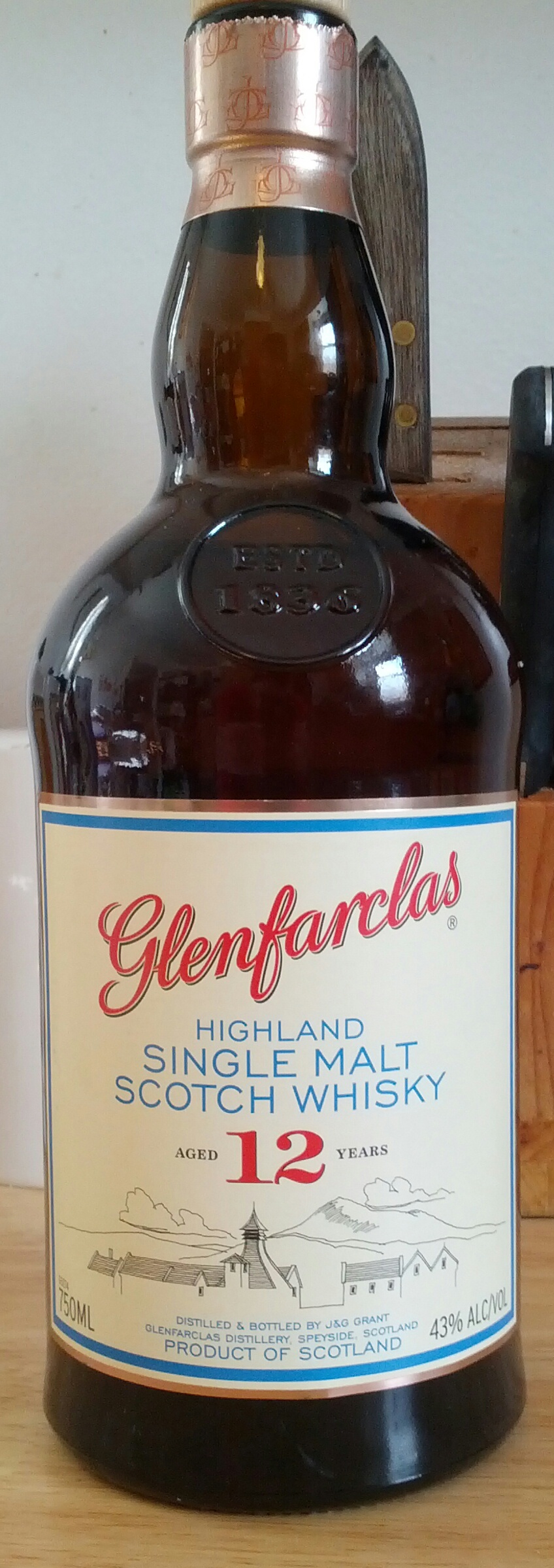
Maker: Glenfarclas, Ballindalloch, Scotland, UK (J & G Grant)Glenfarcas 12

Region: Speyside, although the label describes it as “Highland”

Michigan State Minimum: $52

Appearance: Light gold (natural color) with long thin legs.

Nose: Sherry, barley bread, dried flowers, crème brûlée.

Palate: Medium bodied and desserty. Butterscotch, French lavender, oak, mace (the spice not the chemical weapon).

Finish: Fairly hot but sweet. Lingers on the lips for a short time.

Parting Words: Glenfarclas is one of the few truely independent malt distilleries left in Scotland. The Grant family (not to be confused with many other Grants making Scotch whisky) has owned Glenfarclas since the nineteenth century and they have continued to do things their own old fashioned way. They refer to their whisky as Highland on the label although most would refer to them as Speyside these days given their proximity to the Spey river. Their labels are simple, their bottles are butch and their range of malts is based primarily on age. In the U.S. a 10, 12, 17, 21, 25, 40 and a 105 proof cask strength NAS version. Also available (but very expensive) are the Family Cask series of vintage bottlings.

The 12 y/o Glenfarclas is a very good whisky.The packaging and marketing may be spartan, but the whisky is not. The distinctive earthy aromas of the older expressions are muted in the 12 , but are still there faintly in the sherry and oak. The result is a classic sherried Speyside profile of the heavier sort, like Balvenie or Mortlach. It’s an excellent after dinner sipper well suited to books and back porches. I don’t smoke cigars, but I have been told that it goes well with them as well.

$52 is a steal for a mature, quality single malt from anywhere these days. Nothing not to like about Glenfarclas 12. It is recommended.

Talisker Storm

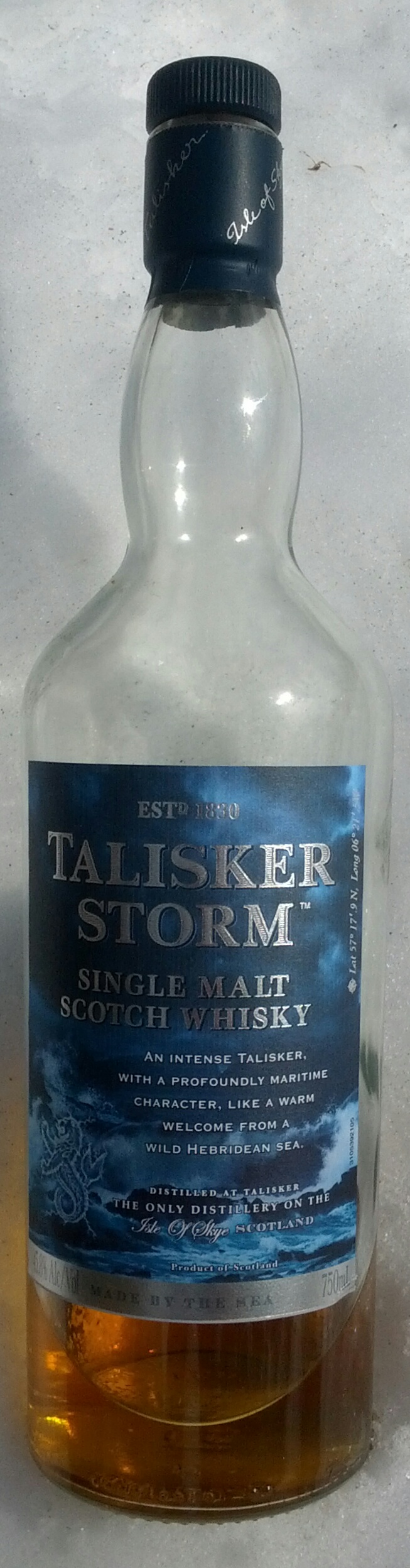
Maker: Talisker, Carbost, Isle of Skye, Scotland, UK (Diageo)
Talisker Storm

Region: Island

Age: NAS

ABV: 45.8%

Michigan State Minimum: $77

Appearance: Light caramel (likely colored)

Nose: Peat, dried flowers, smoke, alcohol, pine needles. Water brings out more smoke but doesn’t alter the flavor much otherwise.

On the palate: Full bodied and sweet. Smoke, cocoa powder, alcohol. Water brings out vanilla, white cake and then a burst of smoke.

Finish: Soot, alcohol, butterscotch candy, Mexican chocolate. Water doesn’t change much here.

Talisker Storm is a relatively new expression from Diageo. Price-wise it is situated between Talisker 10 y/o ($70 state minimum) and the Distiller’s Edition ($80). All three are bottled at the same proof. I have not had the Distiller’s Edition, so I can’t comment on how Storm compares to that, but Storm is definitely superior to the 10 y/o. Storm tastes more mature and shows better flavor integration than the 10, which seems to vacillate between sappy new make and murky maritime peat. Storm works better than the 10 as a gateway to Talisker and smoky Hebridean single malts in general. There is also a Dark Storm available in travel retail outlets that is aged in heavily charred casks.

If I have one criticism, it’s that it’s by-the-numbers with nothing in the way of surprises lurking in the nose or finish. That’s OK though, since it seems to be intended as a gateway or go-to type malt. It’s not cheap, but the price is firmly in line with comparable malts. If I have two criticisms, it’s that the label and packaging are cheesy.

In sum, I liked it, and could see myself buying it again. Talisker Storm is recommended. It’s worthwhile noting that this whiskyalso won Whisky Advocate’s Highland/Island Single Malt Scotch of the Year for 2013.

Glen Grant 16 y/o

Maker: Grent Grant, Rothes, Moray, Scotland, UK (Campari)

Region: Speyside- Rothes

ABV: 43%

Michigan State Minimum: $80

Appearance: Dark straw. Coats the inside of the glass with thick, gentle legs.Glen Grant 16

Nose: Green apple, sherry, caramel pear, lemon thyme. Water brings it together and brings out some light spice like sweet cinnamon and ginger and a firm but unobtrusive oak structure.

On the palate: Medium bodied and a little hot. Custard, butterscotch candy, caramel.

Finish: Hot but rich and sweet. Lingers for a long time.

Parting words: I don’t like sherry. I have tried to like it but I have never been able to develop a taste for it despite my heavily British genetic makeup.

My dislike of sherry has kept me away from Speyside single malts because of their traditionally heavy use of sherry casks and the resulting sherry flavors. I’m starting to rethink my aversion to Speysiders, though. This is a powerful, flavorful and well-balanced single malt. It is now my favorite Speyside single malt. It’s everything anybody could want in a Speyside malt. At $80 it’s not cheap but one could to worse for more. As frugal as I can be with whisky, I have never regretted buying Glen Grant 16. Highly recommended.

My Two Ounces: Suntory, Beam and Marketing

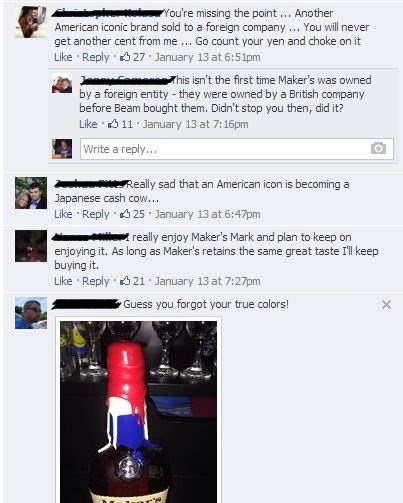
Cap from Maker's Mark Facebook Page
Cap from Maker’s Mark Facebook Page

It was announced earlier this week that Suntory, a privately held Japanese whisky company, will purchase Beam Inc. (owner of Jim Beam, Knob Creek, Old Grand Dad, Maker’s Mark, Laphroaig, Canadian Club, Teacher’s and many other brands) this summer for somewhere between $13 and $16 billion dollars. Online reaction was swift and passionate, to put it kindly. While the response from enthusiasts has been nearly all positive, most of the non-enthusiast response was negative. Much of the negative was xenophobic and some of it was flatly racist. Most of those critical voices can and should be written off as cranks. People claiming that they will no longer drink Maker’s Mark or Jim Beam because their grandfathers fought against the Japanese in the 1940s shouldn’t taken seriously and neither should people who don’t know the difference between China and Japan.

My first reaction was was that this news signals a big restructuring in the spirits industry. It is technically an acquisition, but the result will look more like a merger. Suntory already owned two Japanese distilleries, three single malt distilleries in Scotland and the McClelland’s single malt Scotch brand. With Beam’s holdings, Suntory is poised to become the third largest spirits company in the world behind Diageo and Pernod-Ricard. Consolidation has been the theme of the booze world from the 1930s to the present and that won’t be changing any time soon. Beam Inc. itself is the result of a series of mergers and acquisitions over the past few decades.  As an enthusiast I was excited about the possibility of new ownership of Beam’s brands, especially since the management of some of those brands has been poor in recent years.

Why was the reaction so negative among non-enthusiasts? It’s because they believed what Beam told them.

Bourbon marketing is something that most enthusiasts become immune to quickly. A little knowledge goes a long way to dispel the yarns the bourbon industry spins. Yarns like the one that Jim Beam has been made by the same family with the same recipe since the eighteenth century. Or that Maker’s Mark was first whipped up in Bill Samuel’s kitchen and has been a quaint, family-oriented, backwoods operation ever since. There may be tiny threads of truth in both yarns, but they are not true in any real sense. A few minutes reading a book or searching on the internet is enough to dispel most myths like those. The harder ones might take a few hours. Enthusiasts have the inclination to do that . Most drinkers don’t.

Those drinkers who don’t are the ones who are angry. They’ve grown emotionally attached from years of hearing those myths. Hearing that their favorite little family business is actually a multinational corporation that is about to be swallowed up by another multinational makes them feel like they’ve been played for suckers. Which makes them angry, which makes them look for someone to direct that anger toward, which is where Suntory and Japan come in.

Something that is not a myth is the American-ness of bourbon. By federal and international treaty it can only be made in the U.S. It is mostly made from what we call corn and the rest of the world calls maize, a New World grain, and aged in American white oak. Congressional proclamations have been made about how American bourbon is. Bourbon producers use an appeal to patriotism in their marketing in the U.S. and even overseas advertising and labels themselves stress how American a drink it is. Bourbon producers aren’t the only ones who use this kind of marketing. American automakers have used this angle to sell cars and especially trucks over the years. Like the yarns about the producers themselves, these messages get repeated and work their way into the consciousness of the uncritical whiskey drinkers. For them, drinking becomes a patriotic exercise. What they drink shows how much they love their country. So when they discover that the maker of their patriotic beverage is owned by a Japanese or Italian or British company, they feel, again, played for suckers. Which makes them angry.

Where does this leave us? This whole ugly mess should lead drinkers, producers and their marketers to do more thinking about what they’re doing. The producers need to think about if they are setting themselves up for backlash further down the road with short-sighted marketing focused on myth-making or patriotism. For their part, drinkers (and consumers in general) need to take a little more time to know what they’re drinking, how it’s made and who makes it. This means moving beyond skimming the label, it means picking up a book or at least a few web searches.  I recognize that most people don’t have the time to do a lot of digging into what they drink, but knowledge is viral. If one person take the time to dig up some good information, that person tells another and that person tells another who might be inspired to do a little more digging herself. Let’s hope that’s what’s happening now.

Head to head: Dewar’s White Label vs. Dewar’s 12 y/o Special Reserve

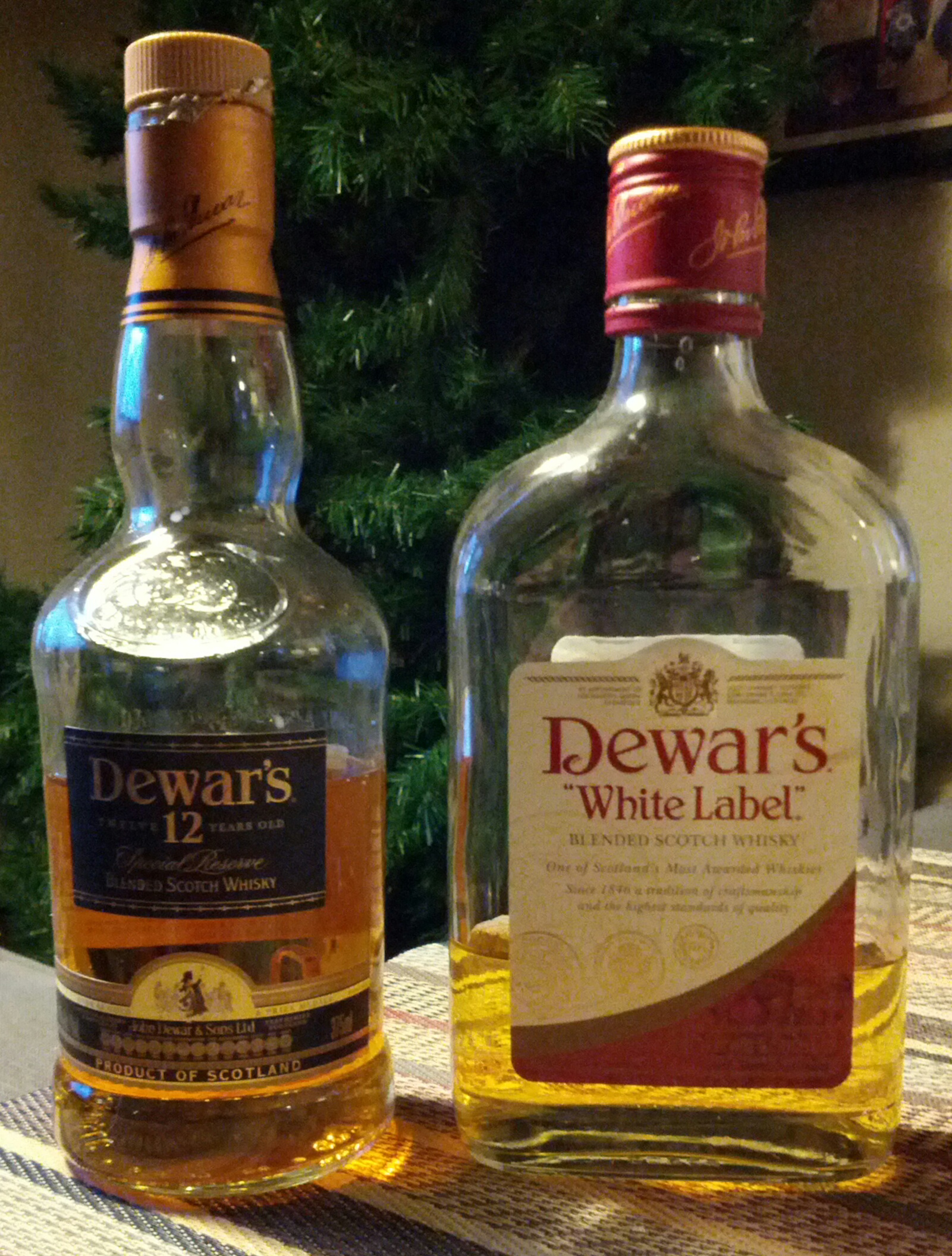
A: White Label

Dewars head to head

B: 12 y/o

Maker: Dewar & Sons, Perthshire, Scotland, UK (Bacardi)

Age

A: NAS

B: 12 y/o

ABV: 40%

Appearance (coloring likely added)

A: Pale gold.

B: Pale copper.

Nose

A: Young. Malt, varnish, and a bit of brown butter.

B: Richer. Woodruff, malt, hints of sherry and oak.

On the palate

A: Full bodied and immature. New make, alcohol, malt, not much else.

B: Full bodied and more rounded. Malt, butterscotch, honey, oak.

Finish

A: Hot and brash with a bit of candy sweetness on the back end.

B: Creamy and sweet with a little bite. Fades slowly.

Mixed

A: Adequate in a hot toddy, but doesn’t contribute  much. Same with a butterscotch, Rob Roy and

Rusty Nail. Pleasantly malty with soda.

B: Does well in all the above drinks, adding a nice buttery note and more depth. In other words, one can actually taste the whisky in the drink.

Parting words: Both of these were perfectly adequate whiskies with the 12 y/o being the richer and more rounded of the two. Surprisingly, given the price difference, I would rank Dewar’s White label above Johnny Walker Red, but it’s still no more than a mixer. To confuse things further, I would rank the 12 y/o version below Johnny Walker Black, even though the two are the same age. The 12 does really well in cocktails but falls flat as a sipper. JW Black isn’t the most complex blend on the market but it has enough smoke and oak to keep me from dozing off mid sip.

In conclusion, Dewar’s White Label is mildly recommended for mixing but not for sipping and Dewar’s 12 y/o is recommended for mixing but only mildly recommended for sipping.